
+9163073 05873 support@silkkhazana.in
Summer sale discount upto 30%! Shop Now

Mini Cart

Banarasi Saree as a Wedding Gift: What to Choose | Silk Khazana
Buying Guide 7 Min Read

How to Choose a Trustworthy Banarasi Saree Shop in Varanasi

How to choose a trustworthy Banarasi saree shop in Varanasi: questions to ask, red flags, what to get in writing and how to compare shops fairly.

Almost everyone who visits Varanasi is told to buy a Banarasi saree. Very few visitors know how to tell a good shop from a poor one. The lanes are full of shops, the sarees can look alike, and prices vary widely.

This guide is a checklist you can use in any shop in Varanasi, including ours. It does not rely on trust in a name. It relies on questions a shop should be happy to answer.

Why choosing the shop matters as much as choosing the saree

Banarasi silk is hard to judge by eye. Two sarees can look alike and differ in fibre, loom and zari. That means the seller's honesty is part of what you are buying. A shop that explains clearly protects you. A shop that avoids questions leaves you guessing.

Before you go

  • Decide your occasion and budget. Bridal, festive, gifting or everyday wear lead to different choices.
  • Learn three terms: handloom vs powerloom, pure silk vs blends, and real vs imitation zari. Our guides on handloom vs powerloom and real vs fake zari take a few minutes.
  • Go in daylight if you can. Colour and sheen look different under shop lights.
  • Allow time. Good shops do not rush you.

Be careful about how you are led to a shop

In many tourist cities, drivers, guides and some hotel contacts earn a commission when they bring a customer to a shop. This is not unique to Varanasi and it is not always a problem, but it can affect the price you pay. A fair approach is to ask how you were recommended, compare at least two or three shops, and never feel obliged to buy in the first one you enter.

Ten questions a good shop will answer

  1. What is the fibre? Pure silk, silk blend or something else. Ask for it in writing.
  2. Is it handloom or powerloom? Both exist and both can be good. The price should reflect which one it is.
  3. What kind of zari is it? Pure, tested or imitation. A seller who knows will say.
  4. Do you weave it yourselves or buy from others? A manufacturer can speak about the weaving. A trader can speak about the sourcing. Either is fine if the answer is honest.
  5. Does it have a Silk Mark? Read our guide on the GI tag and Silk Mark to understand what it does and does not prove.
  6. Why is this saree priced this way? Look for a reasoned answer: weaving time, zari, design. See why Banarasi sarees are expensive.
  7. Will you give a proper bill? It should state the product and the amount.
  8. Can I see the back of the weave? A neat reverse is a good sign.
  9. What is your return or exchange policy? Get it in writing before paying.
  10. Can you ship it, and how is it packed? This matters if you travel.

Red flags

  • Pressure. "Today only" prices, or a seller who gets irritated when you want to compare.
  • No clear answers on fibre, loom or zari.
  • Claims that cannot be checked, such as "100% pure" with no explanation.
  • A price that drops sharply the moment you walk away, with no reason given.
  • No bill, or a bill that does not describe the saree.
  • Being asked to pay in a way that leaves no record.
  • Reluctance to let you look at the back, or to let you see the saree in daylight.

A single red flag is not proof of a problem, but several together are a good reason to leave.

How to compare shops fairly

Take a short note of each shop:

Shop 1Shop 2Shop 3
Fibre in writing
Handloom or powerloom
Zari type
Silk Mark
Price and reason
Return policy

Compare like with like. A handloom katan and a powerloom blend should not cost the same, so a lower price on a different saree is not a bargain. For more, see our complete guide to buying Banarasi sarees in Varanasi.

A few quick checks on the saree itself

  • Back of the weave: neat, short thread ends are a good sign.
  • Selvedge and edges: straight and even.
  • Colour in daylight: look for evenness.
  • Feel and drape: hold it up and let it fall.

Our guide to identifying a pure Banarasi silk saree covers these in detail. Please do not burn or damage a saree in a shop to test it. A shop that is confident should not need you to.

Visiting Silk Khazana

We are a family weaving business in Varanasi, working since 1970, with our own weaving unit and a showroom in Jaitpura. You can visit us at J 14/180, opp. Chhavi Mahal Cinema, Qazi Sadullah Pura, Jaitpura, Varanasi 221001. Our store location page has the address and directions, and you can message us on WhatsApp at +91 63073 05873 for directions from your hotel.

Whichever shop you choose, ask the ten questions above. We would rather you ask them of us than not ask at all.

Further reading on trustworthy banarasi saree shop in varanasi: Banarasi sari on Wikipedia.

Key takeaways

  • Choose the shop as carefully as the saree. You are relying on the seller's honesty.
  • Ask for fibre, loom and zari details in writing.
  • Be careful about commission-led recommendations, and compare at least two or three shops.
  • Watch for pressure, vague answers and missing bills.
  • Compare like with like and do not treat the lowest price as the best.

Frequently Asked Questions

Look for clear answers on fibre, loom and zari, a proper bill, a written return policy and no pressure. Compare at least two or three shops.

It can be, but guides and drivers may earn a commission. Ask how you were recommended and compare before you buy.

Either can be honest. A manufacturer can tell you about weaving first-hand, and a trader can offer a wider range. What matters is clear, truthful answers.

Many visitors do. Compare similar sarees first, so you understand the price range, and treat a very large discount with caution.

Fibre content, handloom or powerloom, zari type and the price, with a proper bill.

Many can. Ask about packing, shipping time, costs and the return policy before you pay.

Message us on WhatsApp at +91 63073 05873 or visit our Varanasi showroom, and we will walk you through trustworthy banarasi saree shop in varanasi with the saree in your hands.

Browse Our Sarees

Looking for a trustworthy Banarasi saree shop in Varanasi? We manufacture Banarasi silk in Varanasi and have done since 1970, selling directly, so you can ask us anything about a saree and get a specific answer.

Not sure what suits you? Message us on WhatsApp at +91 63073 05873 and tell us the occasion. Visit us: J 14/180, opp. Chhavi Mahal Cinema, Qazi Sadullah Pura, Jaitpura, Varanasi 221001.
Banarasi Saree Wholesale in Varanasi: A Guide for Buyers | Silk Khazana
Buying Guide 8 Min Read

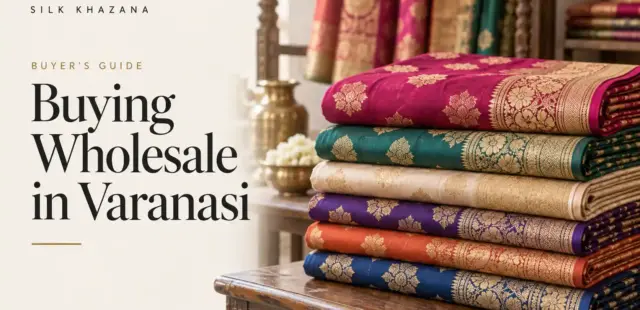
Banarasi Saree Wholesale in Varanasi: A Guide for Buyers

Banarasi saree wholesale in Varanasi: a buyer's guide for boutiques on what to ask, how to verify authenticity and work with a manufacturer.

If you run a boutique, plan to start one or buy sarees in numbers for events, Varanasi is the natural place to source Banarasi silk. It is also a place where it pays to ask careful questions, because quality, labelling and honesty vary widely.

This guide is for trade and bulk buyers. It explains how the market is organised, what to ask, how to check authenticity and what a good working relationship with a manufacturer looks like.

A note on how we work: Silk Khazana is a family business with a showroom in Varanasi, and our focus is on retail customers and direct relationships. We do not publish wholesale rates or minimum quantities here. If you are a trade buyer, the best step is to contact us and discuss your requirement directly.

Banarasi saree wholesale in Varanasi: who this guide is for

  • Boutique owners stocking Banarasi sarees
  • Wedding planners and stylists sourcing for clients
  • Families buying several sarees for a wedding
  • Corporate buyers planning gifts
  • Overseas retailers looking for a dependable source

How the Banarasi market is organised

The trade in Varanasi has several layers. Understanding them helps you see where value and risk sit.

  • Weavers and weaving families, who make the cloth
  • Master weavers (or gaddidars), who commission work and supply yarn
  • Manufacturers and showrooms, who design, source, quality-check and sell
  • Traders and agents, who buy and resell
  • Retailers and boutiques, who sell to the end customer

Buying closer to the source usually gives you better traceability, meaning you can ask who made the saree and how. Our piece on the weavers of Varanasi explains the people at the base of the chain.

Why buy directly from a manufacturer?

  • Traceability. You can ask about the weaving, the fibre and the zari.
  • Consistency. A manufacturer can repeat designs and qualities.
  • Accountability. If something is wrong, you know who to ask.
  • Fewer layers. Each added middleman adds cost and reduces your visibility.

None of this guarantees quality. It simply makes it easier to ask the right questions and get straight answers.

What to ask a supplier

Whoever you buy from, ask these questions and ask for the answers in writing.

  • 1. Is it pure silk? Which silk (katan, organza, georgette, tissue, etc.)?
  • 2. Handloom or powerloom? Both are legitimate, but they are different products at different prices. See handloom vs powerloom.
  • 3. What is the zari? Pure, tested or imitation. See real vs fake zari.
  • 4. Is there a Silk Mark? And is the GI tag applicable? See our authenticity guide.
  • 5. Can I see the saree in daylight, front and back?
  • 6. What is the process for exchanges and defects? Ask for the policy.
  • 7. Can you supply invoices and clear labels?
  • 8. How do you pack and ship? Ask how sarees are protected in transit.

A supplier who answers readily and in detail is a good sign. A supplier who avoids specifics is a warning.

How to verify authenticity at scale

When you buy in numbers, small errors multiply. A few habits help.

  • Inspect a sample from each batch, not only the first piece.
  • Check the reverse. Neat, short thread ends signal careful weaving.
  • Check the label against the saree. The fibre, loom and zari details should match what you were told.
  • Be careful with burn tests. They should be done only on a loose thread, with the seller's permission, never on the saree. Results from a burn test are indicative only.
  • Use a trusted lab if you need formal testing on a high-value order.
  • Compare against a reference piece you have already verified.

For more on spotting pure silk, read how to identify pure Banarasi silk.

Understanding price

Pricing in Banarasi silk reflects silk quality, zari type and weight, design complexity, time on the loom and whether the work is handloom or powerloom. A price that looks far below the market for a heavily worked saree should prompt questions. Our piece on why Banarasi sarees are expensive explains each factor.

We do not quote prices in articles because they change with silk and zari costs. For a quote, speak to us directly.

Building a range for your boutique

A good Banarasi range usually balances several things:

  • Fabric variety: katan, organza, georgette, tissue and dupion
  • Price tiers: entry, mid and premium pieces
  • Occasions: weddings, festivals, receptions and gifting
  • Colour spread: classic reds and maroons, plus pastels and neutrals
  • A few statement pieces, such as jungla, Jamawar or shikargah

Start with what your customers ask for, then expand. See our overview of types of Banarasi sarees.

Visiting Varanasi

If you can, visit in person. You can see the cloth in daylight, meet the people and compare qualities side by side. Our complete guide to buying Banarasi sarees in Varanasi covers how to plan a visit.

When you come to Silk Khazana, we will take you through the range and answer questions directly. You can find us at our Varanasi showroom, and the address is in the footer of this page.

Buying remotely

If you cannot travel, you can still source with care.

  • Ask for videos in natural light, showing front, back, pallu and border.
  • Ask for close-up photos of the weave and the zari.
  • Start with a small order to test quality and service.
  • Confirm packing and delivery arrangements before placing a larger order.
  • Keep records of what was promised.

Our guide on buying Banarasi sarees online has more advice.

Red flags

  • Reluctance to state the fibre, loom or zari
  • Prices far below the market for the described work
  • Pressure to buy quickly
  • No clear policy for exchanges or defects
  • No invoice or label
  • Sample quality that differs from bulk quality

Further reading on banarasi saree wholesale in varanasi: Banarasi sari on Wikipedia, and the Silk Mark scheme.

Key takeaways

  • Buying closer to the source improves traceability.
  • Ask about silk, loom and zari and get the answers in writing.
  • Inspect every batch, not just the first sample.
  • Be sceptical of prices far below the market for heavy work.
  • Visit if you can, or start small if you buy remotely.

Frequently Asked Questions

Yes, Varanasi is a major sourcing centre. Contact us to discuss your requirement directly.

No. Pricing depends on the saree and the quantity, so we discuss it directly.

Ask for the fibre content in writing, look for the Silk Mark and inspect the weave. Our guide to identifying pure silk helps.

It depends on your customers and price points. Both are legitimate, as long as they are labelled honestly.

Yes, we welcome visitors at our Varanasi showroom.

Begin with a small, varied order, check the quality and build from there.

Message us on WhatsApp at +91 63073 05873 or visit our Varanasi showroom, and we will walk you through banarasi saree wholesale in varanasi with the saree in your hands.

About Silk Khazana

Looking for banarasi saree wholesale in varanasi? We manufacture Banarasi silk in Varanasi and have done since 1970, selling directly, so you can ask us anything about a saree and get a specific answer.

Not sure what suits you? Message us on WhatsApp at +91 63073 05873 and tell us the occasion. Visit us: J 14/180, opp. Chhavi Mahal Cinema, Qazi Sadullah Pura, Jaitpura, Varanasi 221001.
Buying Banarasi Silk from India: A Guide for NRIs | Silk Khazana
Buying 8 Min Read

Buying Banarasi Silk from India: A Guide for NRIs

A practical guide for NRIs buying Banarasi silk from India: choosing, sizing, shipping, customs, wedding timelines and how to avoid surprises.

If you live in the USA, UK, Canada, Australia, Singapore, the Gulf or anywhere else far from India, a Banarasi saree is more than a purchase. It is a link to a place. You may be buying for a wedding in the family, a festival abroad, a gift for a daughter or a piece you have wanted since your last trip home.

Buying from a distance has its own questions. Will the colour match the photo? Will the blouse fit? How long will shipping take, and what about customs? This guide answers those questions in plain language.

Buying Banarasi silk from India: why buy directly from Varanasi?

Banarasi weaving is centred in Varanasi, and buying from a seller there shortens the chain between the weaver and you. You can ask who made the saree, what it is made of and how it was woven. Items marked as Banarasi are protected by a Geographical Indication (GI) tag, and a seller in Varanasi can discuss it with you directly. Read our guide to the GI tag and Silk Mark.

Step 1: define what you need

Start with a short brief. Tell the seller:

  • The occasion: wedding, festival, party, gift
  • The date you need it by
  • Your colour and budget preferences
  • The fabric you like, if you know: katan, organza, tissue, georgette
  • Your location, since climate and venue matter
  • How the saree will be worn, and whether you need a blouse stitched

The more you share, the better the shortlist. Our guides to bridal sarees and khaddi georgette can help you narrow fabrics.

Step 2: see the saree properly

You cannot touch it, so do the next best thing.

  • Ask for photos in natural light.
  • Ask for close-ups of the zari and the back of the weave.
  • Request a live video call to see the saree move.
  • Ask for weight and dimensions.
  • Ask for the fibre, loom type and zari type in writing.

Our guide to buying Banarasi sarees online safely has a full checklist.

Step 3: plan the blouse and sizing

Most Banarasi sarees come with an unstitched blouse piece. You can have it stitched abroad by your own tailor, or you can ask the seller whether blouse stitching is available for your order.

If you are asking for stitching:

  • Take accurate measurements with a tape, wearing a well-fitting blouse or the garments you will wear underneath.
  • Share a photo of a blouse that fits you well.
  • Mention the neckline, sleeve and back style. See our blouse design guide.
  • Allow extra time in your schedule for any alterations.

If you plan to stitch abroad, ask the seller to confirm the size of the blouse piece, so your tailor knows what is possible.

Step 4: shipping and delivery

Shipping from India to another country depends on the courier, the destination and the season. Delivery times, charges and tracking options vary, so ask for current details before you order.

A few practical points:

  • Ask for tracking and an expected delivery window.
  • Ask how the saree is packed. Silk should travel wrapped in cotton or tissue, protected from moisture.
  • Provide a full address and phone number for the courier.
  • Be available to receive the parcel, or arrange a safe delivery point.
  • Ask about insurance for high-value pieces.

Our shipping and delivery page lists our current terms, and we are happy to answer questions on WhatsApp.

Step 5: customs and duties

Import rules differ by country, and they change. Some destinations charge duties or taxes on parcels, while others have thresholds below which none apply. We cannot give you your country's rules, but we can help you prepare.

  • Check your country's customs website for the current rules on textile imports.
  • Ask us for an invoice that describes the item accurately and states its value.
  • Be prepared for possible duties or taxes, and ask your courier how they are collected.
  • Keep the invoice and tracking information until the parcel arrives.

An accurate invoice helps parcels clear faster and avoids disputes.

Step 6: plan the timeline

Do not leave an overseas order to the last minute. Allow time for:

  • 1. Choosing the saree, including video calls and photos.
  • 2. Any customisation, blouse stitching or finishing.
  • 3. Packing and dispatch.
  • 4. Shipping and customs.
  • 5. A buffer for the unexpected.

For a wedding, we suggest ordering as early as you can. If you are ordering a made-to-order piece, ask how long weaving will take, since it depends on the design.

Step 7: payments

Ask which payment methods are available for international buyers, and use secure, traceable ones. Request a receipt or invoice. Confirm the currency and any fees before you pay.

Step 8: when the parcel arrives

  • Open it with care, ideally on camera.
  • Compare the saree with the photos and the written details.
  • Air it for a few hours before wearing.
  • Contact the seller promptly if anything differs.

See returns and exchanges for our policy, and check any seller's terms before ordering.

Buying in person and bringing it home

If you are visiting India, buying in Varanasi lets you feel the cloth and watch the weaving. A few tips for the journey home:

  • Carry the saree in your cabin bag if it is high-value, so it stays with you.
  • Keep the invoice in case customs ask for it.
  • Check the airline's baggage rules and your destination's import allowances.
  • Fold the saree loosely, with tissue between layers, and unpack it soon after arrival.

Our guide to buying Banarasi sarees in Varanasi covers the in-person experience.

Common worries, answered

"What if the colour looks different?" Ask for natural-light photos and a video. Screens vary, so confirm before you order.

"What if it does not fit?" The saree itself is free-size. Blouses are the main fitting issue, so plan stitching carefully.

"What if there is a delay?" Build in a buffer, and keep in touch with the seller and the courier.

"What if I want to return it?" Read the returns terms before ordering. International returns can be harder than domestic ones, which is one reason to be sure before buying.

Further reading on buying banarasi silk from india: Banarasi sari on Wikipedia.

Visiting Varanasi? Read our checklist on how to choose a trustworthy Banarasi saree shop in Varanasi.

Key takeaways

  • Give a clear brief: occasion, date, colour, fabric and budget.
  • See the saree on video and ask for fibre, loom and zari in writing.
  • Plan the blouse and allow extra time for stitching.
  • Check shipping, customs and returns before you pay.
  • Order early, especially for weddings.

Frequently Asked Questions

Yes, we ship internationally. Ask on WhatsApp for current charges, timelines and packing details for your country.

It depends on your country's rules. Check your customs authority's current guidance, and ask us for an accurate invoice.

It varies by destination and courier. Ask for the current estimate when you order, and allow a buffer.

Ask us when you place your order. Share accurate measurements and a photo of a well-fitting blouse.

Ask for fibre, loom and zari in writing, request a video and check the Silk Mark. See our online buying guide.

Order as early as possible, tell the seller your date and ask about timelines for any customisation.

Message us on WhatsApp at +91 63073 05873 or visit our Varanasi showroom, and we will walk you through buying banarasi silk from india with the saree in your hands.

Browse Banarasi Sarees

Looking for buying banarasi silk from india? We manufacture Banarasi silk in Varanasi and have done since 1970, selling directly, so you can ask us anything about a saree and get a specific answer.

Not sure what suits you? Message us on WhatsApp at +91 63073 05873 and tell us the occasion. Visit us: J 14/180, opp. Chhavi Mahal Cinema, Qazi Sadullah Pura, Jaitpura, Varanasi 221001.

How to Buy Authentic Banarasi Sarees Online Safely | Silk Khazana
Buying 8 Min Read

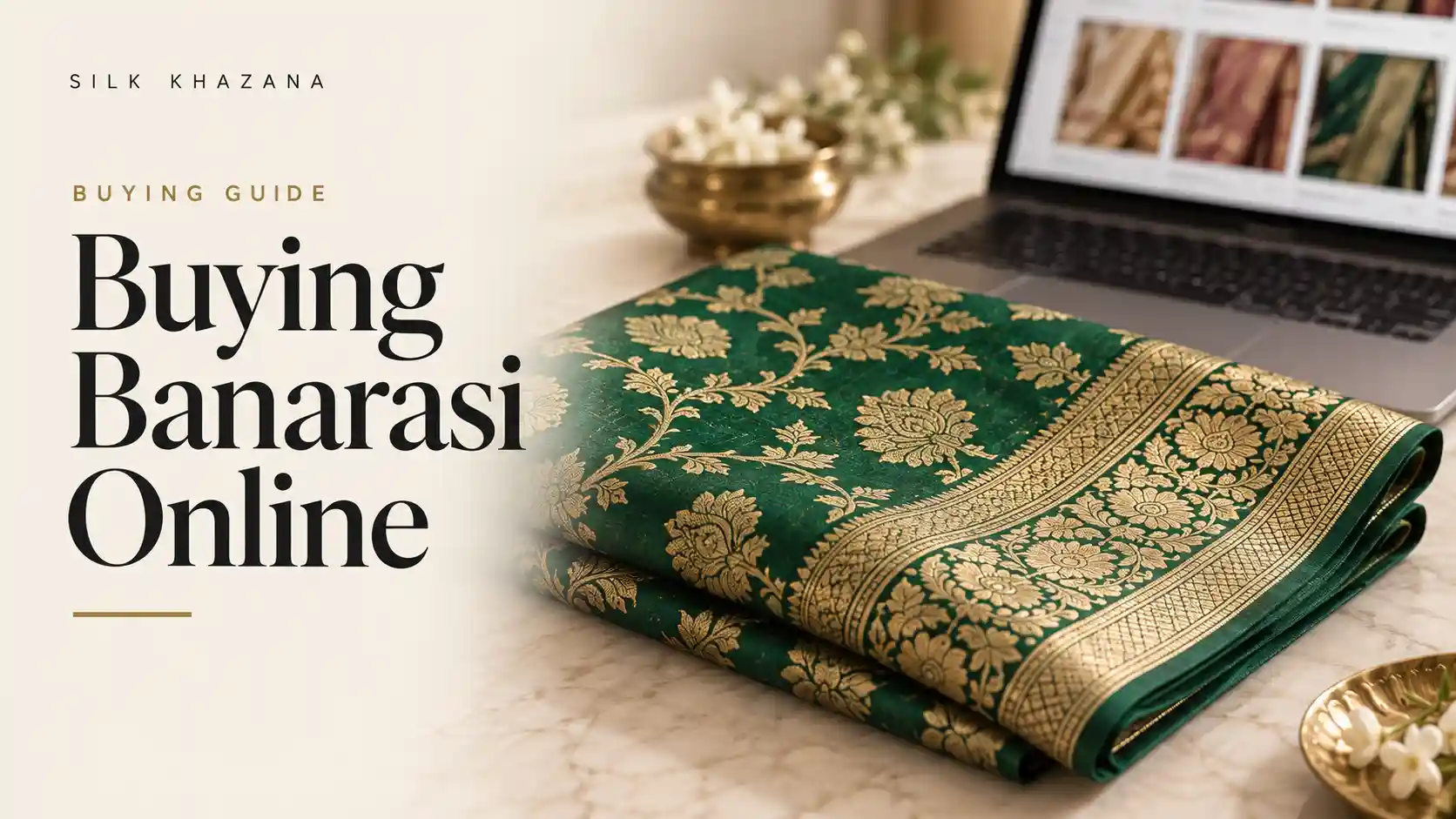
How to Buy Authentic Banarasi Sarees Online Safely

How to buy authentic Banarasi sarees online: a checklist for verifying the seller, asking the right questions and spotting red flags.

Buying a Banarasi saree online asks you to do something unusual: trust a photograph. You cannot feel the silk, see how the zari catches light or lift the pallu to judge its weight. A few clicks later a parcel arrives, and the saree in your hands is not quite what the picture promised.

It does not have to go that way. Many people buy excellent Banarasi sarees online, and the ones who do usually follow a handful of habits. This guide gives you those habits, in order.

How to buy authentic Banarasi sarees online: Step 1, check the seller

Before you look at a single saree, look at the seller.

  • Do they have a real address? A showroom or manufacturing unit you can find on a map is reassuring.
  • Can you contact them? Look for a phone number, WhatsApp, email and a response within a reasonable time.
  • Do they appear in more than one place? A website, a Google Business profile, social media pages and customer reviews that agree with each other point to a real business.
  • How long have they been operating? A long history is not a guarantee, but it counts.
  • Do they explain themselves? Honest sellers describe their fabrics, looms and processes in plain language.

A quick tip: search for the seller's name and address on Google Maps. Look at the photos, the reviews and the number of years in business.

Step 2: ask the right questions

The product page rarely tells the whole story. Ask the seller, in writing:

  • 1. What is the fibre? Is it pure silk?
  • 2. Is it handloom or powerloom? Read handloom vs powerloom first so you know what the answer means.
  • 3. What type of zari is used? Pure, tested or imitation? See real vs fake zari.
  • 4. Does it carry the Silk Mark label? And is it a Banarasi from Varanasi? Our guide to the GI tag and Silk Mark explains both.
  • 5. How long did it take to weave? A good seller can speak to this.
  • 6. What are the saree's dimensions and weight?
  • 7. What is the care advice?

Keep the answers. They are useful if there is a problem later.

Step 3: look at the pictures properly

  • Natural light photos. Showroom lamps and filters change colour. Ask for pictures near a window.
  • Close-ups of the weave and zari. You want to see the thread structure.
  • The back of the saree. Neat, short thread ends are a good sign.
  • The pallu, border and body together. Not only the pallu.
  • A fold or a drape. It shows how the fabric behaves.

If a seller only has polished studio images, ask for more. Candid photos from the showroom floor are often more honest.

Step 4: ask for a live video

This is the single most useful step. A short video call lets you:

  • See the saree move.
  • Ask to flip it, show the reverse, hold it to the light.
  • Compare colour in natural light.
  • Judge how the seller treats questions.

Sellers who are proud of their work are usually happy to show it.

Step 5: understand the price

Real Banarasi silk has a floor. Silk yarn, zari and weaving time all cost money. If a "pure handloom Banarasi katan with real zari" is priced like a printed polyester, something is not what it seems. Read why Banarasi sarees are expensive so you can judge the arithmetic.

At the same time, a high price does not guarantee authenticity. Compare, ask and judge the seller as much as the number.

Step 6: read the policies

Before paying, read:

  • Returns and exchanges. What is accepted, within how many days and under which conditions?
  • Shipping. Cost, time, tracking and insurance.
  • Payment methods. Secure channels, receipts and invoices.
  • Customisation terms if you are ordering something made to measure.

Policies vary, so check each seller's current terms. Ours are on the returns and exchanges and shipping and delivery pages.

Step 7: pay safely

  • Use secure, traceable payment methods.
  • Ask for an invoice that names the fabric, the loom type and the zari.
  • Be wary of requests to pay through unknown personal accounts with no invoice.
  • Keep screenshots of conversations and payment confirmations.

Step 8: unbox with care

  • Record a short unboxing video when the parcel arrives, showing the seal and the saree.
  • Check the saree against what you were told: colour, weave, zari, size.
  • Raise concerns quickly, within the seller's stated window.
  • Keep the packaging until you are satisfied.

Red flags

  • Prices far below what silk and zari could cost
  • Vague answers to simple questions
  • Photos that look copied from other sites or brands
  • No physical address or contact details
  • Pressure to buy immediately, such as fake countdowns
  • Refusal to do a video call
  • Claims such as "100% real gold zari" with no explanation
  • No clear returns policy
  • Payment requested to personal accounts with no invoice

Marketplace or manufacturer?

Large marketplaces offer convenience and buyer protections, but you may be buying from a reseller several steps away from the weaver. Buying from a manufacturer or a specialist showroom means shorter chains and clearer answers about the cloth. Neither option is automatically safer. What matters is how clearly the seller answers your questions.

Online shopping with Silk Khazana

We weave and sell Banarasi silk from our family unit in Varanasi, and we are happy to answer the questions above for any saree on our site. Message us on WhatsApp, tell us the occasion and what you like, and we will send photos and a video of the pieces that suit. If you are buying from abroad, our NRI guide covers shipping and sizing in more detail.

Further reading on how to buy authentic banarasi sarees online: Banarasi sari on Wikipedia, and the Silk Mark scheme.

Visiting Varanasi? Read our checklist on how to choose a trustworthy Banarasi saree shop in Varanasi.

Key takeaways

  • Check the seller first: address, history, contact and reviews.
  • Ask about fibre, loom and zari in writing.
  • Ask for natural-light photos, the back of the weave and a live video.
  • Read the policies, pay traceably and unbox on camera.
  • Treat very low prices and vague answers as warnings.

Frequently Asked Questions

Yes, if you check the seller, ask clear questions, request a video and read the policies. Most problems come from skipping those steps.

Ask for the fibre, loom type and zari in writing, look for the Silk Mark label, and consider the GI tag. A reputable seller will answer openly.

Yes. It is the best way to see the saree move and judge colour and texture.

Contact the seller quickly, share your unboxing video and refer to the written answers you were given. Check the returns policy before ordering.

They can be, and they offer buyer protections. The key is to know who the seller is and to ask the same questions you would of any shop.

It depends on the silk, zari, weave density and whether it is handloom. Read why Banarasi sarees are expensive to understand the factors.

Message us on WhatsApp at +91 63073 05873 or visit our Varanasi showroom, and we will walk you through how to buy authentic banarasi sarees online with the saree in your hands.

Browse Banarasi Sarees

Looking for how to buy authentic banarasi sarees online? We manufacture Banarasi silk in Varanasi and have done since 1970, selling directly, so you can ask us anything about a saree and get a specific answer.

Not sure what suits you? Message us on WhatsApp at +91 63073 05873 and tell us the occasion. Visit us: J 14/180, opp. Chhavi Mahal Cinema, Qazi Sadullah Pura, Jaitpura, Varanasi 221001.

Sign Up Newsletter

Sign up our newsletter and save 25% off for the next purchase!

Subscribe to our newsletters and don’t miss new arrivals, the latest fashion updates and our promotions.