+9163073 05873 support@silkkhazana.in
Handwoven Banarasi silk, direct from our Varanasi weaving family. Shop Now

Mini Cart

Banarasi Saree as a Wedding Gift: What to Choose | Silk Khazana
Comparison 6 Min Read

Moonga vs Tussar Silk: What Is the Difference?

Moonga vs tussar silk explained: how the terms are used in the Banarasi trade, how they compare on colour, texture and price, and what to ask before you buy.

Moonga and tussar are two words buyers often see side by side, and sellers often use together, as in "moonga tussar saree". Are they the same? Different? Which is better?

The honest answer is that they overlap, and the words are used loosely. This guide explains how each is generally understood and how to ask for clarity.

The short version

TussarMoonga (trade term)
What it isA wild silk, woven from yarn of silkworms that live on forest treesA trade term for a golden or earthy wild-silk saree, often a tussar-type yarn
ColourNatural golden-brown, also dyed in many coloursWarm golden or honey tones, also dyed
TextureSlightly coarse, with a natural unevennessSimilar, sometimes smoother depending on the yarn
SheenSoft, earthySoft glow
Protected name?NoNo
WeightLighter than katanSimilar to tussar

What is tussar silk?

Tussar is a wild silk. The silkworms feed on forest trees rather than being raised on mulberry leaves. The yarn has a natural golden-brown shade, a slightly coarse feel and a gentle sheen. Because it takes dye well, tussar appears in both natural and bright colours. In Banarasi weaving it is used for sarees, dupattas and suit fabric. Our tussar ghicha guide explains one popular type in detail.

What is moonga?

In the Banarasi trade, moonga (or munga) usually describes a saree with a golden, honey or earthy look, woven in a wild silk, often a tussar-type yarn. It is a market term and not a protected name, so what it means depends on the seller. Our moonga silk saree guide goes into the term in more detail.

Why the confusion?

  • The names overlap. "Moonga tussar" is a common label, so people treat the two as one.
  • Both are wild silks with a natural, textured look.
  • Muga is a third word. True Muga silk comes only from Assam and has a GI tag. "Moonga" sounds like Muga but is not the same thing.

So when someone says "moonga", they might mean a tussar-type saree with a golden tone, or they might be pointing, accurately or not, to Muga. Do not guess. Ask.

How they compare in practice

  • Look: moonga-type sarees lean golden and warm. Tussar covers a wider range, from natural brown to dyed jewel tones.
  • Feel: both are breathable and textured.
  • Occasions: both suit daytime festive events and family functions. Richer zari work suits evening events.
  • Care: the same for both: dry clean, store in muslin, keep away from strong sunlight.
  • Price: it depends less on the word and more on fibre, loom, zari and design. See why Banarasi sarees are expensive.

At Silk Khazana, our moonga sarees are tussar-type silk, so for us the two overlap closely. Neither is automatically better. The right one is the one you can identify, that suits your colouring and occasion and is priced fairly for what it is.

Questions to ask the seller

  1. What is the fibre, exactly? Ask for it in writing.
  2. Is it tussar, a moonga-type tussar, true Muga or a blend?
  3. Is it handloom or powerloom? See handloom vs powerloom.
  4. What is the zari?
  5. Is there a Silk Mark?
  6. Is the colour natural or dyed?

If a seller answers clearly, you can compare fairly. If they avoid the question, that is useful information too. Our guide to identifying a pure Banarasi saree covers more checks.

Which should you choose?

  • Choose tussar if you want a wide colour range and a natural, textured look.
  • Choose a moonga-type saree if you love warm golden tones.
  • Choose true Muga only if the seller can show it is Muga, and you are comfortable with the price.
  • Choose by occasion and comfort, not just the label.

Further reading on moonga vs tussar silk: Banarasi sari on Wikipedia.

Key takeaways

  • Tussar is a wild silk with a natural golden-brown tone.
  • Moonga is a trade term for a golden or earthy wild-silk saree, often tussar-type. It is not a protected name.
  • Muga is a different, GI-tagged silk from Assam.
  • The words overlap, so ask for the exact fibre in writing.
  • Price depends on fibre, loom, zari and design, not only the name.

Frequently Asked Questions

Not exactly. They overlap, and "moonga tussar" is a common label. Moonga is a trade term, while tussar is a type of wild silk. Ask the seller for the fibre.

Neither is automatically better. Choose by look, comfort, occasion and how clearly the seller can describe the saree.

Not necessarily. Muga is a GI-tagged golden silk made only in Assam. "Moonga" or "munga" is used more loosely.

It depends on fibre, loom, zari and design. True Muga is rarer and usually costs more. Compare like with like.

Both can suit festive events and weddings as a guest, especially with richer zari work. Many brides choose katan for the main ceremony.

Dry clean with a silk specialist, store folded in muslin and avoid strong sunlight.

Message us on WhatsApp at +91 63073 05873 or visit our Varanasi showroom, and we will walk you through moonga vs tussar silk with the saree in your hands.

Browse Moonga Silk Sarees

Choosing between moonga and tussar? We manufacture Banarasi silk in Varanasi and have done since 1970, selling directly, so you can ask us anything about a saree and get a specific answer.

Not sure what suits you? Message us on WhatsApp at +91 63073 05873 and tell us the occasion. Visit us: J 14/180, opp. Chhavi Mahal Cinema, Qazi Sadullah Pura, Jaitpura, Varanasi 221001.
Kanjivaram vs Banarasi Saree: Which to Choose | Silk Khazana
Comparison 8 Min Read

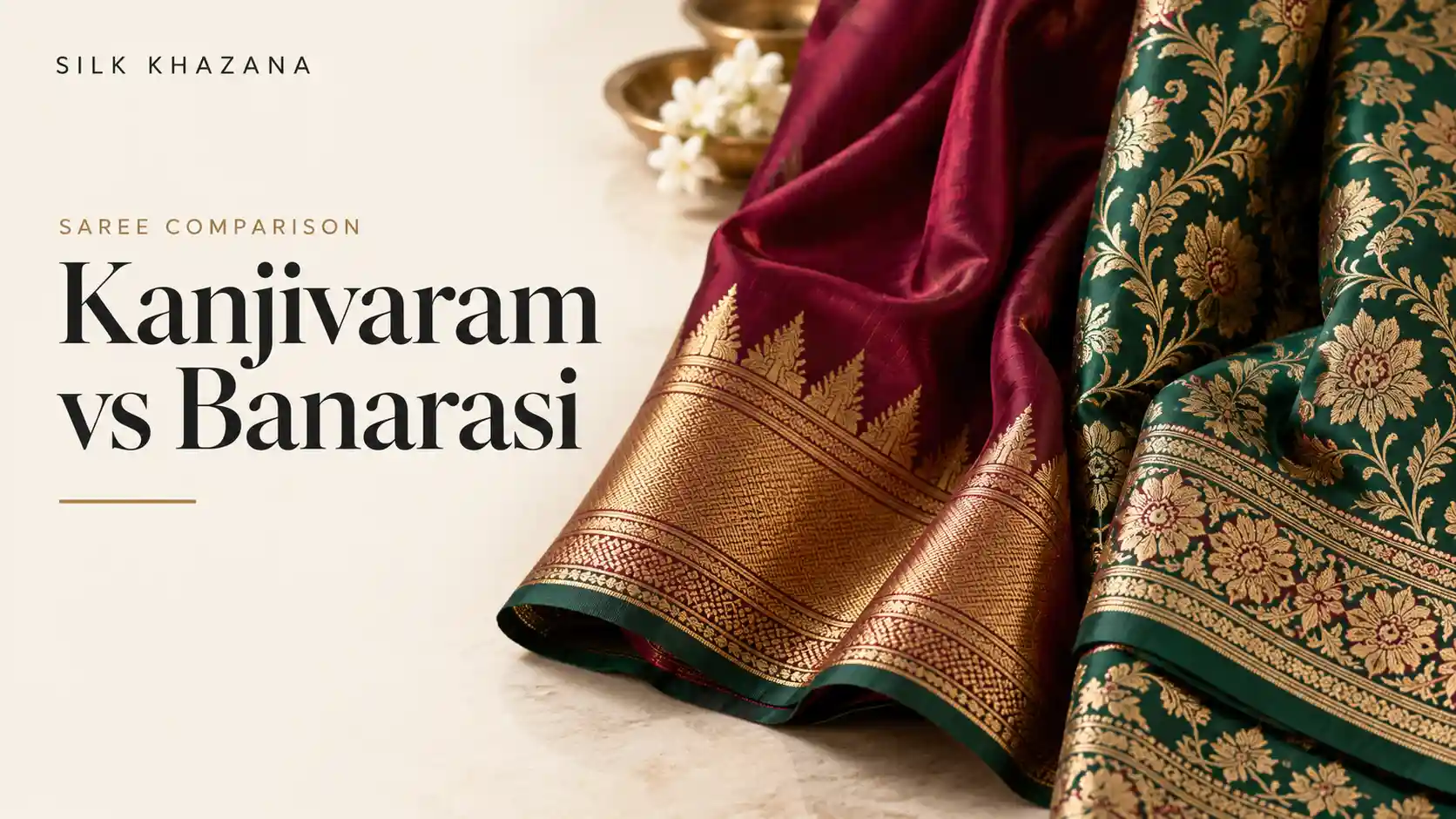
Kanjivaram vs Banarasi Saree: Which to Choose

Kanjivaram vs Banarasi saree: an even-handed comparison of origin, weave, weight, zari, drape and occasions, and how to choose.

Two names stand above the rest in Indian silk: Kanjivaram and Banarasi. They are often compared, sometimes argued over and occasionally confused. Both are masterpieces. Both are woven by people who have inherited a craft. Both are collectable. And they are different.

We make Banarasi silk, so we have a view. But this is an even-handed guide, because the best choice for you depends on the occasion, the climate, your family's traditions and what you love. Here is how the two compare.

Kanjivaram vs Banarasi saree: the short answer

  • Choose Kanjivaram if you love bold contrast borders, temple motifs and the structured richness of South Indian weddings.
  • Choose Banarasi if you love fine floral and jaal patterns, a wider range from featherlight to heavy, and the shimmer of brocade.
  • Choose either and you will own a piece of craft. The key is to buy authentic.

Where they come from

Kanjivaram sarees come from Kanchipuram in Tamil Nadu, a temple town long associated with silk weaving. The name Kanjivaram is an older form of Kanchipuram.

Banarasi sarees come from Varanasi (Banaras) in Uttar Pradesh and the surrounding region.

Both have Geographical Indication protection, which links the name to its place of origin.

Side-by-side comparison

KanjivaramBanarasi
OriginKanchipuram, Tamil NaduVaranasi, Uttar Pradesh
Typical silkMulberry silk, often a firm, substantial weaveMulberry silk in many forms, from light organza to heavy katan
Design characterBold, structured: contrast borders, stripes, checks, temple and animal motifsFine, flowing: floral and foliage jaal, paisley, brocade
ZariOften rich, with a strong metallic presenceWide range, from subtle to dense
WeightTends to be heavier and stifferVaries widely, from very light to heavy
Border and bodyBorder and body often contrast strongly in colourBorder often harmonises with the body
PalluOften woven separately and joined, with a distinct contrastIntegral, intricate and often the most decorated part
Typical occasionsWeddings, temple ceremonies, festivalsWeddings, festivals, receptions, formal events
Cultural associationSouth Indian weddings and traditionsNorth and East Indian weddings and wider use

These are tendencies, not rules. Both traditions have light and heavy, traditional and modern pieces.

The weave and the look

Kanjivaram is known for its strength. The fabric often feels dense and substantial, with a firm hand. Weavers commonly join the border to the body using an interlocking technique, so the contrast between border and body is sharp. Motifs often draw on temple architecture, birds, mangoes and checks.

Banarasi is known for its detail and range. Floral jaal, paisleys, creepers and Mughal-influenced designs cover the saree, often with finely worked brocade. The fabric can be nearly sheer, like organza, or weighty, like a bridal katan. See our guide to Banarasi motifs.

Weight and drape

Because Kanjivaram is often dense, it tends to hold its shape and fall in strong, structured pleats. Banarasi varies. A katan has weight and richness, while organza, tissue and georgette drape lightly and flow. If you want a saree you can move in easily over a long day, Banarasi offers lighter options. If you prefer structure and presence, both can deliver, depending on the piece.

Occasion and tradition

Family tradition matters more than any comparison. In many South Indian families, a Kanjivaram is expected for key ceremonies. In many North Indian families, a Banarasi is. Brides sometimes wear one for the ceremony and the other for the reception, and some families gift both. If tradition guides your choice, follow it.

Colour

Kanjivaram is celebrated for its strong, saturated colours and its contrast between body and border. Banarasi covers an enormous spectrum, from rich reds to soft pastels. Read our guide to bridal colours.

Zari and price

In both traditions, price follows the same logic: quality of silk, type and amount of zari, complexity of the design, time on the loom and whether the saree is handloom or powerloom. Neither is cheap when done properly, and both have imitations. For Banarasi, our piece on why Banarasi sarees are expensive explains each factor, and the same questions apply to Kanjivaram: ask about fibre, loom and zari.

Care

The care for both is similar: dry clean with a specialist, store folded in muslin, refold regularly and keep away from perfume and damp. Heavy zari needs tissue between folds. See our guides on storing and washing and caring for silk.

How to choose

Ask yourself:

  • 1. What does my family expect? Tradition may decide it.
  • 2. What is the climate and the season? A light Banarasi can suit hot weather.
  • 3. How long will I wear it? Weight and structure matter.
  • 4. What do I love? Bold contrast, or fine detail?
  • 5. What will I wear with it? Your jewellery and blouse are part of the picture.

If you are still undecided, see both in person. Touch them, hold them up to the light, and notice which one you reach for.

Beware of look-alikes

Both sarees are copied. Powerloom versions, synthetic blends and imitation zari are common in both markets. Whatever you choose:

  • Ask for the fibre, loom and zari type in writing.
  • Look for the Silk Mark and the GI tag where relevant. See our guide to verifying authenticity.
  • Buy from a seller who answers questions plainly.

A note of respect

We have a deep respect for Kanjivaram weavers. Both traditions are living crafts that depend on buyers who value them. Choosing either, and choosing authentic, supports the people who make them.

Further reading on kanjivaram vs banarasi saree: Banarasi sari on Wikipedia.

Key takeaways

  • Kanjivaram and Banarasi come from different places and have different design personalities.
  • Kanjivaram tends to be bold and structured. Banarasi spans fine detail and a wide weight range.
  • Family tradition and occasion often guide the choice.
  • Both have imitations, so ask about fibre, loom and zari.

Frequently Asked Questions

Neither is better overall. They are different crafts. The best choice depends on occasion, tradition, climate and personal taste.

Kanjivaram tends to be denser, while Banarasi ranges from very light to heavy.

Both are used for weddings. Family customs and regional traditions often decide.

Both span a wide price range. Cost depends on silk quality, zari, design complexity and loom type.

Yes. Some brides wear one for the ceremony and the other for the reception.

Ask for fibre, loom and zari in writing, check labels and buy from a seller who answers questions openly.

Message us on WhatsApp at +91 63073 05873 or visit our Varanasi showroom, and we will walk you through kanjivaram vs banarasi saree with the saree in your hands.

Browse Katan Silk Sarees

Looking for kanjivaram vs banarasi saree? We manufacture Banarasi silk in Varanasi and have done since 1970, selling directly, so you can ask us anything about a saree and get a specific answer.

Not sure what suits you? Message us on WhatsApp at +91 63073 05873 and tell us the occasion. Visit us: J 14/180, opp. Chhavi Mahal Cinema, Qazi Sadullah Pura, Jaitpura, Varanasi 221001.

Sign Up Newsletter

Sign up our newsletter and save 25% off for the next purchase!

Subscribe to our newsletters and don’t miss new arrivals, the latest fashion updates and our promotions.