
The short answer
A Banarasi saree's price is mostly a measure of time and skill, not materials alone.
A single saree can take anywhere from around 15 days to six months to weave, and exceptionally intricate pieces can take longer still. On the most detailed designs, a weaver may progress only a few inches in a full working day. Creating one saree typically requires the collaboration of at least three artisans, each with a specialised role, before any material cost is counted.
Everything below explains where that time goes.
What actually drives the price
1. The silk itself
Pure silk is a genuinely expensive raw material, and quality varies considerably. The grade, purity and consistency of the yarn all affect both cost and how the finished saree looks, feels and ages.
Fine Katan silk — woven from tightly twisted yarns — costs more than lower grades, and that difference is visible in the saree's sheen, drape and durability decades later. Cheaper "silk" sarees frequently contain blends or synthetic fibres, which is a large part of why they cost less.
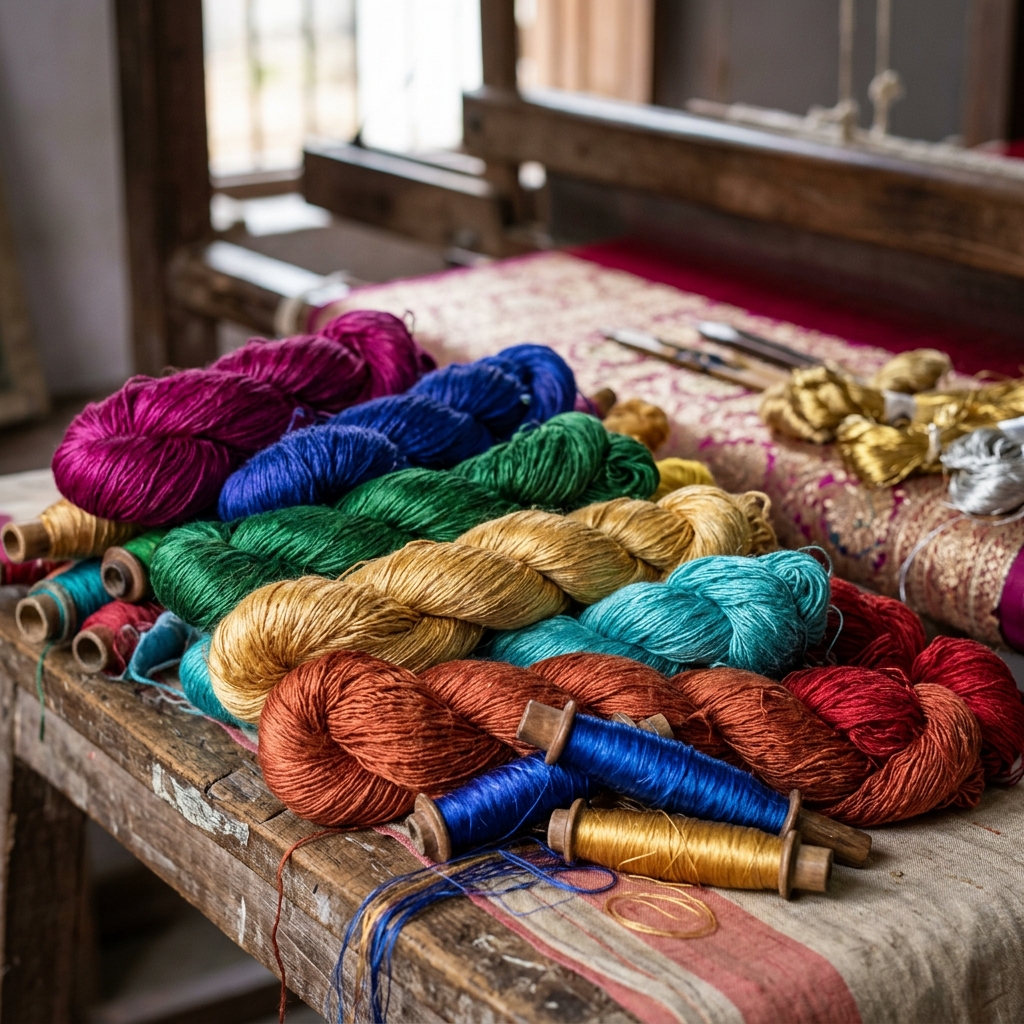
Pure Katan silk yarns are the foundation of a true Banarasi.
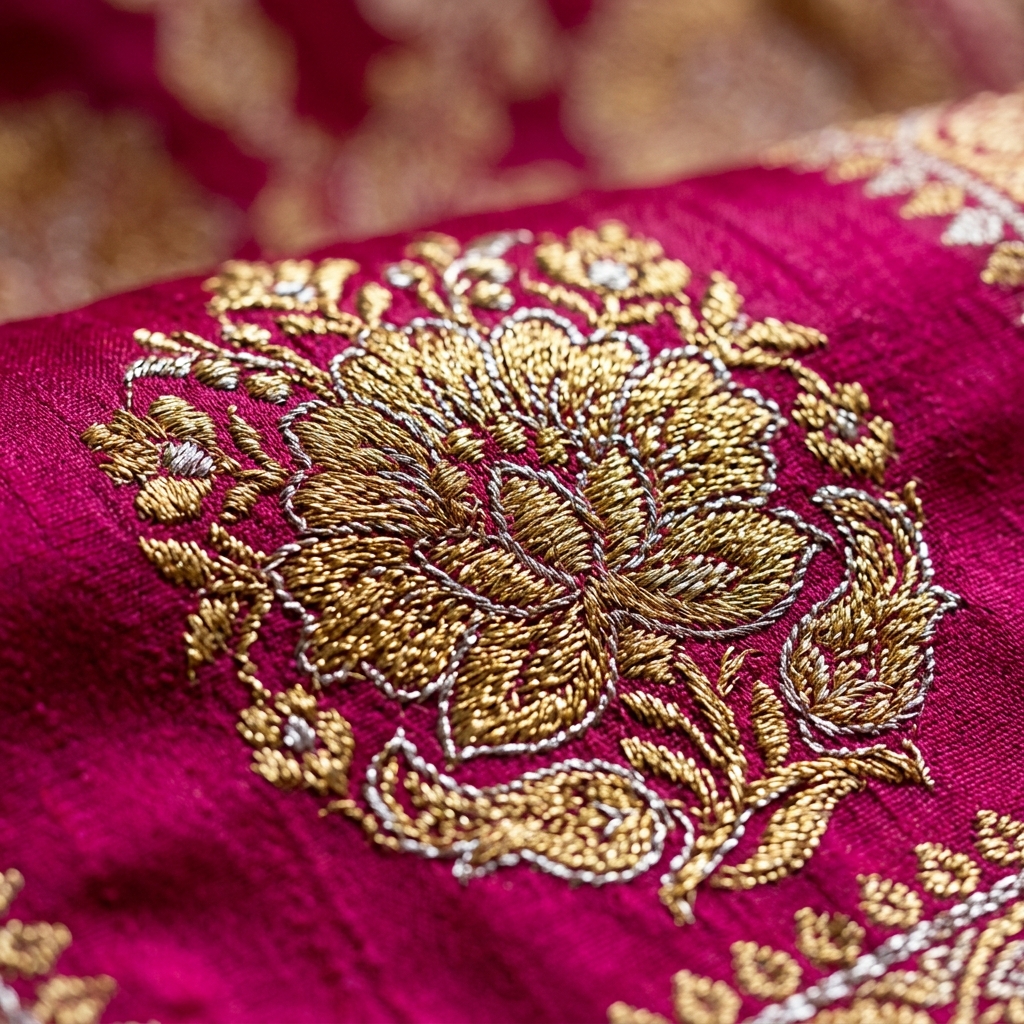
Zari work requires incredible precision and directly impacts the material cost.
2. The zari
Zari is the metallic thread that forms a Banarasi saree's ornamental patterns, and it is often the single largest material cost.
Two things matter: what the zari is made of, and how much of it there is. Historically zari incorporated real gold or silver; today materials vary widely by product and price point. A saree using genuine precious-metal zari sits in an entirely different cost bracket from one using contemporary metallic zari.
Density matters just as much. A saree with heavy all-over zari work simply contains far more of an expensive material than one with a plain body and a simple border. Since no certification covers zari composition, this is something you must ask about directly. We cover why in our guide to GI Tag and Silk Mark certifications.
3. The design work — before weaving even begins
This is the stage most buyers never hear about, and it's genuinely fascinating.
Before a single thread is woven, an artist creates the naksha — the design mapped onto graph paper, where each tiny square represents a single thread of the weave. A specialist called the naqshaband translates the artistic drawing into this thread-by-thread blueprint.
That blueprint is then converted into a series of punch cards that instruct the loom which threads to lift for each pass — a system strikingly similar in principle to early computing. For an elaborate design, preparing the naksha and punch cards is substantial skilled work in its own right, completed before weaving starts. A saree with an original, complex design carries this development cost. A simple repeated pattern does not.
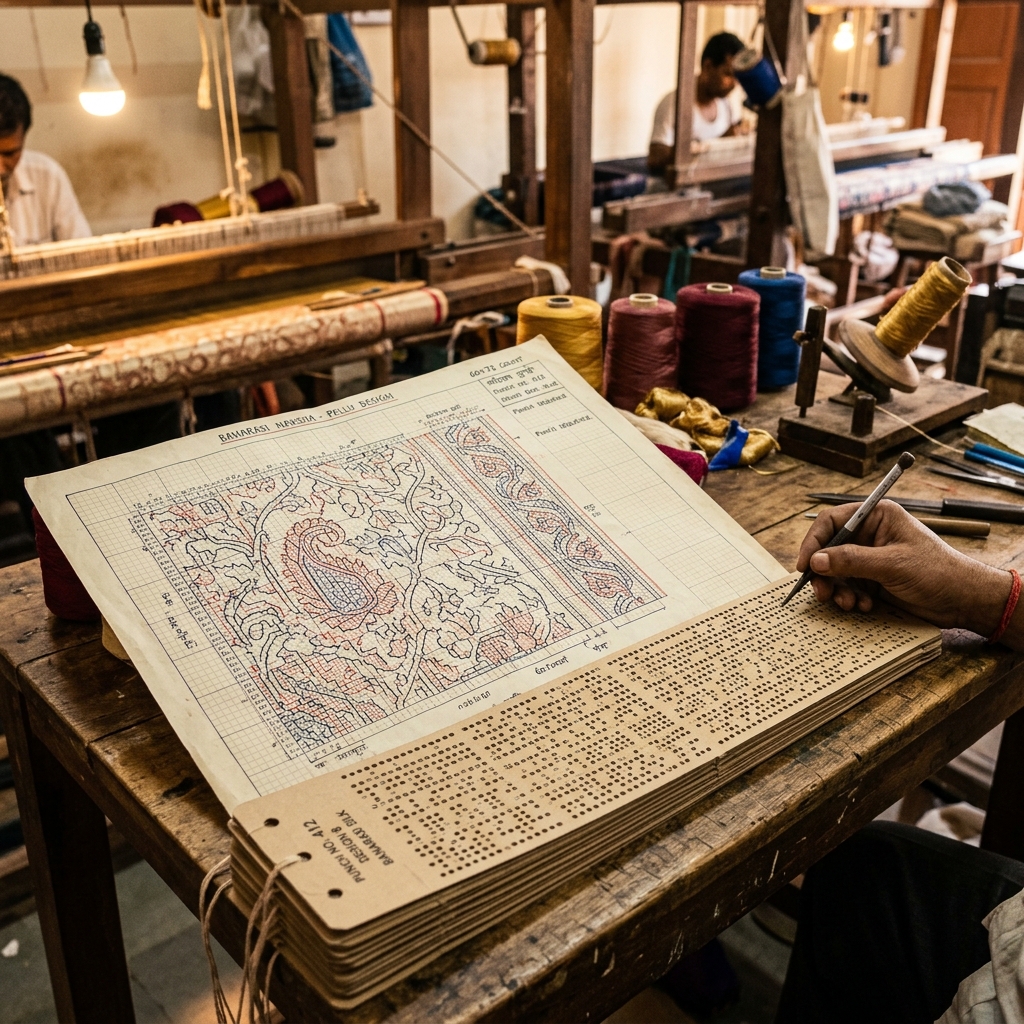
The blueprint stage: creating a 'naksha' and Jacquard punch cards requires specialized skill before a single thread is woven.
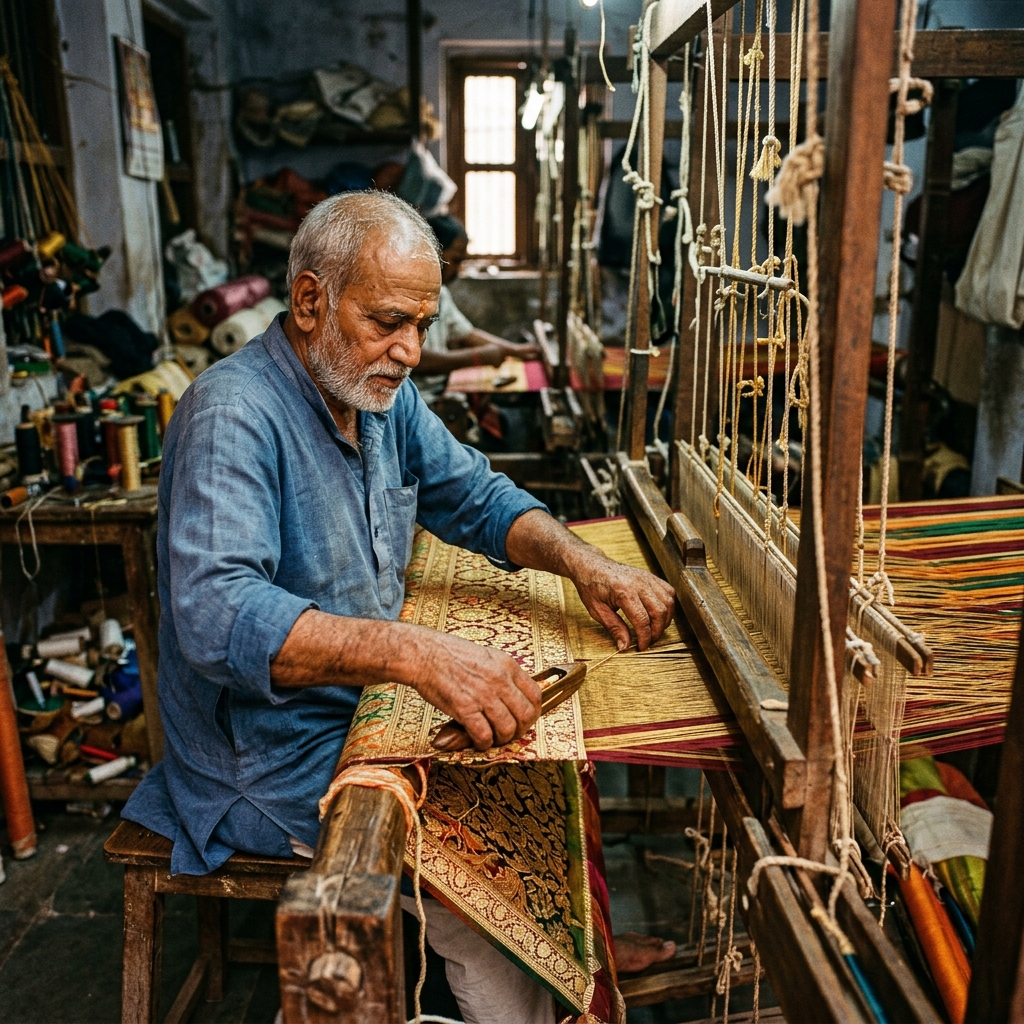
A master weaver can take 15 days to six months to complete a single piece.
4. The weaving time & 5. Handloom vs Powerloom
Here is where the cost concentrates.
On intricate pieces, hand weavers may take around ten hours to complete just one to two inches of fabric. A master weaver working full days on a complex design might produce roughly two to four inches daily. Do the arithmetic across six yards of an elaborately patterned saree and the timeline — weeks, often months — becomes obvious. During that entire period, the loom is occupied and the weaver is committed to that single piece.
A powerloom produces in hours what a handloom produces in days or weeks. That single fact accounts for much of the price spread you see in the market. Both are legitimate products — a well-made powerloom Banarasi at a fair powerloom price is good value. The problem arises only when one is sold as the other. We explain how to tell them apart in our guide to handloom versus powerloom Banarasi sarees.
6. The number of hands involved
A Banarasi saree is not the work of one person. Typically it involves at least three artisans, and often more across the full process:
- The designer who conceives the pattern
- The naqshaband who translates it thread by thread
- The weaver (sometimes two, on complex jacquard setups)
- Specialists for dyeing, warp preparation, finishing and quality inspection
Each is a skilled trade with its own years of training. The price reflects an entire chain of craftsmanship. Read more about the people behind the craft in our feature on the silk bunkars of Varanasi.
7. Design density and colour complexity
An all-over Jangla or floral jaal covering the full body of the saree involves vastly more work than a plain body with a decorative border and pallu.
Meenakari and Rangkat add another layer of difficulty, because the weaver manages multiple colours simultaneously while keeping the base pattern precise. More colours means more thread changes, more concentration, and more time.
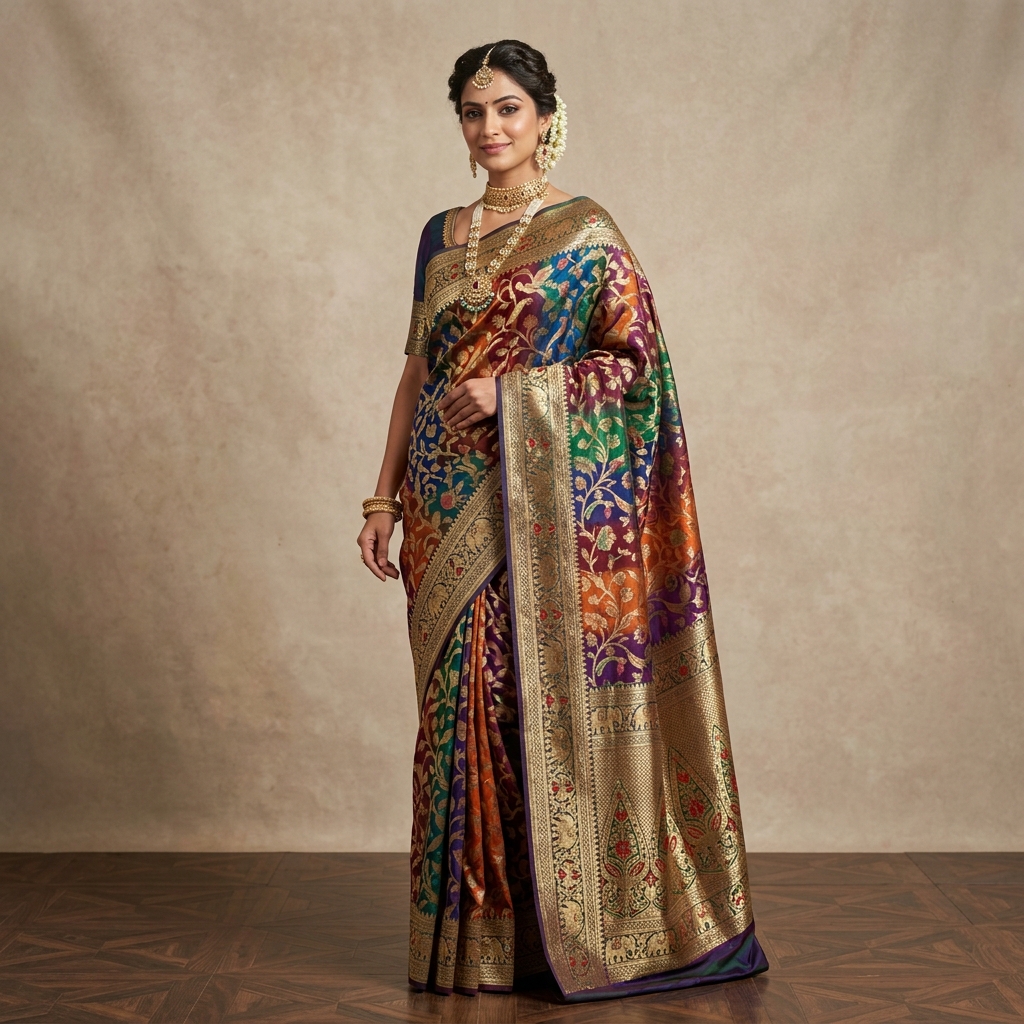
Jangla patterns with intricate Meenakari and Rangkat demand the highest level of weaving expertise.
What you get for the money
Price is one side of the equation. Here is the other.
Longevity
A well-made Banarasi saree, properly stored, remains wearable for decades. Many families pass them down. Measured as cost-per-wear across thirty years and multiple generations, the arithmetic looks very different from the price tag.
Material integrity
Real silk and quality zari age gracefully. Synthetic imitations degrade, lose their sheen, and look tired within a few seasons.
True Craftsmanship
Intricate handwoven work has an irreducible labour cost. There is no version of skilled human weaving that is also fast.
Sustaining a craft
Buying handloom directly sustains weaving families and keeps the tradition economically viable for the next generation. This is the practical reality of how the craft survives.
How to judge whether a price is fair
You don't need to be an expert. Ask what you're paying for:
1
What is the fabric, and what grade of silk?
Pure Katan will always be more expensive than lower grades or synthetic blends.
2
Handloom or powerloom?
This alone accounts for a large share of the price difference.
3
What weaving technique — Kadwa or Fekwa?
Kadwa is significantly more time-consuming and expensive.
4
What type of zari, and how dense is the work?
Heavy metallic threadwork across the whole body adds material cost.
5
How intricate is the design?
Compare the density of pattern against the price.
A useful warning sign
If a saree is presented as intricate handloom Kadwa work with heavy zari, at a price that seems remarkable, the arithmetic deserves scrutiny. Weeks of skilled labour cannot be sold for very little. When the maths seems impossible, it usually is — and something in the description is likely inaccurate.
Equally, an expensive saree isn't automatically the right one for you. A lighter powerloom Georgette may suit a wedding guest far better than a heavy bridal Katan, at a fraction of the cost. Fair value means the price matches what the saree actually is — not that you should always buy the most expensive option.
Our approach at Silk Khazana
We are a family-owned manufacturer weaving in Varanasi since 1970, selling directly to customers rather than through layers of intermediaries. That structure removes markups, but it doesn't remove the labour cost — and we don't pretend it does.
What we do instead is tell you exactly what you're paying for. Ask us about the silk, the zari, the technique, or whether a piece is handloom, and you'll get a specific answer. If a less expensive saree suits your occasion better, we'll say so.
We would rather you understand the value and buy confidently than be talked into something you don't understand.
Explore our collections: Katan silk · Tissue · Organza · Real Gold Zari · browse the full shop
Have a specific budget and occasion in mind? Message us on WhatsApp at +91 63073 05873 and we'll show you the best options within it.
Key Takeaways
- You're paying for time, not just materials. A saree can take 15 days to six months to weave, with intricate pieces progressing only a few inches a day.
- Four factors explain most of the price: silk grade, zari type and density, handloom versus powerloom, and design complexity.
- Fair value means the price matches what the saree is. Ask specific questions — and be sceptical when elaborate handwoven work is offered unusually cheaply.