+9163073 05873 support@silkkhazana.in
Summer sale discount upto 30%! Shop Now

Mini Cart

Handloom vs Powerloom Banarasi Saree: How to Tell | Silk Khazana
Authenticity & Trust ~2,100 Words Updated August 2026

The Buyer's Guide

Handloom vs Powerloom Banarasi Saree: How to Tell the Difference

A handloom Banarasi saree and a powerloom one can look nearly identical hanging in a shop — and differ substantially in price. Knowing which you're holding is the difference between paying for skilled human labour and paying for the idea of it.

Silk Khazana

Banarasi Silk Manufacturer since 1970 · Jaitpura, Varanasi · Worldwide Shipping

"Let's be clear about something first... a powerloom Banarasi saree is not a fake. Both handloom and powerloom sarees are genuinely made in and around Varanasi, both have real markets, and a well-made powerloom saree can be beautiful and excellent value. The only real problem is dishonesty — when a powerloom saree is sold as handloom at a handloom price."

The fundamental difference

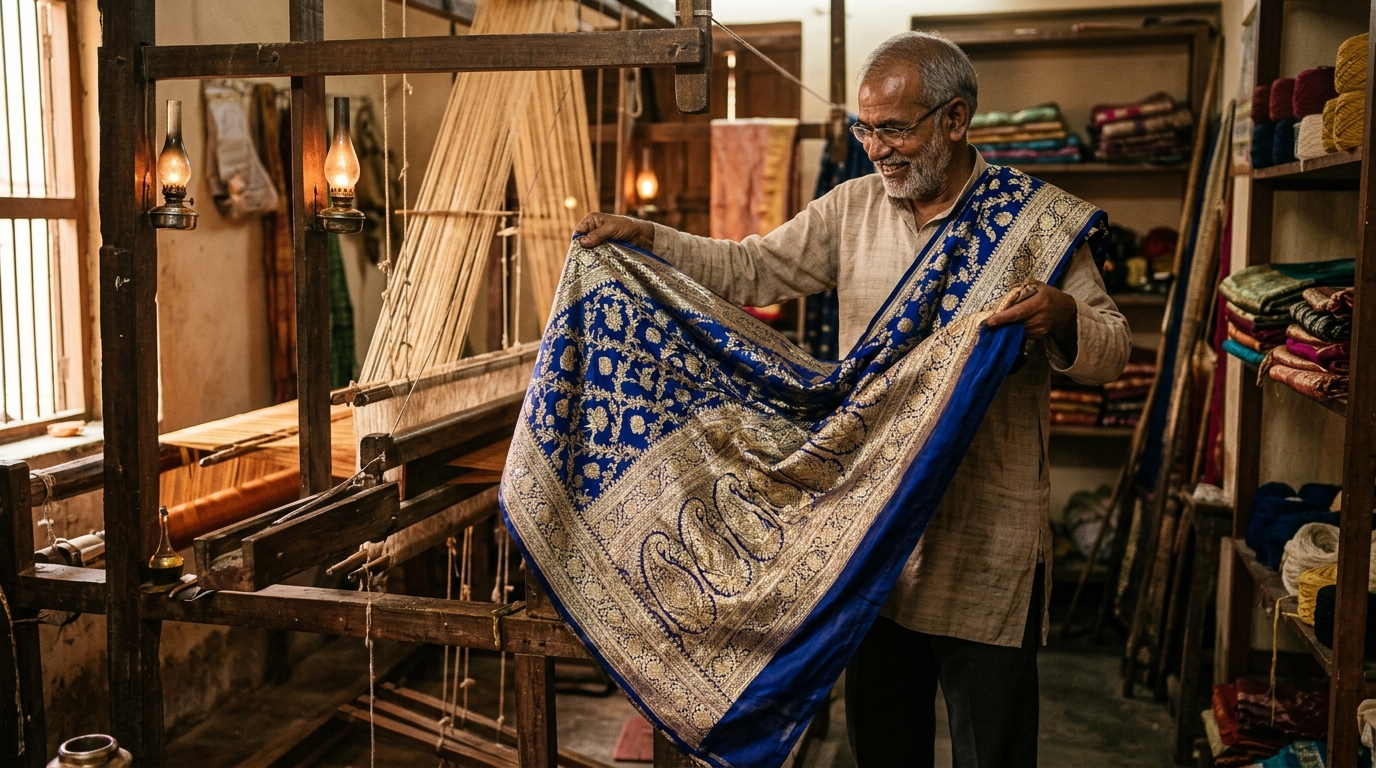
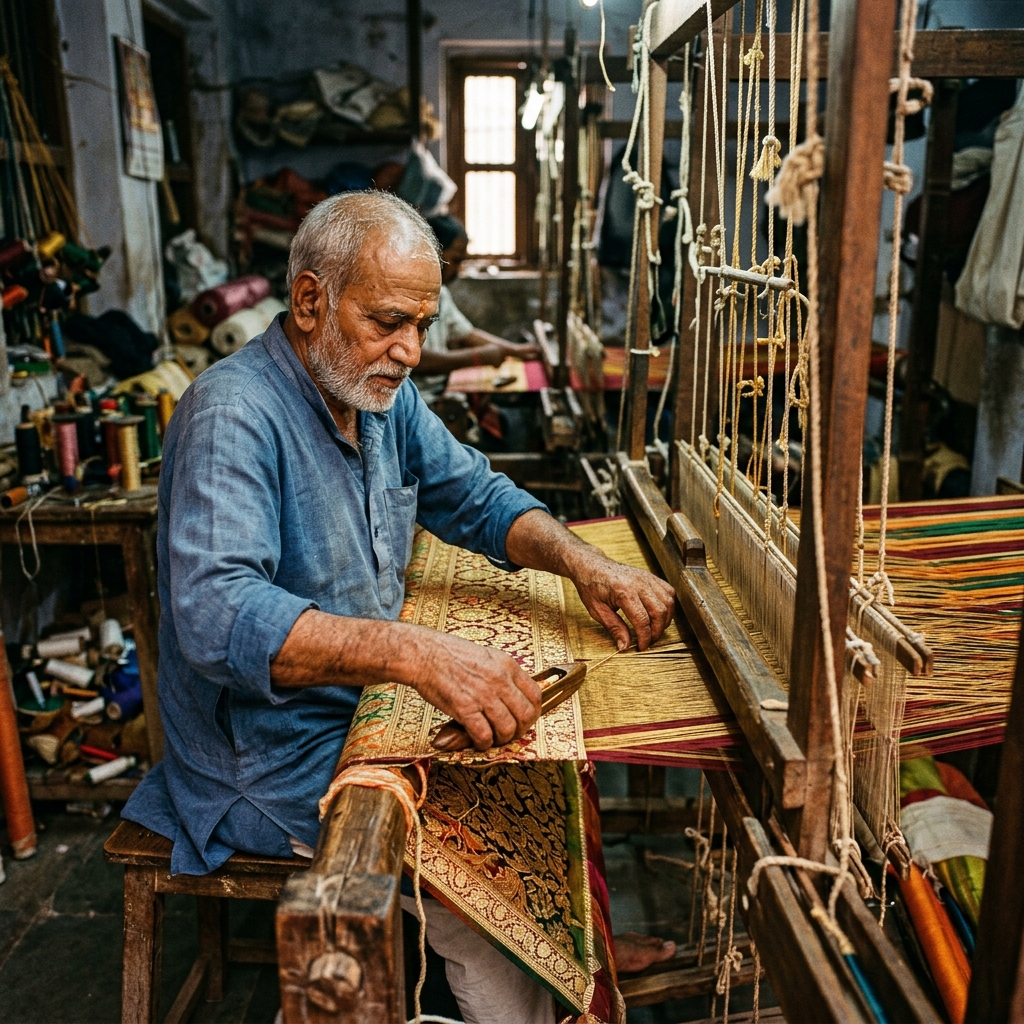
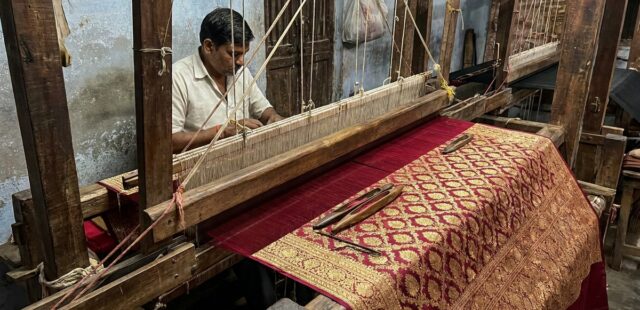
Handloom weaving is done by a skilled artisan operating a traditional loom manually. The weaver controls tension, pace, and the placement of every motif. On intricate designs, progress may be only a few inches a day.

Powerloom weaving uses mechanically powered equipment. It is far faster, produces highly consistent output, and makes Banarasi-style designs accessible at much lower prices.

Everything that follows — the visual differences, the price gap, the way each saree feels — flows from that single distinction: a human hand versus a machine, and the time each requires.

Feature Handloom Powerloom
Production speed Days to weeks per saree Hours to a day
Consistency Minor natural variations Highly uniform
Texture Softer, more pliable, breathable Often crisper or more compact
Price Substantially higher More accessible
Design flexibility Very high, including Kadwa placement Constrained by machine setup
Certification Eligible for Handloom Mark Not eligible for Handloom Mark
A split screen conceptual image comparing handloom weaving with mechanical powerloom weaving
Handloom artisans weave with natural variations, while powerlooms create artificial perfection.

Seven ways to tell the difference

No single check is conclusive on its own. Use several together and a clear picture emerges quickly.

Close up photography of the selvedge edge of a traditional handloom silk saree showing tiny pin marks
Notice the slightly uneven selvedge edge and the tiny pin marks, a true sign of handloom tension.

1. Examine the selvedge

The selvedge — the finished woven edge running along the length of the saree — is the single most reliable indicator.

  • On a handloom saree, the selvedge is neat but not machine-perfect. You'll see slight unevenness from natural variations in hand tension, and sometimes small thread loops along the edge.
  • On a powerloom saree, the edge is uniform and mechanically precise all the way down.

Run the edge between your fingers along its length. Perfect consistency over six yards is a machine signature.

2. Look for pin marks near the borders

Handloom weaving often leaves small pin holes or marks at regular intervals near the borders or along the edges, where the fabric was held under tension on the loom. These are a genuine artefact of hand-weaving and one of the more useful physical tells. They are not damage.

3. Look for small, natural irregularities

Turn the saree in the light and study the weave closely. Handloom fabric almost always shows minor variations — a slightly uneven thread here, a small slub there, a fractional difference in the pattern repeat, or slightly varying density across the length.

These are not defects. They are the fingerprint of the human hand, and experienced buyers actively look for them.

A weave that is flawlessly uniform across the entire saree, with every motif identical to the millimetre, points to a machine.

Close up photography of a machine-made powerloom silk fabric showing perfectly straight and uniform threads
Perfectly straight, artificial uniformity is the hallmark of a powerloom machine.
Reverse side of a handloom Banarasi saree showing small floating silk threads
The reverse side of a handloom saree shows floating threads and organic threadwork mirroring the front.

4. Turn the saree over

The reverse side tells you a great deal. On handloom work, the design reads clearly on the back — a legible mirror of the front, with visible thread work. On powerloom pieces the reverse is often flatter or less crisply defined.

One important note: this check also distinguishes any genuinely woven saree from a printed imitation, where the reverse shows only a faded ghost of the front with no thread work at all. If you learn one check, learn this one — it eliminates outright fakes instantly.

5

Feel the fabric and watch the drape

Handloom silk tends to feel softer and more pliable, with a natural give, and it drapes fluidly around the body. Powerloom fabric often feels crisper or more compact because the weft is packed more evenly and tightly. Some pieces are also starched for presentation, which adds a temporary stiffness. Drape a length over your arm. Handloom silk generally falls in softer, more organic folds.

6

Consider the design complexity

Certain techniques are extremely difficult to reproduce on a powerloom. Intricate Kadwa work — where each motif is woven individually with no long floating threads behind it — and elaborate Shikargah compositions are strong indicators of handloom craftsmanship. If a saree shows genuinely intricate Kadwa detailing at a very low price, that combination deserves questions.

7

Check for a Handloom Mark

The Handloom Mark, issued under the Development Commissioner for Handlooms, certifies specifically that a fabric was handwoven. This is separate from Silk Mark, which only certifies that the fibre is pure silk. Note also that Handloom Mark participation is voluntary. Plenty of genuine handloom weavers don't register — so its absence is not proof of powerloom.


Why handloom costs more

The price difference is not arbitrary. It reflects:

  • Time. A handloom weaver may spend days or weeks on a single saree; a powerloom produces one in a fraction of that.
  • Skill. Handloom weaving is a craft learned over years, often across generations.
  • Labour. One saree can occupy a weaver — sometimes two, on complex jacquard setups — for its entire production.
  • Output limits. A weaver can only produce so many sarees a year, which naturally constrains supply.

When you buy handloom, a much larger share of the price goes to human skill rather than machine throughput. That is also why handloom purchases directly sustain weaving communities and keep the craft viable for the next generation.


Which should you actually buy?

This is a genuine choice, not a trick question.

Neither choice is wrong. What matters is that you know which you're buying and pay a price that matches. A well-made powerloom saree at a fair powerloom price is a good purchase. A powerloom saree sold to you as handloom is not — regardless of how it looks.

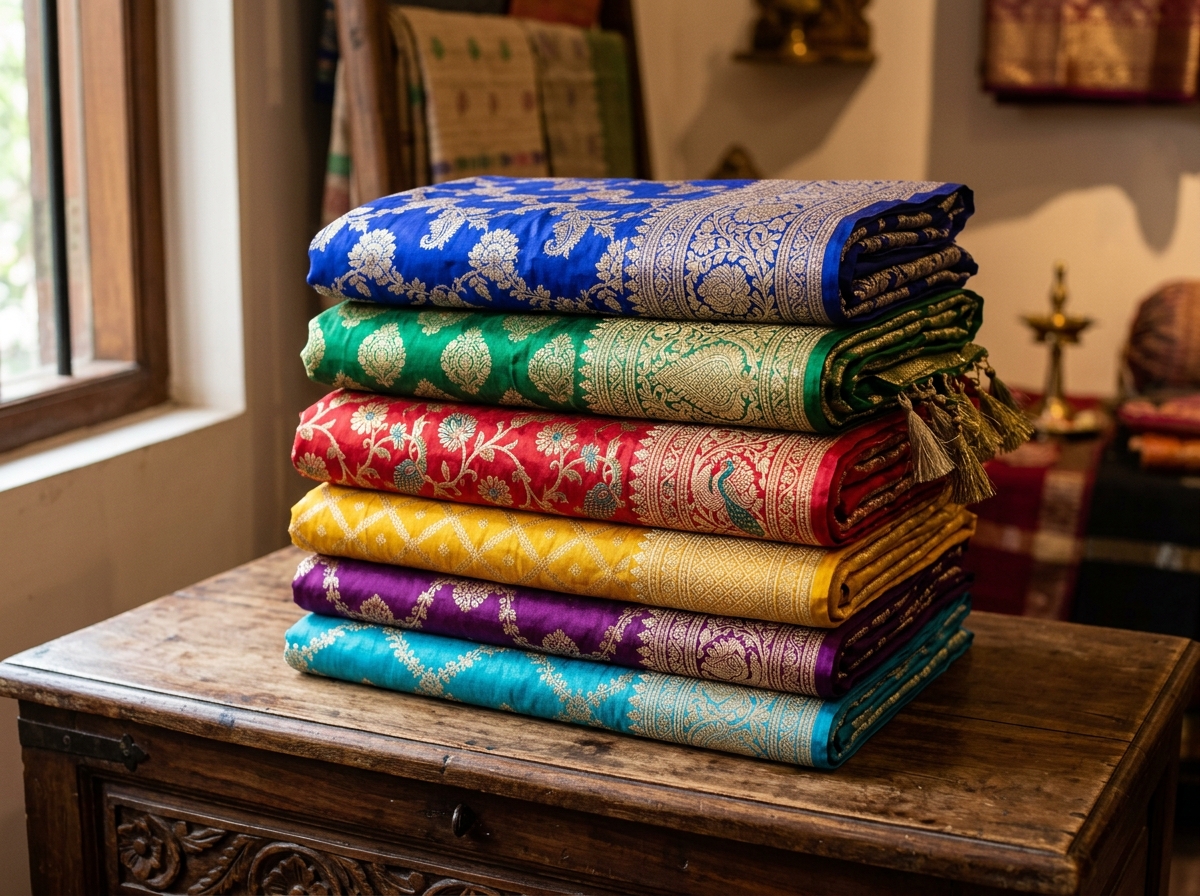
A stack of colorful Banarasi silk sarees
Whether handloom or powerloom, making an informed choice allows you to appreciate the value of what you're buying.

Questions to ask any seller

The fastest route to clarity is simply asking directly. A trustworthy seller will answer without hesitation:

1

"Is this handloom or powerloom?"

A straight answer is the baseline. Evasion or a vague "it's traditional work" tells you a great deal.

2

"What weaving technique is used?"

Specific answers like Kadwa or Fekwa indicate genuine product knowledge.

3

"What type of zari is this?"

No certification covers zari composition, so you must ask.

4

"Does it carry a Handloom Mark or Silk Mark?"

And if not, why not — the answer may be perfectly reasonable.

Be cautious of "guaranteed" all-handloom stores

Be cautious of any seller who claims everything they stock is handloom. Given how much of the market is powerloom, that claim is statistically improbable, and an honest seller has no reason to make it.


How we handle it at Silk Khazana

We are a family-owned manufacturer weaving Banarasi silk in Varanasi since 1970, with our own weaving operation.

Our approach is straightforward: we tell you what a saree is. If it's handloom, we say so and explain the technique. If it's powerloom, we say that too, and price it accordingly. We would rather sell you a powerloom saree you're genuinely happy with than a misrepresented one that damages your trust in the craft.

Explore our collections: Katan silk · Katan Meenakari · Katan Jungla · Shikargah · browse the full shop

If you're comparing sarees — including ones you're considering elsewhere — send us photographs on WhatsApp at +91 63073 05873 and we'll tell you honestly what we see.

Key Takeaways

  • Powerloom isn't fake. Both are genuine Banarasi products. The only real problem is a powerloom saree sold at a handloom price.
  • The selvedge and the reverse side are your best checks. Handloom edges show slight natural unevenness and small thread loops; the reverse of any true brocade shows real thread work.
  • Ask directly, and judge the answer. "Is this handloom or powerloom?" is a fair question with a simple answer. Hesitation is itself information.

Frequently Asked Questions

What is the difference between a handloom and powerloom Banarasi saree?+

A handloom saree is woven manually by a skilled artisan on a traditional loom, taking days or weeks. A powerloom saree is produced on mechanically powered equipment, far faster and more uniformly. Both are genuinely made in the Banaras region; they differ in labour, character and price.

How can I tell if a Banarasi saree is handloom?+

Check several signals together: a slightly uneven selvedge with small thread loops, pin marks at regular intervals near the borders, minor natural irregularities in the weave, a clearly legible design on the reverse, softer drape, and a Handloom Mark where present.

Is a powerloom Banarasi saree fake?+

No. A powerloom Banarasi woven in the region is a legitimate product, and often good value. It is only a problem when it is misrepresented as handloom or priced as one.

Does a Silk Mark mean my saree is handloom?+

No. Silk Mark certifies only that the fibre is pure natural silk — both handloom and powerloom sarees can carry it. Handweaving is certified separately by the Handloom Mark.

Why are handloom Banarasi sarees more expensive?+

Because of the time and skill involved. A single intricate saree can occupy a weaver for days or weeks, and output per weaver is naturally limited. A larger share of the price goes to human craftsmanship.

Can Kadwa work be done on a powerloom?+

Kadwa — where each motif is woven individually without long floating threads — is extremely difficult to replicate on a powerloom. Genuinely intricate Kadwa detailing offered at a very low price warrants careful questions.

Are small irregularities in a handloom saree a defect?+

No. Minor variations in thread, slubs, or slight differences in pattern repeat are natural characteristics of hand-weaving and are generally regarded as marks of authenticity rather than flaws.

Shop with Confidence from the Source

Silk Khazana — weaving authentic Banarasi silk in Varanasi since 1970. Direct from the GI region, honest about every saree we sell.

Unsure about a saree you are considering elsewhere? Message us — we will tell you honestly what we see.

GI Tag & Silk Mark: Verify a Genuine Banarasi Saree | Silk Khazana
Authenticity & Trust ~1,900 Words Updated August 2026

The Buyer's Certification Guide

GI Tag & Silk Mark: How to Verify a Genuine Banarasi Saree

Three certifications. Three different questions. Here is exactly what each one proves — and what none of them prove alone.

Silk Khazana

Banarasi Silk Manufacturer since 1970 · Jaitpura, Varanasi · Worldwide Shipping

"Most buyers assume a Silk Mark label means their saree is a genuine handwoven Banarasi. It does not — and that single misunderstanding is why so many people pay Banarasi prices for something that isn't one."

The three marks at a glance

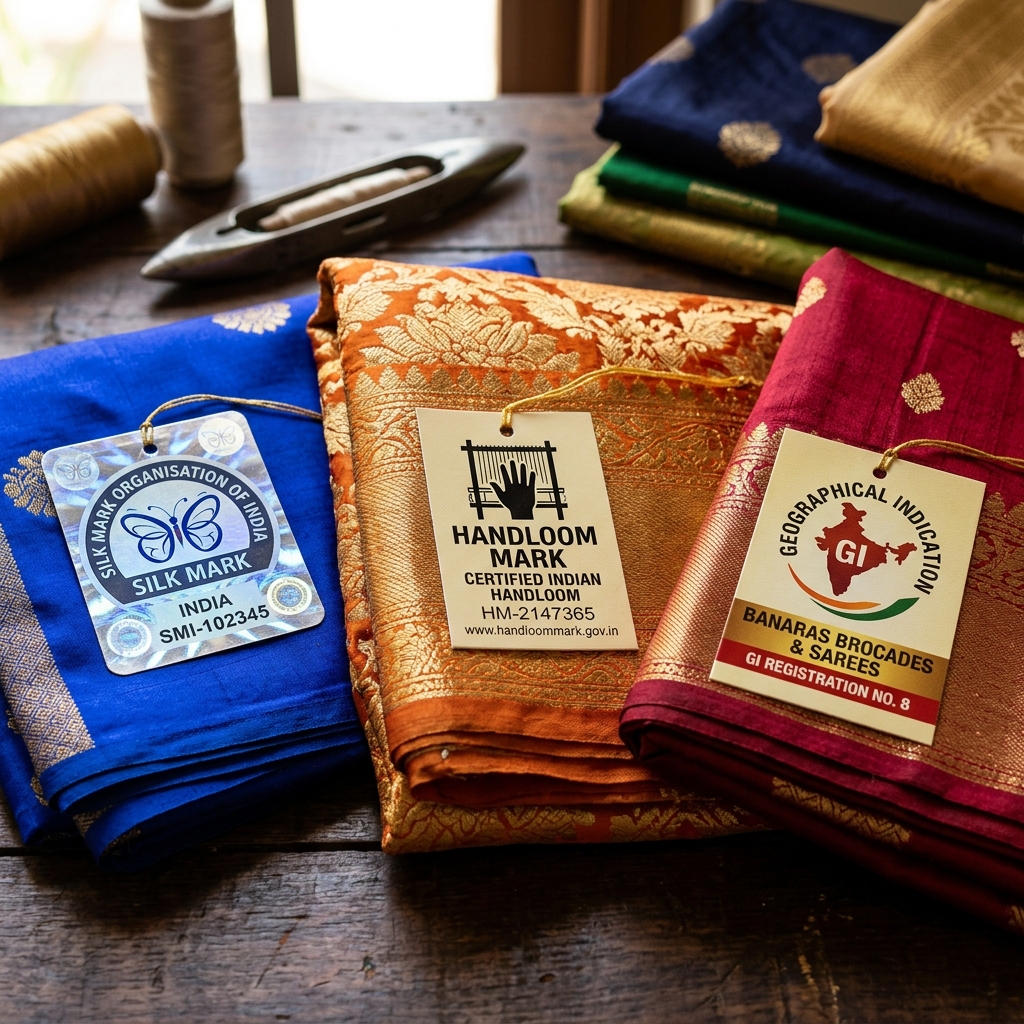
There are three different certifications you may encounter when buying a Banarasi saree: the GI tag, the Silk Mark, and the Handloom Mark. Each certifies something completely different, and none of them, on its own, tells you everything.

This table is the heart of this guide. If you remember nothing else, remember this:

Certification What it certifies What it does NOT prove
GI Tag
Banaras Brocades & Sarees
Saree originates from the defined Banaras region Not handloom; not silk purity
Silk Mark
Central Silk Board
The textile is pure natural silk Not handloom; not from Banaras
Handloom Mark
Ministry of Textiles
Fabric was handwoven on a traditional loom Not silk purity; not regional origin

Read that right-hand column carefully. A Silk Mark proves your saree is real silk — it says nothing about whether it was woven by hand or machine, or whether it came from Varanasi or anywhere else. A powerloom saree made of pure silk can legitimately carry a Silk Mark. This is not a flaw — each mark answers one specific question. The confusion arises when a seller lets you assume one label covers all three.

Three certification marks: GI Tag, Silk Mark, and Handloom Mark displayed on authentic silk sarees
Three marks, three different questions answered — understand what each one actually proves.

The GI Tag: what "Banarasi" legally means

A Geographical Indication (GI) is a form of intellectual property protection that ties a product to its place of origin — the same principle that protects Champagne or Darjeeling tea.

In 2009, "Banaras Brocades and Sarees" received GI status. The application was led by the Banaras Bunkar Samiti, and the protection covers weaving in a defined area of eastern Uttar Pradesh — Varanasi and the surrounding districts of Mirzapur, Chandauli, Bhadohi, Jaunpur and Azamgarh.

🛡

What it protects

The GI stops sarees woven elsewhere from being sold as "Banarasi". It protects buyers who get what they paid for — and weaving communities whose craft the name represents.

Origin Protection
⚠️

The honest limitation

Enforcement in a large informal market is genuinely difficult. Not every authentic Banarasi carries a visible GI label, and "GI" in a product description cannot be verified from a photograph online.

Know the limits
📍

How to use it

Treat the GI as important context — a reason to care where your saree was actually woven — rather than as a sticker that settles the authenticity question by itself.

Context, not proof

The Silk Mark: what it does and doesn't certify

The Silk Mark is issued by the Silk Mark Organisation of India, a society established under the Central Silk Board. Its purpose is narrow and specific: it certifies that a textile is made of pure natural silk.

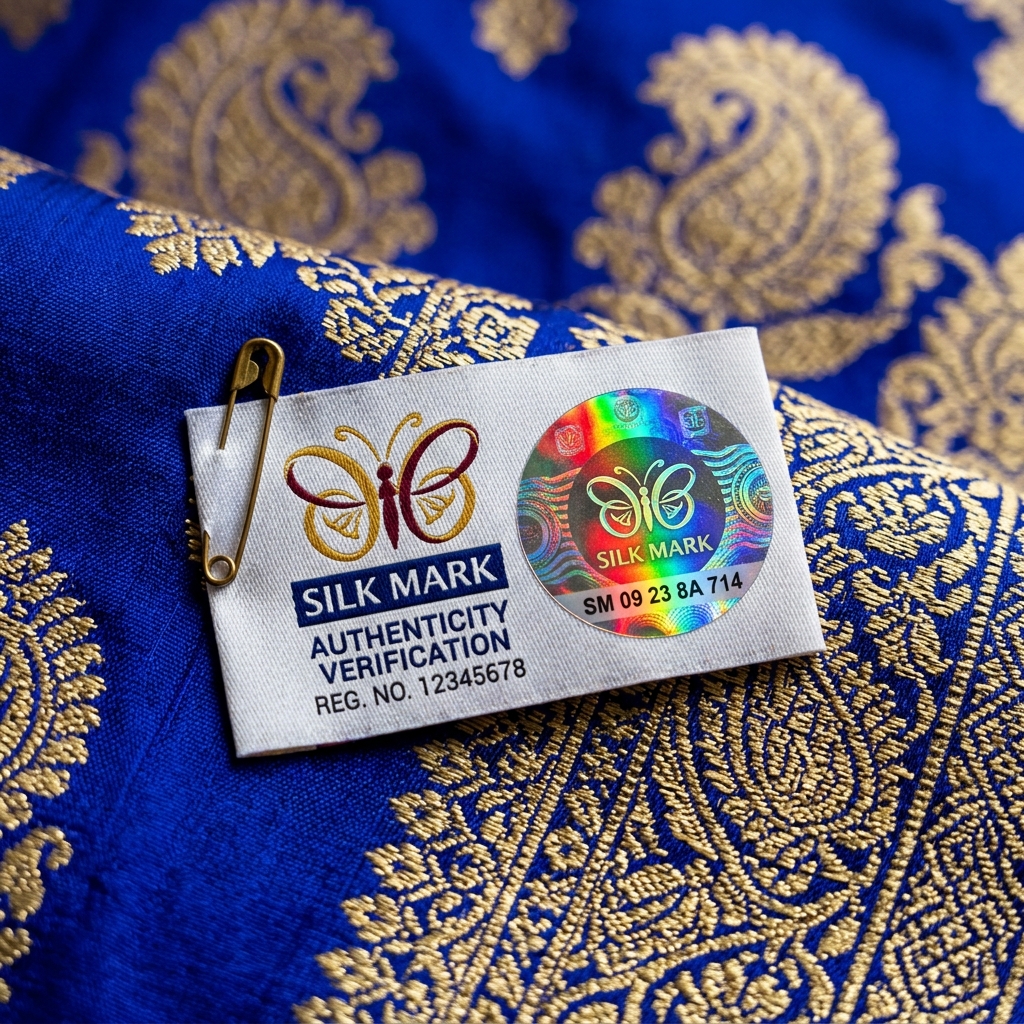
Close-up macro photo of authentic Silk Mark hologram label with unique serial number on Banarasi silk saree
A genuine Silk Mark carries both a hologram and a unique traceable identification number — both are required to be genuine.

How to check a Silk Mark label

A genuine Silk Mark label carries:

  • A hologram that shifts colour and pattern at different angles
  • A unique identification number traceable back to the authorised registered user who applied it

That traceability is the point. If a seller shows you a Silk Mark label, the number on it corresponds to a registered entity. A photocopied or generic-looking label with no hologram or number is a red flag in itself.

The three limits you must know

  • It certifies fibre, not craft. Both handloom and powerloom sarees can carry Silk Mark, provided the silk is genuine.
  • It certifies fibre, not origin. A pure silk saree woven far outside the Banaras region can carry a Silk Mark.
  • It is advisory, not mandatory. Many genuine weavers — particularly smaller family units — sell authentic sarees without registering for it.

The absence of a Silk Mark does not mean a saree is fake. Its presence does not mean the saree is handwoven in Varanasi. It is one useful data point about one specific question.


The Handloom Mark: the one most buyers have never heard of

If what you care about is that a human being wove your saree on a traditional loom, the Handloom Mark is the certification that actually addresses that. It is issued under the Development Commissioner for Handlooms, Ministry of Textiles, and certifies that a fabric was handwoven — regardless of whether it is silk, cotton, or wool.

A saree can legitimately carry both Silk Mark and Handloom Mark: the first confirming the fibre is pure silk, the second confirming it was woven by hand. Together, that is meaningfully stronger assurance than either alone.

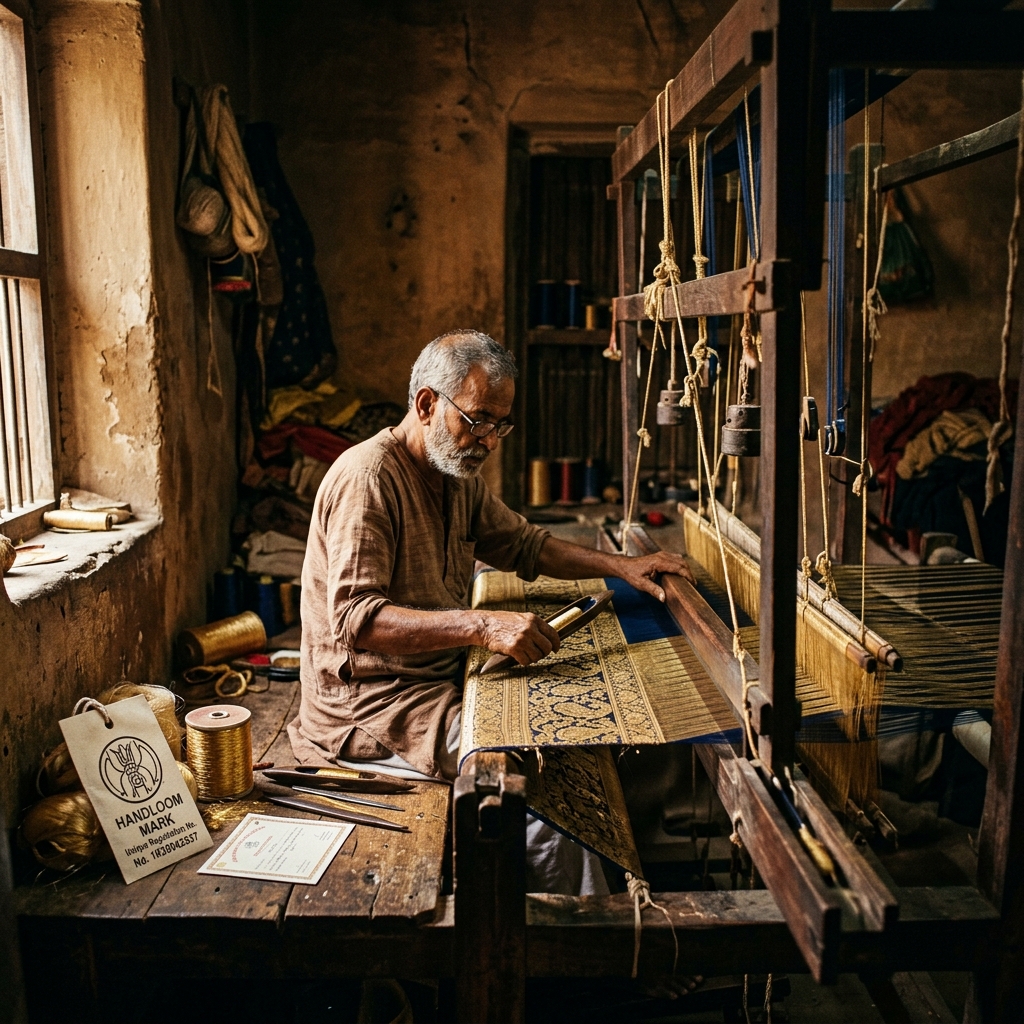
Master weaver at traditional Varanasi pit loom with authentic Handloom Mark certification
The Handloom Mark certifies human hands wove the fabric — the one certification most buyers never ask about.

What no certification can tell you

Certifications verify specific, narrow facts. Here is the part most articles skip entirely. They cannot tell you:

Outside the scope of all certifications

  • The quality of the weaving — whether motifs are cleanly executed, whether the bel resolves properly at the corners, whether the pallu is well proportioned
  • The type of zari — no mark certifies whether zari is precious-metal gold/silver or contemporary metallic. You must ask the seller directly.
  • The weaving technique — Kadwa versus Fekwa makes an enormous difference to labour and price, and no label records it
  • Whether the price is fair for the work actually involved in making that specific saree

These are judgements, and they come from either your own developing eye or a seller you can trust to answer straight questions. Which brings us to the thing that actually matters most.


The verification method that works

Use certifications as supporting evidence within a broader check. In order of practical usefulness:

1

Assess the source first

A Varanasi-based manufacturer who will answer direct questions is the strongest signal available. Ask: What is the fabric? Handloom or powerloom? What weaving technique? What type of zari? Vague or evasive answers tell you more than any label.

2

Turn the saree over

Genuine woven brocade shows the pattern in reverse on the back, with thread work clearly visible. A print shows a flat, faded ghost of the front with no thread work. This single check eliminates most imitations instantly.

3

Feel the fabric

Real silk has weight, warmth against the skin, and a soft rather than glassy sheen. Check the selvedge and finishing quality. Genuine handwoven pieces show neat, considered edges.

4

Then check the labels

Silk Mark for fibre purity — confirm the hologram and unique number. Handloom Mark if handweaving matters to you. Understand the GI as important context for what "Banarasi" should mean.

5

Watch for these red flags

Any single "guaranteed" authenticity test; blanket claims all stock is handloom; assumptions all zari is gold; prices dramatically below market for comparable work. Intricate handweaving has an irreducible labour cost.

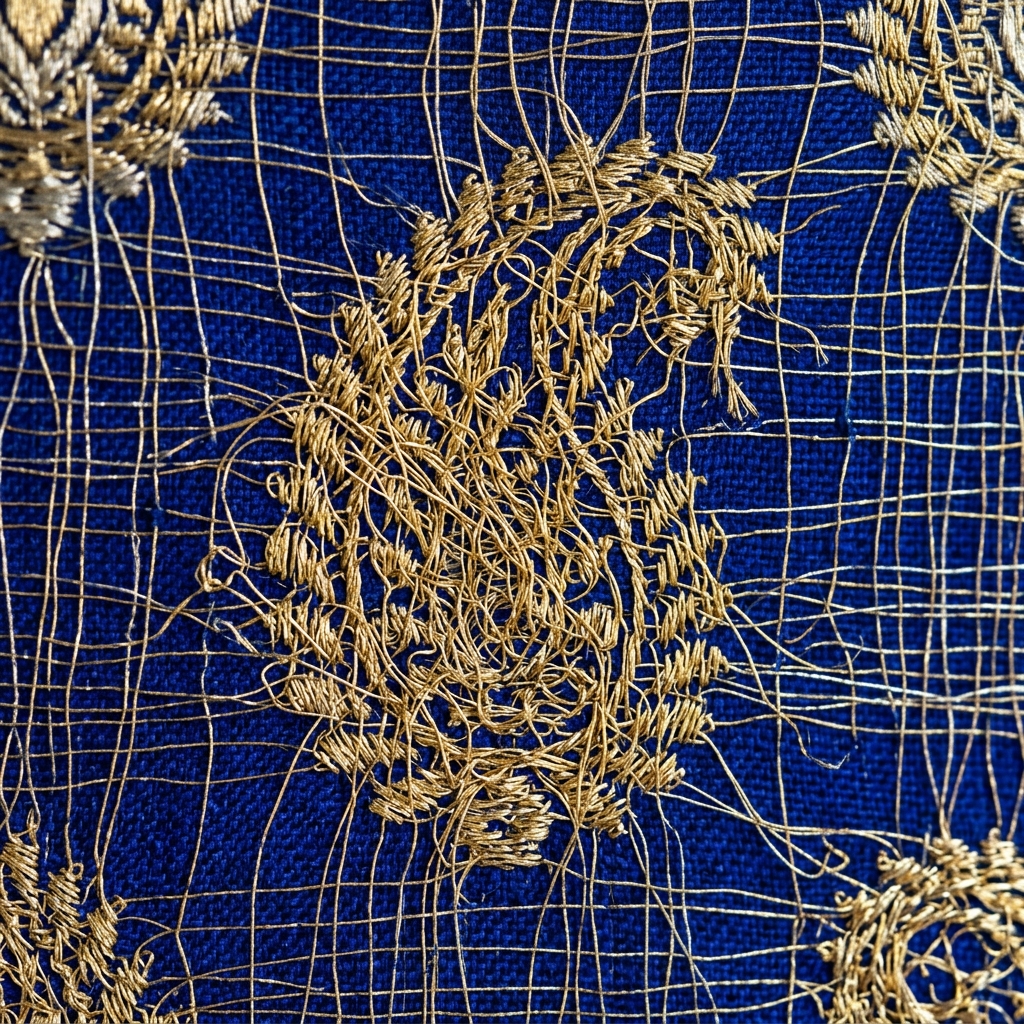
Back side of handwoven Banarasi silk saree showing floating zari threads proving genuine woven brocade
Turn it over: the reverse of genuine woven brocade shows floating threads or motif reverses — a print shows nothing.

For more detail on steps 2 and 3, read our guide on how to identify a pure Banarasi silk saree.


How we handle this at Silk Khazana

We are a family-owned manufacturer weaving Banarasi silk in Varanasi since 1970 — inside the GI region, in our own weaving operation.

What that means for you practically: when you ask us what a saree is, you get a specific answer. If a saree is powerloom, we say so. If the zari is contemporary metallic rather than precious metal, we say so. If a saree is not right for your occasion or budget, we'll tell you that too.

We would rather you buy the right saree with full information — even if that turns out to be a less expensive one — than buy an expensive one under a misunderstanding and lose trust in the craft entirely.

Explore our collections: Katan silk · Tissue · Meenakari · Real Gold Zari · browse the full shop

Have a saree you are unsure about — even one you are considering elsewhere? Message us on WhatsApp at +91 63073 05873. We are happy to tell you what we see.

Key Takeaways

  • Three marks, three different questions. GI = where it was woven. Silk Mark = whether the fibre is pure silk. Handloom Mark = whether a human wove it. No single mark covers all three.
  • Silk Mark does not mean handloom. A pure-silk powerloom saree can legitimately carry one. Always confirm the hologram and unique number when you see the label.
  • The source outweighs the sticker. A credible Varanasi weaver who answers specific questions about fabric, technique and zari is stronger evidence than any label alone.

Frequently Asked Questions

What is the GI tag for Banarasi sarees?+

"Banaras Brocades and Sarees" received Geographical Indication status in 2009. It legally ties the name to sarees woven in a defined region of eastern Uttar Pradesh — Varanasi plus Mirzapur, Chandauli, Bhadohi, Jaunpur and Azamgarh — protecting both buyers and local weaving communities.

Does a Silk Mark mean my saree is handloom?+

No. Silk Mark certifies only that the textile is pure natural silk. Both handloom and powerloom sarees can carry it. Handweaving is certified separately under the Handloom Mark.

What is the difference between Silk Mark and Handloom Mark?+

Silk Mark, issued by the Silk Mark Organisation of India, certifies pure natural silk regardless of how it was woven. Handloom Mark certifies the fabric was handwoven on a traditional loom regardless of fibre. A pure-silk handwoven saree can carry both.

How do I check if a Silk Mark label is genuine?+

A genuine Silk Mark label carries a hologram and a unique identification number traceable to the authorised user who applied it. A label with no hologram or number should be treated with caution.

Is a Banarasi saree without a Silk Mark fake?+

Not necessarily. The Silk Mark scheme is advisory and voluntary, and many genuine weavers — particularly smaller family units — sell authentic sarees without registering. Judge the source, the weaving and the fabric alongside any labels.

Can a powerloom saree be a genuine Banarasi?+

Yes. Banarasi sarees are genuinely made on both handloom and powerloom, and a powerloom Banarasi woven in the region is a legitimate product. The issue is only when a powerloom saree is sold as handloom. A trustworthy seller tells you which a specific saree is.

Does any certification tell me if the zari is real gold?+

No. None of these marks certify zari composition. You must ask the seller directly, and only sarees specifically described as using real gold or silver zari contain precious metals.

Shop with Confidence from the Source

Silk Khazana — weaving authentic Banarasi silk in Varanasi since 1970. Direct from the GI region, honest about every saree we sell.

Unsure about a saree you are considering elsewhere? Message us — we will tell you honestly what we see.

The Complete Guide to Banarasi Silk Sarees | Silk Khazana
Silk Khazana Pillar Guide ~3,600 Words Updated July 2026

The Master Heritage Guide

The Complete Guide to Banarasi Silk Sarees

Your complete guide to Banarasi silk sarees — the types, weaves, zari, how to spot a genuine one, and how to care for it so it lasts generations. Written directly from our Varanasi showroom.

Silk Khazana

Banarasi Silk Manufacturer since 1970 · Jaitpura, Varanasi · Worldwide Shipping

"A Banarasi silk saree is a handwoven saree made in and around Varanasi (Banaras), known for its fine silk, intricate brocade weaving, and rich zari work. It is one of India's most treasured textile traditions — a saree families keep for weddings, pass down through generations, and recognise instantly by its weight, sheen, and craftsmanship."

What is a Banarasi silk saree?

A Banarasi saree is defined less by a single feature and more by a combination of them: fine silk yarn, traditional weaving done in the Varanasi region, decorative brocade patterns, and detailed borders and pallus.

The most important thing to understand is that the designs are woven into the fabric — not printed or embroidered on top. Extra threads (usually zari) are introduced during weaving to build the pattern as the cloth itself is formed. This is what "brocade" means, and it is why a genuine Banarasi has a distinctive raised, textured feel and shows the pattern in reverse on the back.

That single fact explains most of what follows: why these sarees take so long to make, why they cost what they do, and why a printed imitation never quite looks or feels the same.

A brief history

Varanasi has been an important weaving centre for centuries, sustained by its position on major trade and pilgrimage routes and by generations of resident master weavers. The craft flourished particularly under Mughal patronage, when Persian-inspired floral and foliate design — flowering vines, paisleys, delicate lattices — merged with local weaving expertise. That fusion produced the visual language we still recognise as Banarasi today.

In 2009, "Banaras Brocades and Sarees" was granted a Geographical Indication (GI) — legal recognition that authentic Banarasi sarees originate from a defined region around Varanasi, covering districts including Mirzapur, Chandauli, Bhadohi, Jaunpur and Azamgarh. We explain how to use that in practice in the authenticity section below.

Master weaver working on a traditional Varanasi pit loom creating intricate gold brocade
Brocade weaving in Varanasi — where patterns are handwoven thread by thread into the cloth.

Why Varanasi matters

Varanasi is not simply where these sarees happen to be made. It is a living craft ecosystem: master weavers, designers, dyers, zari specialists and finishers working within walking distance of one another, many from families who have practised the craft for generations.

That concentration of skill is difficult to replicate elsewhere, and it is the real reason "Banarasi" carries weight as a name. When you buy from a Varanasi manufacturer, you are buying from inside that ecosystem rather than from a reseller several steps removed from it.


Why Banarasi sarees are special

Three things set a Banarasi apart from an ordinary silk saree.

Craftsmanship over speed

A finely woven Banarasi is the result of days or weeks of skilled work — designing the pattern, translating it for the loom, preparing thousands of warp threads, weaving, and finishing. On the most intricate pieces, a weaver may progress only a few inches in a day. The value comes from that time and skill, not merely the final appearance.

Heritage you can wear

The motifs and methods have been refined across generations. Buying a Banarasi is, in a real sense, owning a piece of India's textile heritage and helping sustain the artisans who keep it alive.

Longevity

A well-made, well-cared-for Banarasi is not fast fashion. Many families wear one at a wedding and then keep it for the next generation. This is why we talk about a Banarasi as an investment rather than a purchase — the cost-per-wear over decades tells a very different story than the price tag alone.


The main types of Banarasi silk sarees

"Banarasi" describes where and how a saree is woven — but within that, there are many fabrics, each with its own weight, drape, and best occasion. Getting this right is the single most useful thing a first-time buyer can learn, because most disappointment comes from choosing the right saree for the wrong occasion.

Type Character Weight Best for
Katan silk Pure silk from tightly twisted yarns; smooth, durable, timeless Medium–heavy Weddings, formal occasions, heirlooms
Tissue silk Lightweight with a luminous, festive sheen Light–medium Receptions, festivals, evening events
Organza (Kora) Light, crisp and sheer with woven motifs Light Day weddings, summer functions
Georgette / Khaddi Soft and fluid with beautiful movement Light–medium Long events, easy draping
Tussar / Moonga Textured natural-toned wild silk, rustic richness Medium Understated luxury, day wear, collectors
Dupion Crisp with a subtle slub texture Medium Structured, statement drapes

Explore each in our collections: Katan · Tissue · Organza · Khaddi Georgette · Tussar · Moonga · Dupion

Katan silk — the classic

Katan is what most people picture when they think "Banarasi". It is pure silk woven from tightly twisted yarns — the twisting is what gives it strength, a smooth surface, and a gentle rather than glaring sheen.

Katan holds structure beautifully. It drapes with weight and presence, which is exactly why it has always been the traditional choice for bridal and ceremonial wear. It also ages well: stored properly, a Katan saree remains wearable for decades. If you want one saree that will still look elegant in twenty years, start here.

Read our dedicated guide: Pure Katan Silk Saree — the timeless treasure.

Showcase of pure Banarasi silk varieties including Katan, Tissue, Organza and Georgette
Banarasi silk varieties — each offering unique weight, sheen, and drape for specific occasions.

Tissue silk — festive and luminous

Tissue Banarasi sarees are prized for their light weight and soft, luminous shine. That glow comes from the weaving structure and the interplay of zari across the surface — not from any coating or finish applied afterwards.

The result is celebratory without being heavy. Tissue is a favourite for receptions and festive occasions where you want to catch the light and stand out gracefully, but still be comfortable through a long evening.

Organza (Kora) — light and contemporary

Organza — also called Kora — is light, crisp and slightly sheer. Banarasi Organza pairs that delicate base with traditional woven motifs, so it reads as modern and heritage-rich at the same time.

It is an excellent choice for daytime functions, warmer months, and younger buyers who find heavier silks daunting. Because the fabric is translucent, the woven motifs appear to float, which is much of its charm.

Georgette and Khaddi — soft drape

If pure Katan feels a little heavy, Georgette (and Khaddi Georgette) offers the Banarasi aesthetic in a softer, more fluid fabric. It moves beautifully, drapes easily, and is forgiving to wear for many hours.

This makes it ideal for wedding guests, for travel, and for anyone who wants authentic Banarasi weaving without the weight of a bridal-grade piece.

Tussar and Moonga — natural texture

Tussar and Moonga are wild silks with a naturally golden, textured tone. They read as understated luxury rather than glossy formality — quieter, earthier, and distinctly tactile.

They are popular with collectors and with buyers who prefer heritage character over shine. Read our Pure Moonga silk sarees guide.


Banarasi weaving techniques explained

Fabric is only half the story. How the pattern is woven often matters more — it is where the craftsmanship lies, and it explains most of the price difference between two sarees that look superficially similar.

Kadwa

Kadwa is regarded as one of the most intricate Banarasi techniques. Each motif is woven individually, rather than by carrying supplementary threads continuously across the back of the fabric. The practical consequence: no long floating threads behind the design, cleaner motifs that sit crisply on the cloth, and dramatically more time at the loom. Kadwa motifs can also be placed exactly where the designer wants them. This is the technique for buyers who care about detailed artistry and durability of the design.

Fekwa (Phekwa)

In Fekwa weaving, supplementary threads are carried across broader sections of the fabric to form motifs more efficiently, with the excess trimmed during finishing. Fekwa is not "lesser" than Kadwa — it simply suits different designs and price points, and produces beautiful results, particularly for all-over patterns. A trustworthy seller will tell you which technique a saree uses rather than implying everything is Kadwa. Suitability depends on the design and your priorities, not on one method being universally superior.

Jangla (Katan Jungla)

Jangla features dense, flowing all-over floral and vine compositions that cover the body of the saree. It is traditionally associated with ceremonial grandeur and bridal wear, and the sheer density of pattern makes it one of the most labour-intensive styles. See our Katan Jungla collection.

Meenakari

Meenakari adds coloured supplementary threads to highlight motifs, giving them a jewel-like, multi-toned quality. Crucially, this is a woven technique — it is not enamel work (as in Meenakari jewellery) and not embroidery added afterwards.

Good Meenakari demands real skill: the weaver manages multiple colours simultaneously while keeping the base pattern precise. Explore Katan Meenakari and read our Royal Meenakari feature.

Close-up of vibrant Meenakari woven floral motifs with gold zari threadwork
Meenakari weaving — adding vibrant colored silk threads alongside gold zari for jewel-like motifs.

Rangkat

Rangkat is recognised for artistic colour transitions — the saree shifts between colours in deliberate, harmonious blocks or gradients, creating visual depth across the length of the fabric. Its appeal lies in colour composition rather than loud pattern, which makes it a sophisticated choice. See the Rangkat collection and our Rangkat Katan guide.

Shikargah

Shikargah designs depict stylised hunting scenes — animals, birds and foliage arranged within elaborate compositions. They are among the most complex Banarasi designs to weave and are traditionally associated with the most elaborate ceremonial textiles. See our Shikargah collection.

Tanchoi and Jamawar

Tanchoi is characterised by richly patterned surfaces created without heavy zari emphasis — the pattern comes from the interplay of coloured silk threads themselves, producing a densely figured, satin-smooth fabric. Jamawar brings intricate, shawl-inspired all-over patterning to the saree form. Both suit buyers who want visual richness with understated shine. See our Jamawar collection.

Cutwork

Cutwork creates decorative woven patterns where excess floating thread is carefully trimmed during finishing. It offers intricate detailing while keeping the fabric lighter and more versatile — well suited to elegant everyday luxury rather than heavy ceremonial wear.


Zari and motifs: the language of a Banarasi saree

Understanding zari

Zari is the decorative metallic thread that creates a Banarasi saree's ornamental patterns. Historically, zari often incorporated precious metals — genuine gold or silver wound around a silk core. Today the material varies considerably by product and price point.

This matters commercially, so be direct about it: never assume a Banarasi contains real gold or silver zari unless it is explicitly specified. An honest seller will tell you exactly what a given saree uses. Where a saree genuinely uses precious-metal zari, we list it as such — for example in our Real Gold Zari collection.

Zari also affects how a saree behaves. Denser zari work adds weight and structure; lighter zari keeps a saree fluid and easier to drape.

Spools of gold and silver zari thread alongside handwoven Banarasi silk fabric
Zari thread spools and handwoven motifs — the ornamental signature of authentic Banarasi silk.
Reading the motifs

The motifs woven with that zari form a design language of their own, drawn mostly from nature and Mughal-era decorative art:

  • Buti — small motifs repeated across the body of the saree
  • Buta — a larger, more prominent motif than a buti
  • Bel — flowing vine or creeper patterns, typically running along borders; a hallmark of Banarasi design
  • Kalga — a stylised floral form inspired by Mughal decorative tradition
  • Paisley — the familiar teardrop motif, associated with elegance and continuity
  • Jhallar — a decorative border treatment placed between the body and the pallu
  • Jaal — an interconnected all-over lattice, such as a floral jaal, creating visual continuity across the saree

Once you can read these, you stop seeing "a pretty pattern" and start assessing a saree the way experienced buyers do — noticing how well the bel resolves at the corners, whether the buti spacing is even, how cleanly the pallu design is executed.


How to tell if a Banarasi saree is genuine

This is the question we are asked most, and the honest answer is that no single test guarantees authenticity. Anyone promising one is overselling. A genuine Banarasi is judged on several factors together.

1

The seller and the source

This is the strongest signal. Buying directly from a Varanasi-based manufacturer removes layers of intermediaries and gives you someone accountable for what the saree actually is. Ask direct questions — fabric, weave technique, zari type, handloom or powerloom — and judge the quality and specificity of the answers.

2

Turn the saree over

Genuine woven brocade shows the pattern in reverse on the back, with floating threads (Fekwa) or individually woven motif reverses (Kadwa) clearly visible. A printed imitation shows a flat, faded version of the front with no thread work at all. This one check eliminates most fakes immediately.

3

Fabric, weight and finish

Real silk has a particular weight, warmth against the skin, and a soft rather than plasticky sheen. Look at the selvedge — the finished woven edge — and the overall finishing. Genuine handwoven pieces show neat, considered edges and a certain organic irregularity that machine-printed synthetics lack.

4

Certifications, where available

A Silk Mark label — issued by the Silk Mark Organisation of India, a body set up under the Central Silk Board — indicates the textile is made of pure natural silk. Each label carries a hologram and a unique number that can be traced back to the authorised user. Note that Silk Mark certifies the silk content, not the weaving origin, and the scheme is advisory rather than legally binding. The GI framework for Banaras Brocades and Sarees protects the regional origin of authentic Banarasi weaving. Neither is a magic guarantee on its own. Together with a credible source, they add real confidence.

Close-up of the reverse side of a genuine woven Banarasi silk saree showing floating zari threads
Turn it over: authentic woven brocade shows the reverse weave on the back, proving it was woven rather than printed.

For a deeper walkthrough, read our companion guide: How to Identify a Pure Banarasi Silk Saree — 10 expert tips.


Why Banarasi sarees vary so much in price

If you have compared Banarasi sarees, you will have seen enormous price differences. The reasons are concrete:

  • Silk quality — the grade, purity and consistency of the yarn
  • Zari — the type, quality and density of metallic thread, and whether it is precious-metal
  • Weaving technique — Kadwa takes substantially longer than Fekwa for the same design area
  • Handloom vs powerloom — handwoven pieces carry far more skilled human labour
  • Design density — an all-over Jangla or jaal involves vastly more work than a plain body with a simple border
  • Colour complexity — Meenakari and Rangkat require managing multiple colours simultaneously at the loom
  • Finishing — quality of trimming, edge finishing and inspection

Price, in short, is largely a proxy for time and skill. This is why we encourage customers to understand what they are paying for rather than shopping on the number alone. A more expensive saree is not automatically better for you — but a suspiciously cheap "handloom Kadwa Katan" should prompt questions.


Which Banarasi saree should you choose?

A simple way to narrow it down by occasion:

Occasion Recommended choice Why
Your wedding Katan silk in Kadwa, Jangla or Meenakari Structure, richness, heirloom durability
Reception / evening Tissue, or Meenakari / Rangkat Luminous colour, festive without heaviness
Daytime or summer function Organza (Kora) or Khaddi Georgette Light, breathable, easy to carry
Wedding guest Georgette, Tissue or Organza Elegant but comfortable for long events
Everyday luxury Tussar or Moonga Understated, textured, characterful
A gift Classic Katan in a timeless colour Broadly appreciated, safe and meaningful
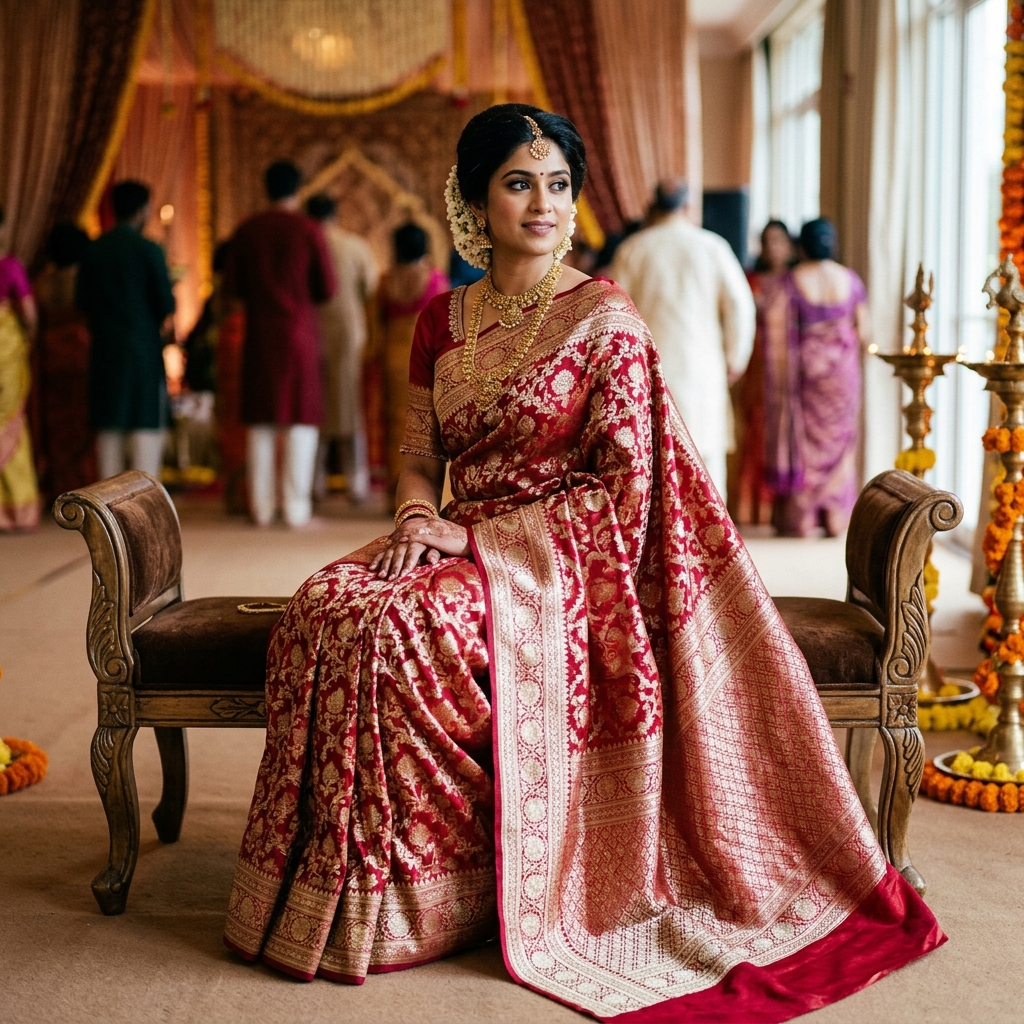
Royal Indian bride in crimson Banarasi Katan silk saree with gold zari motifs
Choosing for a wedding: Pure Katan silk with rich Jangla gold zari motifs provides unmatched bridal grandeur.

Three practical questions to ask yourself before buying:

  1. How long will I be wearing it? Long events favour lighter fabrics.
  2. What season and time of day? Organza and Georgette suit heat and daylight; Katan and Tissue suit evenings.
  3. Is this for one occasion or for keeping? If it is meant to last generations, invest in Katan and better zari.

If you are still unsure, that is exactly what we are here for — tell us the occasion and we will guide you, not upsell you.


How to care for a Banarasi silk saree

A Banarasi rewards a little care with decades of life. The essentials:

  • Store it wrapped in a breathable cotton or muslin cloth — never plastic, which traps moisture and can damage silk and zari over time.
  • Refold it every three to four months along different lines, so permanent creases don't set into the silk or crack the zari.
  • Keep it away from prolonged direct sunlight, which fades colour, and from damp, which invites mildew.
  • Never spray perfume directly onto the fabric — alcohol can stain silk and tarnish zari.
  • Clean delicate silk sarees through professional dry cleaning rather than machine washing.
  • Avoid hanging heavy sarees for long periods; the weight can distort the weave. Fold and lay flat instead.
Folded Banarasi silk saree wrapped neatly in breathable soft white muslin cloth
Proper storage: wrap your Banarasi saree in cotton or muslin cloth and refold periodically along different lines.

If a saree has been stored for years, air it gently in shade before wearing, and refold it along new lines afterwards. Treat it as the heirloom it is, and it will be ready for the next celebration — and the next generation.


Buying authentic Banarasi silk from Silk Khazana

Silk Khazana is a family-owned manufacturer weaving Banarasi silk in Varanasi since 1970. Buying directly from us means buying from the source — with control over quality, honest information about each saree, and personal help choosing the right one, whether you are in India or ordering from abroad with worldwide shipping.

What that means in practice: if you ask us what zari a saree uses, or whether it is handloom or powerloom, you will get a straight answer. If a saree is not right for your occasion, we will say so and suggest something that is.

Explore our collections by fabric and weave — Katan, Tissue, Meenakari, Organza and more — or browse the full shop.

For personal guidance, message us on WhatsApp at +91 63073 05873 and tell us your occasion; we are happy to help you choose with confidence. Planning a trip to Varanasi? Read our complete guide to buying Banarasi sarees in Varanasi.

Key Takeaways

  • A Banarasi saree is defined by woven brocade — patterns created during weaving with zari, not printed or embroidered afterwards. Turning the saree over is the fastest authenticity check.
  • Choose the fabric for the occasion. Katan for weddings and heirlooms, Tissue for receptions, Organza and Georgette for daytime and comfort, Tussar and Moonga for understated character.
  • Authenticity comes from the source, not a single test. A credible Varanasi manufacturer who answers direct questions about fabric, weave and zari is worth more than any one label.

Frequently Asked Questions

What is a Banarasi silk saree? +

A Banarasi silk saree is a handwoven saree made in the Varanasi (Banaras) region, known for fine silk, intricate brocade weaving, and zari motifs woven into the fabric rather than printed on it. In 2009 it received a Geographical Indication as "Banaras Brocades and Sarees", protecting its regional origin.

How can I tell if a Banarasi saree is genuine? +

Check several things together: buy from a credible, ideally Varanasi-based source; turn the saree over to confirm the pattern is genuinely woven rather than printed; assess the silk's weight, warmth and finish; and look for a Silk Mark label where available. No single test alone proves authenticity.

What is the difference between Kadwa and Fekwa weaving? +

In Kadwa, each motif is woven individually, leaving no long floating threads behind the design — more intricate and far more time-consuming. In Fekwa, supplementary threads run across broader sections and excess is trimmed during finishing. Neither is universally better; suitability depends on the design and your priorities.

Which Banarasi silk is best for a wedding? +

Pure Katan silk in an intricate weave such as Kadwa, Jangla or Meenakari is the traditional bridal choice, for its structure, richness and durability as an heirloom.

Do all Banarasi sarees use real gold zari? +

No. Zari material varies by product and price point. Only sarees specifically described as using real gold or silver zari contain precious metals — always confirm with the seller.

Are Banarasi sarees always handloom? +

No. Banarasi sarees are made on both handloom and powerloom. A trustworthy seller will tell you which technique a specific saree uses rather than claiming every piece is handloom.

What does a Silk Mark label certify? +

Silk Mark, issued by the Silk Mark Organisation of India under the Central Silk Board, certifies that a textile is made of pure natural silk. Each label carries a hologram and a unique traceable number. It certifies silk content rather than weaving origin, and is advisory rather than legally binding.

How do I care for a Banarasi silk saree? +

Store it in a breathable cotton or muslin cloth, refold it every few months along different lines, keep it away from sunlight, moisture and direct perfume, and prefer professional dry cleaning for delicate silk.

Can Banarasi sarees be worn in summer? +

Yes. Lighter fabrics such as Organza (Kora), Khaddi Georgette and lighter Tissue sarees are well suited to warm weather and daytime functions, while heavier Katan pieces are better for evenings and cooler months.

Experience Authentic Varanasi Weaving

Silk Khazana — weaving authentic Banarasi silk in Varanasi since 1970.

Have questions about a specific fabric or custom weave? Message us directly — our master weavers are here to guide you.

Silk Bunkar in Varanasi: The Weavers Behind Banarasi Silk

A Silk Khazana Heritage Guide

Silk Bunkar in Varanasi

The Weavers Behind Every Authentic Banarasi Saree — the history, the craft, the looms, and how to buy genuine handloom Banarasi silk directly from the source.

Silk Khazana

Banarasi Silk Manufacturer since 1970 · Jaitpura, Varanasi · Worldwide Shipping

"In the old lanes of Varanasi, before the city wakes for its prayers, a sound is already moving through the walls — the steady knock of wood on wood, the whisper of silk being pulled tight. It is the sound of the bunkar. It has been the soundtrack of this city for more than four hundred years."

The Lane That Never Stopped Weaving

Turn off the main road in Madanpura or Lallapura and the noise of scooters fades within a few steps. What replaces it is older and quieter: the rhythmic clack of a pit loom, a rhythm so even you could set a clock by it. Push open a low wooden door and you may find a man seated waist-deep in the floor, his feet working pedals sunk into a pit, his fingers throwing a shuttle across a river of gold and crimson thread. Above him, strings hang from the ceiling like the roots of some patient tree. Around him, often, is his family — a son learning to tie a broken warp, a wife winding bobbins, a father who has done this every day for fifty years and cannot imagine stopping.

This man is a bunkar. In Hindi and Urdu the word simply means weaver, but in Varanasi it means something closer to keeper of a tradition. The silk bunkars of Varanasi are the reason a Banarasi saree is not merely fabric but heirloom — the reason a bride in Delhi, a grandmother in New Jersey, and a collector in London will all pay, and wait, for a length of cloth woven entirely by hand in a city on the banks of the Ganga.

This is their story: who they are, how they work, why their craft is worth protecting, and how you — whether you live down the road or on the other side of the world — can buy a genuine handloom Banarasi saree in a way that honours the hands that made it.

A narrow weaving lane in Madanpura, Varanasi, lined with weavers' homes
Madanpura, known for fine, delicate work and neat selvedges.

A Heritage Woven Over Four Centuries: The History of Banarasi Silk

Varanasi has been a textile city for a very long time, but the Banarasi silk we recognise today has a more specific beginning. Most textile historians trace it to the late 16th and early 17th century, when a wave of skilled weavers and merchants migrated eastward from Gujarat. The famine of 1603 pushed many of them toward Banaras, and they arrived carrying something precious: a mastery of the warp and weft and the art of weaving figured silk.

They could not have chosen a better home. Banaras already sat on India's great trade and pilgrimage routes, drawing traders, patrons, and raw materials from across the subcontinent. When the Mughal court saw what these weavers could do, the craft found its golden age. Persian floral vines, paisleys, and hunting scenes met Indian sensibility; threads of real gold and silver were drawn into silk to clothe queens and courtiers. The dense brocade known as kinkhab (kimkhwab) — literally "a little dream" — belongs to this era. By the 18th and 19th centuries, Banarasi brocade had become a byword for luxury across India.

Then the story turned. As British rule dismantled the old networks of royal patronage, demand for court finery collapsed, and the craft nearly died with it. That it survived at all is a testament to the stubbornness of the bunkar families, who kept the looms running through lean generations. In 2009, the tradition finally received formal legal protection: the Geographical Indication (GI) tag for "Banaras Brocades and Sarees." Under that tag, a saree can only be called Banarasi if it is woven within the Banaras–Bhadohi–Mirzapur cluster of eastern Uttar Pradesh, using the region's traditional methods. The law simply recognised what the weavers had always known — that this cloth belongs to this place and these hands.

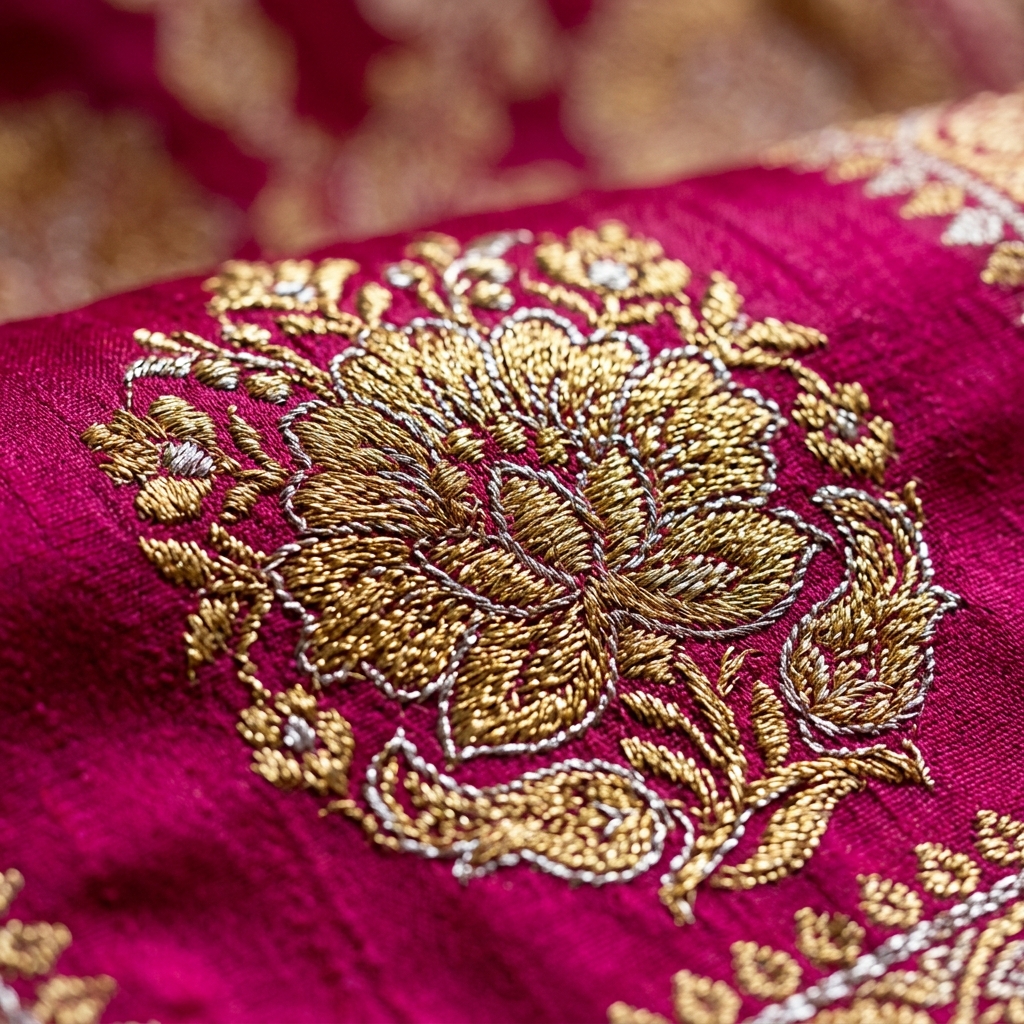
Close-up of a Varanasi silk weaver's hands working gold zari into silk
Every gold motif is placed by hand — the mark of a genuine handloom Banarasi.

Who are the Silk Bunkars of Varanasi?

The word describes a profession, but in Varanasi it also describes a community and a way of life. The overwhelming majority of the city's silk weavers belong to the Ansari community (also called Momin) — Muslim families for whom weaving has been a hereditary craft passed from father to son, and increasingly from mother and daughter too, for many generations. Women make up roughly a fifth of the weaving workforce, doing much of the essential preparation — winding, sizing, and finishing — that a finished saree depends on.

A bunkar rarely works alone, and rarely works in a factory. Weaving in Varanasi is a household craft. The loom sits in the family home, often in the front room, and the household organises itself around it. This is why buying a Banarasi saree is never quite like buying a shirt off a rack: you are buying the output of a home, a family, and a skill that took a lifetime to acquire.

It helps to know the cast of characters behind a single saree, because the bunkar is only the most visible of them:

  • Naqshaband — the design-maker who translates a painted motif onto graph paper, deciding where every thread and colour will fall.
  • Karigar — the master weaver, the person at the loom.
  • Tilli helper — often a second weaver who carves out individual motifs with a small wooden spool during intricate work.
  • Gaddidaar / Mahajan — the financier-trader who historically advanced money and raw silk to weavers and bought back the finished cloth. This relationship is central to the economics of the craft, and, as we'll see, not always a fair one.
A Varanasi weaver's family working together around a handloom at home
Behind every saree is a family — weaving is a household craft.

A Day in the Life of a Banarasi Weaver

Ask a bunkar when his day begins and he might smile, because the honest answer is that the loom rarely fully sleeps. Work often starts soon after the dawn prayer, in the cool hours when the light is soft and the hands are steady. Silk is unforgiving of a tired grip; a moment's inattention with the zari and a motif can pull out of line.

The morning is for the most demanding weaving — the fine kadhua motifs where each flower is built up thread by thread. By mid-morning the room warms and the family's other tasks weave themselves around the loom: bobbins are refilled, a snapped warp thread is knotted back with a speed that looks like sleight of hand, tea arrives. A skilled weaver might complete only a few inches of an elaborate pallu in a full day. There is no rushing it. The saree will take as long as it takes — two weeks for something simpler, six months for a heavy bridal piece dense with gold.

What strikes most visitors is the quiet concentration. There is conversation, there is the radio, there are children underfoot — and yet the hands never stop calculating. A weaver reads his own graph paper the way a musician reads a score, translating squares into threads without looking up. It is muscle memory layered over mathematics, refined across a lifetime.

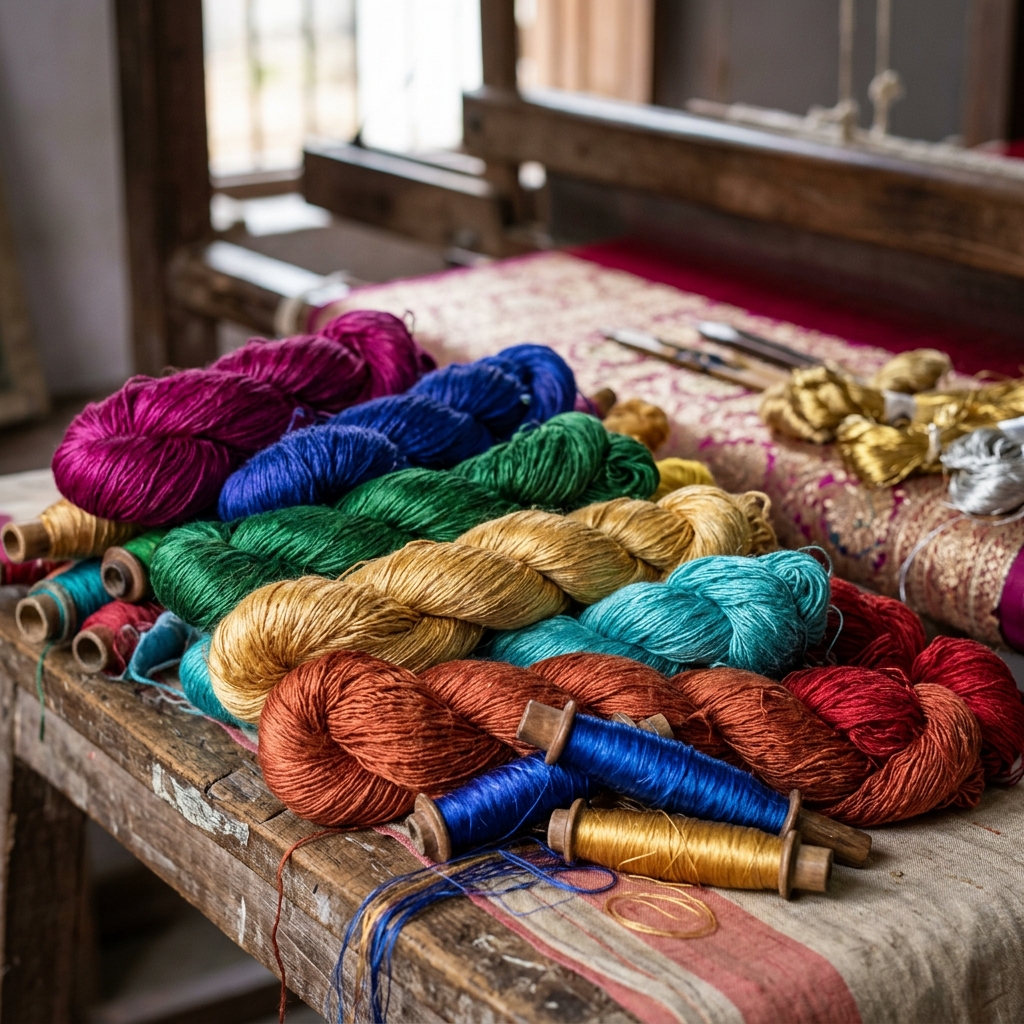
Brightly dyed silk yarn wound on bobbins in a Varanasi workshop
Dyed silk ready for the warp, the foundation of every saree.

The Sound of a Traditional Handloom

If you ever want to know whether a saree was truly handwoven, listen before you look.

A traditional pit loom has a voice. The heavy wooden beater swings forward and lands with a deep, wooden thock. The shuttle hisses across the warp. The pedals thump softly in the pit below. Layer a dozen of these looms along a single lane and you get the particular music of a weavers' mohalla — not machinery, but something more human and irregular, like many hearts beating slightly out of time.

A powerloom sounds nothing like this. It screams: fast, metallic, relentless, the same note repeated hundreds of times a minute. Old weavers say you can tell a real handloom saree from the room it was made in — one room hums, the other roars. That difference in sound is, in a sense, the difference you are paying for.

Spools of gold and silver zari thread used in Banarasi weaving
Real zari gives genuine Banarasi silk its warm, lasting shimmer.

The Evolution of Silk Weavers in Varanasi

For most of its history, the story of the Varanasi weaver was one of slow refinement — new motifs absorbed, new fabrics mastered, techniques handed down and quietly improved. The great rupture came with mechanisation.

The numbers tell it starkly. Older estimates put the number of handloom weavers in Varanasi at around 300,000; by the mid-2010s that figure had fallen to roughly 40,000. Behind that collapse sits the powerloom, which can imitate the look of a Banarasi saree at a fraction of the cost and time, and the economics that make hand-weaving harder to sustain each year.

And yet the tradition has not surrendered. Weaver families have adapted — some moving into jacquard handlooms that allow more complex patterning while keeping the work in human hands, others specialising in the very finest kadhua and cutwork that powerlooms simply cannot replicate. New buyers, especially discerning collectors and international customers who care about authenticity, have given the finest weavers a reason to keep going. The craft is smaller than it was, but at the top end it is arguably as skilled as it has ever been.

A street in the Lallapura weavers' colony, a heartland of Banarasi silk
Lallapura, home to generations of fine silk and zari weavers.

The Complete Banarasi Saree Manufacturing Process

People often imagine a saree is simply "woven." In truth, weaving is only the final act of a long, collaborative production. Here is how a genuine handloom Banarasi saree actually comes into being.

1

The Design (naksha)

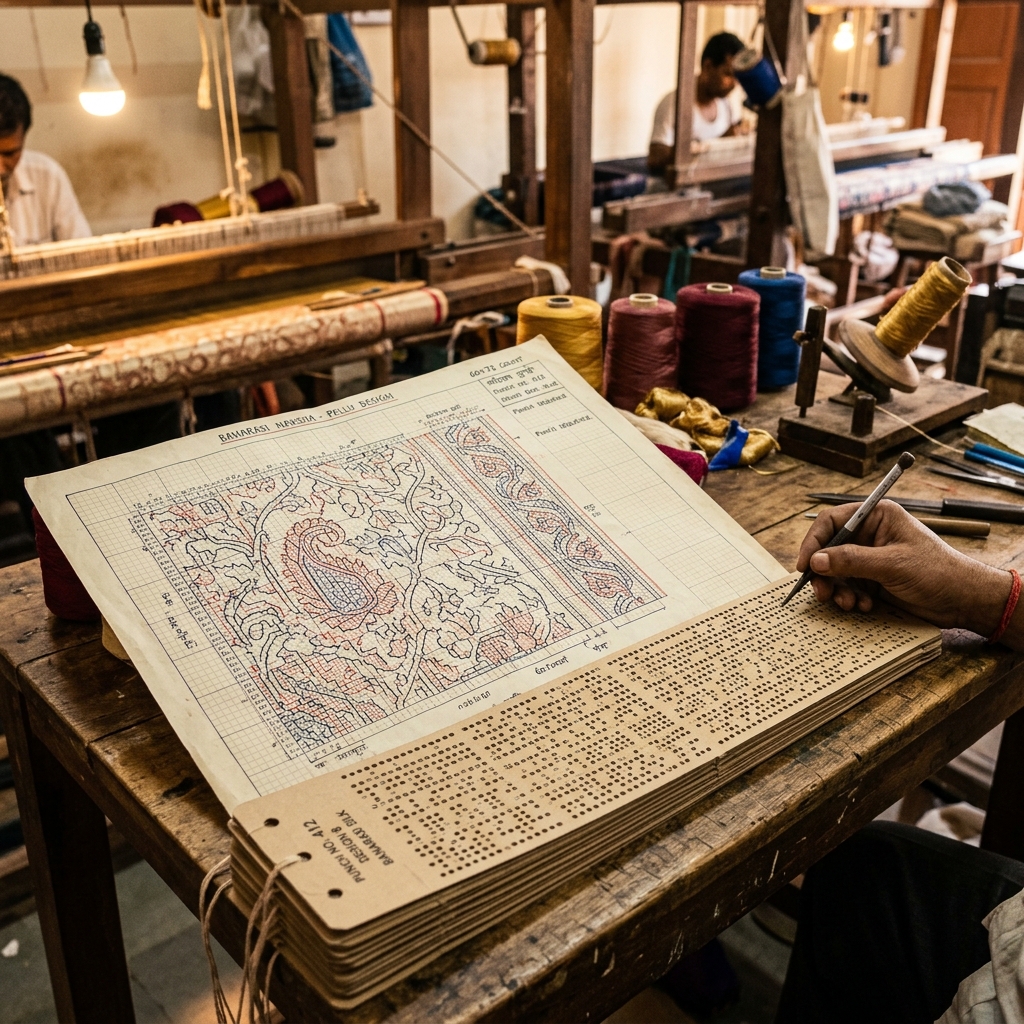
It begins on paper. An artist draws the motif — a spray of flowers, a paisley, a border vine. A specialist called the naqshaband then translates that drawing onto graph paper, where each tiny square represents a single thread of the future weave. This blueprint is the naksha, and it maps every thread and every colour.

Naqshaband mapping design on graph
2

Converting the Design to the Loom (jala / punch cards)

Traditionally, the design was tied out by hand in cotton yarn on a wooden frame, creating a thread-stencil called the jala that was mounted onto the loom. Most workshops today plot the design onto punch cards: large sheets are cut into strips and punched by hand, following the graph, so that hundreds of cards may be needed for a single elaborate saree. Linked in a chain, these cards feed the jacquard mechanism, which lifts exactly the right warp threads for each pass of the shuttle.

Jacquard punch cards
3

Preparing the Silk

Raw silk yarn is dyed, dried, and wound onto bobbins. The long warp threads are measured and set onto the loom under even tension — a painstaking job in itself, because thousands of threads must run perfectly parallel.

4

Weaving

Now the bunkar takes over. Sitting at the loom, he throws the shuttle carrying the weft through the warp, presses the pedals to shift the threads, and beats each line into place. For patterned areas the jacquard raises the right threads; for the finest motifs the weaver inserts extra weft by hand, motif by motif.

5

Finishing

The woven saree is cut from the loom, checked for flaws, cleaned of loose threads, and pressed. Only then does it leave the weaver's home.

From Silk Thread to Finished Saree: The Many Hands Behind One Piece

Here is something most buyers never realise: a single fine Banarasi saree may pass through six or more pairs of expert hands before it is folded for sale.

The naqshaband imagines it on graph paper. A card-cutter punches the design. A warp-maker sets thousands of silk threads in perfect parallel. A dyer gets the colours exactly right. The bunkar and, for intricate work, a tilli helper weave it, sometimes over months. A finisher cleans, checks, and presses it. Each of them is a specialist; each of them can ruin the piece with a single careless step; each of them has spent years learning their part.

When you understand this, the price of a genuine handloom Banarasi saree stops looking like a number and starts looking like a payroll — a chain of skilled livelihoods, most of them in a single Varanasi neighbourhood.

Behind Every Saree is a Family

It is worth pausing on this, because it is easy to romanticise a craft and forget the people. The Banarasi loom is not a factory machine tended by shift workers. It sits in a family's home, and the family's fortunes rise and fall with it.

A child in a weaver's household grows up inside the rhythm of the loom. They wind bobbins before they can read a graph; they learn to knot a broken thread before they are trusted to weave a border; they absorb the family's particular style — the motifs their grandfather favoured, the tension their father swears by — long before anyone teaches it formally. When you buy from such a family, you are not just buying thread and labour. You are helping a household keep a skill alive for one more generation.

The Weaver Localities of Varanasi

Varanasi's weaving is not spread evenly across the city; it is concentrated in a handful of historic mohallas, each with its own character. Knowing them is a mark of a serious buyer.

Locality Known for Signature character
Madanpura Fine, delicate traditional work and kinkhab brocade Neat, precise selvedges; classic restraint
Alaipura Experimentation with new techniques and designs Deliberately rough, uneven selvedges; inventive
Lallapura Fine silk and pure zari work; a heartland of the craft Deep concentration of hereditary weaving families
Peeli Kothi Cluster of karigars working under gaddidaar producers Traditional production hub
Bajardiha Dense weaver clusters Large working-weaver community

A lovely detail connoisseurs share: the selvedge (the finished edge of the fabric) tends to be neat and tidy on cloth from Madanpura, and deliberately left rougher on cloth from Alaipura. Two neighbourhoods, two philosophies, woven into the very edge of the fabric.

Handloom vs Powerloom: The Difference That Matters Most

This is the single most important thing a buyer can understand, so let's be plain about it.

Feature Handloom Banarasi Powerloom Banarasi
Made by A weaver, by hand, at home A machine, tended by an operator
Time per saree Weeks to months Hours to a day or two
The reverse side Slight irregularities; individually turned threads Machine-perfect, often with long floating threads cut flat
Feel & weight Substantial, cool, "alive" in the hand Often lighter, flatter, more uniform
Zari & motifs Can include real gold/silver zari and true kadhua Usually imitation zari; kadhua cannot be truly replicated
Price Higher — it reflects real labour Lower
Supports Weaver families and a living tradition Industrial production
Uniqueness Subtle variation; no two exactly alike Identical, mass-produced

Neither is "evil" — powerlooms make silk look affordable and accessible, and that has its place. But if you want an authentic handwoven Banarasi saree, the distinction is everything. And here is the honest truth many shops won't tell you: a great deal of what is sold as "Banarasi" in tourist markets is powerloom cloth priced as though it were handloom.

Handloom vs Powerloom Saree Reverse Side
Comparison of handloom and powerloom Banarasi saree reverse sides.

Why Handmade Banarasi Sarees Cost More

When someone sees the price of a genuine handloom Banarasi saree and flinches, it usually means they are comparing it — knowingly or not — to a powerloom imitation. Once you know what goes into the real thing, the price explains itself.

  • Raw materials. Pure silk yarn is expensive, and real gold or silver zari more so. For a full katan silk saree, the raw materials alone can cost more than the entire price of a cheap powerloom copy.
  • Time. A weaver may spend weeks or months on one piece. That time is a human life, not a machine cycle.
  • Skill. Behind the loom stand years of apprenticeship and, behind that, generations of accumulated knowledge.
  • The whole chain. As we saw, six or more specialists contribute to one saree. Every one of them must be paid.

There is a useful rule of thumb here: a genuine handwoven katan silk Banarasi saree priced below a few thousand rupees is almost certainly not what it claims to be. The mathematics of real silk and real labour simply do not allow it.

Different Types of Banarasi Sarees

Part of the pleasure of learning about Banarasi silk is discovering how varied it is. "Banarasi" describes a place and a tradition, not a single look. A few of the fabrics you will meet:

  • Katan silk — the classic. Tightly twisted pure silk yarns give it a smooth, strong, elegant drape. Timeless, and a favourite for weddings.
  • Kinkhab / Kimkhwab — the densest, most opulent brocade, historically woven with heavy gold and silver, made for royal occasions.
  • Tissue silk — light and luminous, with a gentle festive sheen; lovely for receptions and celebrations.
  • Organza (kora) — crisp, sheer, and airy, pairing delicate transparency with traditional motifs.
  • Georgette Banarasi — a softer, more fluid drape for those who want lighter weight without losing the Banarasi aesthetic.

And the weaves that pattern them:

  • Kadhua (kadwa) — the crown of Banarasi weaving. Each motif is woven separately and locked into the cloth, with no threads floating behind. Durable, labour-intensive, and virtually impossible to fake on a powerloom.
  • Cutwork — a lighter approach where extra threads are cut away after weaving; more affordable than kadhua and quicker to make.
  • Jangla — dense, all-over floral and vine patterns, associated with grandeur and bridal wear.
  • Tanchoi — finely patterned surfaces created without heavy zari, for understated elegance.
  • Meenakari — coloured supplementary threads that add jewel-like highlights within motifs.

What Makes Handwoven Sarees Different

You can describe the difference technically — irregular selvedges, individually turned motifs, real zari — but weavers describe it differently. They say a handwoven saree carries the hand of the person who made it.

A powerloom saree is flawless in the way a printout is flawless: identical, repeatable, anonymous. A handwoven saree has tiny, honest imperfections — a motif a hair out of true, a slight variation in the weave — that are not defects but signatures. They are proof that a person, not a program, made this exact piece, and that no other saree in the world is precisely like it. For many buyers, that is the whole point.

How to Identify Genuine Handloom Silk

You do not need to be an expert to protect yourself. A few checks go a long way:

  1. Turn it over. On a handloom saree the reverse shows slight irregularities and individually finished threads. Machine-perfect uniformity, or long floats of thread cut flat across the back, points to powerloom.
  2. Feel the weight. Pure silk is substantial and cool to the touch. Very light, papery cloth is a warning sign.
  3. Check the zari. Genuine zari has a deep, warm sheen and does not dull instantly. Cheap metallic thread looks flat and tarnishes quickly.
  4. Look for the marks. A Silk Mark tag certifies pure silk; a Handloom Mark certifies the production method; a GI hologram and serial confirm authentic Banaras origin. (More on these below.)
  5. Be realistic about price. If a "pure silk handloom Banarasi" costs less than its raw materials would, it is not what it claims to be.
  6. Ask about the weave and the weaver. A genuine seller can tell you the fabric, the technique, and where it was woven. Vague answers are their own answer.
Silk Mark Certification Tag on a Banarasi Saree
A Silk Mark certification tag with QR code on a Banarasi silk saree.

The Importance of Silk Mark Certification

Because "pure silk" is claimed far more often than it is true, certification exists to protect buyers. It's worth knowing exactly what each mark does — and does not — promise.

Certification Issued by What it certifies
Silk Mark Silk Mark Organisation of India The yarn is 100% pure silk (fibre)
Handloom Mark Office of the Development Commissioner (Handlooms), Govt. of India The saree was made on a handloom, not a powerloom (method)
GI tag Geographical Indications Registry, Govt. of India The saree genuinely originates from the Banaras region (origin)

Notice that these cover different things. Silk Mark tells you the fibre is real silk, but not whether it was handwoven. The Handloom Mark tells you it was handwoven, but not the fibre. The GI tag confirms the origin. A truly authentic handloom Banarasi ideally carries all three, and modern Silk Mark tags often include a QR or scratch code you can scan to verify on the spot.

The Challenges Silk Weavers Face Today

To tell this story honestly — and honesty is the only foundation of real trust — we have to acknowledge how hard the bunkar's life has become.

The powerloom is the first pressure: it undercuts handloom prices and floods the market with imitations, so that genuine weavers compete against machines pretending to be them. The second pressure is economic structure. Many weavers depend on the gaddidaar or mahajan, who advances raw silk and money and then buys the finished saree, often deducting the advance and setting the price. A weaver may spend five or six days — sometimes far longer — on a saree and see only a small fraction of its eventual retail value. For a saree that sells for around ₹10,000, a handloom weaver has historically earned only ₹1,500–₹2,000.

The result is a slow exodus. Families that wove for ten generations are sending their children to cities for factory work, because the loom no longer reliably feeds a household. Rising silk prices and thin margins have pushed the craft, at times, toward crisis.

There is resistance, though. Weavers have organised: the Bunkar Dastkaar Adhikaar Manch (BDAM), formed in 2003, advocates for weavers' rights, and bodies such as the Varanasi Vastra Bunkar Sangathan have signed up thousands of members. And every buyer who chooses genuine handloom over cheap imitation is, quietly, part of that resistance too.

Government Initiatives Supporting Weavers

The weavers are not entirely without support. Over the years, a framework of protections and schemes has grown up around the craft, including:

  • The GI tag (2009) for Banaras Brocades and Sarees, which gives legal weight to authenticity and origin.
  • The Handloom Mark and Silk Mark, which help genuine weavers distinguish their work from imitations in the marketplace.
  • Weavers' Service Centres and the Office of the Development Commissioner (Handlooms) under the Ministry of Textiles, which offer design, training, and marketing support.
  • Textiles Committee documentation (such as the detailed study of Banaras sarees and brocades) that records and preserves the craft's techniques.

These are meaningful, if imperfect, and the most effective support ultimately comes from the market itself: sustained demand for genuine handloom, at fair prices, from buyers who know what they are looking at.

Why Banarasi Weaving is More Than a Profession

It would be a mistake to file the bunkar under "occupation." For these families, weaving is closer to identity. It shapes the geography they live in, the community they belong to, the skills they are proud of, and the story they tell about themselves. A weaver does not simply make Banarasi silk; he is a Banarasi weaver, in the way an artist is an artist.

That is why the survival of the craft matters beyond economics. When a loom falls silent, it is not just a job that ends. A specific way of seeing — a vocabulary of motifs, a mathematics of thread, a family's particular signature — risks disappearing with it. Each genuine saree sold is a small vote for that knowledge to continue.

Generations of Craftsmanship

Skill like this cannot be downloaded or fast-tracked. It is accumulated. A master weaver today carries not only his own decades at the loom but the refinements of his father, his grandfather, and further back still. The motif he weaves without thinking was perfected by someone he never met. The tension he keeps by instinct was argued over by two generations before him.

This is what "heritage" really means in Varanasi — not a marketing word, but an unbroken chain of hands. It is also why a genuine manufacturer with deep roots in the city can offer something a reseller never can: not just a saree, but a direct line back through that chain.

The Emotional Value of Supporting Indian Artisans

There is a quiet pleasure in owning something made by a person you could, in principle, meet. In a world of mass production, a handwoven Banarasi saree is a rare thing: fully traceable to a human being, a family, a neighbourhood.

When you buy one — thoughtfully, from a source that pays its weavers fairly — you are doing several things at once. You are acquiring an object of real beauty and lasting value. You are joining a very long story that runs from Mughal courts to a loom in Lallapura. And you are helping ensure that the sound of the handloom still moves through those old lanes tomorrow morning. That is a kind of value no powerloom can offer.

How Silk Khazana Supports Local Weavers

Silk Khazana sits inside this ecosystem, not outside it. Established in 1970 and run by the same family across generations, it is based in the historic weaving heart of Varanasi — at Jaitpura, one of the city's living weaving quarters. Being a manufacturer rather than a reseller means the looms, the weavers, and the quality control are part of the same house, not a supply chain bought at arm's length.

That closeness matters for two people: the weaver and the buyer. For the weaver, working directly with a manufacturer that understands the craft means the value of the work stays closer to the hands that did it. For the buyer, it means every saree can be explained — its fabric, its weave, its origin — by people who were there when it was made. Silk Khazana's sarees are woven from pure silk and offered with Silk Mark assurance of fibre authenticity, and the house ships worldwide so that distance is no barrier to owning genuine Banarasi silk from the source.

Why Buying Directly from a Manufacturer is Better

Between the loom and most buyers stand several middle layers — wholesalers, retailers, marketplaces — each adding cost and distance. Buying directly from a Varanasi manufacturer collapses that gap.

Feature Manufacturer (e.g. Silk Khazana) Retail shop / reseller
Source of goods Own weaving unit and weavers Bought in from various suppliers
Knowledge of the product Complete — fabric, weave, weaver, origin Often limited to what the supplier said
Authenticity assurance Direct, with certification Depends on the reseller's honesty
Value for money Fewer middlemen, fairer pricing Retail markup layered on top
Benefit to weavers Stays closer to the artisans Diluted across the chain
Customisation & guidance Possible, personal Rare

A Tourist's Guide to Buying Banarasi Sarees in Varanasi

If you are visiting Varanasi, buying a Banarasi saree can be one of the most memorable parts of the trip — or one of the most disappointing, depending on how you go about it. A little preparation makes all the difference.

Set aside unhurried time; the good stuff rewards patience. Try to see the fabric in daylight, where you can judge the true colour and sheen. Ask to see the reverse of the saree, and ask what fabric and weave you're looking at — a genuine seller will happily walk you through it. If you can, visit a weaving quarter such as Lallapura or Madanpura to see a handloom working; understanding the craft is the best defence against being misled. And favour sellers who can show you certification and speak knowledgeably about origin.

The weavers' colonies are reachable by auto-rickshaw or taxi from most parts of the city, and a genuine manufacturer's showroom lets you combine the experience — seeing the craft and buying with confidence — in one place.

Buying from the Local Market vs Buying from Silk Khazana

Feature Random local market stall Silk Khazana (manufacturer)
Authenticity Uncertain; powerloom often sold as handloom Genuine handloom, Silk Mark assured
Pricing Opaque; heavy bargaining; tourist markups Transparent, manufacturer-direct
Product knowledge Varies wildly Expert, first-hand
See the craft Sometimes Yes — living weaving heritage
After-sale & shipping Rare Worldwide shipping, ongoing assistance
Peace of mind Buyer beware Explained, certified, traceable

Mistakes Tourists Should Avoid

A few honest warnings, from watching how buyers get caught out:

  • Believing a price that's too good to be true. A "pure silk handloom Banarasi" for a few hundred rupees is a powerloom copy. The maths doesn't lie.
  • Buying blind under shop lighting. Warm halogen makes everything glow. See it in daylight before you commit.
  • Skipping the reverse side. The back of the saree tells you more about authenticity than the front.
  • Ignoring certification. No Silk Mark, no Handloom Mark, no clear answer about origin — no confidence.
  • Rushing. Pressure to "buy now, last piece" is a sales tactic, not a fact. A real heirloom purchase deserves time.
  • Assuming every shop near the ghats is a weaver. Many are resellers. If authenticity and fair pricing matter to you, seek out an actual manufacturer.
Choosing a Banarasi Saree in Varanasi
A visitor examining a handwoven Banarasi saree in daylight in Varanasi.

Questions to Ask Before Buying

Bring these with you — a good seller welcomes them:

  1. Is this handloom or powerloom?
  2. What fabric is it — katan, tissue, organza, georgette?
  3. What weave/technique — kadhua, cutwork, jangla, tanchoi?
  4. Is the zari real (gold/silver) or tested/imitation?
  5. Does it carry a Silk Mark? May I scan the code?
  6. Is there a Handloom Mark or GI assurance?
  7. Where was it woven, and by whom?
  8. May I see the reverse of the saree?
  9. What is your return or exchange policy?
  10. Do you ship internationally, and how is it packed and insured?

If the answers are clear, specific, and unhurried, you are in good hands. If they are vague or evasive, keep your money in your pocket.

Proper Care & Storage

Because authentic handwoven silk is fine and precious, proper care ensures it stays pristine for generations:

  • Muslin Wrap: Fold along existing creases, wrap in a muslin cloth, and store flat. Avoid plastic bags which trap moisture.
  • Air Occasionally: Air the saree in the shade every few months to prevent mustiness.
  • Ironing: Use a low-heat iron on the reverse side, with a thin cloth between the iron and the saree. Never iron directly on the zari.
  • Dry Clean: Prefer professional dry cleaning, especially for the first few wears.
Storing a Banarasi Silk Saree wrapped in muslin cloth
Wrapped in breathable muslin — the right way to store silk.

Why Visit Silk Khazana

To stand in a weaving quarter of Varanasi and watch a bunkar bring a motif to life, thread by thread, is to understand a Banarasi saree in a way no photograph can teach. At Silk Khazana, that experience and the purchase live under one roof: a family manufacturer, rooted in the city since 1970, where you can see the craft, meet the people behind it, and choose a genuine handloom saree with the full story attached.

Whether you are a bride searching for the one, a traveller who wants to take home something truly of this place, an NRI hoping to own authentic Banarasi silk without the guesswork, or a collector who values the real thing — buying from the source is the difference between owning a saree and owning a story.

Plan your visit to Silk Khazana in Varanasi to experience live handloom weaving and meet the artisans, or — if you can't travel — message the Silk Khazana team on WhatsApp for personal guidance and worldwide shipping, and buy genuine Banarasi silk directly from the manufacturer.

Silk Khazana Showroom in Varanasi
The Silk Khazana showroom displays our heritage collections under warm, direct lights.

Final Thoughts

The next time you see a Banarasi saree catch the light, look past the shimmer for a moment and think of the lane it came from — the low wooden door, the loom sunk into the floor, the family arranged around it, the four hundred years of knowledge in a pair of hands. The silk bunkars of Varanasi have kept that light alive through famine, empire, and the roar of the machine. Every genuine saree you choose helps them keep it alive a little longer.

That is what you are really buying: not just cloth, but the continuation of one of the world's great living crafts. Choose it thoughtfully, buy it from the source, and you carry a piece of Varanasi — and its weavers — with you.

Frequently Asked Questions

1. What does "bunkar" mean? +

Bunkar is the Hindi/Urdu word for weaver. In Varanasi it specifically refers to the traditional handloom silk weavers who create Banarasi sarees, most of them from the Ansari community.

2. What are the silk weavers of Varanasi called? +

They are called bunkars. Many also identify by their community name, Ansari (or Momin), and by their role — for example, karigar (master weaver) or naqshaband (design-maker).

3. Which community weaves Banarasi silk? +

The overwhelming majority of Banarasi silk weavers belong to the Ansari (Momin) Muslim community, a hereditary weaving community concentrated in neighbourhoods like Madanpura, Lallapura, and Alaipura.

4. How long does it take to weave one Banarasi saree by hand? +

Anywhere from about two weeks for a simpler design to six months or more for an intricate bridal piece dense with kadhua motifs and heavy zari.

5. How much do Varanasi silk weavers earn? +

Historically, very little relative to the retail price — often ₹1,500–₹2,000 for a saree that sells for around ₹10,000. This gap is a major reason the craft is under threat and why fair, direct buying matters.

6. What is the difference between handloom and powerloom Banarasi sarees? +

Handloom sarees are woven by hand over weeks or months, with slight natural irregularities and often real zari. Powerloom sarees are machine-made in hours, look machine-perfect, and usually use imitation zari. Powerloom cannot truly replicate kadhua weaving.

7. What is kadhua (kadwa) weaving? +

A technique in which each motif is woven separately and locked into the fabric with no floating threads behind it. It is the most durable and labour-intensive Banarasi weave, and effectively impossible to fake on a powerloom.

8. How can I tell if a Banarasi saree is genuine handloom? +

Check the reverse for natural irregularities, feel the weight (real silk is cool and substantial), inspect the zari's sheen, look for Silk Mark/Handloom Mark/GI certification, and be wary of prices below the cost of the raw materials.

9. What is a Silk Mark, and why does it matter? +

Silk Mark, issued by the Silk Mark Organisation of India, certifies that a product is 100% pure silk. It protects buyers from silk blends and imitations. It certifies the fibre, not the weaving method.

10. What does the Handloom Mark certify? +

It certifies that a textile was genuinely made on a handloom rather than a powerloom. It confirms the production method, not the fibre.

11. What is the GI tag on Banarasi sarees? +

The Geographical Indication tag, granted in 2009, legally restricts the name "Banarasi" to sarees woven in the Banaras–Bhadohi–Mirzapur region using traditional methods. It confirms authentic origin.

12. Why are handmade Banarasi sarees so expensive? +

Because of real silk and real zari, weeks or months of skilled labour, and a production chain of six or more specialists. The materials alone for a genuine katan saree often exceed the price of a powerloom copy.

13. What are the main types of Banarasi silk? +

Common fabrics include katan (classic pure silk), kinkhab (dense brocade), tissue (luminous, festive), organza/kora (sheer, crisp), and georgette (soft, fluid). Weaves include kadhua, cutwork, jangla, tanchoi, and meenakari.

14. Where in Varanasi are the silk weavers located? +

Chiefly in historic mohallas such as Madanpura, Lallapura, Alaipura, Peeli Kothi, and Bajardiha. Each has its own weaving character.

15. Can I visit the silk weavers of Varanasi? +

Yes. The weavers' colonies are reachable by auto-rickshaw or taxi, and manufacturers like Silk Khazana let you see live handloom weaving and meet artisans. Always buy respectfully and, ideally, directly.

16. Is it safe to buy Banarasi silk online as an NRI or international customer? +

Yes, if you buy from a reputable manufacturer that offers certification, clear product information, and secure worldwide shipping. Buying directly from the source reduces the risk of imitations.

17. Why should I buy directly from a manufacturer instead of a shop? +

A manufacturer removes middlemen, so pricing is fairer, product knowledge is first-hand, authenticity assurance is stronger, and more value reaches the weavers.

18. How do I care for a Banarasi silk saree? +

Store it wrapped in a breathable cotton or muslin cloth, keep it out of prolonged direct sunlight, refold it occasionally to avoid permanent creases, keep it away from moisture and perfume, and prefer professional dry cleaning.

19. Are all Banarasi sarees handloom? +

No. Many sarees sold as "Banarasi" are powerloom-made. Always verify the production method rather than assuming — the name alone doesn't guarantee handloom.

20. What mistakes should first-time buyers avoid? +

Trusting prices that are too good to be true, judging colour under shop lighting, skipping the reverse side, ignoring certification, rushing under sales pressure, and assuming every shop near the ghats is an actual weaver.

Experience the Heritage

Explore our curated collection of authentic, handwoven Banarasi Silk Sarees made by Varanasi's master weavers.

*Published by Silk Khazana — authentic Banarasi silk sarees, woven in Varanasi and delivered worldwide. For personalized saree assistance or to see live weaving via video call, contact us at support@silkkhazana.in or call +91 63073 05873.*

Shop Banarasi Sarees
Chiniya Silk Saree: Everything You Need to Know

Silk Khazana Presents

Chiniya Silk Saree

Everything You Need to Know

When most people think of Banarasi silk, they picture the heavy, golden-bordered Katan sarees of bridal ceremonies. But Varanasi's weaving tradition runs far deeper than a single fabric. Among its lesser-known — and deeply underappreciated — varieties is the Chiniya silk saree: a lightweight, luminous fabric with a history tied to ancient trade routes and centuries of artisan knowledge.

If you've never heard of Chiniya silk, you're not alone. Most buyers discover it only when they visit a serious Banarasi weaving house in Varanasi. This guide covers everything — from what Chiniya silk actually is, to how it's woven, what to look for when buying, and how to care for it at home.

What is Chiniya silk?

Chiniya silk takes its name from the Hindi word for Chinese — Chiniya — because the silk thread used in its weaving was historically imported from China. Specifically, it refers to a variety of raw silk yarn that is extraordinarily fine in count, producing a thread that is thinner and lighter than the mulberry silk used in traditional Katan sarees.

This ultra-fine thread is woven on handlooms by skilled artisans in Varanasi using the same centuries-old techniques that define Banarasi weaving. The result is a fabric that is notably lighter than Katan or Georgette Banarasi sarees, with a soft, smooth hand feel and a natural sheen that catches light differently depending on how it drapes.

Chiniya silk sarees are not powerloom products. Authentic ones are handwoven — a process that can take anywhere from a few days to several weeks depending on the complexity of the pattern.

Close-up of fine Chiniya silk fabric texture

A Brief History of Chiniya Silk

The influence of Chinese silk on Varanasi's textile tradition dates back to the Mughal era, when trade caravans brought raw silk thread from China along the Silk Road. Varanasi's weavers — already accomplished in complex brocade weaving — incorporated this finer thread into their craft, creating a new category of fabric that was distinctly lighter and more fluid than the existing Katan tradition.

Over time, the name "Chiniya" stuck, even as local sericulture developed and the original Chinese import became less central. Today, Chiniya silk refers more to the thread count and texture than to its geographic origin — though the finest examples still use imported silk known for its high-grade fineness.

This historical crossing of traditions is characteristic of Banarasi weaving as a whole: an art form built on centuries of cultural exchange, now preserved by families of master weavers in Varanasi's Jaitpura, Madanpura, and Peeli Kothi localities.

Traditional weaver in Varanasi working on a handloom

What Makes Chiniya Silk Sarees Special?

Lightweight & Breathable

Because the yarn is finer, the resulting fabric is lighter than Katan or Dupion silk. This makes Chiniya silk sarees particularly suited to warmer months and occasions where you want the elegance of silk without the weight of a heavy bridal saree.

Distinctive, Subtle Sheen

Chiniya silk does not have the intense, almost metallic luster of Katan silk. Instead, it carries a softer, more diffused sheen — luminous rather than glossy. In natural light, it has a depth and warmth that photographs beautifully.

Excellent Drape & Feel

The fine thread allows the fabric to fall smoothly and closely, making it easy to drape. Unlike stiffer silk varieties, Chiniya silk conforms naturally to movement with a smooth, silky hand feel.

Versatile design language: Chiniya silk sarees are woven with a wide range of Banarasi motifs — from delicate butti to elaborate jaal and meenakari. Because the base fabric is lighter, the zari work tends to be more refined and delicate.

Types of Designs Found in Chiniya Silk Sarees

Varanasi's weavers apply their full repertoire of Banarasi motifs to Chiniya silk:

Butti weave: Small, repeated motifs scattered across the body of the saree. These can be simple geometric shapes, florals, or stylized paisleys. Ideal for semi-formal occasions and festive wear.

Jaal weave: An all-over lattice or net pattern that covers the entire saree body. Chiniya jaal sarees have an intricate, almost lace-like quality that is particularly striking in light or pastel colourways.

Meenakari: Multicoloured silk thread woven into the zari motifs, giving individual design elements a jewel-like quality. Among the most elaborate and visually rich.

Kadhua work: Individual motifs woven separately into the fabric using the shuttle-free technique, creating a cleaner finish on the reverse side. Considered the finest and most labour-intensive.

Intricate Jaal pattern woven on a light pastel Chiniya silk saree

How to Identify an Authentic Chiniya Silk Saree

Check the reverse side: A handwoven Chiniya silk saree will have threads running neatly along the back, with no loose threads or uneven weave. The zari on the reverse should mirror the front pattern cleanly.

Look for the Silk Mark: The Silk Mark Organisation of India certifies genuine silk sarees. Ask your seller for the Silk Mark tag, which guarantees the fabric is pure silk.

Feel the weight and drape: Authentic Chiniya silk is notably light. If a saree claims to be Chiniya silk but feels heavy or stiff, it is likely a blend or a heavier silk variety.

Examine the zari: Real zari in handloom Chiniya sarees is tightly woven and has a consistent, even appearance. Powerloom zari often looks flatter and more uniform.

Buy from verified manufacturers: Purchase directly from a Varanasi-based weaving house or trusted manufacturer.

Clean reverse side of a handwoven Chiniya silk saree

How to Style a Chiniya Silk Saree

The lightness and drape of Chiniya silk make it one of the more versatile Banarasi varieties to style:

For festivals and pujas: Pair a bright Chiniya silk saree — in reds, yellows, or greens — with a contrasting silk blouse. Keep jewellery traditional: temple jewellery or gold jhumkas work well.

For weddings as a guest: Opt for jewel tones — deep burgundy, royal blue, or emerald green. Chiniya silk in these shades photographs beautifully and reads as elegant without being overdressed.

For semi-formal or office occasions: Lighter colourways — ivory, soft pink, or pale gold — with minimal butti work make excellent choices. Pair with a simple blouse and understated accessories.

For gifting: A classic colourway — red, maroon, or gold — with traditional Banarasi motifs makes a thoughtful and meaningful gift for special occasions.

Elegant styling of a bright Chiniya silk saree

How to Care for a Chiniya Silk Saree

Because Chiniya silk is fine and lightweight, proper care ensures it stays pristine for years:

Dry clean only for the first few wears: For new sarees, especially those with heavy zari work, dry cleaning is the safest option until you are confident about the fabric's stability.

If hand washing: Use cold water and a very mild, pH-neutral detergent. Submerge gently — do not rub or wring the fabric. Rinse once in clean water and allow to drip dry in shade.

Never machine wash: Machine washing damages both the silk fibre and the zari work.

Store correctly: Fold along existing creases, wrap in a muslin cloth, and store flat. Avoid plastic bags. Air the saree every few months to prevent mustiness.

Ironing: Use a low-heat iron on the reverse side, with a thin cloth between the iron and the saree. Never iron directly on the zari.

Chiniya silk saree neatly folded and wrapped in muslin cloth

Where to Buy Authentic Chiniya Silk Sarees in Varanasi

Silk Khazana is a Varanasi-based manufacturer and retailer of authentic Banarasi silk sarees, including Chiniya silk, woven directly by skilled artisans using traditional handloom techniques. Because there are no middlemen in the supply chain, the pricing reflects the actual weaving cost — not inflated retail margins.

For customers who cannot visit Varanasi, Silk Khazana offers a live video shopping experience: a real-time video call where you can examine the fabric, zari work, colour, and drape before purchasing. This is particularly valuable for NRI and international buyers who want the authenticity of buying from Varanasi without the uncertainty of purchasing blind online.

Silk Khazana ships across India and internationally to the USA, UK, Canada, Australia, UAE, Singapore, and other countries, with secure packaging and dedicated customer support before and after purchase.

Explore the Chiniya Silk Saree collection at silkkhazana.in.

Frequently Asked Questions

What is the difference between Chiniya silk and Katan silk? +

Katan silk is woven from a tightly twisted, heavier mulberry silk thread, producing a firmer, weightier fabric with an intense lustre — it is the traditional choice for heavy bridal Banarasi sarees. Chiniya silk uses a finer, lighter thread, resulting in a softer, more breathable fabric with a subtler sheen. Katan is heavier and more structured; Chiniya is lighter and more fluid.

Is Chiniya silk saree suitable for summer? +

Yes. Because the thread is finer and the weave less dense, Chiniya silk is one of the better Banarasi choices for warmer weather. It is significantly lighter than Katan or Dupion silk sarees.

How much does a Chiniya silk saree cost? +

Price depends on the complexity of the weave, the quality of the zari, and whether it is handloom or powerloom. Authentic handloom Chiniya silk sarees from Varanasi manufacturers typically start from around ₹4,000–₹6,000 for simpler designs, and can go higher for elaborate meenakari or kadhua work.

How do I verify that my Chiniya silk saree is genuine? +

Look for the Silk Mark tag, examine the reverse side for clean handloom weaving, and if possible, purchase directly from a Varanasi-based manufacturer or verified weaving house. Avoid unmarked sellers on unverified platforms.

Can Chiniya silk sarees be worn for weddings? +

Chiniya silk is well-suited for wedding guests and for ceremonies like mehendi, haldi, or sangeet. For the bride's main wedding look, heavier Katan or Real Zari sarees are the traditional choice — though lighter bridal Chiniya sarees with elaborate meenakari or kadhua jaal work can also make a striking choice.

How should I store a Chiniya silk saree? +

Wrap in a soft muslin cloth, store flat or loosely rolled, and keep in a cool, dry place away from direct light. Air the saree every few months. Avoid plastic wrapping, which traps moisture and can damage silk fibres.

Experience the Elegance

Explore our curated collection of authentic Chiniya Silk Sarees.

*Published by Silk Khazana — authentic Banarasi silk sarees, woven in Varanasi and delivered worldwide. For personalized saree assistance, reach us at support@silkkhazana.in or call +91 63073 05873.*

Shop Chiniya Silk Sarees