+9163073 05873 support@silkkhazana.in
Summer sale discount upto 30%! Shop Now

Mini Cart

Why Silk Khazana is the best saree shop in Varanasi | Silk Khazana
Store Guide Authenticity

The Buyer's Guide

Why Silk Khazana is the best saree shop in Varanasi

A buyer’s guide to authentic Banarasi silk — without the guesswork.

Silk Khazana

Banarasi Silk Manufacturer since 1970 · Jaitpura, Varanasi · Worldwide Shipping

"Walk down any lane in Varanasi's saree market and you'll hear the same claim from every shop: 'Pure Banarasi silk, madam. Directly from the loom.' After a while, those words start to blur. When everyone says the same thing, how do you know who actually means it? That confusion is genuinely stressful, especially when you're shopping for a bridal saree or placing a bulk wholesale order where the stakes are high."

This guide is centred on one answer: Silk Khazana, the best saree shop in Varanasi for buyers who want authentic Banarasi silk without the guesswork. A manufacturer and wholesaler based in Jaitpura, Varanasi, Silk Khazana says it sources its sarees directly from the skilled artisans who sit at the loom. By the time you finish reading, you'll know what authentic Banarasi silk actually looks like, what Silk Khazana's collection covers, what prices to expect, what real customers have said, and exactly how to visit or place an order from wherever you are.
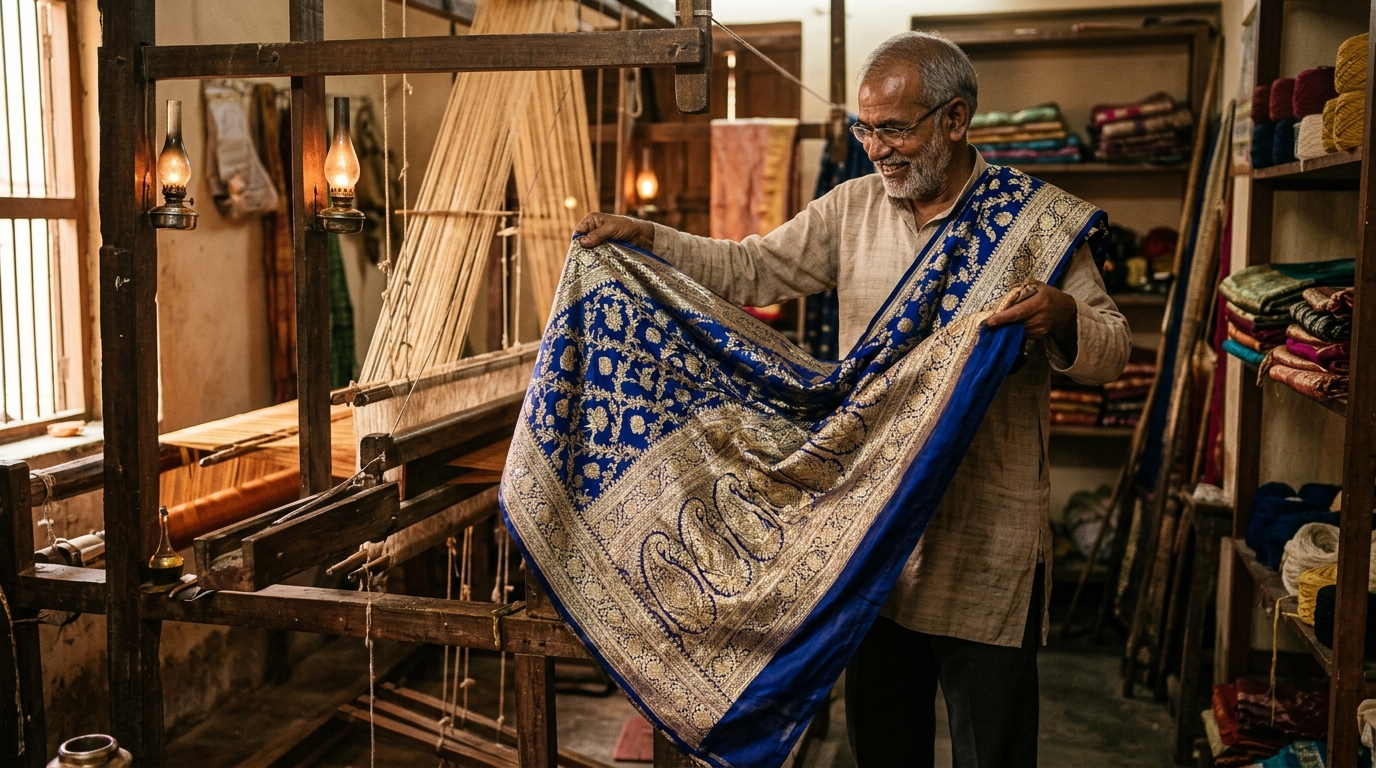
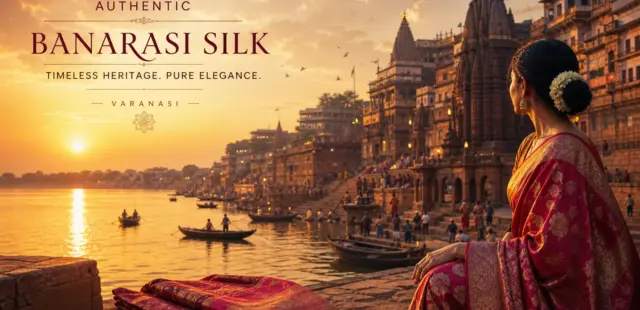
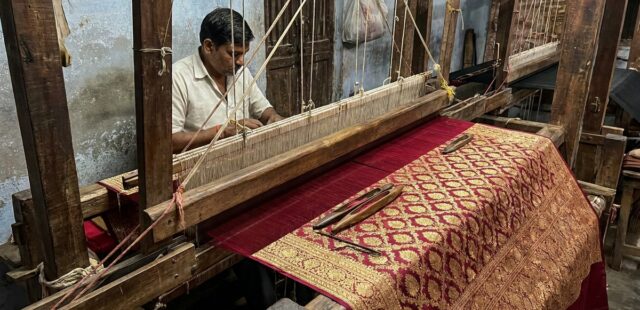
Artisan displaying authentic Banarasi Saree
Sourced directly from skilled artisans who sit at the loom.

What separates a trustworthy Banarasi saree shop from the rest

Before you walk into any saree shop in Varanasi, it helps to arrive with a small vocabulary. Not because you need to become a textile scholar, but because the right questions get you the right answers.

The weave types worth knowing before you buy

Katan is the purest Banarasi base: tightly twisted silk in both the warp and weft, which gives it a crisp, lustrous hand and a satisfying weight. Jamawar is the showstopper of the family, a dense brocade with richly worked, all-over motifs that covers the fabric like a painting. These are the heavier, more formal weaves, suited to weddings and grand occasions.

Jamdani and Minakari are lighter and more delicate, with motifs that seem to float on a translucent ground. Khaddi Georgette is the airy option, a crinkled, fluid drape that works beautifully for those who want the Banarasi aesthetic without the weight. Tanchoi uses a satin-like base with intricate woven ornamentation, less reliant on heavy zari than the classic brocades. Tissue, Organza/Kora, Shikargah, and Moonga round out the family, each with its own character and occasion.

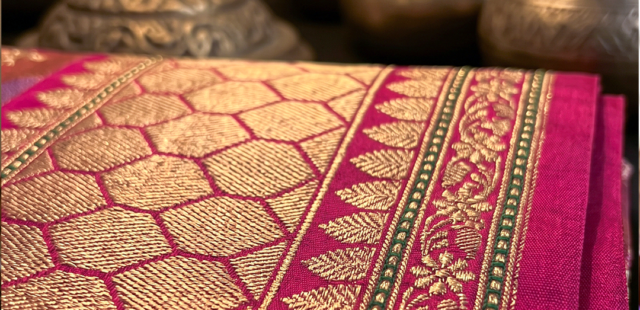
Banarasi Silk Zari detailing
Authentic zari and handloom marks are fingerprints of genuine craftsmanship.

Zari quality and handloom signs a first-time buyer can spot

Authentic zari is typically fine metallic thread wrapped around a silk or cotton core; many imitations tarnish sooner and lack the warm, deep gleam of the genuine article. On handloom sarees, look for slight irregularities in the weave, small variations in spacing or tension that a power loom simply doesn't produce. These aren't flaws; they're fingerprints.

Two certification marks provide an additional safety net: the GI tag ("Banaras Brocades and Sarees," registered in 2009) confirms the saree was woven in the notified Varanasi cluster, while the Silk Mark, issued by the Silk Mark Organisation of India under the Central Silk Board, confirms the fibre is pure natural silk. A legitimate Silk Mark tag carries a hologram and a unique authentication number you can verify. A shop that starts at the loom, rather than buying from traders, skips the layers of handling where authenticity most often gets lost.


Why Silk Khazana is the best saree shop in Varanasi for authentic Banarasi silk

There's a reason Silk Khazana describes itself as a Pure Banarasi Saree Manufacturer and Wholesaler rather than simply a saree shop. The distinction matters more than it sounds.

From weaver to wardrobe: how the supply chain actually works

Silk Khazana says its sarees are crafted by skilled artisans in Varanasi and travel directly to the showroom and online store without passing through layers of middlemen. That supply-chain structure has two practical consequences worth understanding. Quality oversight can be tighter when the same team that supervises weaving also decides what reaches the shelf. And pricing may be fairer, because you're not absorbing the markup each intermediary would otherwise add along the way.

For retail buyers, that can mean genuine handloom quality at honest prices. For wholesale traders and boutique owners, it means a manufacturer-level supply chain with the consistency and reliability that bulk sourcing demands.

Bridal collections and custom orders: what the craftsmen can do

Silk Khazana's in-house craftsmen, weavers, and designers collaborate on both ready pieces and bespoke commissions. For a bride with a specific colour combination in mind, or a boutique owner who wants exclusive designs that won't show up in a competitor's window, the custom order route is worth exploring. The bridal and wedding saree collections draw on the full range of Banarasi weaves, with embellishments and motifs chosen for occasion and impact. Call or message via WhatsApp to start a custom enquiry well before you need the finished piece.


Inside the collection: what you'll actually find here

Range matters. A shop that stocks only a handful of styles can't serve a bride hunting for a very specific weave, or a retailer who needs variety across price points. Silk Khazana's collection is built to cover the full spectrum.

Sarees for weddings, festivals, and everyday elegance

The core of the collection runs from bridal Katan silk and dense Jamawar pieces through Jamdani Minakari, Shikargah, Moonga, and contemporary Georgette Banarasi styles. Specific pieces in the range include the Jamawar Orange Banarasi Pathini Handloom Silk Saree and the Grey Jamdani Minakari Handloom Silk Saree, both strong examples of the shop's design sensibility, balancing traditional motifs with everyday wearability. Whether you're shopping for a wedding day saree, a Diwali celebration, or something elegant enough for a formal occasion without being overtly bridal, the collection has entries at every point.

Beyond sarees: dupattas, dress materials, and gifting options

Silk Khazana also stocks Banarasi dupattas, stoles, suit sets, and home furnishing textiles, including bed covers, cushion covers, and table runners. This makes the shop genuinely useful for trousseau shopping beyond the main saree, for coordinated gifting, and for buyers who want the Banarasi aesthetic across multiple pieces. For wholesale buyers, the breadth of categories means a single supplier relationship can cover a wider range of inventory needs.
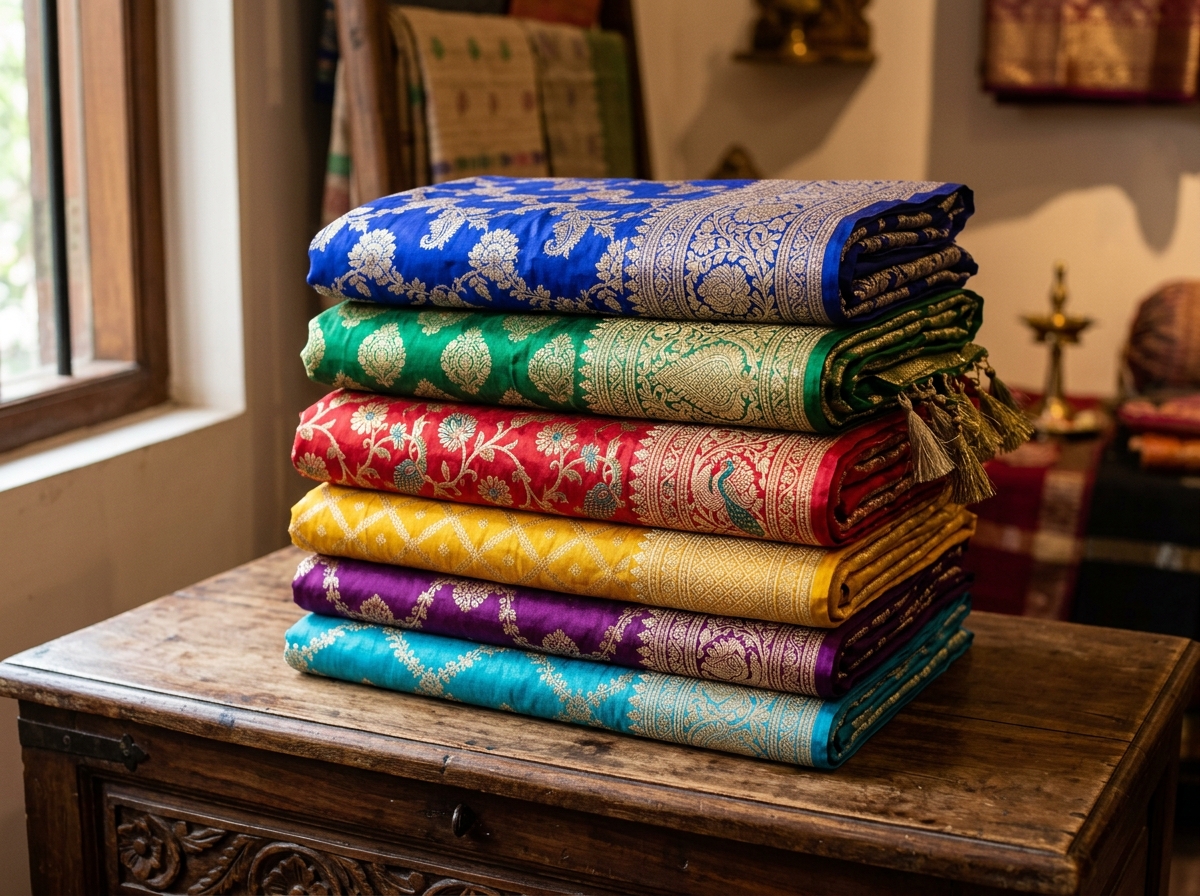
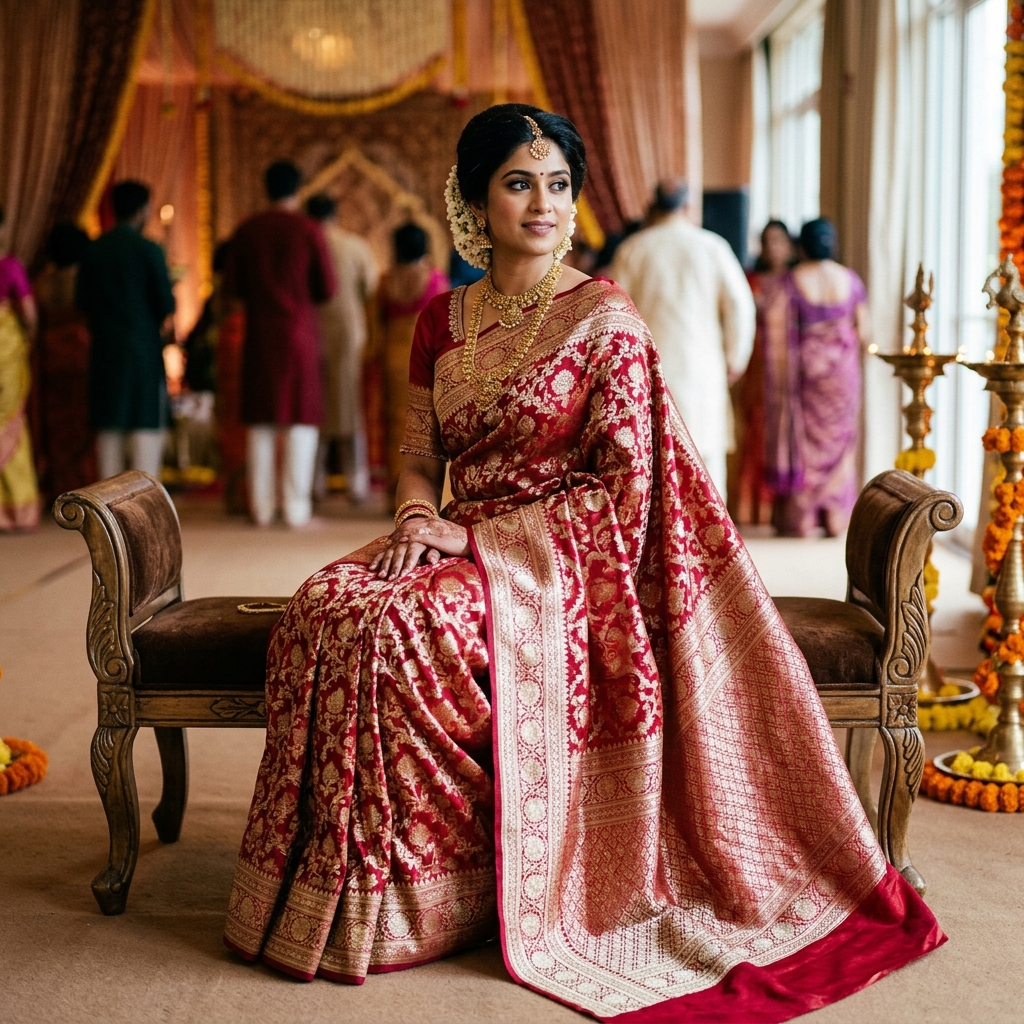
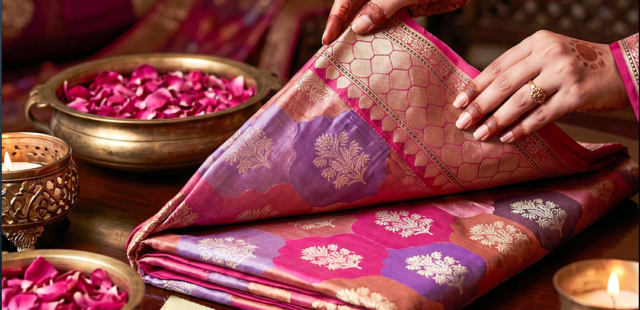
A collection of beautiful banarasi sarees
A diverse collection ensures there is a Banarasi weave for every occasion and style preference.

What it costs: honest price expectations for retail and wholesale

Prices vary considerably, and having a rough range in mind before you walk in avoids the most common buying mistakes.

₹

Retail pricing: what individual buyers should budget for

Authentic handloom Banarasi silk sarees in Varanasi currently range from around ₹7,000 for a plain Katan with a minimal zari border up to ₹2 lakh or more for densely worked Kadhua pieces with real zari. The weave and the zari work are the two biggest price drivers. A Katan with an elaborate border and pallav typically falls between ₹14,000 and ₹35,000; Jangla pieces range from ₹35,000 to ₹90,000; Tissue and Shikargah sarees can reach ₹2,00,000 for exceptional craftsmanship. Buying directly from a manufacturer like Silk Khazana can reduce intermediary markups, so the price you pay is more likely to reflect the actual work that went into the piece. Online orders above ₹2,000 qualify for free shipping.

📦

Wholesale enquiries: what traders and boutique owners need to know

Silk Khazana operates as a manufacturer-wholesaler, which means bulk pricing is available for retailers, boutique owners, and distributors. Minimum order quantities and specific pricing are best confirmed directly with the team, as requirements can vary by weave category and order type, contact Silk Khazana via WhatsApp or phone at +91 63073 05873 to discuss your requirements in full. Lower-entry sample orders may also be possible for buyers who want to assess quality before committing to a larger run. Cash-on-delivery is available within Uttar Pradesh for eligible orders.


What real customers say: Silk Khazana's ratings across platforms

Ratings are easy to claim. What actually matters is where they come from and whether they hold up across multiple platforms.

The rating picture: 4.9 stars and what's behind it

Silk Khazana holds a 4.9/5 rating from 567 Google reviews and a 4.9/5 from 582 ratings on Justdial for its Jaitpura location. (Ratings reflect figures at the time of writing and may be updated on each platform's listing.) Those numbers are consistent, which is meaningful: a shop can occasionally game one platform, but maintaining near-identical scores across independent review systems over hundreds of verified buyers is harder to fake. Reviewers consistently mention the variety of designs, the authentic quality of the Banarasi weaves, fair pricing, and staff who are patient and knowledgeable rather than pushy. That last detail matters more than most buyers realise: a high-pressure saree shop is exhausting and often leads to regrettable purchases.

What the absence of complaints tells you

Justdial's listing for the main Jaitpura branch flags no recurring complaints from its reviews. When hundreds of buyers, many of them making a significant, once-in-a-while purchase, come away without a common grievance, it signals that the shop's processes are consistent and its products are what they claim to be. A single bad experience can be an anomaly. No pattern of bad experiences, across hundreds of reviews, is a meaningful signal worth trusting.


How to visit or order: your complete practical guide

Here are all the details you need to visit in person or place an order from home.

📍

Finding the Jaitpura showroom: address, hours, and directions

The showroom is located at Plot J/14/180, Qazi Sadullah Pura, Alaipura, Opposite Chhavi Mahal Cinema, Jaitpura, Varanasi, Uttar Pradesh 221001. The shop is open 10 AM to 9 PM, seven days a week. Phone and WhatsApp: +91 63073 05873. Jaitpura is a well-known commercial area in Varanasi; if you're coming from the Ghats or the older city area, it's a straightforward auto or cab ride. Chhavi Mahal Cinema is a recognisable local landmark, so mentioning it to your driver will get you there without complications.

💻

Shopping online: ordering, shipping, and support

For shoppers who can't make the trip to Varanasi, Silk Khazana's website carries the collection with online ordering available through credit cards, debit cards, and net banking (Indian-issued cards supported). Free shipping applies on orders above ₹2,000. Cash-on-delivery is available within Uttar Pradesh for eligible orders; international shipping terms are best confirmed directly with the team before placing an order. WhatsApp and phone support are available for questions before you buy. For wholesale enquiries, calling or messaging directly is the most efficient route: the team can discuss bulk pricing, available stock across weave categories, and order requirements in a single conversation.

The bottom line: Silk Khazana, the best saree shop in Varanasi for discerning buyers

If you're a bride looking for a Banarasi saree that is genuinely handloom, properly authenticated, and priced without unnecessary intermediary markups, Silk Khazana is the kind of shop where the product and the story behind it match up. If you're a retailer or wholesale buyer, the direct-from-manufacturer supply chain removes much of the guesswork about what you're actually buying and putting on your shelves.

The practical facts are straightforward: the showroom is in Jaitpura, open daily from 10 AM to 9 PM, reachable at +91 63073 05873 by phone or WhatsApp. For many local buyers, Silk Khazana in Jaitpura, Varanasi, is simply the most reliable address in the city for authentic Banarasi silk, and the collection is available to browse and buy online as well. Whether you walk in off the street or order from home, the sarees speak for themselves. Many of the weavers behind them carry long traditions of the craft, passed through the weaving communities that have shaped Varanasi's textile heritage for centuries.

Shop with Confidence from the Source

Silk Khazana — weaving authentic Banarasi silk in Varanasi since 1970. Direct from the GI region, honest about every saree we sell.

The most reliable address in the city for authentic Banarasi silk.
Tissue Silk Saree: The Complete Guide | Silk Khazana
Fabrics 8 Min Read

Tissue Silk Saree: The Complete Guide

Most Banarasi sarees place their zari in the borders and motifs. A tissue saree puts it across the entire surface — which is why it doesn't just shine in places, it glows all over.

That single construction difference explains everything people love about tissue silk: the liquid, light-catching sheen, the surprising lightness, and the way it photographs beautifully under evening light. It also explains why tissue needs slightly different care from a heavy Katan.

This guide covers what tissue silk actually is, the three main types you'll encounter, who it suits, how to style it, and how to look after it. We weave tissue at Silk Khazana in Varanasi, where our family has been manufacturing Banarasi silk since 1970.

What is a tissue silk saree?

A tissue silk saree is a Banarasi saree woven with a fine silk warp and a metallic zari weft, so that zari runs through the body of the fabric rather than sitting only in the borders and motifs.

The result is a continuous, all-over sheen across the entire drape. Tissue is also noticeably lighter and more sheer than traditional Banarasi silks, with a fluid movement that catches light as you move.

This is worth being precise about, because it's commonly misunderstood: the shine is structural, not a finish. It isn't a coating, a print, or a treatment applied afterwards. It comes from how the fabric is woven. That's also why the glow doesn't wear off — it is the cloth.

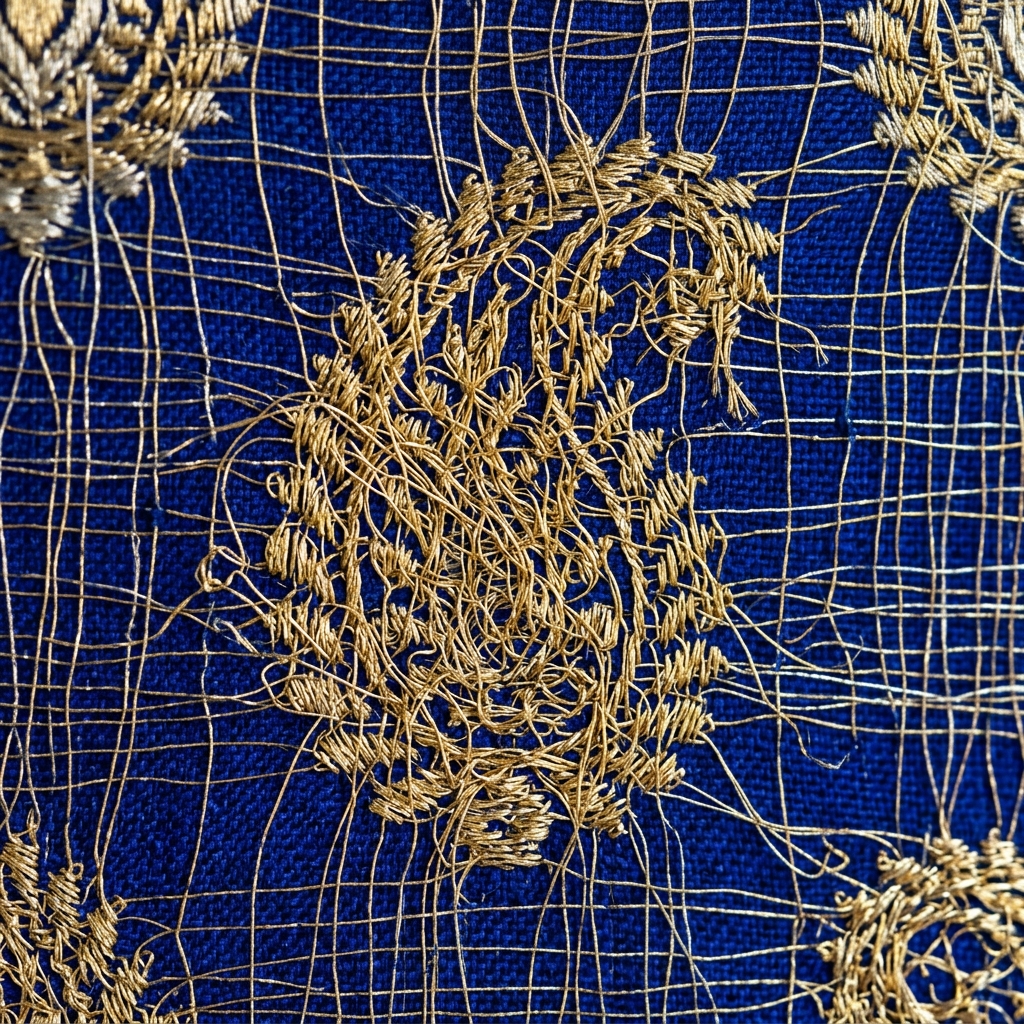
Close-up of tissue silk weave showing fine silk warp and metallic zari weft
The structural glow: Zari weft intertwined with fine silk warp.

Why this matters when you're buying

If a "tissue" saree's shine looks like it sits on the surface rather than coming from it, examine it closely. Genuine tissue reveals its zari when you look into the weave and turn it in the light; the sheen shifts with the angle rather than staying flat.

The three types of tissue silk saree

Not all tissue sarees are the same, and knowing the difference helps you choose well.

Type Construction Character Best for
Plain Tissue Zari weft across a sheer silk ground Uninterrupted all-over glow, lightest Minimal, modern elegance
Tissue Brocade Raised woven motifs above the tissue ground Texture you can feel; shine plus pattern Festive occasions, statement wear
Katan Tissue Katan silk base with tissue-style zari More body and structure, still shimmering Weddings, when you want weight
A plain tissue Banarasi silk saree with a sheer silk ground

Plain Tissue

The purest expression of the technique. A sheer silk ground with zari weft throughout produces an unbroken, liquid sheen. It is the lightest of the three and reads as understated rather than ornate — ideal if you want luminosity without heavy ornamentation.

Tissue Brocade

Here, woven motifs — florals, paisleys, or a jaal lattice — sit raised above the tissue ground. Run a finger across the fabric and you can feel the pattern.

This combines the all-over glow with the traditional Banarasi brocade vocabulary, making it the most festive of the three and the most popular for celebrations.

Tissue brocade Banarasi saree with raised woven floral motifs
Katan tissue Banarasi saree with firmer Katan silk base

Katan Tissue

For buyers who love tissue's shimmer but want more presence, Katan Tissue pairs a firmer Katan silk base with tissue-style zari detailing.

It drapes with more weight and structure than plain tissue, which makes it a strong bridal-adjacent option — the shimmer of tissue, closer to the substance of a traditional wedding saree.

Who tissue silk suits best

Tissue tends to be the right choice when:

  • You want to stand out gracefully rather than through heavy ornamentation. Tissue attracts attention through light, not bulk.
  • The event is in the evening. Tissue is at its most spectacular under artificial and candle light, which is why it's a reception favourite.
  • You want lightness. If a heavy bridal Katan feels like too much to carry for hours, tissue delivers Banarasi luxury at a fraction of the weight.
  • You're photographed a lot. The light-catching surface is genuinely flattering in photographs.

Tissue is less suited to rough daily wear or situations where the fabric will be snagged or crushed — it's a special-occasion silk by nature.

Best occasions for a tissue saree

  • Wedding receptions — arguably the perfect tissue occasion; evening light, photographs, and a dress code that rewards elegance over sheer weight
  • Engagement ceremonies and sangeet — light enough to move and dance in
  • Festivals — Diwali and Karva Chauth especially, where the glow suits the occasion
  • Luxury gifting — tissue photographs beautifully and feels immediately special
  • Evening receptions and formal dinners

For the bride herself, we'd usually point to a heavier Katan, Jangla or Meenakari piece — with a Katan Tissue as an excellent option for a second function or reception look.

How to style a tissue silk saree

Blouse. Tissue's shimmer gives you two good routes: a contrasting raw silk or velvet blouse for depth and grounding, or a matching tissue blouse for a seamless, monochrome column. Velvet in particular works beautifully against tissue's lightness in cooler months.

Draping. Because tissue is light and slightly crisp, it holds pleats well and creates elegant volume. A classic Nivi drape suits it, and the pallu falls with lovely movement. Avoid over-tight pleating, which flattens the sheen.

Jewellery. Tissue already carries a great deal of shine, so restraint reads as more expensive. Consider:

  • Uncut/polki or kundan for a traditional look
  • Pearls for softness against gold tissue
  • One statement piece rather than a full set

Petticoat. This matters more with tissue than other silks. Because the fabric is sheer, choose a well-matched petticoat in a close shade — a mismatched one is visible through the drape.

Model wearing a tissue silk Banarasi saree draped gracefully
Elegant styling with a contrasting velvet blouse and traditional jewelry.

A practical note: be mindful of sharp-edged jewellery, embellished bags and rough surfaces. Tissue's fine zari weave can snag, and prevention is far easier than repair.

How to care for a tissue silk saree

Tissue is delicate, and its zari content means it needs slightly more attention than a sturdy Katan.

Dry Clean Only

Never machine wash. Use a cleaner experienced with zari work.

Store Folded

Hanging stretches the fabric and stresses the zari over time. Store folded.

Breathable Storage

Wrap in breathable cotton or muslin — never plastic, which traps moisture.

Refold Regularly

Refold every few months along different lines to prevent permanent creases.

Avoid Perfumes

Spray before dressing, never onto the saree — alcohol can dull the zari.

No Direct Sunlight

Avoid prolonged direct sunlight, which fades colour and can dull the sheen.

Iron on low heat with a cotton cloth between the iron and the fabric, if at all. Better still, let a professional handle it. Treated well, a good tissue saree stays luminous for many years.

Tissue vs other Banarasi fabrics

Tissue vs Katan

Katan is heavier, firmer and more durable — the traditional bridal choice. Tissue is lighter, shinier and more festive. Katan is the heirloom; tissue is the showpiece.

Tissue vs Organza

Both are light and somewhat sheer, but Organza is crisper and more matte, with motifs that appear to float on a transparent ground. Tissue is fluid and metallic. Choose Organza for daytime and structure; tissue for evening and glow.

Tissue vs Georgette

Georgette is soft, fluid and matte, with the best drape of the three and the easiest wear. Tissue trades some of that softness for shine and crispness.

For the full comparison across every Banarasi fabric, see our Complete Guide to Banarasi Silk Sarees.

What affects the price of a tissue saree

Tissue pricing is driven by the same factors as other Banarasi sarees, with one particular emphasis:

  • Zari type and density — especially significant here, since zari runs through the whole fabric rather than just the borders
  • Silk quality of the warp
  • Handloom or powerloom production
  • Brocade complexity — Tissue Brocade with intricate motifs costs more than plain tissue
  • Design and colour work

Because tissue carries zari throughout, the type of zari has an outsized effect on its price compared with a saree where zari appears only in borders. Always ask what the zari is. We explain the full picture in why Banarasi sarees are expensive.

Key takeaways

  • Tissue's glow is structural. A zari weft runs through the entire fabric, so the sheen comes from the weave itself, not a surface finish.
  • Three types, three purposes. Plain Tissue for understated glow, Tissue Brocade for festive texture, Katan Tissue when you want more weight.
  • It rewards careful handling. Store folded in muslin, refold periodically, dry clean only, and keep perfume and sharp jewellery away from the zari.

Frequently Asked Questions

A tissue silk saree is woven with a fine silk warp and a metallic zari weft, so zari runs through the whole fabric rather than only the borders and motifs. This produces a continuous all-over sheen, and makes tissue lighter and more sheer than traditional Banarasi silks.

No. Both are light and semi-sheer, but Organza is crisper and more matte, with motifs on a transparent ground. Tissue is fluid and metallic, with zari woven throughout for an all-over glow.

The three main types are Plain Tissue (zari weft on a sheer silk ground for uninterrupted glow), Tissue Brocade (raised woven motifs above the tissue ground), and Katan Tissue (a firmer Katan silk base with tissue-style zari for more body).

Yes — tissue is especially popular for receptions, engagements and sangeet, where evening light shows it at its best. For the bride's main ceremony, a heavier Katan, Jangla or Meenakari saree is the more traditional choice, with Katan Tissue a good middle ground.

Dry clean only, using a cleaner experienced with zari work. Never machine wash. Store folded in breathable cotton or muslin rather than hanging, and refold periodically to avoid permanent creases.

No. Tissue is among the lighter Banarasi fabrics — noticeably lighter than pure Katan — which makes it comfortable for long events while still looking luxurious.

The sheen comes from zari woven into the fabric rather than a surface coating, so it does not simply wear off. However, zari can dull over time if exposed to moisture, perfume or prolonged sunlight, so proper storage matters.

Explore tissue silk at Silk Khazana

We manufacture Banarasi silk in Varanasi and have done since 1970 — selling directly, so you can ask us anything about a saree and get a specific answer: the zari, the weave, whether it's handloom.

Not sure which suits your occasion? Message us on WhatsApp at +91 63073 05873 — tell us the event and we'll help you choose.

Why Are Banarasi Sarees So Expensive? The Real Reasons | Silk Khazana
Authenticity ~2,000 Words Updated September 2026

Trust / Value

Why Are Banarasi Sarees So Expensive? The Real Reasons

Ten hours of skilled work can produce one to two inches of an intricate Banarasi saree. At that pace, six yards is not a purchase — it's a commission.

Silk Khazana

Banarasi Silk Manufacturer since 1970 · Jaitpura, Varanasi · Worldwide Shipping

"If you've ever looked at a Banarasi saree's price and wondered what could possibly justify it, this article answers that honestly. Not with vague talk of 'heritage' and 'craftsmanship', but with the actual cost drivers: what the silk costs, what the zari costs, how long the weaving takes, and how many people are involved before a saree reaches you."

The short answer

A Banarasi saree's price is mostly a measure of time and skill, not materials alone.

A single saree can take anywhere from around 15 days to six months to weave, and exceptionally intricate pieces can take longer still. On the most detailed designs, a weaver may progress only a few inches in a full working day. Creating one saree typically requires the collaboration of at least three artisans, each with a specialised role, before any material cost is counted.

Everything below explains where that time goes.


What actually drives the price

1. The silk itself

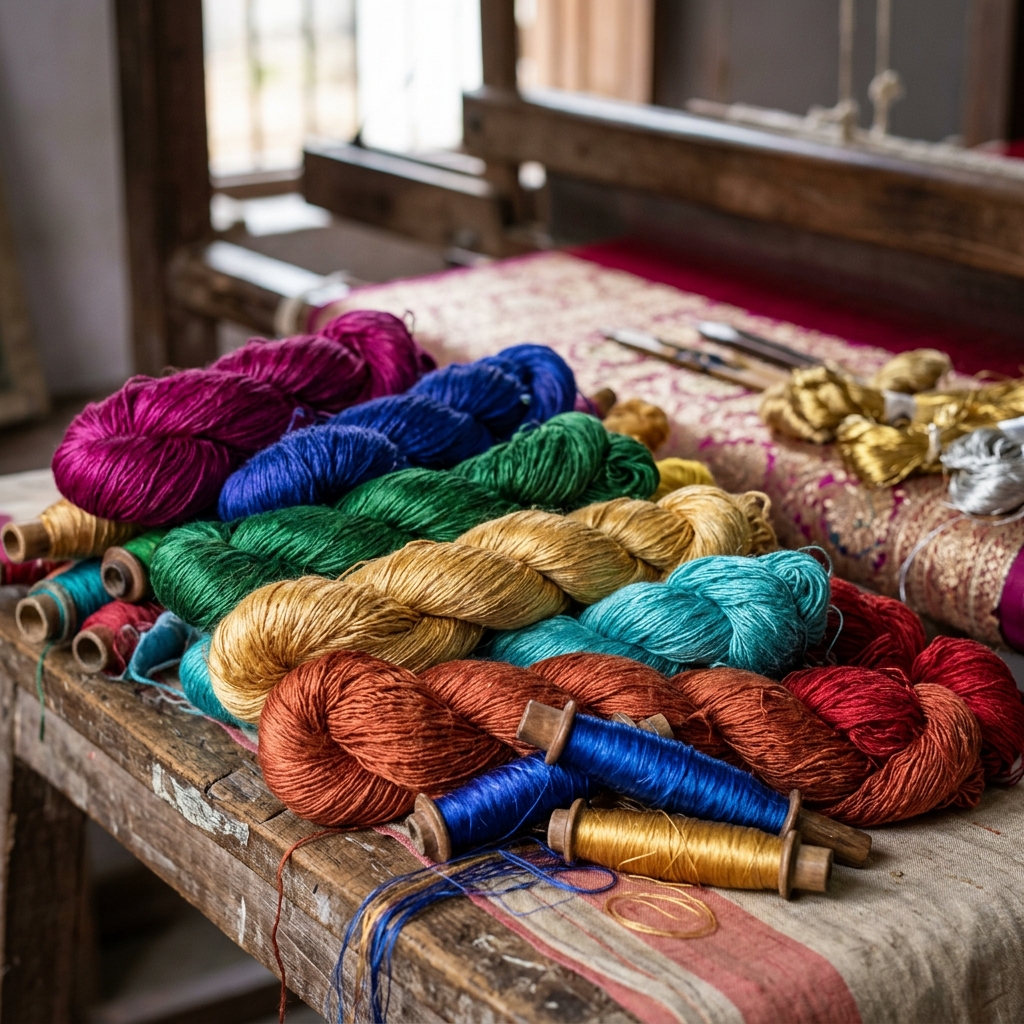
Pure silk is a genuinely expensive raw material, and quality varies considerably. The grade, purity and consistency of the yarn all affect both cost and how the finished saree looks, feels and ages.

Fine Katan silk — woven from tightly twisted yarns — costs more than lower grades, and that difference is visible in the saree's sheen, drape and durability decades later. Cheaper "silk" sarees frequently contain blends or synthetic fibres, which is a large part of why they cost less.

Premium quality, pure Katan silk threads used for weaving Banarasi sarees
Pure Katan silk yarns are the foundation of a true Banarasi.
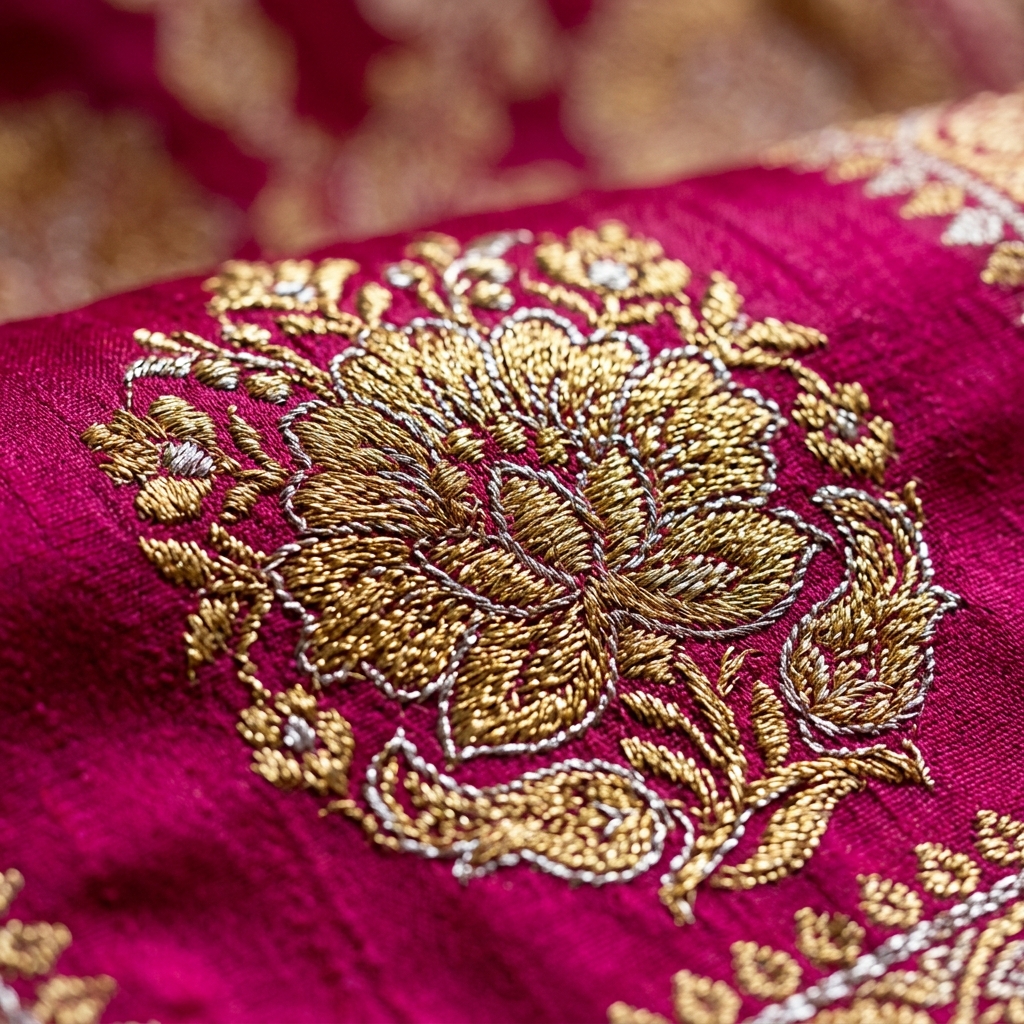
Close-up of intricate zari metallic thread woven into a Banarasi silk saree
Zari work requires incredible precision and directly impacts the material cost.

2. The zari

Zari is the metallic thread that forms a Banarasi saree's ornamental patterns, and it is often the single largest material cost.

Two things matter: what the zari is made of, and how much of it there is. Historically zari incorporated real gold or silver; today materials vary widely by product and price point. A saree using genuine precious-metal zari sits in an entirely different cost bracket from one using contemporary metallic zari.

Density matters just as much. A saree with heavy all-over zari work simply contains far more of an expensive material than one with a plain body and a simple border. Since no certification covers zari composition, this is something you must ask about directly. We cover why in our guide to GI Tag and Silk Mark certifications.

3. The design work — before weaving even begins

This is the stage most buyers never hear about, and it's genuinely fascinating.

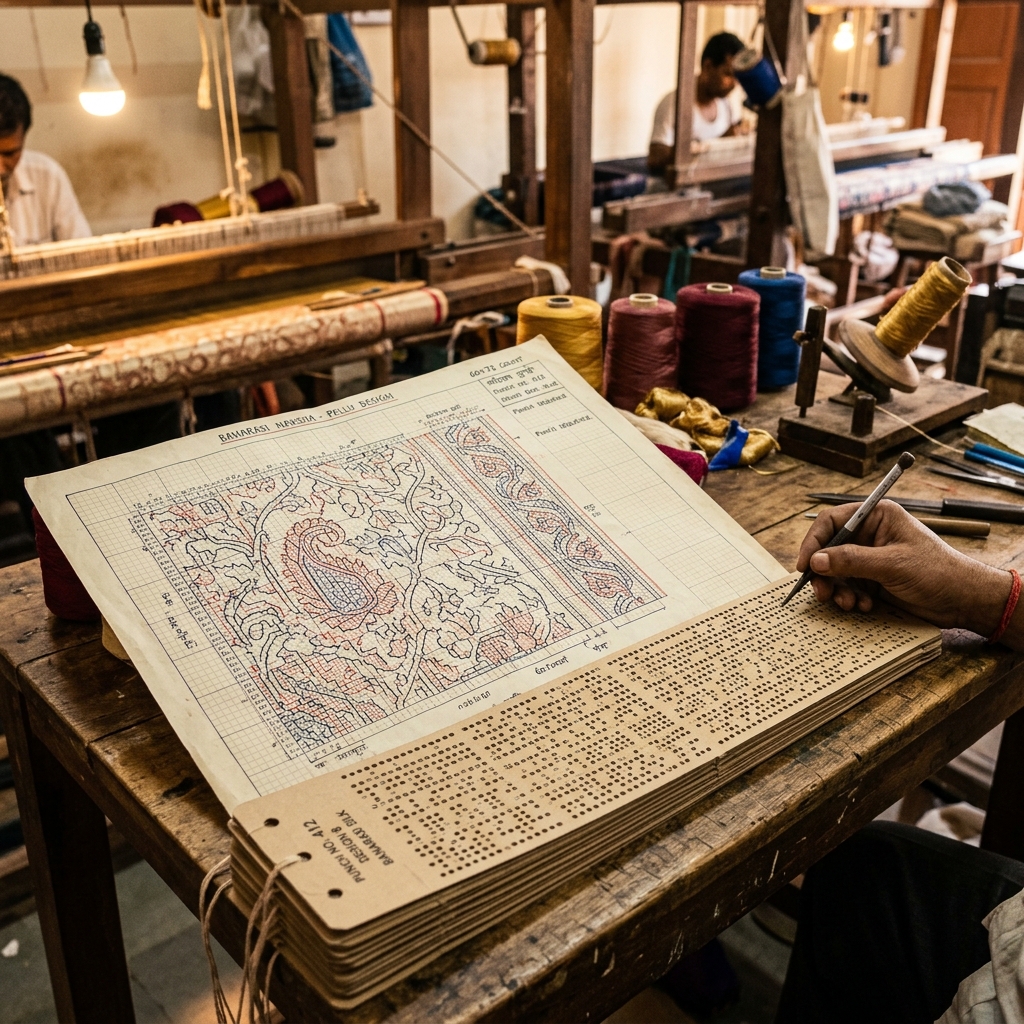
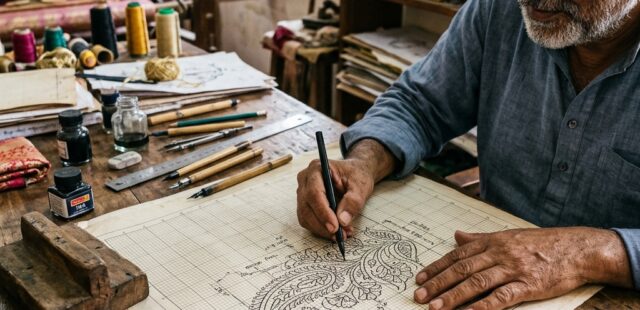
Before a single thread is woven, an artist creates the naksha — the design mapped onto graph paper, where each tiny square represents a single thread of the weave. A specialist called the naqshaband translates the artistic drawing into this thread-by-thread blueprint.

That blueprint is then converted into a series of punch cards that instruct the loom which threads to lift for each pass — a system strikingly similar in principle to early computing. For an elaborate design, preparing the naksha and punch cards is substantial skilled work in its own right, completed before weaving starts. A saree with an original, complex design carries this development cost. A simple repeated pattern does not.

A traditional 'naksha' design mapping on graph paper and punch cards
The blueprint stage: creating a 'naksha' and Jacquard punch cards requires specialized skill before a single thread is woven.
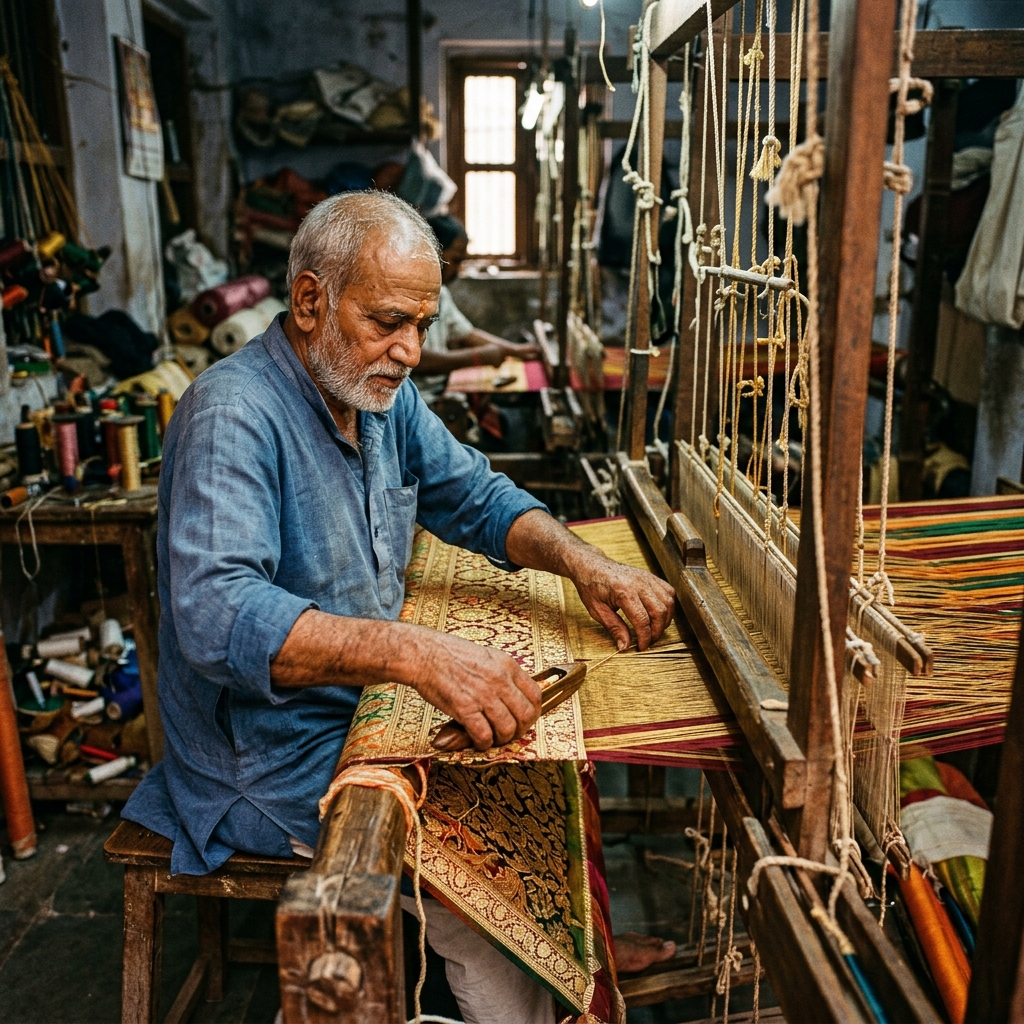
An Indian artisan master weaver operating a traditional wooden handloom
A master weaver can take 15 days to six months to complete a single piece.

4. The weaving time & 5. Handloom vs Powerloom

Here is where the cost concentrates.

On intricate pieces, hand weavers may take around ten hours to complete just one to two inches of fabric. A master weaver working full days on a complex design might produce roughly two to four inches daily. Do the arithmetic across six yards of an elaborately patterned saree and the timeline — weeks, often months — becomes obvious. During that entire period, the loom is occupied and the weaver is committed to that single piece.

A powerloom produces in hours what a handloom produces in days or weeks. That single fact accounts for much of the price spread you see in the market. Both are legitimate products — a well-made powerloom Banarasi at a fair powerloom price is good value. The problem arises only when one is sold as the other. We explain how to tell them apart in our guide to handloom versus powerloom Banarasi sarees.

6. The number of hands involved

A Banarasi saree is not the work of one person. Typically it involves at least three artisans, and often more across the full process:

  • The designer who conceives the pattern
  • The naqshaband who translates it thread by thread
  • The weaver (sometimes two, on complex jacquard setups)
  • Specialists for dyeing, warp preparation, finishing and quality inspection

Each is a skilled trade with its own years of training. The price reflects an entire chain of craftsmanship. Read more about the people behind the craft in our feature on the silk bunkars of Varanasi.

7. Design density and colour complexity

An all-over Jangla or floral jaal covering the full body of the saree involves vastly more work than a plain body with a decorative border and pallu.

Meenakari and Rangkat add another layer of difficulty, because the weaver manages multiple colours simultaneously while keeping the base pattern precise. More colours means more thread changes, more concentration, and more time.

A breathtakingly beautiful Banarasi Jangla saree with intricate Meenakari and Rangkat work
Jangla patterns with intricate Meenakari and Rangkat demand the highest level of weaving expertise.

What you get for the money

Price is one side of the equation. Here is the other.

⏳

Longevity

A well-made Banarasi saree, properly stored, remains wearable for decades. Many families pass them down. Measured as cost-per-wear across thirty years and multiple generations, the arithmetic looks very different from the price tag.

💎

Material integrity

Real silk and quality zari age gracefully. Synthetic imitations degrade, lose their sheen, and look tired within a few seasons.

🙌

True Craftsmanship

Intricate handwoven work has an irreducible labour cost. There is no version of skilled human weaving that is also fast.

🌱

Sustaining a craft

Buying handloom directly sustains weaving families and keeps the tradition economically viable for the next generation. This is the practical reality of how the craft survives.


How to judge whether a price is fair

You don't need to be an expert. Ask what you're paying for:

1

What is the fabric, and what grade of silk?

Pure Katan will always be more expensive than lower grades or synthetic blends.

2

Handloom or powerloom?

This alone accounts for a large share of the price difference.

3

What weaving technique — Kadwa or Fekwa?

Kadwa is significantly more time-consuming and expensive.

4

What type of zari, and how dense is the work?

Heavy metallic threadwork across the whole body adds material cost.

5

How intricate is the design?

Compare the density of pattern against the price.

A useful warning sign

If a saree is presented as intricate handloom Kadwa work with heavy zari, at a price that seems remarkable, the arithmetic deserves scrutiny. Weeks of skilled labour cannot be sold for very little. When the maths seems impossible, it usually is — and something in the description is likely inaccurate.

Equally, an expensive saree isn't automatically the right one for you. A lighter powerloom Georgette may suit a wedding guest far better than a heavy bridal Katan, at a fraction of the cost. Fair value means the price matches what the saree actually is — not that you should always buy the most expensive option.


Our approach at Silk Khazana

We are a family-owned manufacturer weaving in Varanasi since 1970, selling directly to customers rather than through layers of intermediaries. That structure removes markups, but it doesn't remove the labour cost — and we don't pretend it does.

What we do instead is tell you exactly what you're paying for. Ask us about the silk, the zari, the technique, or whether a piece is handloom, and you'll get a specific answer. If a less expensive saree suits your occasion better, we'll say so.

We would rather you understand the value and buy confidently than be talked into something you don't understand.

Explore our collections: Katan silk · Tissue · Organza · Real Gold Zari · browse the full shop

Have a specific budget and occasion in mind? Message us on WhatsApp at +91 63073 05873 and we'll show you the best options within it.

Key Takeaways

  • You're paying for time, not just materials. A saree can take 15 days to six months to weave, with intricate pieces progressing only a few inches a day.
  • Four factors explain most of the price: silk grade, zari type and density, handloom versus powerloom, and design complexity.
  • Fair value means the price matches what the saree is. Ask specific questions — and be sceptical when elaborate handwoven work is offered unusually cheaply.

Frequently Asked Questions

Why are Banarasi sarees so expensive?+

Mainly because of the time and skill involved. A single saree can take from around 15 days to six months to weave, typically requires at least three artisans, and uses costly materials — pure silk and zari. On intricate designs a weaver may complete only a few inches per day.

How long does it take to weave a Banarasi saree?+

Typically 15 days to six months depending on complexity, and longer for exceptionally elaborate pieces. On intricate work, roughly ten hours of weaving may produce only one to two inches of fabric.

What is a naksha in Banarasi weaving?+

The naksha is the design mapped onto graph paper, where each square represents a single thread. A specialist called the naqshaband creates it, and it is then translated into punch cards that guide the loom — a system similar in principle to early computing.

Why are some Banarasi sarees much cheaper than others?+

Chiefly because of powerloom versus handloom production, lower silk grades or blends, contemporary rather than precious-metal zari, lighter zari density, and simpler designs that take far less time to weave.

Is an expensive Banarasi saree always better?+

Not necessarily better *for you*. A lighter, less costly saree may suit your occasion far better than a heavy bridal piece. Fair value means the price matches what the saree actually is.

Does buying handloom really support weavers?+

Yes. Handloom purchases direct a larger share of the price toward skilled human labour and help keep weaving economically viable for artisan families and the next generation of the craft.

How can I tell if a Banarasi saree is fairly priced?+

Ask what fabric and silk grade it is, whether it's handloom or powerloom, which weaving technique was used, and what type and density of zari it carries. Specific answers let you judge value; vague answers are themselves informative.

Shop with Confidence from the Source

Silk Khazana — weaving authentic Banarasi silk in Varanasi since 1970. Direct from the GI region, honest about every saree we sell.

Unsure about a saree you are considering elsewhere? Message us — we will tell you honestly what we see.

Handloom vs Powerloom Banarasi Saree: How to Tell | Silk Khazana
Authenticity & Trust ~2,100 Words Updated August 2026

The Buyer's Guide

Handloom vs Powerloom Banarasi Saree: How to Tell the Difference

A handloom Banarasi saree and a powerloom one can look nearly identical hanging in a shop — and differ substantially in price. Knowing which you're holding is the difference between paying for skilled human labour and paying for the idea of it.

Silk Khazana

Banarasi Silk Manufacturer since 1970 · Jaitpura, Varanasi · Worldwide Shipping

"Let's be clear about something first... a powerloom Banarasi saree is not a fake. Both handloom and powerloom sarees are genuinely made in and around Varanasi, both have real markets, and a well-made powerloom saree can be beautiful and excellent value. The only real problem is dishonesty — when a powerloom saree is sold as handloom at a handloom price."

The fundamental difference

Handloom weaving is done by a skilled artisan operating a traditional loom manually. The weaver controls tension, pace, and the placement of every motif. On intricate designs, progress may be only a few inches a day.

Powerloom weaving uses mechanically powered equipment. It is far faster, produces highly consistent output, and makes Banarasi-style designs accessible at much lower prices.

Everything that follows — the visual differences, the price gap, the way each saree feels — flows from that single distinction: a human hand versus a machine, and the time each requires.

Feature Handloom Powerloom
Production speed Days to weeks per saree Hours to a day
Consistency Minor natural variations Highly uniform
Texture Softer, more pliable, breathable Often crisper or more compact
Price Substantially higher More accessible
Design flexibility Very high, including Kadwa placement Constrained by machine setup
Certification Eligible for Handloom Mark Not eligible for Handloom Mark
A split screen conceptual image comparing handloom weaving with mechanical powerloom weaving
Handloom artisans weave with natural variations, while powerlooms create artificial perfection.

Seven ways to tell the difference

No single check is conclusive on its own. Use several together and a clear picture emerges quickly.

Close up photography of the selvedge edge of a traditional handloom silk saree showing tiny pin marks
Notice the slightly uneven selvedge edge and the tiny pin marks, a true sign of handloom tension.

1. Examine the selvedge

The selvedge — the finished woven edge running along the length of the saree — is the single most reliable indicator.

  • On a handloom saree, the selvedge is neat but not machine-perfect. You'll see slight unevenness from natural variations in hand tension, and sometimes small thread loops along the edge.
  • On a powerloom saree, the edge is uniform and mechanically precise all the way down.

Run the edge between your fingers along its length. Perfect consistency over six yards is a machine signature.

2. Look for pin marks near the borders

Handloom weaving often leaves small pin holes or marks at regular intervals near the borders or along the edges, where the fabric was held under tension on the loom. These are a genuine artefact of hand-weaving and one of the more useful physical tells. They are not damage.

3. Look for small, natural irregularities

Turn the saree in the light and study the weave closely. Handloom fabric almost always shows minor variations — a slightly uneven thread here, a small slub there, a fractional difference in the pattern repeat, or slightly varying density across the length.

These are not defects. They are the fingerprint of the human hand, and experienced buyers actively look for them.

A weave that is flawlessly uniform across the entire saree, with every motif identical to the millimetre, points to a machine.

Close up photography of a machine-made powerloom silk fabric showing perfectly straight and uniform threads
Perfectly straight, artificial uniformity is the hallmark of a powerloom machine.
Reverse side of a handloom Banarasi saree showing small floating silk threads
The reverse side of a handloom saree shows floating threads and organic threadwork mirroring the front.

4. Turn the saree over

The reverse side tells you a great deal. On handloom work, the design reads clearly on the back — a legible mirror of the front, with visible thread work. On powerloom pieces the reverse is often flatter or less crisply defined.

One important note: this check also distinguishes any genuinely woven saree from a printed imitation, where the reverse shows only a faded ghost of the front with no thread work at all. If you learn one check, learn this one — it eliminates outright fakes instantly.

5

Feel the fabric and watch the drape

Handloom silk tends to feel softer and more pliable, with a natural give, and it drapes fluidly around the body. Powerloom fabric often feels crisper or more compact because the weft is packed more evenly and tightly. Some pieces are also starched for presentation, which adds a temporary stiffness. Drape a length over your arm. Handloom silk generally falls in softer, more organic folds.

6

Consider the design complexity

Certain techniques are extremely difficult to reproduce on a powerloom. Intricate Kadwa work — where each motif is woven individually with no long floating threads behind it — and elaborate Shikargah compositions are strong indicators of handloom craftsmanship. If a saree shows genuinely intricate Kadwa detailing at a very low price, that combination deserves questions.

7

Check for a Handloom Mark

The Handloom Mark, issued under the Development Commissioner for Handlooms, certifies specifically that a fabric was handwoven. This is separate from Silk Mark, which only certifies that the fibre is pure silk. Note also that Handloom Mark participation is voluntary. Plenty of genuine handloom weavers don't register — so its absence is not proof of powerloom.


Why handloom costs more

The price difference is not arbitrary. It reflects:

  • Time. A handloom weaver may spend days or weeks on a single saree; a powerloom produces one in a fraction of that.
  • Skill. Handloom weaving is a craft learned over years, often across generations.
  • Labour. One saree can occupy a weaver — sometimes two, on complex jacquard setups — for its entire production.
  • Output limits. A weaver can only produce so many sarees a year, which naturally constrains supply.

When you buy handloom, a much larger share of the price goes to human skill rather than machine throughput. That is also why handloom purchases directly sustain weaving communities and keep the craft viable for the next generation.


Which should you actually buy?

This is a genuine choice, not a trick question.

Neither choice is wrong. What matters is that you know which you're buying and pay a price that matches. A well-made powerloom saree at a fair powerloom price is a good purchase. A powerloom saree sold to you as handloom is not — regardless of how it looks.

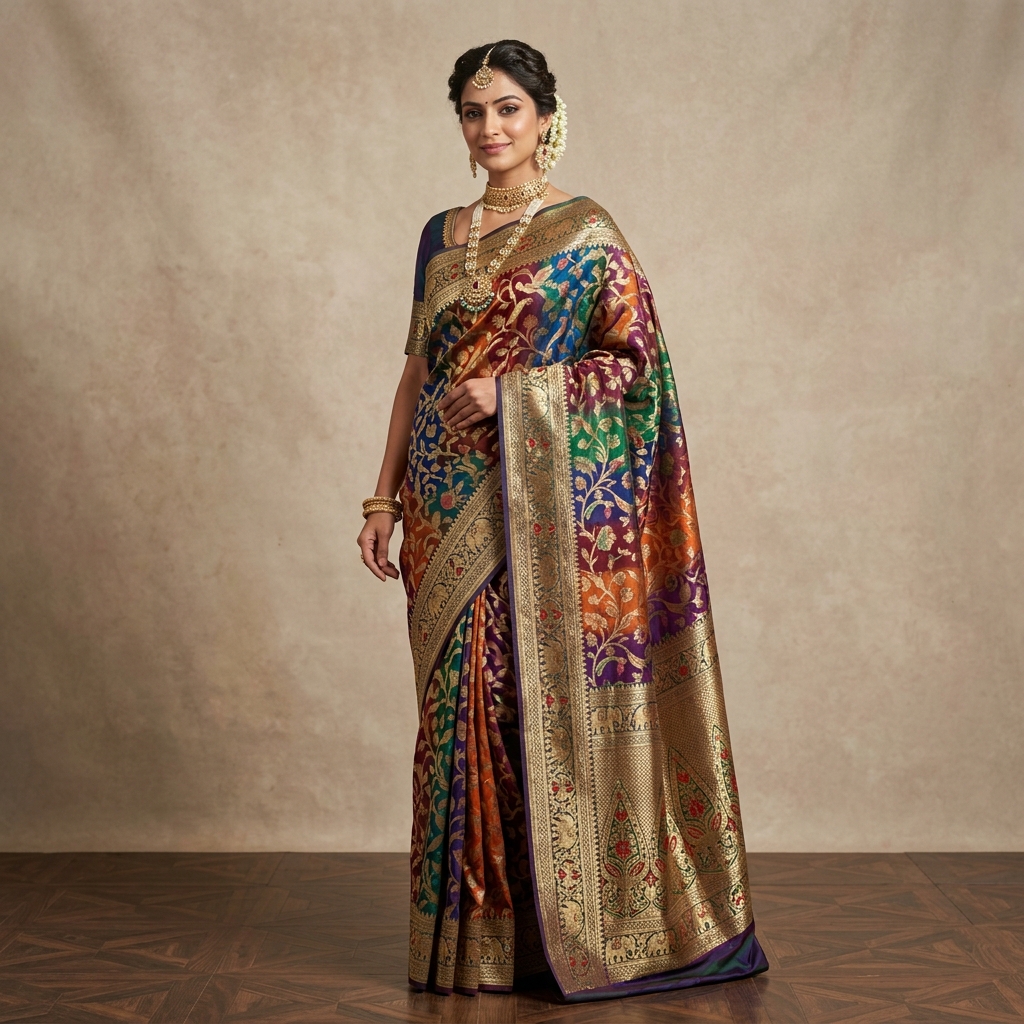
A stack of colorful Banarasi silk sarees
Whether handloom or powerloom, making an informed choice allows you to appreciate the value of what you're buying.

Questions to ask any seller

The fastest route to clarity is simply asking directly. A trustworthy seller will answer without hesitation:

1

"Is this handloom or powerloom?"

A straight answer is the baseline. Evasion or a vague "it's traditional work" tells you a great deal.

2

"What weaving technique is used?"

Specific answers like Kadwa or Fekwa indicate genuine product knowledge.

3

"What type of zari is this?"

No certification covers zari composition, so you must ask.

4

"Does it carry a Handloom Mark or Silk Mark?"

And if not, why not — the answer may be perfectly reasonable.

Be cautious of "guaranteed" all-handloom stores

Be cautious of any seller who claims everything they stock is handloom. Given how much of the market is powerloom, that claim is statistically improbable, and an honest seller has no reason to make it.


How we handle it at Silk Khazana

We are a family-owned manufacturer weaving Banarasi silk in Varanasi since 1970, with our own weaving operation.

Our approach is straightforward: we tell you what a saree is. If it's handloom, we say so and explain the technique. If it's powerloom, we say that too, and price it accordingly. We would rather sell you a powerloom saree you're genuinely happy with than a misrepresented one that damages your trust in the craft.

Explore our collections: Katan silk · Katan Meenakari · Katan Jungla · Shikargah · browse the full shop

If you're comparing sarees — including ones you're considering elsewhere — send us photographs on WhatsApp at +91 63073 05873 and we'll tell you honestly what we see.

Key Takeaways

  • Powerloom isn't fake. Both are genuine Banarasi products. The only real problem is a powerloom saree sold at a handloom price.
  • The selvedge and the reverse side are your best checks. Handloom edges show slight natural unevenness and small thread loops; the reverse of any true brocade shows real thread work.
  • Ask directly, and judge the answer. "Is this handloom or powerloom?" is a fair question with a simple answer. Hesitation is itself information.

Frequently Asked Questions

What is the difference between a handloom and powerloom Banarasi saree?+

A handloom saree is woven manually by a skilled artisan on a traditional loom, taking days or weeks. A powerloom saree is produced on mechanically powered equipment, far faster and more uniformly. Both are genuinely made in the Banaras region; they differ in labour, character and price.

How can I tell if a Banarasi saree is handloom?+

Check several signals together: a slightly uneven selvedge with small thread loops, pin marks at regular intervals near the borders, minor natural irregularities in the weave, a clearly legible design on the reverse, softer drape, and a Handloom Mark where present.

Is a powerloom Banarasi saree fake?+

No. A powerloom Banarasi woven in the region is a legitimate product, and often good value. It is only a problem when it is misrepresented as handloom or priced as one.

Does a Silk Mark mean my saree is handloom?+

No. Silk Mark certifies only that the fibre is pure natural silk — both handloom and powerloom sarees can carry it. Handweaving is certified separately by the Handloom Mark.

Why are handloom Banarasi sarees more expensive?+

Because of the time and skill involved. A single intricate saree can occupy a weaver for days or weeks, and output per weaver is naturally limited. A larger share of the price goes to human craftsmanship.

Can Kadwa work be done on a powerloom?+

Kadwa — where each motif is woven individually without long floating threads — is extremely difficult to replicate on a powerloom. Genuinely intricate Kadwa detailing offered at a very low price warrants careful questions.

Are small irregularities in a handloom saree a defect?+

No. Minor variations in thread, slubs, or slight differences in pattern repeat are natural characteristics of hand-weaving and are generally regarded as marks of authenticity rather than flaws.

Shop with Confidence from the Source

Silk Khazana — weaving authentic Banarasi silk in Varanasi since 1970. Direct from the GI region, honest about every saree we sell.

Unsure about a saree you are considering elsewhere? Message us — we will tell you honestly what we see.

GI Tag & Silk Mark: Verify a Genuine Banarasi Saree | Silk Khazana
Authenticity & Trust ~1,900 Words Updated August 2026

The Buyer's Certification Guide

GI Tag & Silk Mark: How to Verify a Genuine Banarasi Saree

Three certifications. Three different questions. Here is exactly what each one proves — and what none of them prove alone.

Silk Khazana

Banarasi Silk Manufacturer since 1970 · Jaitpura, Varanasi · Worldwide Shipping

"Most buyers assume a Silk Mark label means their saree is a genuine handwoven Banarasi. It does not — and that single misunderstanding is why so many people pay Banarasi prices for something that isn't one."

The three marks at a glance

There are three different certifications you may encounter when buying a Banarasi saree: the GI tag, the Silk Mark, and the Handloom Mark. Each certifies something completely different, and none of them, on its own, tells you everything.

This table is the heart of this guide. If you remember nothing else, remember this:

Certification What it certifies What it does NOT prove
GI Tag
Banaras Brocades & Sarees
Saree originates from the defined Banaras region Not handloom; not silk purity
Silk Mark
Central Silk Board
The textile is pure natural silk Not handloom; not from Banaras
Handloom Mark
Ministry of Textiles
Fabric was handwoven on a traditional loom Not silk purity; not regional origin

Read that right-hand column carefully. A Silk Mark proves your saree is real silk — it says nothing about whether it was woven by hand or machine, or whether it came from Varanasi or anywhere else. A powerloom saree made of pure silk can legitimately carry a Silk Mark. This is not a flaw — each mark answers one specific question. The confusion arises when a seller lets you assume one label covers all three.

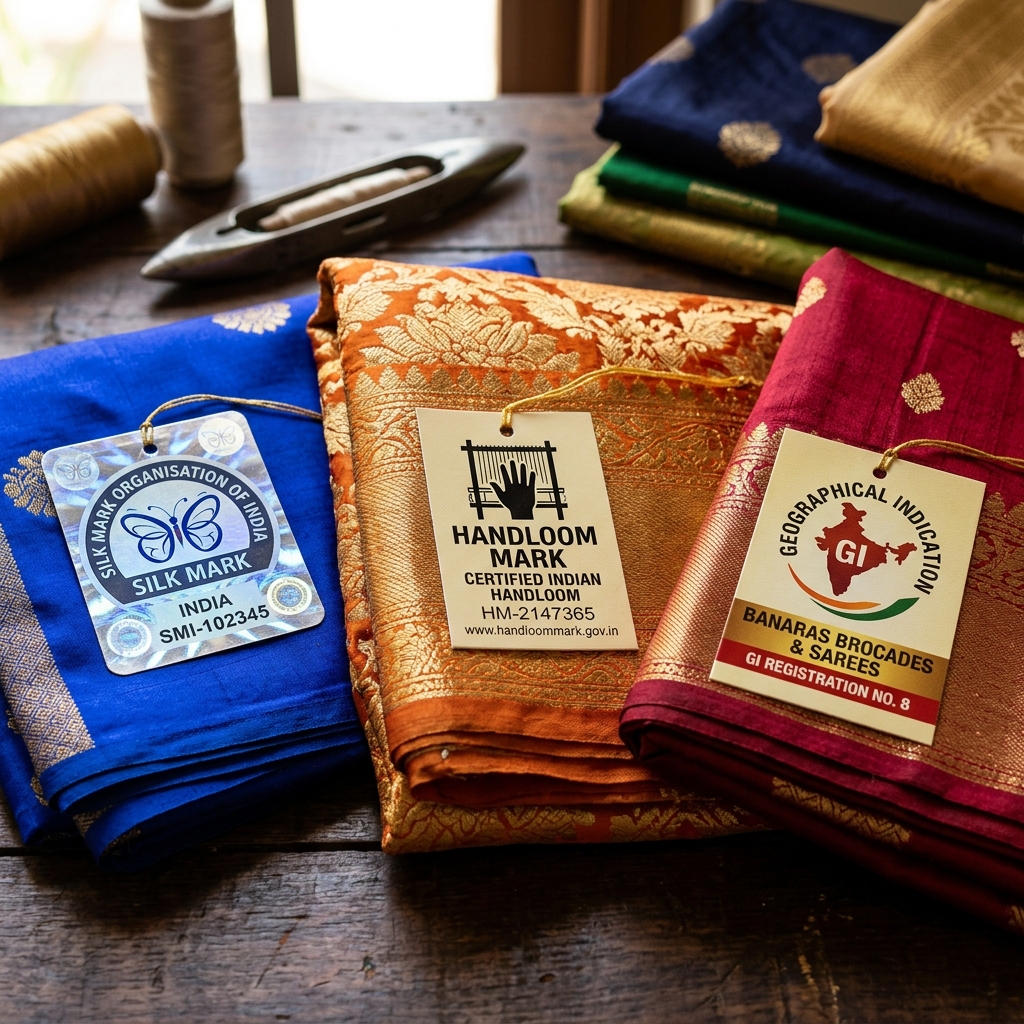
Three certification marks: GI Tag, Silk Mark, and Handloom Mark displayed on authentic silk sarees
Three marks, three different questions answered — understand what each one actually proves.

The GI Tag: what "Banarasi" legally means

A Geographical Indication (GI) is a form of intellectual property protection that ties a product to its place of origin — the same principle that protects Champagne or Darjeeling tea.

In 2009, "Banaras Brocades and Sarees" received GI status. The application was led by the Banaras Bunkar Samiti, and the protection covers weaving in a defined area of eastern Uttar Pradesh — Varanasi and the surrounding districts of Mirzapur, Chandauli, Bhadohi, Jaunpur and Azamgarh.

🛡

What it protects

The GI stops sarees woven elsewhere from being sold as "Banarasi". It protects buyers who get what they paid for — and weaving communities whose craft the name represents.

Origin Protection
⚠️

The honest limitation

Enforcement in a large informal market is genuinely difficult. Not every authentic Banarasi carries a visible GI label, and "GI" in a product description cannot be verified from a photograph online.

Know the limits
📍

How to use it

Treat the GI as important context — a reason to care where your saree was actually woven — rather than as a sticker that settles the authenticity question by itself.

Context, not proof

The Silk Mark: what it does and doesn't certify

The Silk Mark is issued by the Silk Mark Organisation of India, a society established under the Central Silk Board. Its purpose is narrow and specific: it certifies that a textile is made of pure natural silk.

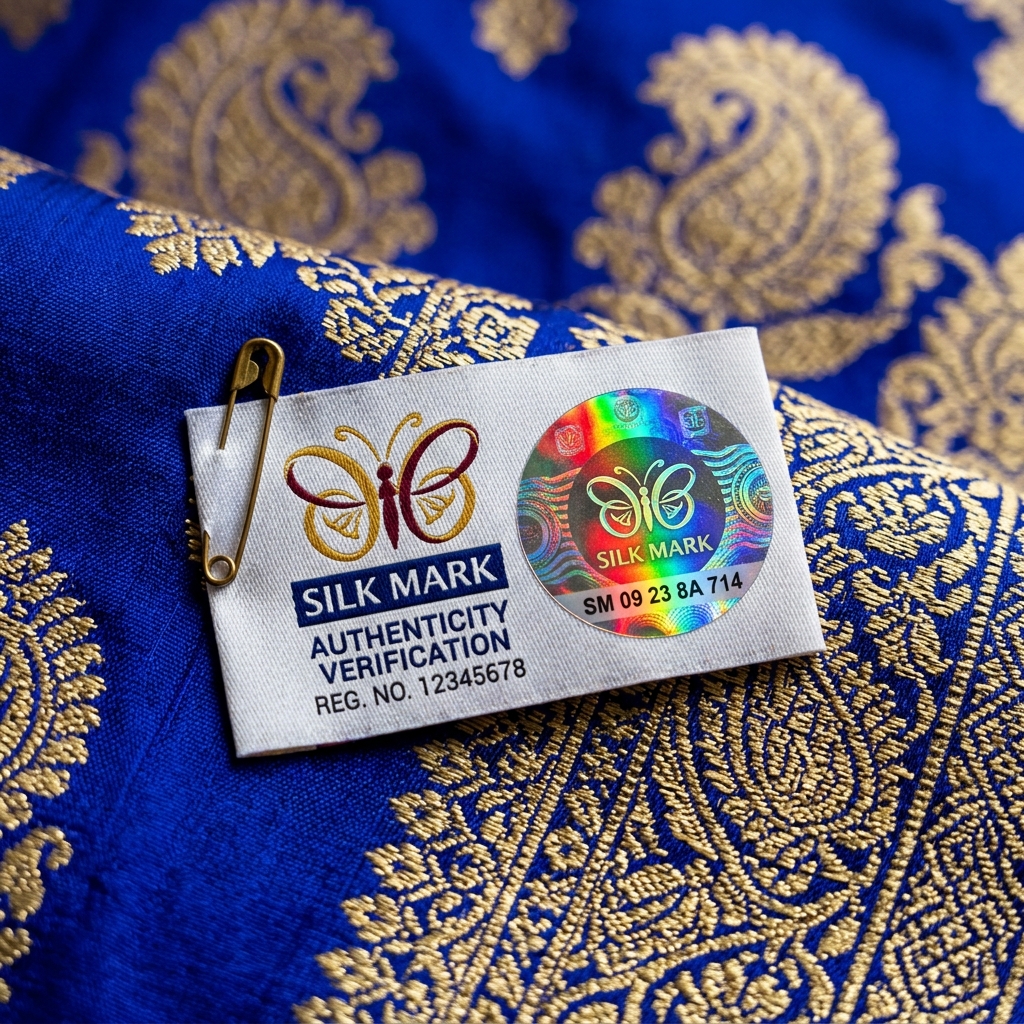
Close-up macro photo of authentic Silk Mark hologram label with unique serial number on Banarasi silk saree
A genuine Silk Mark carries both a hologram and a unique traceable identification number — both are required to be genuine.

How to check a Silk Mark label

A genuine Silk Mark label carries:

  • A hologram that shifts colour and pattern at different angles
  • A unique identification number traceable back to the authorised registered user who applied it

That traceability is the point. If a seller shows you a Silk Mark label, the number on it corresponds to a registered entity. A photocopied or generic-looking label with no hologram or number is a red flag in itself.

The three limits you must know

  • It certifies fibre, not craft. Both handloom and powerloom sarees can carry Silk Mark, provided the silk is genuine.
  • It certifies fibre, not origin. A pure silk saree woven far outside the Banaras region can carry a Silk Mark.
  • It is advisory, not mandatory. Many genuine weavers — particularly smaller family units — sell authentic sarees without registering for it.

The absence of a Silk Mark does not mean a saree is fake. Its presence does not mean the saree is handwoven in Varanasi. It is one useful data point about one specific question.


The Handloom Mark: the one most buyers have never heard of

If what you care about is that a human being wove your saree on a traditional loom, the Handloom Mark is the certification that actually addresses that. It is issued under the Development Commissioner for Handlooms, Ministry of Textiles, and certifies that a fabric was handwoven — regardless of whether it is silk, cotton, or wool.

A saree can legitimately carry both Silk Mark and Handloom Mark: the first confirming the fibre is pure silk, the second confirming it was woven by hand. Together, that is meaningfully stronger assurance than either alone.

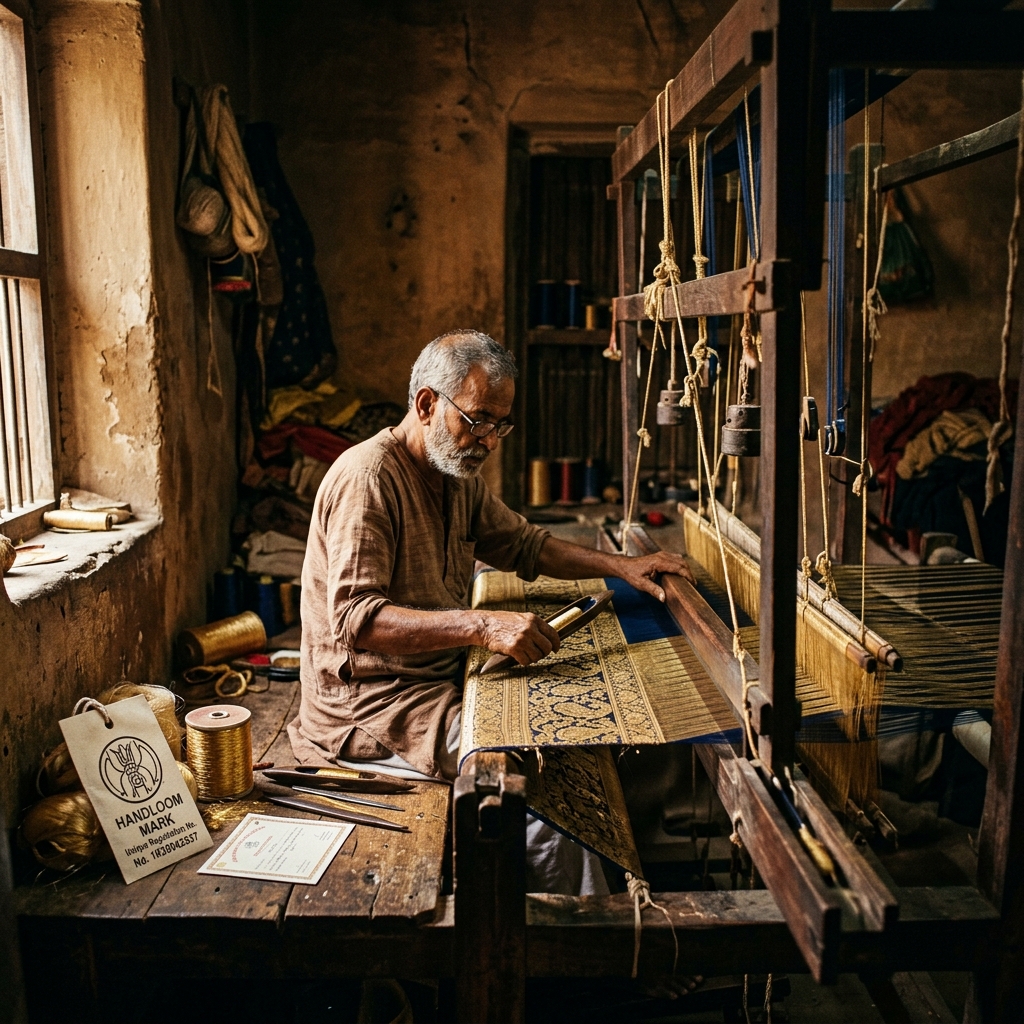
Master weaver at traditional Varanasi pit loom with authentic Handloom Mark certification
The Handloom Mark certifies human hands wove the fabric — the one certification most buyers never ask about.

What no certification can tell you

Certifications verify specific, narrow facts. Here is the part most articles skip entirely. They cannot tell you:

Outside the scope of all certifications

  • The quality of the weaving — whether motifs are cleanly executed, whether the bel resolves properly at the corners, whether the pallu is well proportioned
  • The type of zari — no mark certifies whether zari is precious-metal gold/silver or contemporary metallic. You must ask the seller directly.
  • The weaving technique — Kadwa versus Fekwa makes an enormous difference to labour and price, and no label records it
  • Whether the price is fair for the work actually involved in making that specific saree

These are judgements, and they come from either your own developing eye or a seller you can trust to answer straight questions. Which brings us to the thing that actually matters most.


The verification method that works

Use certifications as supporting evidence within a broader check. In order of practical usefulness:

1

Assess the source first

A Varanasi-based manufacturer who will answer direct questions is the strongest signal available. Ask: What is the fabric? Handloom or powerloom? What weaving technique? What type of zari? Vague or evasive answers tell you more than any label.

2

Turn the saree over

Genuine woven brocade shows the pattern in reverse on the back, with thread work clearly visible. A print shows a flat, faded ghost of the front with no thread work. This single check eliminates most imitations instantly.

3

Feel the fabric

Real silk has weight, warmth against the skin, and a soft rather than glassy sheen. Check the selvedge and finishing quality. Genuine handwoven pieces show neat, considered edges.

4

Then check the labels

Silk Mark for fibre purity — confirm the hologram and unique number. Handloom Mark if handweaving matters to you. Understand the GI as important context for what "Banarasi" should mean.

5

Watch for these red flags

Any single "guaranteed" authenticity test; blanket claims all stock is handloom; assumptions all zari is gold; prices dramatically below market for comparable work. Intricate handweaving has an irreducible labour cost.

Back side of handwoven Banarasi silk saree showing floating zari threads proving genuine woven brocade
Turn it over: the reverse of genuine woven brocade shows floating threads or motif reverses — a print shows nothing.

For more detail on steps 2 and 3, read our guide on how to identify a pure Banarasi silk saree.


How we handle this at Silk Khazana

We are a family-owned manufacturer weaving Banarasi silk in Varanasi since 1970 — inside the GI region, in our own weaving operation.

What that means for you practically: when you ask us what a saree is, you get a specific answer. If a saree is powerloom, we say so. If the zari is contemporary metallic rather than precious metal, we say so. If a saree is not right for your occasion or budget, we'll tell you that too.

We would rather you buy the right saree with full information — even if that turns out to be a less expensive one — than buy an expensive one under a misunderstanding and lose trust in the craft entirely.

Explore our collections: Katan silk · Tissue · Meenakari · Real Gold Zari · browse the full shop

Have a saree you are unsure about — even one you are considering elsewhere? Message us on WhatsApp at +91 63073 05873. We are happy to tell you what we see.

Key Takeaways

  • Three marks, three different questions. GI = where it was woven. Silk Mark = whether the fibre is pure silk. Handloom Mark = whether a human wove it. No single mark covers all three.
  • Silk Mark does not mean handloom. A pure-silk powerloom saree can legitimately carry one. Always confirm the hologram and unique number when you see the label.
  • The source outweighs the sticker. A credible Varanasi weaver who answers specific questions about fabric, technique and zari is stronger evidence than any label alone.

Frequently Asked Questions

What is the GI tag for Banarasi sarees?+

"Banaras Brocades and Sarees" received Geographical Indication status in 2009. It legally ties the name to sarees woven in a defined region of eastern Uttar Pradesh — Varanasi plus Mirzapur, Chandauli, Bhadohi, Jaunpur and Azamgarh — protecting both buyers and local weaving communities.

Does a Silk Mark mean my saree is handloom?+

No. Silk Mark certifies only that the textile is pure natural silk. Both handloom and powerloom sarees can carry it. Handweaving is certified separately under the Handloom Mark.

What is the difference between Silk Mark and Handloom Mark?+

Silk Mark, issued by the Silk Mark Organisation of India, certifies pure natural silk regardless of how it was woven. Handloom Mark certifies the fabric was handwoven on a traditional loom regardless of fibre. A pure-silk handwoven saree can carry both.

How do I check if a Silk Mark label is genuine?+

A genuine Silk Mark label carries a hologram and a unique identification number traceable to the authorised user who applied it. A label with no hologram or number should be treated with caution.

Is a Banarasi saree without a Silk Mark fake?+

Not necessarily. The Silk Mark scheme is advisory and voluntary, and many genuine weavers — particularly smaller family units — sell authentic sarees without registering. Judge the source, the weaving and the fabric alongside any labels.

Can a powerloom saree be a genuine Banarasi?+

Yes. Banarasi sarees are genuinely made on both handloom and powerloom, and a powerloom Banarasi woven in the region is a legitimate product. The issue is only when a powerloom saree is sold as handloom. A trustworthy seller tells you which a specific saree is.

Does any certification tell me if the zari is real gold?+

No. None of these marks certify zari composition. You must ask the seller directly, and only sarees specifically described as using real gold or silver zari contain precious metals.

Shop with Confidence from the Source

Silk Khazana — weaving authentic Banarasi silk in Varanasi since 1970. Direct from the GI region, honest about every saree we sell.

Unsure about a saree you are considering elsewhere? Message us — we will tell you honestly what we see.

Sign Up Newsletter

Sign up our newsletter and save 25% off for the next purchase!

Subscribe to our newsletters and don’t miss new arrivals, the latest fashion updates and our promotions.