
What is a Banarasi silk saree?
A Banarasi saree is defined less by a single feature and more by a combination of them: fine silk yarn, traditional weaving done in the Varanasi region, decorative brocade patterns, and detailed borders and pallus.
The most important thing to understand is that the designs are woven into the fabric — not printed or embroidered on top. Extra threads (usually zari) are introduced during weaving to build the pattern as the cloth itself is formed. This is what "brocade" means, and it is why a genuine Banarasi has a distinctive raised, textured feel and shows the pattern in reverse on the back.
That single fact explains most of what follows: why these sarees take so long to make, why they cost what they do, and why a printed imitation never quite looks or feels the same.
A brief history
Varanasi has been an important weaving centre for centuries, sustained by its position on major trade and pilgrimage routes and by generations of resident master weavers. The craft flourished particularly under Mughal patronage, when Persian-inspired floral and foliate design — flowering vines, paisleys, delicate lattices — merged with local weaving expertise. That fusion produced the visual language we still recognise as Banarasi today.
In 2009, "Banaras Brocades and Sarees" was granted a Geographical Indication (GI) — legal recognition that authentic Banarasi sarees originate from a defined region around Varanasi, covering districts including Mirzapur, Chandauli, Bhadohi, Jaunpur and Azamgarh. We explain how to use that in practice in the authenticity section below.
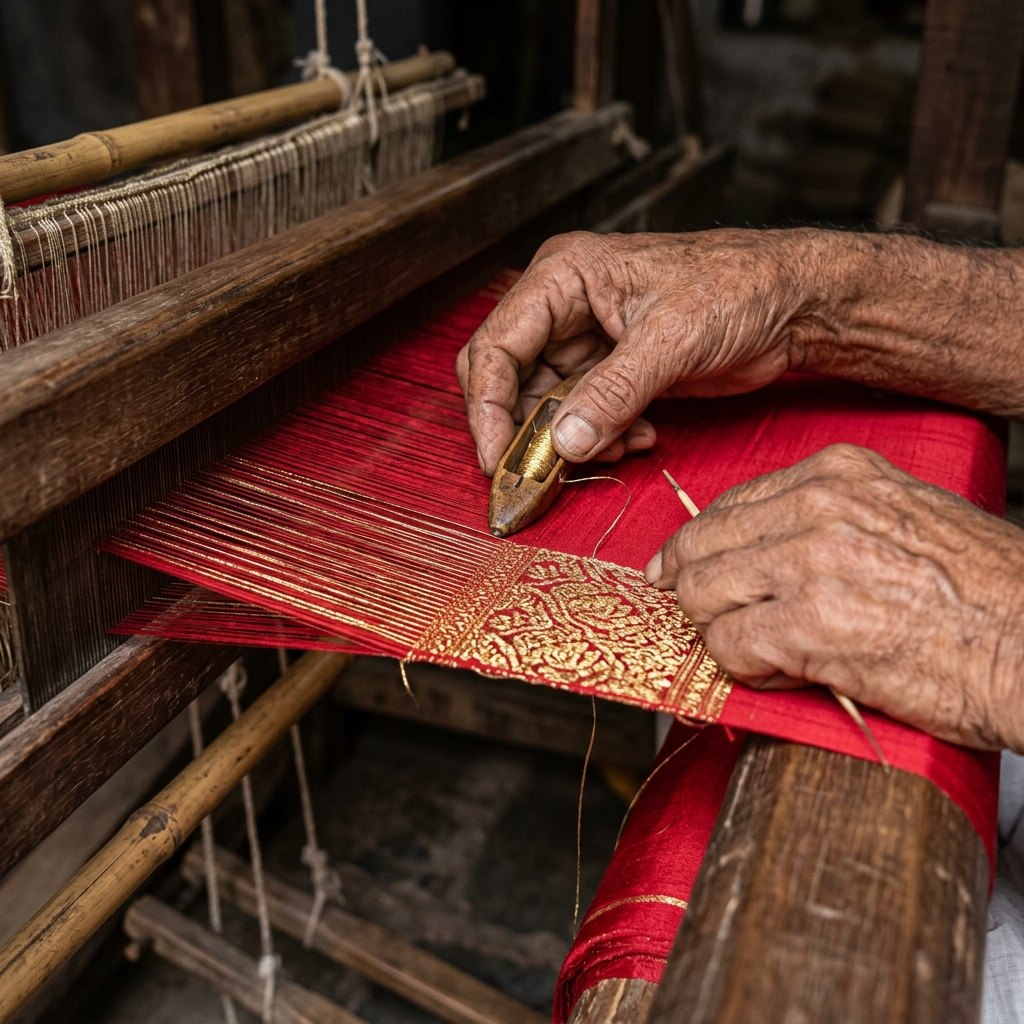
Brocade weaving in Varanasi — where patterns are handwoven thread by thread into the cloth.
Why Varanasi matters
Varanasi is not simply where these sarees happen to be made. It is a living craft ecosystem: master weavers, designers, dyers, zari specialists and finishers working within walking distance of one another, many from families who have practised the craft for generations.
That concentration of skill is difficult to replicate elsewhere, and it is the real reason "Banarasi" carries weight as a name. When you buy from a Varanasi manufacturer, you are buying from inside that ecosystem rather than from a reseller several steps removed from it.
Why Banarasi sarees are special
Three things set a Banarasi apart from an ordinary silk saree.
Craftsmanship over speed
A finely woven Banarasi is the result of days or weeks of skilled work — designing the pattern, translating it for the loom, preparing thousands of warp threads, weaving, and finishing. On the most intricate pieces, a weaver may progress only a few inches in a day. The value comes from that time and skill, not merely the final appearance.
Heritage you can wear
The motifs and methods have been refined across generations. Buying a Banarasi is, in a real sense, owning a piece of India's textile heritage and helping sustain the artisans who keep it alive.
Longevity
A well-made, well-cared-for Banarasi is not fast fashion. Many families wear one at a wedding and then keep it for the next generation. This is why we talk about a Banarasi as an investment rather than a purchase — the cost-per-wear over decades tells a very different story than the price tag alone.
The main types of Banarasi silk sarees
"Banarasi" describes where and how a saree is woven — but within that, there are many fabrics, each with its own weight, drape, and best occasion. Getting this right is the single most useful thing a first-time buyer can learn, because most disappointment comes from choosing the right saree for the wrong occasion.
| Type | Character | Weight | Best for |
|---|---|---|---|
| Katan silk | Pure silk from tightly twisted yarns; smooth, durable, timeless | Medium–heavy | Weddings, formal occasions, heirlooms |
| Tissue silk | Lightweight with a luminous, festive sheen | Light–medium | Receptions, festivals, evening events |
| Organza (Kora) | Light, crisp and sheer with woven motifs | Light | Day weddings, summer functions |
| Georgette / Khaddi | Soft and fluid with beautiful movement | Light–medium | Long events, easy draping |
| Tussar / Moonga | Textured natural-toned wild silk, rustic richness | Medium | Understated luxury, day wear, collectors |
| Dupion | Crisp with a subtle slub texture | Medium | Structured, statement drapes |
Explore each in our collections: Katan · Tissue · Organza · Khaddi Georgette · Tussar · Moonga · Dupion
Katan silk — the classic
Katan is what most people picture when they think "Banarasi". It is pure silk woven from tightly twisted yarns — the twisting is what gives it strength, a smooth surface, and a gentle rather than glaring sheen.
Katan holds structure beautifully. It drapes with weight and presence, which is exactly why it has always been the traditional choice for bridal and ceremonial wear. It also ages well: stored properly, a Katan saree remains wearable for decades. If you want one saree that will still look elegant in twenty years, start here.
Read our dedicated guide: Pure Katan Silk Saree — the timeless treasure.
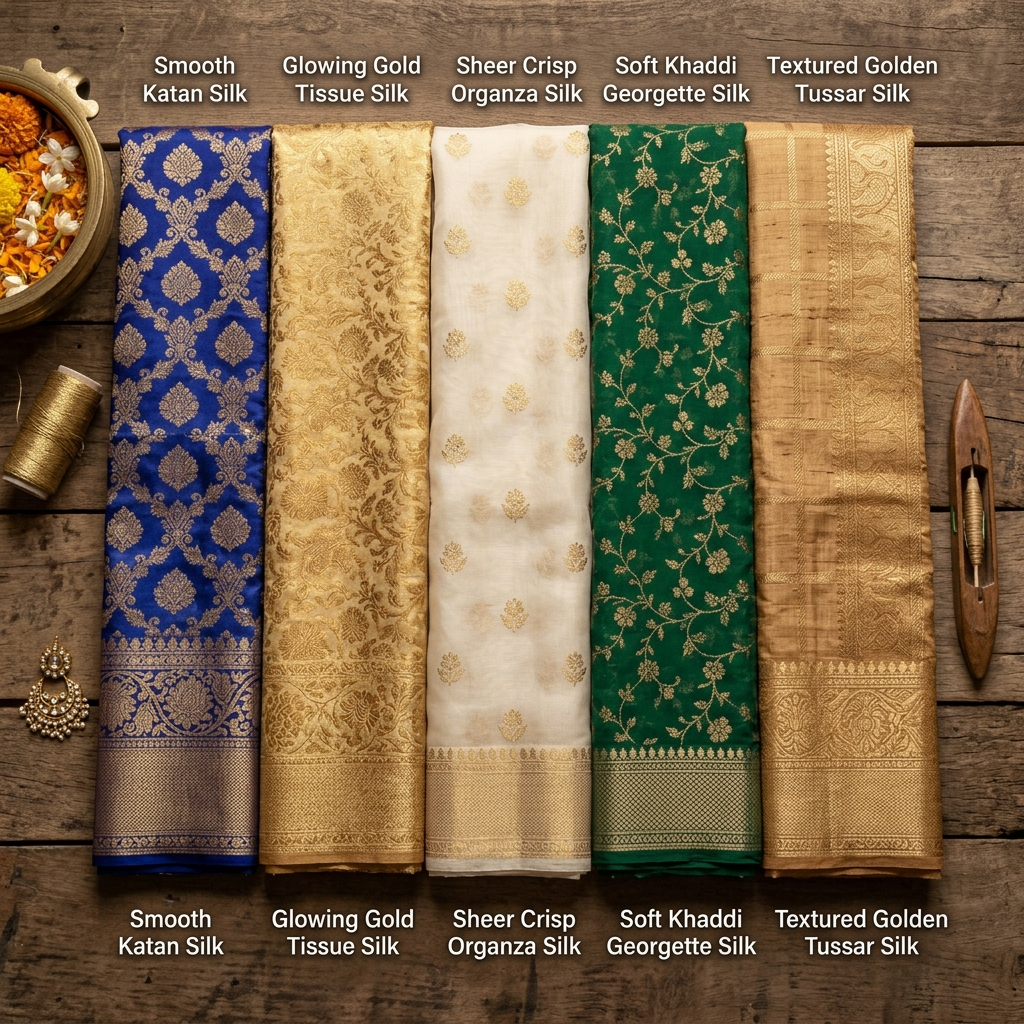
Banarasi silk varieties — each offering unique weight, sheen, and drape for specific occasions.
Tissue silk — festive and luminous
Tissue Banarasi sarees are prized for their light weight and soft, luminous shine. That glow comes from the weaving structure and the interplay of zari across the surface — not from any coating or finish applied afterwards.
The result is celebratory without being heavy. Tissue is a favourite for receptions and festive occasions where you want to catch the light and stand out gracefully, but still be comfortable through a long evening.
Organza (Kora) — light and contemporary
Organza — also called Kora — is light, crisp and slightly sheer. Banarasi Organza pairs that delicate base with traditional woven motifs, so it reads as modern and heritage-rich at the same time.
It is an excellent choice for daytime functions, warmer months, and younger buyers who find heavier silks daunting. Because the fabric is translucent, the woven motifs appear to float, which is much of its charm.
Georgette and Khaddi — soft drape
If pure Katan feels a little heavy, Georgette (and Khaddi Georgette) offers the Banarasi aesthetic in a softer, more fluid fabric. It moves beautifully, drapes easily, and is forgiving to wear for many hours.
This makes it ideal for wedding guests, for travel, and for anyone who wants authentic Banarasi weaving without the weight of a bridal-grade piece.
Tussar and Moonga — natural texture
Tussar and Moonga are wild silks with a naturally golden, textured tone. They read as understated luxury rather than glossy formality — quieter, earthier, and distinctly tactile.
They are popular with collectors and with buyers who prefer heritage character over shine. Read our Pure Moonga silk sarees guide.
Banarasi weaving techniques explained
Fabric is only half the story. How the pattern is woven often matters more — it is where the craftsmanship lies, and it explains most of the price difference between two sarees that look superficially similar.
Kadwa
Kadwa is regarded as one of the most intricate Banarasi techniques. Each motif is woven individually, rather than by carrying supplementary threads continuously across the back of the fabric. The practical consequence: no long floating threads behind the design, cleaner motifs that sit crisply on the cloth, and dramatically more time at the loom. Kadwa motifs can also be placed exactly where the designer wants them. This is the technique for buyers who care about detailed artistry and durability of the design.
Fekwa (Phekwa)
In Fekwa weaving, supplementary threads are carried across broader sections of the fabric to form motifs more efficiently, with the excess trimmed during finishing. Fekwa is not "lesser" than Kadwa — it simply suits different designs and price points, and produces beautiful results, particularly for all-over patterns. A trustworthy seller will tell you which technique a saree uses rather than implying everything is Kadwa. Suitability depends on the design and your priorities, not on one method being universally superior.
Jangla (Katan Jungla)
Jangla features dense, flowing all-over floral and vine compositions that cover the body of the saree. It is traditionally associated with ceremonial grandeur and bridal wear, and the sheer density of pattern makes it one of the most labour-intensive styles. See our Katan Jungla collection.
Meenakari
Meenakari adds coloured supplementary threads to highlight motifs, giving them a jewel-like, multi-toned quality. Crucially, this is a woven technique — it is not enamel work (as in Meenakari jewellery) and not embroidery added afterwards.
Good Meenakari demands real skill: the weaver manages multiple colours simultaneously while keeping the base pattern precise. Explore Katan Meenakari and read our Royal Meenakari feature.
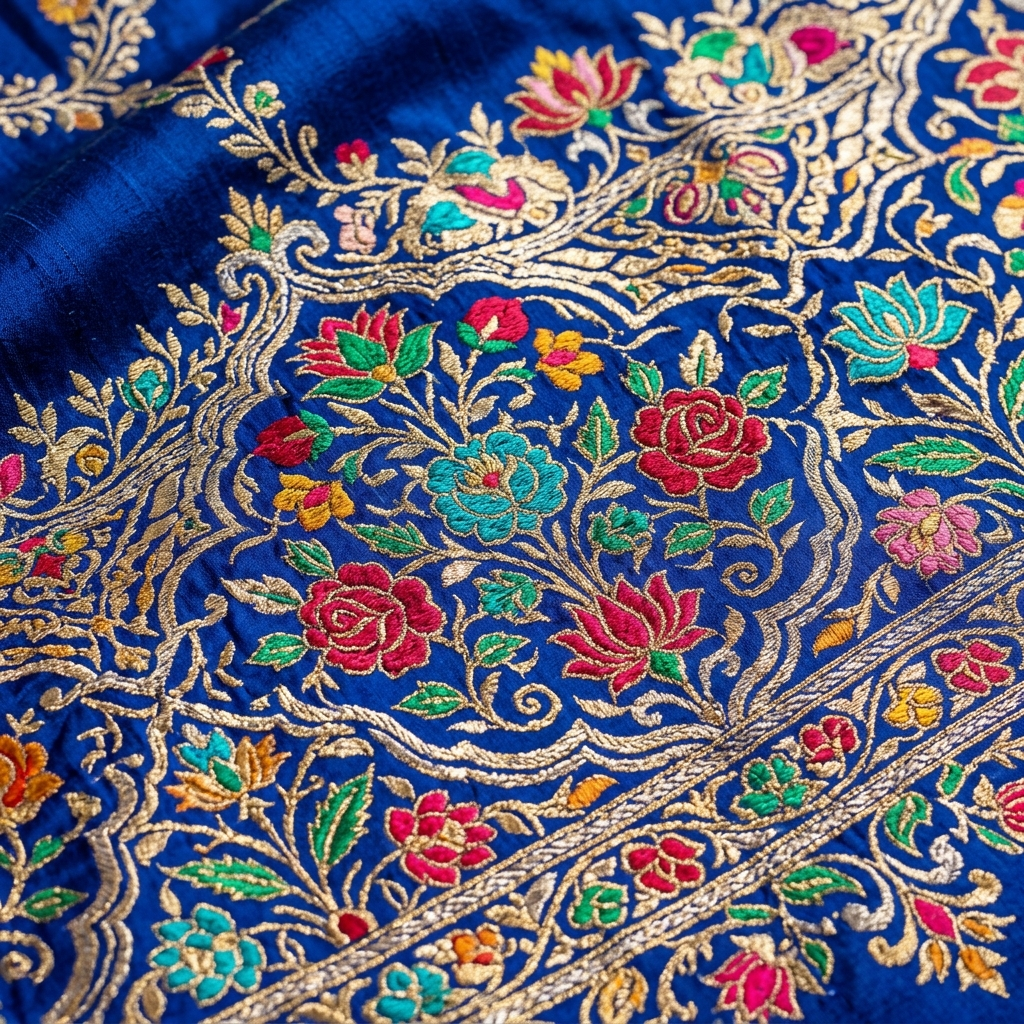
Meenakari weaving — adding vibrant colored silk threads alongside gold zari for jewel-like motifs.
Rangkat
Rangkat is recognised for artistic colour transitions — the saree shifts between colours in deliberate, harmonious blocks or gradients, creating visual depth across the length of the fabric. Its appeal lies in colour composition rather than loud pattern, which makes it a sophisticated choice. See the Rangkat collection and our Rangkat Katan guide.
Shikargah
Shikargah designs depict stylised hunting scenes — animals, birds and foliage arranged within elaborate compositions. They are among the most complex Banarasi designs to weave and are traditionally associated with the most elaborate ceremonial textiles. See our Shikargah collection.
Tanchoi and Jamawar
Tanchoi is characterised by richly patterned surfaces created without heavy zari emphasis — the pattern comes from the interplay of coloured silk threads themselves, producing a densely figured, satin-smooth fabric. Jamawar brings intricate, shawl-inspired all-over patterning to the saree form. Both suit buyers who want visual richness with understated shine. See our Jamawar collection.
Cutwork
Cutwork creates decorative woven patterns where excess floating thread is carefully trimmed during finishing. It offers intricate detailing while keeping the fabric lighter and more versatile — well suited to elegant everyday luxury rather than heavy ceremonial wear.
Zari and motifs: the language of a Banarasi saree
Understanding zari
Zari is the decorative metallic thread that creates a Banarasi saree's ornamental patterns. Historically, zari often incorporated precious metals — genuine gold or silver wound around a silk core. Today the material varies considerably by product and price point.
This matters commercially, so be direct about it: never assume a Banarasi contains real gold or silver zari unless it is explicitly specified. An honest seller will tell you exactly what a given saree uses. Where a saree genuinely uses precious-metal zari, we list it as such — for example in our Real Gold Zari collection.
Zari also affects how a saree behaves. Denser zari work adds weight and structure; lighter zari keeps a saree fluid and easier to drape.
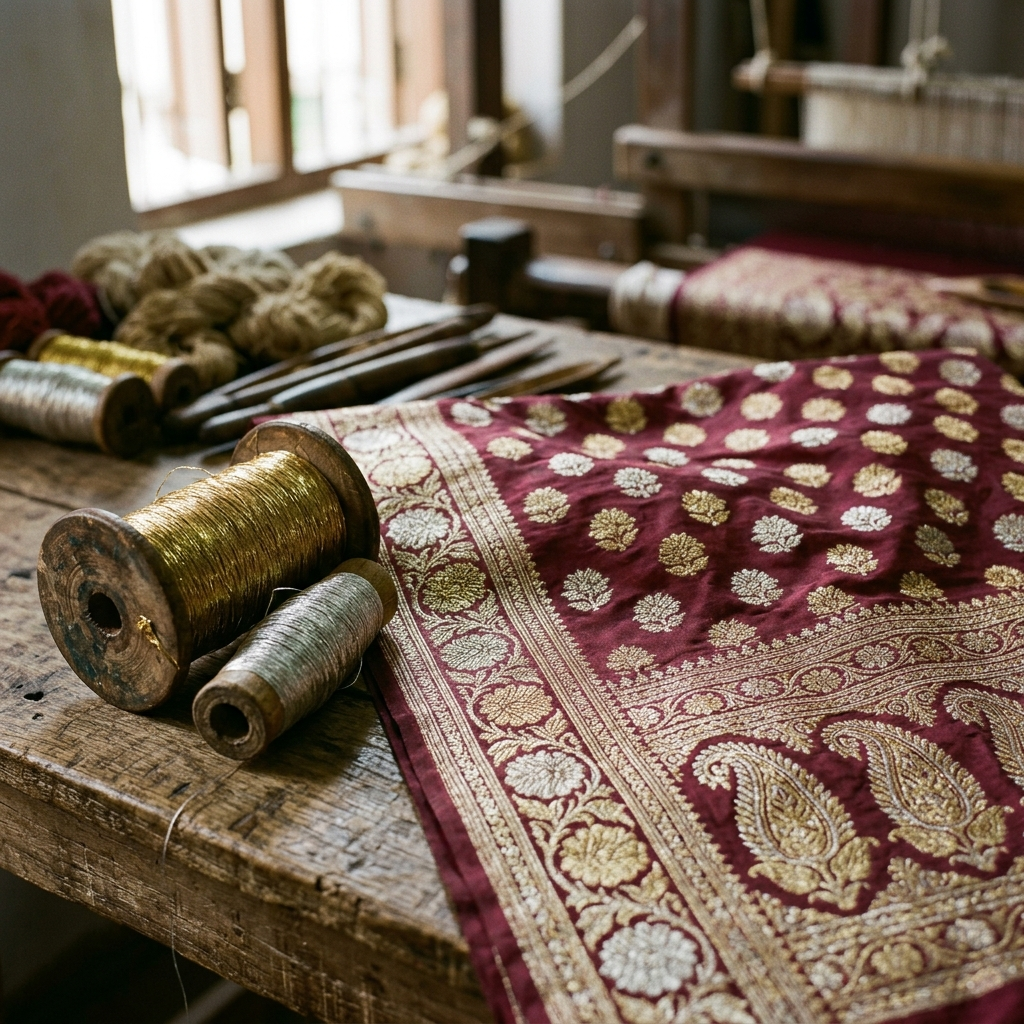
Zari thread spools and handwoven motifs — the ornamental signature of authentic Banarasi silk.
Reading the motifs
The motifs woven with that zari form a design language of their own, drawn mostly from nature and Mughal-era decorative art:
- Buti — small motifs repeated across the body of the saree
- Buta — a larger, more prominent motif than a buti
- Bel — flowing vine or creeper patterns, typically running along borders; a hallmark of Banarasi design
- Kalga — a stylised floral form inspired by Mughal decorative tradition
- Paisley — the familiar teardrop motif, associated with elegance and continuity
- Jhallar — a decorative border treatment placed between the body and the pallu
- Jaal — an interconnected all-over lattice, such as a floral jaal, creating visual continuity across the saree
Once you can read these, you stop seeing "a pretty pattern" and start assessing a saree the way experienced buyers do — noticing how well the bel resolves at the corners, whether the buti spacing is even, how cleanly the pallu design is executed.
How to tell if a Banarasi saree is genuine
This is the question we are asked most, and the honest answer is that no single test guarantees authenticity. Anyone promising one is overselling. A genuine Banarasi is judged on several factors together.
1
The seller and the source
This is the strongest signal. Buying directly from a Varanasi-based manufacturer removes layers of intermediaries and gives you someone accountable for what the saree actually is. Ask direct questions — fabric, weave technique, zari type, handloom or powerloom — and judge the quality and specificity of the answers.
2
Turn the saree over
Genuine woven brocade shows the pattern in reverse on the back, with floating threads (Fekwa) or individually woven motif reverses (Kadwa) clearly visible. A printed imitation shows a flat, faded version of the front with no thread work at all. This one check eliminates most fakes immediately.
3
Fabric, weight and finish
Real silk has a particular weight, warmth against the skin, and a soft rather than plasticky sheen. Look at the selvedge — the finished woven edge — and the overall finishing. Genuine handwoven pieces show neat, considered edges and a certain organic irregularity that machine-printed synthetics lack.
4
Certifications, where available
A Silk Mark label — issued by the Silk Mark Organisation of India, a body set up under the Central Silk Board — indicates the textile is made of pure natural silk. Each label carries a hologram and a unique number that can be traced back to the authorised user. Note that Silk Mark certifies the silk content, not the weaving origin, and the scheme is advisory rather than legally binding. The GI framework for Banaras Brocades and Sarees protects the regional origin of authentic Banarasi weaving. Neither is a magic guarantee on its own. Together with a credible source, they add real confidence.
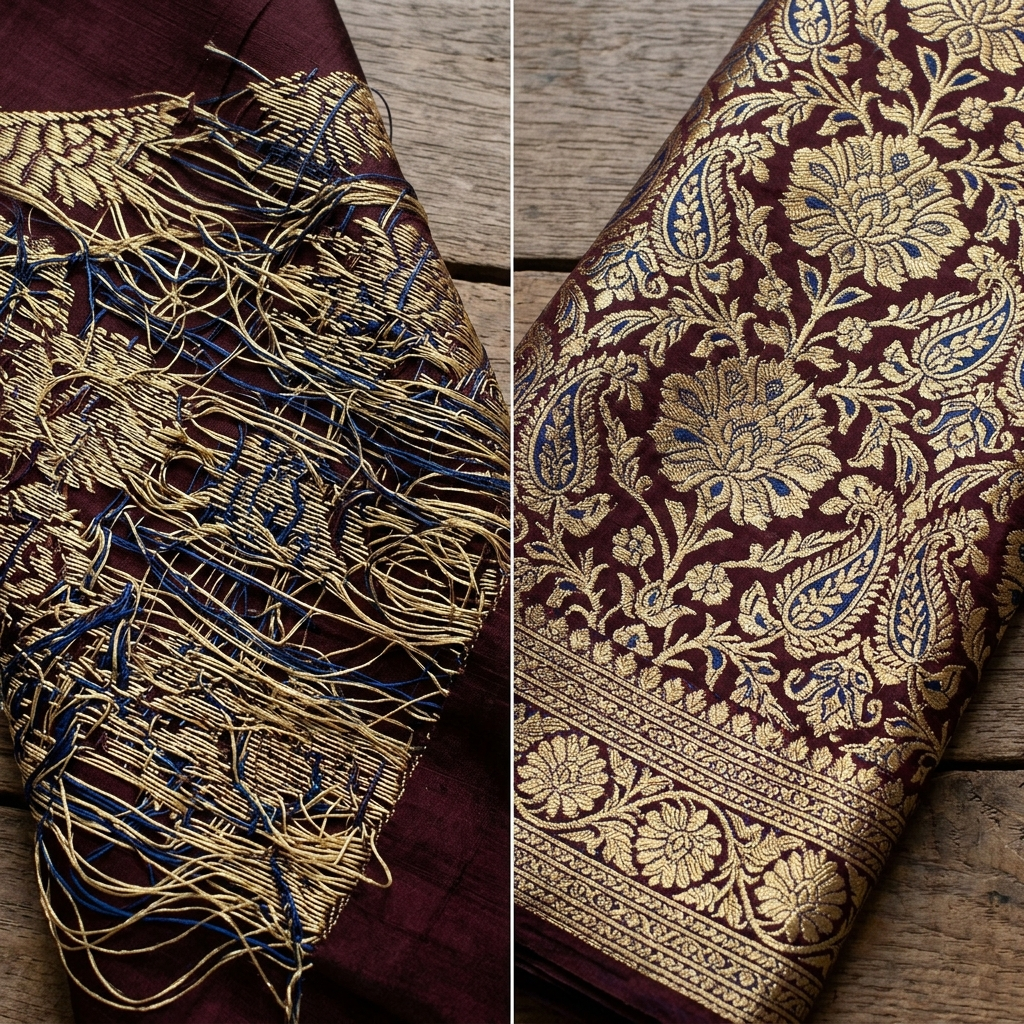
Turn it over: authentic woven brocade shows the reverse weave on the back, proving it was woven rather than printed.
What to be cautious about
- Anyone claiming a single quick test proves authenticity
- Blanket claims that every saree sold is "100% handloom" — Banarasi sarees are genuinely made on both handloom and powerloom, and honest sellers say which
- Assumptions that all zari is precious metal
- Prices dramatically below the market for comparable work; intricate weaving has an irreducible labour cost
For a deeper walkthrough, read our companion guide: How to Identify a Pure Banarasi Silk Saree — 10 expert tips.
Why Banarasi sarees vary so much in price
If you have compared Banarasi sarees, you will have seen enormous price differences. The reasons are concrete:
- Silk quality — the grade, purity and consistency of the yarn
- Zari — the type, quality and density of metallic thread, and whether it is precious-metal
- Weaving technique — Kadwa takes substantially longer than Fekwa for the same design area
- Handloom vs powerloom — handwoven pieces carry far more skilled human labour
- Design density — an all-over Jangla or jaal involves vastly more work than a plain body with a simple border
- Colour complexity — Meenakari and Rangkat require managing multiple colours simultaneously at the loom
- Finishing — quality of trimming, edge finishing and inspection
Price, in short, is largely a proxy for time and skill. This is why we encourage customers to understand what they are paying for rather than shopping on the number alone. A more expensive saree is not automatically better for you — but a suspiciously cheap "handloom Kadwa Katan" should prompt questions.
Which Banarasi saree should you choose?
A simple way to narrow it down by occasion:
| Occasion | Recommended choice | Why |
|---|---|---|
| Your wedding | Katan silk in Kadwa, Jangla or Meenakari | Structure, richness, heirloom durability |
| Reception / evening | Tissue, or Meenakari / Rangkat | Luminous colour, festive without heaviness |
| Daytime or summer function | Organza (Kora) or Khaddi Georgette | Light, breathable, easy to carry |
| Wedding guest | Georgette, Tissue or Organza | Elegant but comfortable for long events |
| Everyday luxury | Tussar or Moonga | Understated, textured, characterful |
| A gift | Classic Katan in a timeless colour | Broadly appreciated, safe and meaningful |
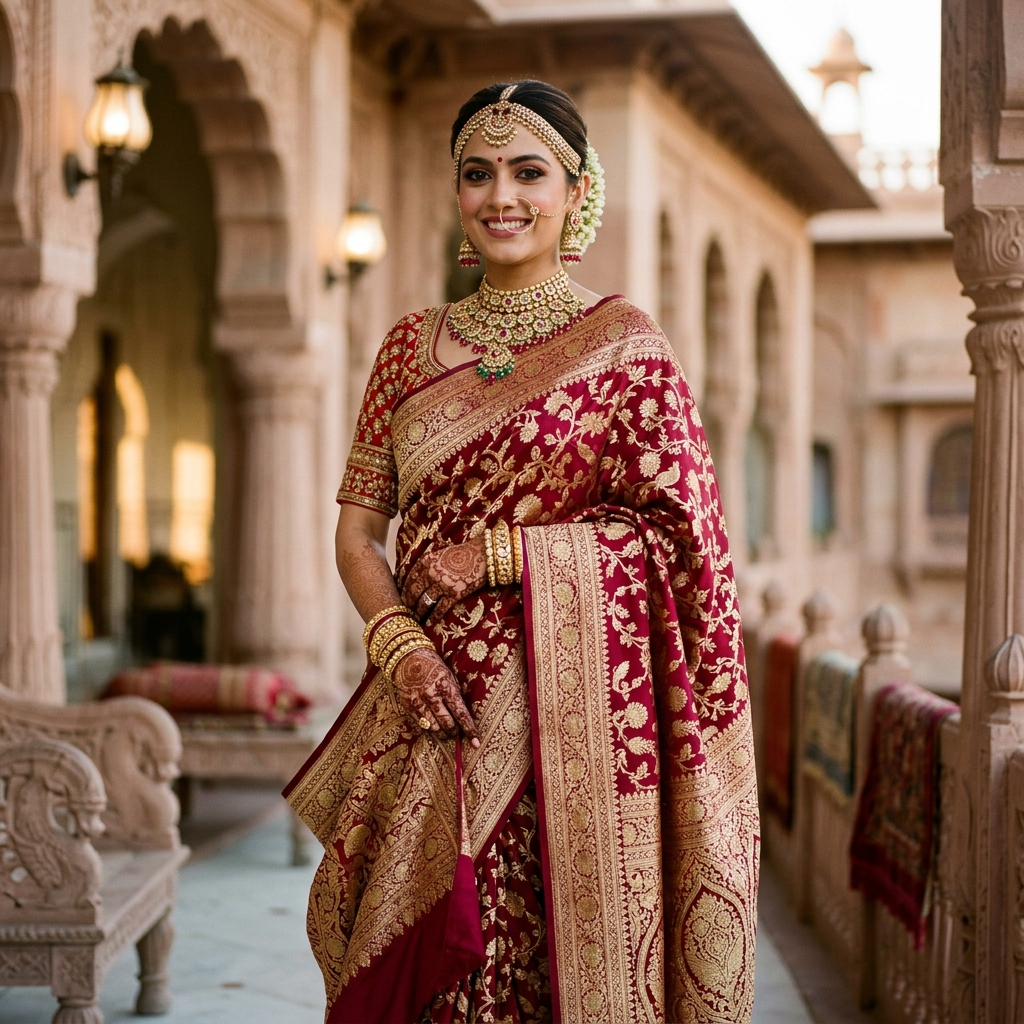
Choosing for a wedding: Pure Katan silk with rich Jangla gold zari motifs provides unmatched bridal grandeur.
Three practical questions to ask yourself before buying:
- How long will I be wearing it? Long events favour lighter fabrics.
- What season and time of day? Organza and Georgette suit heat and daylight; Katan and Tissue suit evenings.
- Is this for one occasion or for keeping? If it is meant to last generations, invest in Katan and better zari.
If you are still unsure, that is exactly what we are here for — tell us the occasion and we will guide you, not upsell you.
How to care for a Banarasi silk saree
A Banarasi rewards a little care with decades of life. The essentials:
- Store it wrapped in a breathable cotton or muslin cloth — never plastic, which traps moisture and can damage silk and zari over time.
- Refold it every three to four months along different lines, so permanent creases don't set into the silk or crack the zari.
- Keep it away from prolonged direct sunlight, which fades colour, and from damp, which invites mildew.
- Never spray perfume directly onto the fabric — alcohol can stain silk and tarnish zari.
- Clean delicate silk sarees through professional dry cleaning rather than machine washing.
- Avoid hanging heavy sarees for long periods; the weight can distort the weave. Fold and lay flat instead.
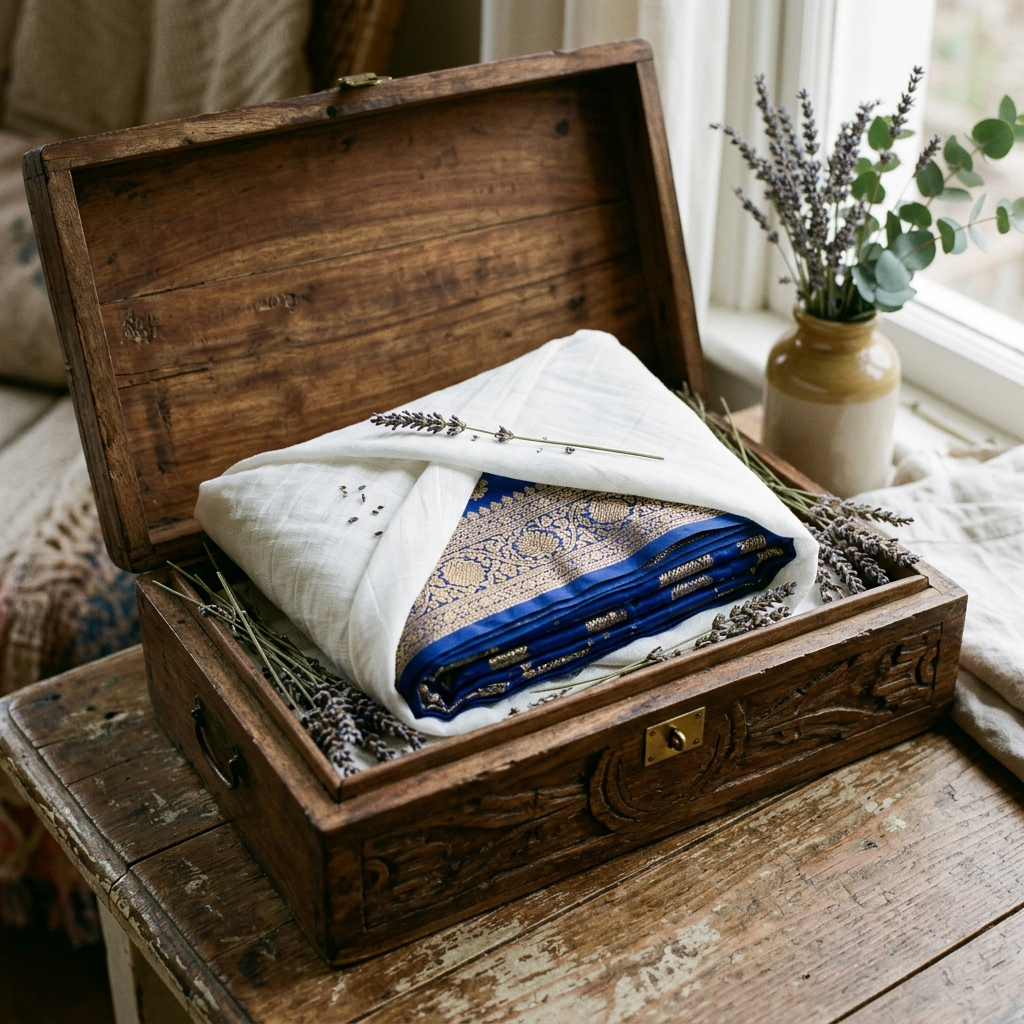
Proper storage: wrap your Banarasi saree in cotton or muslin cloth and refold periodically along different lines.
If a saree has been stored for years, air it gently in shade before wearing, and refold it along new lines afterwards. Treat it as the heirloom it is, and it will be ready for the next celebration — and the next generation.
Buying authentic Banarasi silk from Silk Khazana
Silk Khazana is a family-owned manufacturer weaving Banarasi silk in Varanasi since 1970. Buying directly from us means buying from the source — with control over quality, honest information about each saree, and personal help choosing the right one, whether you are in India or ordering from abroad with worldwide shipping.
What that means in practice: if you ask us what zari a saree uses, or whether it is handloom or powerloom, you will get a straight answer. If a saree is not right for your occasion, we will say so and suggest something that is.
Explore our collections by fabric and weave — Katan, Tissue, Meenakari, Organza and more — or browse the full shop.
For personal guidance, message us on WhatsApp at +91 63073 05873 and tell us your occasion; we are happy to help you choose with confidence. Planning a trip to Varanasi? Read our complete guide to buying Banarasi sarees in Varanasi.
Key Takeaways
- A Banarasi saree is defined by woven brocade — patterns created during weaving with zari, not printed or embroidered afterwards. Turning the saree over is the fastest authenticity check.
- Choose the fabric for the occasion. Katan for weddings and heirlooms, Tissue for receptions, Organza and Georgette for daytime and comfort, Tussar and Moonga for understated character.
- Authenticity comes from the source, not a single test. A credible Varanasi manufacturer who answers direct questions about fabric, weave and zari is worth more than any one label.