+9163073 05873 support@silkkhazana.in
Summer sale discount upto 30%! Shop Now

Mini Cart

Best Banarasi Saree Colours for Brides: How to Choose | Silk Khazana
Bridal 6 Min Read

Best Banarasi Saree Colours for Brides: How to Choose

Best Banarasi saree colours for brides: red, maroon, pink, green and more, with notes on tradition, daylight, zari tones and photographs.

Every bride is told to choose red. Many do, and it is a beautiful choice. But walk through a Banarasi showroom and you will see that bridal colour is wider, softer and more personal than a single rule.

This guide looks at the colours brides most often choose, what they traditionally mean to many families, and how to judge a colour properly before you commit.

Best Banarasi saree colours for brides: start with the conversation

Colour for a wedding is rarely a solo decision. Families often have views on what is auspicious, what is traditional for specific rituals and what the bride's side or the groom's side expects. Practices vary across regions and communities, so ask elders. If there is a tradition, you will want to know it before you fall in love with a shade.

Once that is settled, you can focus on what suits you.

The colours brides choose most

Red

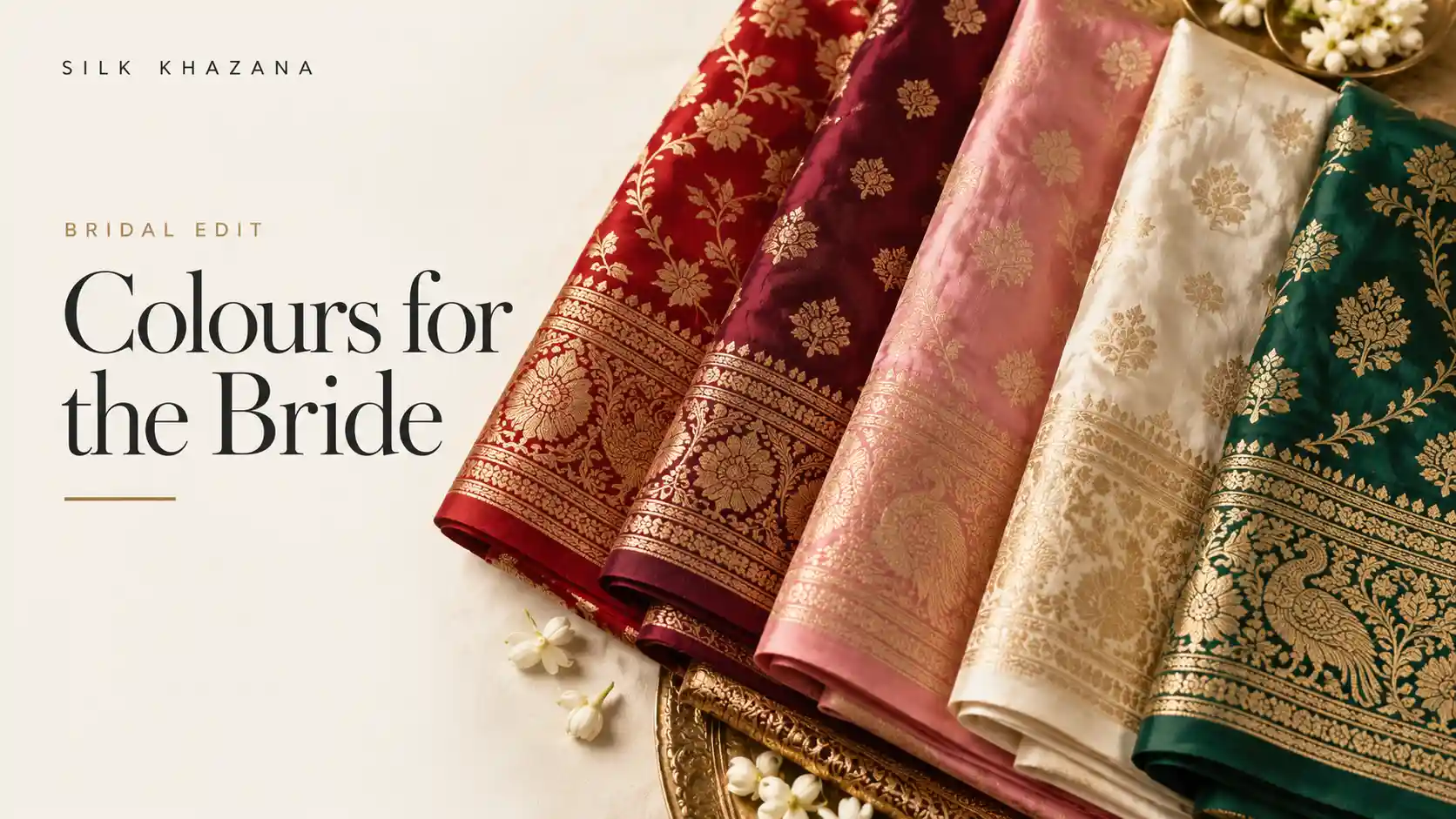
The classic. In many North Indian families red is closely associated with weddings and new beginnings. A red Banarasi, whether a deep crimson or a brighter vermilion, is made to catch ceremony light. Gold zari glows on it.

Maroon and deep wine

Richer and slightly more restrained than red. Maroon photographs beautifully and feels regal. It is a favourite for brides who want tradition without brightness.

Pink and rani

From soft rose to saturated magenta. Rani pink is a Banarasi signature, loved for its vibrancy and its pairing with gold and green.

Green

Associated with prosperity and freshness in many traditions. Emerald, bottle green and peacock shades are frequently chosen, especially for receptions and second functions.

Orange and saffron

Warm, bold and festive. Often chosen by brides who want a saree that stands out in photographs.

Yellow and haldi tones

Naturally associated with haldi ceremonies, and also with spring and renewal. A pale yellow organza or a mustard katan can be glowing.

Royal blue and deep teal

A confident, modern choice. Blue with gold zari looks regal.

Ivory, champagne and soft pastels

Increasingly popular for receptions, court weddings and day ceremonies, especially in tissue or organza. Pair with antique gold or silver zari.

Colour, zari and the effect together

The colour of the zari changes the personality of the base colour.

Base colourZari toneEffect
RedBright goldClassic, festive
MaroonAntique goldRegal, restrained
PinkGold or silverFresh or cool
GreenGoldRich, traditional
BlueSilver or antique goldModern, elegant
IvoryAntique goldSoft, sophisticated

Our guide on real vs fake zari explains the types of zari you may meet.

How to judge a colour properly

Colour lies. A shade that looks perfect under showroom lamps can look different outdoors, and different again in a photograph.

  • 1. Look in natural light. Ask to take the saree near a window or to a doorway.
  • 2. Look in lamp light. Weddings are often evening events. See how the saree behaves under warm light.
  • 3. Look at the zari from different angles. Metal reflects, so the base colour can change.
  • 4. Compare with your jewellery. Hold the saree against your gold or stones.
  • 5. Take a photo, but trust your eyes. Cameras can shift reds into orange and pinks into magenta.
  • 6. Consider the blouse and dupatta. The colour will repeat in other pieces. See our blouse guide.

Think about the setting

  • Daytime ceremony outdoors: lighter or brighter colours, such as pink, yellow, orange, sage or ivory, can look luminous.
  • Evening ceremony or reception: deeper tones, such as maroon, emerald, navy and wine, glow under light.
  • Summer wedding: lighter fabrics in soft shades are more comfortable and look cooler.
  • Winter wedding: velvet blouses and deeper tones feel natural.

Colour and fabric: a note on dye

Rich reds, deep blues and dark greens use strong dyes. Ask how the colour will behave with cleaning, and follow the care advice. Avoid sprinkling water or perfume on deep colours, and dry clean with a cleaner who handles zari. See our guide on caring for Banarasi silk.

Choosing for a second function

Many brides plan a heavy katan for the main ceremony and a lighter saree for the reception or the next day. A good approach is to choose a second colour that complements the first, such as a deep green after a red, or a champagne tissue after a maroon. It keeps the outfits distinct but harmonious. For a lighter look, explore tissue silk or organza.

Mistakes to avoid

  • Choosing colour from an online photo alone
  • Ignoring the lighting of the venue
  • Forgetting that the zari colour changes the whole effect
  • Picking the trend of the season over the shade you love
  • Not asking elders about ritual preferences

Further reading on best banarasi saree colours for brides: Banarasi sari on Wikipedia.

Planning for the festive season? See our Karwa Chauth saree guide and our Diwali Banarasi saree guide.

Key takeaways

  • Red, maroon, pink, green, orange and blue are the colours most chosen for Banarasi brides, with pastels rising for receptions.
  • Ask elders about traditions before you fall for a shade.
  • Judge colour in daylight and lamp light, with the zari from several angles.
  • Plan a second-function colour that complements the first.

Frequently Asked Questions

Red and maroon are the most traditional for many families, with pink, green, orange and blue also popular. The best colour combines family tradition with what suits you.

No. Red is widely loved, but many brides choose other colours based on family customs, personal taste and the time of day.

Deep reds, maroons, emeralds and royal blues usually photograph richly. Check the saree under the type of light you will have on the day.

Gold is classic. Antique gold and silver suit blues, ivories and pastels. Try the saree with your jewellery.

Yes. Many brides choose ivory, champagne or soft pink, particularly for receptions and day ceremonies.

Ask for photos in natural light and a video call. Screens can distort colour, so confirm with the seller before ordering.

Message us on WhatsApp at +91 63073 05873 or visit our Varanasi showroom, and we will walk you through best banarasi saree colours for brides with the saree in your hands.

Browse Katan Meenakari Sarees

Looking for best banarasi saree colours for brides? We manufacture Banarasi silk in Varanasi and have done since 1970, selling directly, so you can ask us anything about a saree and get a specific answer.

Not sure what suits you? Message us on WhatsApp at +91 63073 05873 and tell us the occasion. Visit us: J 14/180, opp. Chhavi Mahal Cinema, Qazi Sadullah Pura, Jaitpura, Varanasi 221001.
Banarasi Bridal Saree Guide: Choosing Your Wedding Saree | Silk Khazana
Bridal 14 Min Read

Banarasi Bridal Saree Guide: Choosing Your Wedding Saree

A complete guide to choosing a Banarasi bridal saree: fabrics, weaves, zari, colours, weight, timelines, customisation and care, from a Varanasi weaving family.

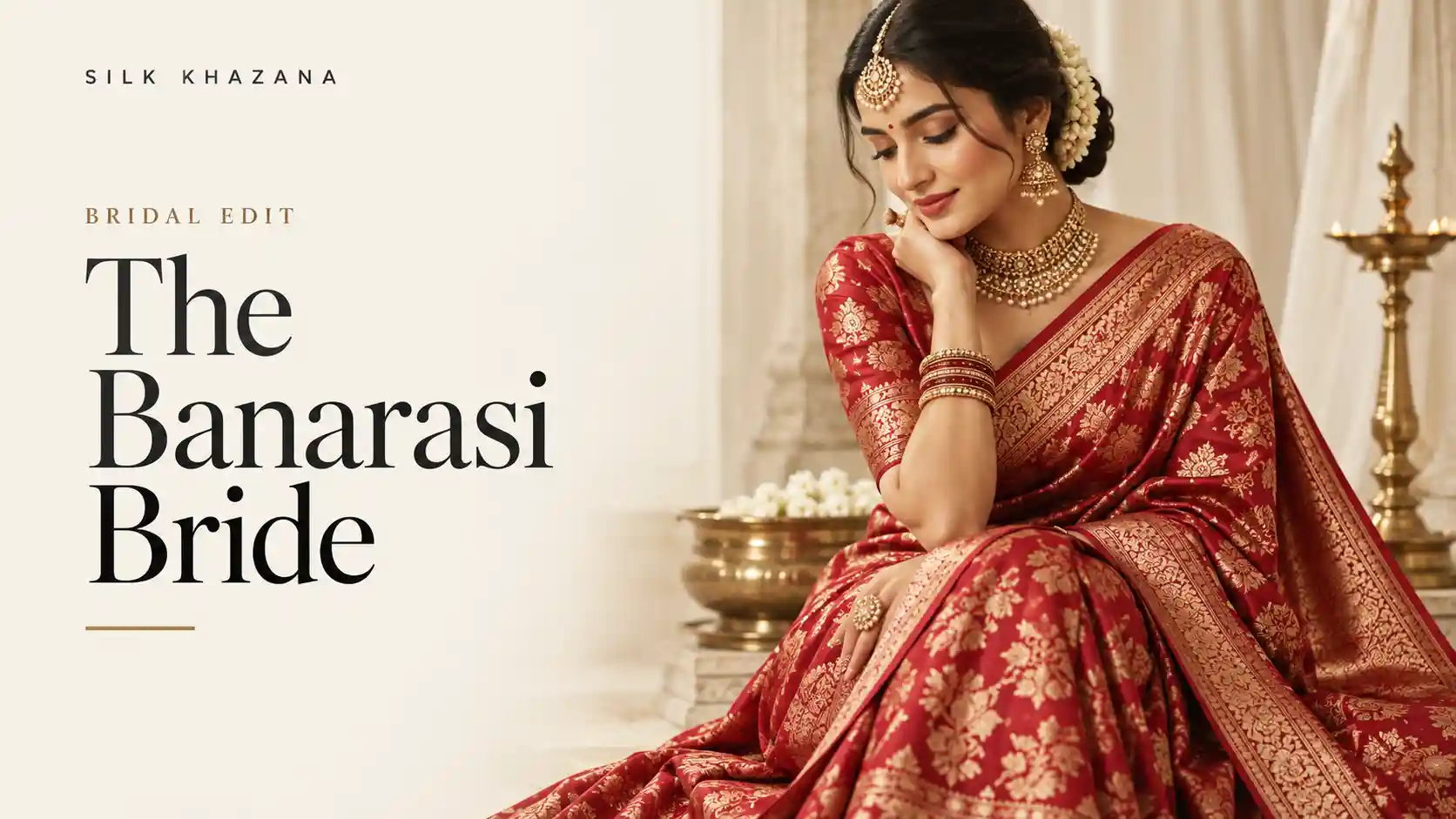
Almost every Banarasi family has a wedding story that includes a saree. A mother who still talks about the red one she wore in the 1980s. A grandmother's pallu, kept folded in muslin for four decades. A sister who rejected twenty sarees and chose the twenty-first in under a minute.

Choosing a bridal saree is not like choosing any other outfit. It will be looked at for hours, photographed for years and, if you look after it, passed on. This guide is meant to make that choice calmer. It covers the fabrics and weaves worth knowing, how zari and weight affect the look and the price, what to ask in the showroom, and how to plan the timeline. We make Banarasi silk at our family unit in Varanasi, and what follows is what we tell brides and their families who walk into the showroom.

What makes a Banarasi bridal saree?

There is no rule. A bridal Banarasi saree is simply one chosen for the wedding itself. In practice, such sarees share some traits:

  • Richness. Dense weaving, a heavy pallu and substantial borders.
  • Zari work. Gold, silver or antique tones that catch light in photographs and in ceremony lamps.
  • Colour with meaning. Red, maroon, pink, green, orange and gold have long associations with weddings in many North Indian families.
  • Presence. The saree should look settled and stately when you stand, sit and walk.
  • Heirloom potential. A good bridal Banarasi is made to be kept.

Some brides prefer something lighter and more modern, such as a tissue or organza for a day ceremony, and that is just as valid. The right choice depends on the family, the rituals and the bride.

The fabrics and weaves worth knowing

This is where most confusion begins. Here is a plain guide to the main bridal choices.

Weave or fabricWhat it isWhy brides choose it
KatanPlain-weave silk from twisted filament yarn, firm and durableThe traditional bridal base. Rich drape, long life
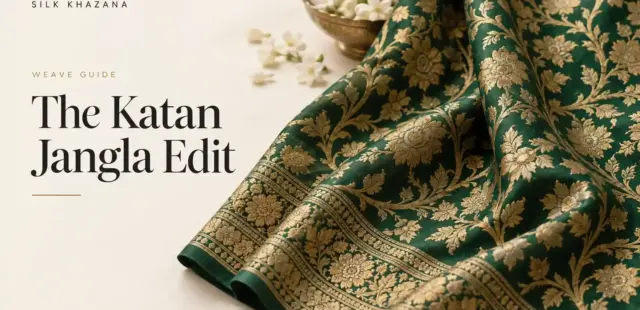
Katan JanglaDense jaal of leaves, vines and flowers across the sareeOpulent, covers the saree in pattern
MeenakariColoured silk threads woven in, like enamel on jewelleryVivid colour detail, lively look
RangkatMultiple colours blended in a single sareePainterly, colourful, distinctive
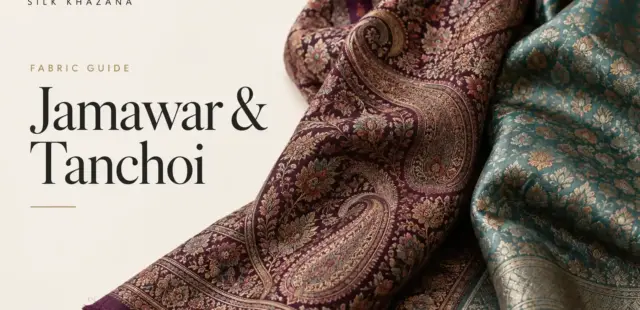
JamawarShawl-inspired, dense, multicoloured weavingHeavy, regal, collectible
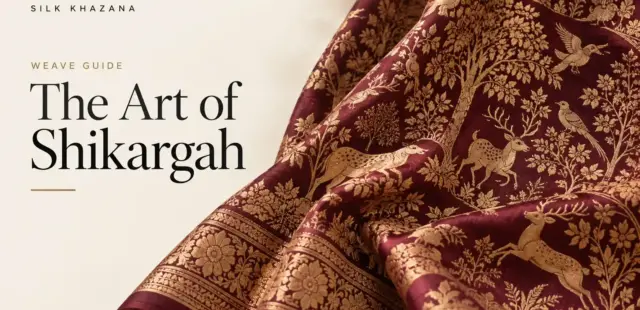
ShikargahHunting-scene figures among foliageA collector's saree with narrative detail
TissueZari weft through the body for an all-over glowLight, shimmering, ideal for receptions
Organza / KoraSheer, crisp silk with floating motifsDay functions, second looks

For deeper dives, see our guides on katan jangla, Meenakari, Rangkat and Jaal, Jamawar and Tanchoi, Shikargah and tissue silk.

For the ceremony itself, most brides land on a katan-based saree, because it combines weight, richness and durability. Lighter fabrics usually appear in the second or third look.

Zari: the part that shapes the price and the glow

Zari is the metallic thread that makes brocade glitter. On a bridal saree there is a lot of it, which is why zari type matters more than on any other saree.

Broadly, zari comes in three qualities: pure (silver wire plated with gold), tested (a lower-silver or copper-based wire) and imitation (metallised film). Pure zari costs the most, ages like fine jewellery and can tarnish gently over time. Imitation costs far less and looks bright, but it does not age as gracefully. Our guide on real vs fake zari explains how to check, and why Banarasi sarees are expensive explains how zari, silk and weaving time combine into a price.

The honest rule: ask what the zari is, and ask for it to be written on the invoice.

Handloom or powerloom?

Both are used across the Banarasi market, and both are priced and described differently. A handloom bridal piece with dense work can take a weaver or a pair of weavers weeks, sometimes longer, depending on the design. Powerloom can reproduce similar looks faster and cheaper. Neither is wrong. What matters is that the label matches the cloth. Read handloom vs powerloom before you shop, and ask directly.

Weight, comfort and how it wears

A bridal saree is worn for many hours. Weight is not a minor detail.

  • Katan with heavy zari has presence and structure but takes some carrying. Practise your drape in advance.
  • Tissue and organza are lighter and easier to move in.
  • Pallu weight matters. A very heavy pallu can pull on the shoulder pin. Ask to try the saree on, or at least drape it over your arm.
  • Climate. For summer weddings, a lighter option or a lighter second look can save the day.

If you are unsure, hold the saree up and let the pallu fall. The way it hangs tells you more than a photograph.

Colours that have long been loved for weddings

Colour is a family conversation as much as a personal one. Red and maroon remain central for many families, followed by pink, green, orange, gold and deep blue. Elders may have views about colour for specific rituals, and some communities follow particular traditions. Our guide to the best Banarasi saree colours for brides looks at colour in detail, including how to judge it under daylight and flash.

Two practical points:

  • Look at the saree in natural light. Showroom lamps can flatter or flatten a shade.
  • Think about the zari colour as well as the base. Antique gold feels different from bright gold or silver.

Building the whole look

A bridal saree is the centrepiece of a set of choices.

Blouse. The blouse piece comes with the saree, and you may choose to have it stitched in the same fabric or in a contrast. See our blouse design guide for necklines, sleeves and backs.

Drape. Practise your draping style, since a heavy saree behaves differently from a light one. Our guide to draping a Banarasi saree shows six styles.

Fall and pico. Ask for the fall to be stitched and the edges finished before the wedding. It prevents fraying and helps the saree sit properly.

Jewellery. Heavy sarees pair well with simpler necklaces, and lighter sarees allow more statement. Think of the saree and the jewellery as taking turns.

When to start, and how to plan the timeline

Do not leave the saree for the last week. Start earlier than feels necessary.

  • 1. Three to six months ahead: Begin looking. Decide your colour palette, budget range and the rituals needing a saree.
  • 2. Two to three months ahead: Shortlist, ask about customisation, finalise blouse and fall work.
  • 3. One month ahead: Do a full trial in the saree, blouse and jewellery.
  • 4. The final weeks: Collect the saree, confirm fall and pico, plan storage.

If you plan to commission something to be woven, ask openly how long the piece will take. Weaving time depends on the design, the density and the loom. We can tell you what is realistic once we know what you have in mind.

What to ask in the showroom

  • What is the fibre? Is it pure silk, and does it carry the Silk Mark?
  • Is it handloom or powerloom?
  • What type of zari is it?
  • How heavy is the saree, and how heavy is the pallu?
  • Can I see the back of the weaving?
  • What colour options are available in this design?
  • Can the saree be customised? If so, how long will it take?
  • What is the care advice for this piece?

Shopping from far away

Many of our brides begin their search from another city or country. If you cannot visit Varanasi, you can still shop with care. Ask for photos in natural light, close-ups of the zari and the back, and a video call so you can see the saree move. Our guides on buying Banarasi sarees online safely and buying Banarasi silk from India as an NRI cover what to check.

Visiting Varanasi to shop

If you can make the trip, it is worth it. Seeing the weave, touching the fabric and talking to the people who make it changes how you choose. Plan a few hours rather than a quick stop. Bring the blouse measurements, photographs of your jewellery and any colour swatches from the wedding. Our guide to buying Banarasi sarees in Varanasi covers the practical side.

After the wedding

A bridal saree deserves to outlive the day.

  • Air it for a few hours in the shade before folding.
  • Dry clean only if needed, using a cleaner who handles zari.
  • Store it folded in muslin, with tissue between layers, away from damp. See how to store Banarasi silk sarees.
  • Refold along different lines every few months to protect the creases.
  • Keep a note of the date, the occasion and who wore it. Future generations will thank you.

Common mistakes to avoid

  • Choosing by a photo alone, without seeing the pallu fall
  • Buying the heaviest saree, then struggling to carry it for six hours
  • Leaving blouse stitching to the final week
  • Forgetting to check the zari type
  • Skipping a full dress trial

Further reading on banarasi bridal saree: Banarasi sari on Wikipedia.

Key takeaways

  • A bridal Banarasi is defined by richness, zari and presence, and katan is the traditional base.
  • Ask about fibre, loom and zari, and have the answers written down.
  • Weight and comfort matter as much as colour.
  • Start three to six months ahead, and do a full trial before the day.
  • Plan the afterlife of the saree: air, fold in muslin and store with care.

Frequently Asked Questions

Katan is the traditional choice for its weight, richness and durability. Tissue, organza or georgette work well for lighter second looks.

It depends on the silk, the zari, the density of the weave and whether it is handloom. A heavily woven pure-zari piece costs far more than a lighter one. Read why Banarasi sarees are expensive for the factors.

Red and maroon remain central for many families, along with pink, green, orange, gold and deep blue. Family traditions and ritual customs can guide the choice.

Begin three to six months before the wedding if you can. That leaves room to shortlist, customise and complete blouse and fall work without hurrying.

Often, yes. Colour, border and blouse options can sometimes be adjusted. Timelines depend on the design, so ask early.

Ask the seller to state the zari type in writing, then use simple checks. See our guide on real vs fake zari.

No, but you should know what you are buying. Handloom and powerloom are both used, and the label should match the cloth.

Air it, fold it in muslin, keep it away from damp and refold along different lines every few months.

Message us on WhatsApp at +91 63073 05873 or visit our Varanasi showroom, and we will walk you through banarasi bridal saree with the saree in your hands.

Browse Katan Silk Sarees

Looking for banarasi bridal saree? We manufacture Banarasi silk in Varanasi and have done since 1970, selling directly, so you can ask us anything about a saree and get a specific answer.

Not sure what suits you? Message us on WhatsApp at +91 63073 05873 and tell us the occasion. Visit us: J 14/180, opp. Chhavi Mahal Cinema, Qazi Sadullah Pura, Jaitpura, Varanasi 221001.

Sign Up Newsletter

Sign up our newsletter and save 25% off for the next purchase!

Subscribe to our newsletters and don’t miss new arrivals, the latest fashion updates and our promotions.