+9163073 05873 support@silkkhazana.in
Handwoven Banarasi silk, direct from our Varanasi weaving family. Shop Now

Mini Cart

Tanchoi Banarasi Saree and Jamawar: A Complete Guide | Silk Khazana
Fabrics 6 Min Read

Tanchoi Banarasi Saree and Jamawar: A Complete Guide

Tanchoi Banarasi saree and Jamawar explained: how the weaves differ, what to look for when buying, and how to style and care for them.

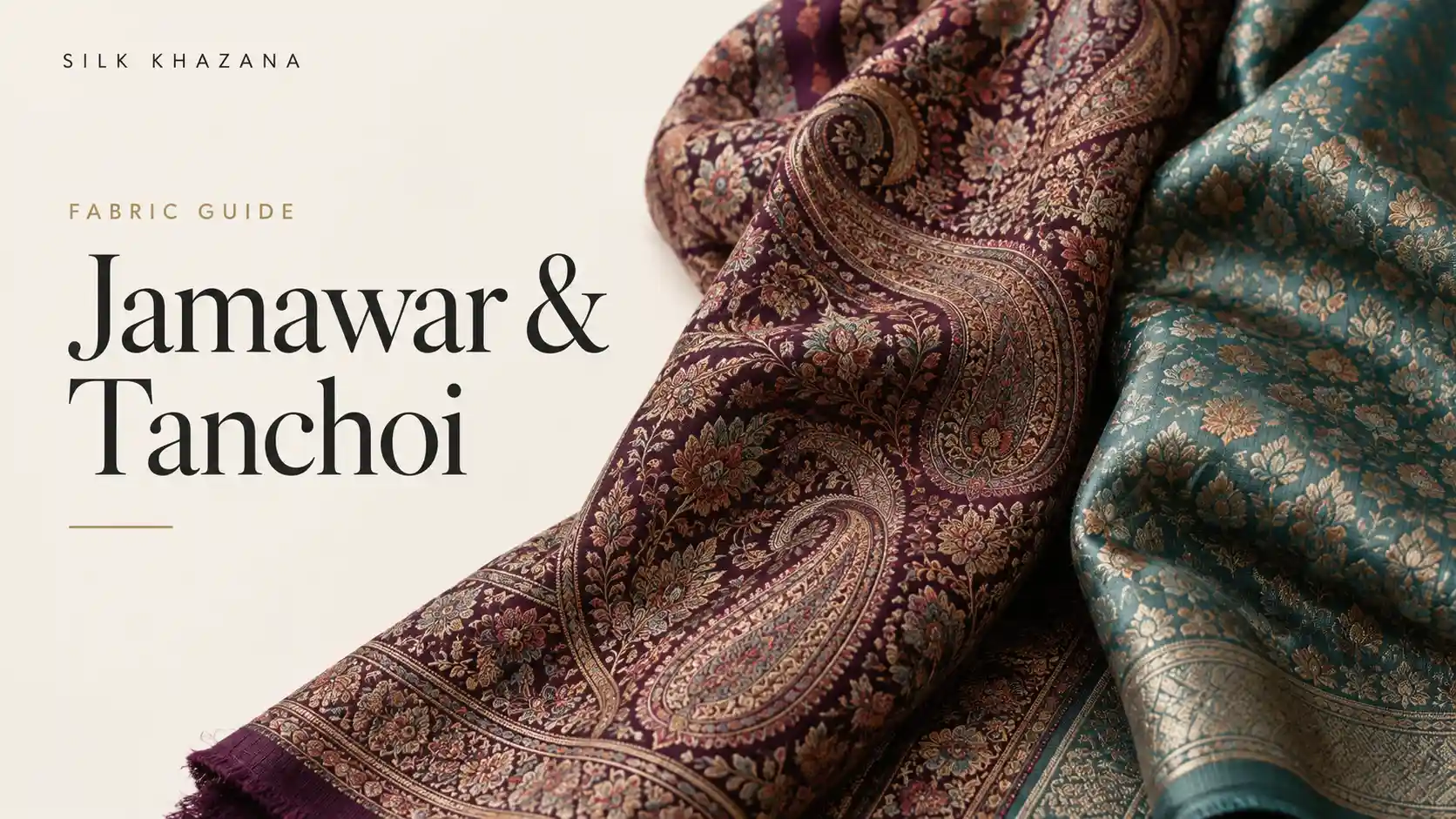
If a katan is a grand hall, Jamawar and Tanchoi are two very different rooms inside it. One is thick with colour and pattern, shawl-rich and regal. The other is quiet, almost whispering, with a pattern that appears only when light finds it.

Both are classics of Banarasi weaving, and both are often misunderstood. This guide explains what they are and how to choose between them.

What is a Jamawar saree?

A Jamawar saree is a richly patterned Banarasi, densely woven in multiple colours, in a style inspired by the Jamawar shawls of Kashmir. Those shawls are known for their packed floral and paisley designs. The Banarasi version translates that richness into silk and zari.

What you see: a dense, almost carpet-like pattern of paisleys, flowers and vines, in several colours, often covering the whole saree.

How it feels: heavy, luxurious and substantial. It is a statement saree.

Techniques: the detailed pattern is typically built using supplementary threads that create the raised design, a bit like brocade.

Best for: brides, collectors and formal occasions, particularly in cooler weather.

What is a Tanchoi Banarasi saree?

A Tanchoi is a subtle, tone-on-tone weave with a fine, satin-like surface. The pattern is formed by supplementary silk threads in the same or a closely related colour as the ground, so the design shows through softly as the fabric moves.

What you see: small, delicate motifs such as paisleys, leaves and florals, finely rendered, usually in the same colour as the base.

How it feels: smooth, refined and dense. The surface has a quiet sheen.

A distinctive feature: a well-made Tanchoi is neat on the reverse, with no long floating threads at the back.

Origin story: the technique is traditionally associated with weavers who learned it from Chinese masters, and it was later adopted in Banaras and other centres. The details vary by account, so we hold the story lightly.

Best for: daytime events, understated formal wear and anyone who prefers refinement over display.

Jamawar vs Tanchoi at a glance

JamawarTanchoi
CharacterDense, multicolour, shawl-likeSubtle, tone-on-tone
PatternPacked paisleys and floralsSmall, delicate motifs
ColourSeveral colours togetherMostly one colour
WeightHeavyMedium, dense
SurfaceRaised, texturedSmooth, satin-like
MoodRegal, opulentQuiet, elegant
OccasionsWeddings, grand ceremoniesDay events, formal gatherings

Which one suits you?

  • Choose Jamawar if you want drama, presence and a piece that looks like heritage.
  • Choose Tanchoi if you want grace, subtlety and a saree that does not shout.
  • Choose a Jamawar-inspired Banarasi if you want the shawl look in a lighter form.

Think also about the colour and the occasion. A rich red Jamawar is a ceremony saree. A soft sage Tanchoi is a luncheon saree.

What to look for when buying

  • 1. Pattern clarity. In Jamawar, the motifs should be crisp and the colours well separated. In Tanchoi, the tone-on-tone patterns should be sharp.
  • 2. The back of the weave. A neat reverse points to careful work. For Tanchoi, a clean back is a mark of quality.
  • 3. Drape and weight. Hold the saree up and let it fall. Does it hang well?
  • 4. Fibre, loom and zari. Ask in writing. See handloom vs powerloom and real vs fake zari.
  • 5. Colour quality. Look at colours in natural light. Strong dyes can behave differently under cleaning.

Styling

Jamawar. Because the saree is already busy, keep the blouse simple, in a solid colour drawn from the saree. Choose jewellery that complements, with fewer pieces and a clear focal point. Draping styles that show the pallu, such as the Gujarati drape, suit it. See our draping guide.

Tanchoi. Let it be quiet. A contrast blouse in raw silk or velvet gives definition, and delicate jewellery suits the refined surface. A neat Nivi drape shows the sheen.

Care

Both need gentle, regular care.

  • Dry clean with a specialist who knows silk and zari.
  • Store folded in muslin, with tissue between layers. Heavy Jamawar benefits from lying flat.
  • Refold every few months along new lines.
  • Keep away from perfume, damp and rough surfaces.

See our storage guide for the full routine.

Further reading on tanchoi banarasi saree: Banarasi sari on Wikipedia.

Key takeaways

  • Jamawar is dense, multicolour and shawl-inspired. Tanchoi is subtle, tone-on-tone and satin-like.
  • Jamawar is for drama. Tanchoi is for quiet elegance.
  • Check the back of the weave, the pattern clarity and the drape.
  • Ask about fibre, loom and zari whichever you choose.

Frequently Asked Questions

A densely woven, multicolour Banarasi saree inspired by Kashmiri Jamawar shawls, with packed paisleys and florals.

A fine, tone-on-tone weave in which supplementary threads create delicate motifs on a smooth, satin-like surface.

Usually, yes. It is a substantial saree, suited to ceremonies and cooler weather.

It can be, especially for day events and guests. For a bride's main ceremony, a heavier katan or Jamawar is more common.

Look for crisp motifs, a smooth surface and a neat reverse with no long floating threads.

Dry clean with a specialist, store folded in muslin and refold every few months.

Message us on WhatsApp at +91 63073 05873 or visit our Varanasi showroom, and we will walk you through tanchoi banarasi saree with the saree in your hands.

Browse Jamawar Silk Sarees

Looking for tanchoi banarasi saree? We manufacture Banarasi silk in Varanasi and have done since 1970, selling directly, so you can ask us anything about a saree and get a specific answer.

Not sure what suits you? Message us on WhatsApp at +91 63073 05873 and tell us the occasion. Visit us: J 14/180, opp. Chhavi Mahal Cinema, Qazi Sadullah Pura, Jaitpura, Varanasi 221001.
Kanjivaram vs Banarasi Saree: Which to Choose | Silk Khazana
Comparison 8 Min Read

Kanjivaram vs Banarasi Saree: Which to Choose

Kanjivaram vs Banarasi saree: an even-handed comparison of origin, weave, weight, zari, drape and occasions, and how to choose.

Two names stand above the rest in Indian silk: Kanjivaram and Banarasi. They are often compared, sometimes argued over and occasionally confused. Both are masterpieces. Both are woven by people who have inherited a craft. Both are collectable. And they are different.

We make Banarasi silk, so we have a view. But this is an even-handed guide, because the best choice for you depends on the occasion, the climate, your family's traditions and what you love. Here is how the two compare.

Kanjivaram vs Banarasi saree: the short answer

  • Choose Kanjivaram if you love bold contrast borders, temple motifs and the structured richness of South Indian weddings.
  • Choose Banarasi if you love fine floral and jaal patterns, a wider range from featherlight to heavy, and the shimmer of brocade.
  • Choose either and you will own a piece of craft. The key is to buy authentic.

Where they come from

Kanjivaram sarees come from Kanchipuram in Tamil Nadu, a temple town long associated with silk weaving. The name Kanjivaram is an older form of Kanchipuram.

Banarasi sarees come from Varanasi (Banaras) in Uttar Pradesh and the surrounding region.

Both have Geographical Indication protection, which links the name to its place of origin.

Side-by-side comparison

KanjivaramBanarasi
OriginKanchipuram, Tamil NaduVaranasi, Uttar Pradesh
Typical silkMulberry silk, often a firm, substantial weaveMulberry silk in many forms, from light organza to heavy katan
Design characterBold, structured: contrast borders, stripes, checks, temple and animal motifsFine, flowing: floral and foliage jaal, paisley, brocade
ZariOften rich, with a strong metallic presenceWide range, from subtle to dense
WeightTends to be heavier and stifferVaries widely, from very light to heavy
Border and bodyBorder and body often contrast strongly in colourBorder often harmonises with the body
PalluOften woven separately and joined, with a distinct contrastIntegral, intricate and often the most decorated part
Typical occasionsWeddings, temple ceremonies, festivalsWeddings, festivals, receptions, formal events
Cultural associationSouth Indian weddings and traditionsNorth and East Indian weddings and wider use

These are tendencies, not rules. Both traditions have light and heavy, traditional and modern pieces.

The weave and the look

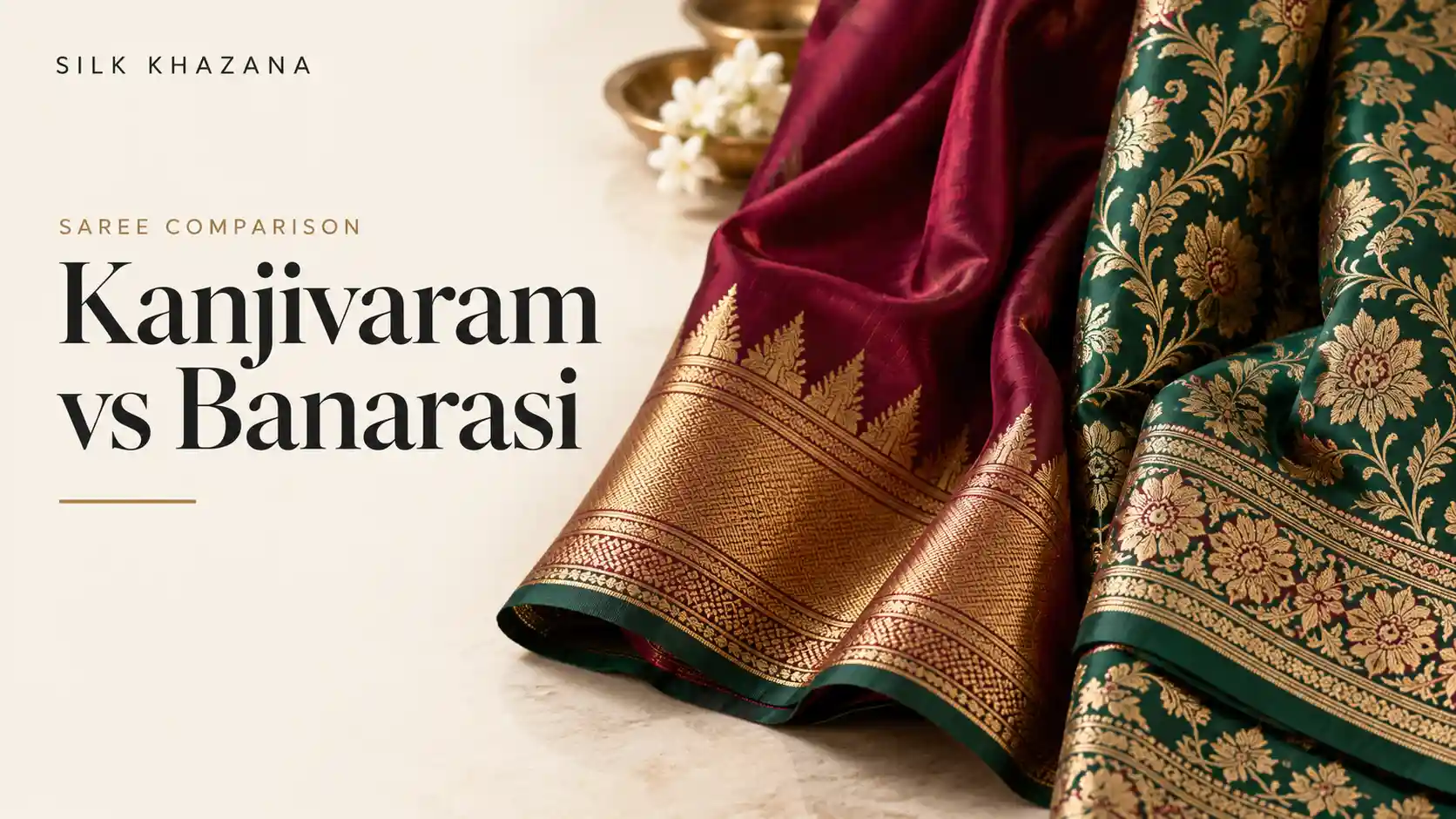
Kanjivaram is known for its strength. The fabric often feels dense and substantial, with a firm hand. Weavers commonly join the border to the body using an interlocking technique, so the contrast between border and body is sharp. Motifs often draw on temple architecture, birds, mangoes and checks.

Banarasi is known for its detail and range. Floral jaal, paisleys, creepers and Mughal-influenced designs cover the saree, often with finely worked brocade. The fabric can be nearly sheer, like organza, or weighty, like a bridal katan. See our guide to Banarasi motifs.

Weight and drape

Because Kanjivaram is often dense, it tends to hold its shape and fall in strong, structured pleats. Banarasi varies. A katan has weight and richness, while organza, tissue and georgette drape lightly and flow. If you want a saree you can move in easily over a long day, Banarasi offers lighter options. If you prefer structure and presence, both can deliver, depending on the piece.

Occasion and tradition

Family tradition matters more than any comparison. In many South Indian families, a Kanjivaram is expected for key ceremonies. In many North Indian families, a Banarasi is. Brides sometimes wear one for the ceremony and the other for the reception, and some families gift both. If tradition guides your choice, follow it.

Colour

Kanjivaram is celebrated for its strong, saturated colours and its contrast between body and border. Banarasi covers an enormous spectrum, from rich reds to soft pastels. Read our guide to bridal colours.

Zari and price

In both traditions, price follows the same logic: quality of silk, type and amount of zari, complexity of the design, time on the loom and whether the saree is handloom or powerloom. Neither is cheap when done properly, and both have imitations. For Banarasi, our piece on why Banarasi sarees are expensive explains each factor, and the same questions apply to Kanjivaram: ask about fibre, loom and zari.

Care

The care for both is similar: dry clean with a specialist, store folded in muslin, refold regularly and keep away from perfume and damp. Heavy zari needs tissue between folds. See our guides on storing and washing and caring for silk.

How to choose

Ask yourself:

  • 1. What does my family expect? Tradition may decide it.
  • 2. What is the climate and the season? A light Banarasi can suit hot weather.
  • 3. How long will I wear it? Weight and structure matter.
  • 4. What do I love? Bold contrast, or fine detail?
  • 5. What will I wear with it? Your jewellery and blouse are part of the picture.

If you are still undecided, see both in person. Touch them, hold them up to the light, and notice which one you reach for.

Beware of look-alikes

Both sarees are copied. Powerloom versions, synthetic blends and imitation zari are common in both markets. Whatever you choose:

  • Ask for the fibre, loom and zari type in writing.
  • Look for the Silk Mark and the GI tag where relevant. See our guide to verifying authenticity.
  • Buy from a seller who answers questions plainly.

A note of respect

We have a deep respect for Kanjivaram weavers. Both traditions are living crafts that depend on buyers who value them. Choosing either, and choosing authentic, supports the people who make them.

Further reading on kanjivaram vs banarasi saree: Banarasi sari on Wikipedia.

Key takeaways

  • Kanjivaram and Banarasi come from different places and have different design personalities.
  • Kanjivaram tends to be bold and structured. Banarasi spans fine detail and a wide weight range.
  • Family tradition and occasion often guide the choice.
  • Both have imitations, so ask about fibre, loom and zari.

Frequently Asked Questions

Neither is better overall. They are different crafts. The best choice depends on occasion, tradition, climate and personal taste.

Kanjivaram tends to be denser, while Banarasi ranges from very light to heavy.

Both are used for weddings. Family customs and regional traditions often decide.

Both span a wide price range. Cost depends on silk quality, zari, design complexity and loom type.

Yes. Some brides wear one for the ceremony and the other for the reception.

Ask for fibre, loom and zari in writing, check labels and buy from a seller who answers questions openly.

Message us on WhatsApp at +91 63073 05873 or visit our Varanasi showroom, and we will walk you through kanjivaram vs banarasi saree with the saree in your hands.

Browse Katan Silk Sarees

Looking for kanjivaram vs banarasi saree? We manufacture Banarasi silk in Varanasi and have done since 1970, selling directly, so you can ask us anything about a saree and get a specific answer.

Not sure what suits you? Message us on WhatsApp at +91 63073 05873 and tell us the occasion. Visit us: J 14/180, opp. Chhavi Mahal Cinema, Qazi Sadullah Pura, Jaitpura, Varanasi 221001.
Banarasi Design Styles: Meenakari, Rangkat and Jaal Compared | Silk Khazana
Weaves 7 Min Read

Banarasi Design Styles: Meenakari, Rangkat and Jaal Compared

Banarasi design styles compared: what Meenakari, Rangkat and Jaal are, how they are woven, how to tell them apart and which suits you.

Walk into a Banarasi showroom and you will hear three words again and again: Meenakari, Rangkat, Jaal. They sound like they might describe three different kinds of saree. They do not quite. They describe three different things: a colour technique, a colour layout and a pattern layout. A single saree can be more than one at once.

This guide separates them so you can recognise each and choose what suits you.

Banarasi design styles: the short version

TermWhat it isThink of it as
MeenakariColoured silk threads woven in to resemble enamelA technique for adding colour detail
RangkatMultiple colours blended or shifted across the sareeA colour layout
JaalA net-like all-over pattern of connected motifsA pattern layout

Weavers do not always use these words in exactly the same way, so treat them as a guide.

Meenakari

Meenakari is the art of enamelling on metal, a jewellery technique in which glassy colours are set into gold or silver. In Banarasi weaving, the word describes extra threads of coloured silk woven into the zari design so that motifs appear as if enamelled: little patches of pink, green, blue or red within a gold outline.

What you see: gold zari motifs filled with bright colours. Flowers with pink petals and green leaves, birds in jewel tones, borders that glint with colour.

How it feels: rich and detailed. Meenakari sarees feel decorated but not necessarily heavy, depending on the base.

Best for: brides and wedding guests who like colour detail. See our Royal Meenakari saree guide.

Rangkat

Rangkat describes a saree in which colour changes across the cloth. In a Rangkat saree, bands or sections of different colours are woven into the body or the pallu, blending from one shade to another. The result looks like a painter's palette.

What you see: gradients and blocks of colour, such as pink moving into orange into yellow, or royal blue into green.

How it feels: playful and vivid. It stands out in photographs.

Best for: festive occasions, celebrations and buyers who love colour. Read our piece on Pure Banarasi Rangkat Katan silk sarees.

Jaal

Jaal means net. A jaal pattern covers the saree with a lattice of connected flowers, leaves and vines, so that the design flows from one motif to the next without large empty spaces. It is one of the Banarasi signatures.

What you see: an all-over floral or foliage pattern, sometimes in a single colour of zari, sometimes with coloured details.

How it feels: elegant and cohesive. A fine jaal looks like lace in metal.

Best for: weddings, formal events and those who like a richly patterned surface. A dense jaal in leaves and creepers is often called jangla. See our katan jangla guide.

How they combine

These styles are not exclusive.

  • A Meenakari jaal has an all-over lattice with enamel-style colour.
  • A Rangkat saree with Meenakari borders combines colour shifts with detailed edges.
  • A Rangkat jaal blends colours across a net pattern.
  • A plain katan with a Meenakari border uses the technique only at the edge.

When a seller names a style, ask which element it refers to.

Comparing the three

MeenakariRangkatJaal
Main ideaEnamel-like colour in motifsColours shift across the sareeAll-over linked pattern
Visual effectJewel-like detailsPainterly, colourfulLace-like richness
Typical moodRich, ornateLively, festiveElegant, classical
Weave effortExtra colour threadsColour planning across sectionsDense pattern throughout
Often seen withKatan, georgetteKatanKatan, Jamawar

How to choose

  • Choose Meenakari if you love colour detail and the glint of enamel.
  • Choose Rangkat if you want colour to be the centrepiece.
  • Choose Jaal if you prefer a classic, cohesive pattern.
  • Mix them if you want several effects. Ask what the saree offers.

Think also about your jewellery, blouse and occasion. A busy Rangkat pallu may call for simple jewellery, while a quiet jaal can take a bolder necklace. Our bridal guide helps you match weave and ceremony.

How to check quality

  • 1. Look at the back. Neat, short thread ends signal careful weaving.
  • 2. Check colour edges. In Meenakari, colours should sit cleanly within the motif.
  • 3. Check the transition. In Rangkat, the shift should look deliberate, not patchy.
  • 4. Check the pattern flow. In jaal, motifs should connect smoothly.
  • 5. Ask about the loom and the zari. See handloom vs powerloom and real vs fake zari.

Care

These sarees share the same care rules as other Banarasi silks: dry clean with a specialist, store folded in muslin, keep away from perfume and damp. Strong colours can be sensitive to water, which is another reason to avoid home washing. See our care guides for storage and washing.

Further reading on banarasi design styles: Banarasi sari on Wikipedia.

Key takeaways

  • Meenakari is a colour technique, Rangkat a colour layout and Jaal a pattern layout.
  • They can combine in one saree.
  • Ask which element a seller means when they use the terms.
  • Check the back and the transitions to judge quality.

Frequently Asked Questions

It describes coloured silk threads woven into the design so motifs look enamelled, like Meenakari jewellery.

A saree in which different colours blend or shift across the body or pallu.

A saree with an all-over net-like pattern of connected flowers, leaves and vines.

Yes. Many sarees combine a jaal layout with Meenakari colour.

Any of them can be, depending on taste. Meenakari and jaal katan sarees are common bridal choices.

No. They can be woven on handlooms or powerlooms. Ask the seller which applies.

Message us on WhatsApp at +91 63073 05873 or visit our Varanasi showroom, and we will walk you through banarasi design styles with the saree in your hands.

Browse Katan Meenakari Sarees

Looking for banarasi design styles? We manufacture Banarasi silk in Varanasi and have done since 1970, selling directly, so you can ask us anything about a saree and get a specific answer.

Not sure what suits you? Message us on WhatsApp at +91 63073 05873 and tell us the occasion. Visit us: J 14/180, opp. Chhavi Mahal Cinema, Qazi Sadullah Pura, Jaitpura, Varanasi 221001.
History of Banarasi Silk Weaving: A Brief, Factual Guide | Silk Khazana
Heritage 8 Min Read

History of Banarasi Silk Weaving: A Brief, Factual Guide

A careful, factual history of Banarasi silk weaving: Kashi's textile tradition, Mughal influence, the weaving families, the GI tag and the craft today.

Ask when Banarasi weaving began and the honest answer is that nobody can give you a single date. The craft grew over many centuries, in many hands, and the written record is patchy. Anyone who offers an exact year is guessing.

What can be said with confidence is still remarkable. This is a short history of Banarasi silk in broad strokes, kept to what is well supported, with the uncertain parts marked as uncertain.

History of Banarasi silk weaving: a city of cloth

Varanasi, also called Banaras or Kashi, is one of the oldest continuously inhabited cities in the world and a centre of pilgrimage, learning and trade. Fine textiles have long been associated with the city. Accounts from different periods mention the cotton and silk cloth of Banaras, and the city's place on trade routes along the Ganga helped its cloth reach distant markets.

We will not pin the beginning to a year. What we can say is that weaving in Banaras is old, that it has deep roots in the city's life and that silk and gold-thread brocade became its best-known products.

Brocade and the art of zari

Banarasi weaving is best known for brocade: silk woven with metallic thread, called zari, to create raised patterns. Brocade traditions exist across Asia, and weavers in Banaras developed their own distinctive form.

Zari work came into its own with the demand for rich fabrics at courts and ceremonies. Weaving with fine metal thread requires patience and skill, and the weavers of Banaras built a reputation for it.

The Mughal influence

Historians generally agree that the Mughal period had a strong effect on Banarasi design. Persian and Central Asian taste for flowers, vines and intricate patterns merged with local Indian traditions. This is the source of much of what we recognise as Banarasi today: the dense floral jaal, the curved kalga or paisley, the creepers and the fine detailing.

Hunting scenes known as shikargah draw on Mughal-era miniature painting. We explain the motifs in Banarasi motifs explained and the hunting weave in our shikargah guide.

The weaving families

Banarasi weaving is a shared craft. Weaving families from different communities have shaped it across generations, and many of them live and work in particular neighbourhoods of the city. Knowledge passes within families: how to set up a loom, how to read a design, how to handle zari without breaking it.

The people behind the cloth include designers who draw patterns, dyers who colour the yarn, weavers who work the loom and finishers who prepare the saree. Read more in our piece on the weavers of Varanasi.

Changing looms and tools

Weaving technology has changed over the centuries. Hand-operated looms, pattern-making devices and later mechanical systems all shaped what was possible. In the modern period, powerloom production arrived, making woven cloth faster and cheaper. Today, Banarasi sarees are made on both handlooms and powerlooms, with different qualities and prices. We explain the difference in handloom vs powerloom.

Challenges of the modern era

The twentieth century and beyond brought pressures. Cheaper powerloom and imitation products affected weavers. Changing tastes, rising costs of silk and zari and a shortage of younger people entering the trade posed challenges. Many weaving families moved to other work.

At the same time, interest in handloom has grown, and consumers are paying attention to authenticity, craft and origin.

Recognition: the GI tag

In 2009, Banaras brocades and sarees received a Geographical Indication (GI) tag. A GI tag recognises that a product is linked to a particular place and its traditional methods, and it helps protect the name from misuse. It applies to a defined region around Varanasi. For how to look for it, see our guide to the GI tag and Silk Mark.

Banarasi weaving today

Banarasi weaving is alive and varied. You can find:

  • Traditional katan sarees, woven in rich colours with heavy zari
  • Light organza and georgette, suited to contemporary wear
  • Modern colour palettes and designs, alongside classical motifs
  • A growing audience abroad, with Banarasi silk being worn at weddings around the world

Many families, including ours, continue to make Banarasi silk in Varanasi. Silk Khazana has been working in this trade since 1970, and we think of ourselves as one small part of a long story.

What we do not know

It is worth being open about gaps. Some stories are told about the craft's origin, such as legends of migration, patronage and particular dates. They may be true, partly true or later embellishments. When we cannot confirm a detail, we prefer to leave it out. If you are researching the history, museum collections, university textile departments and published scholarship are the best sources.

Why history matters when you buy

Knowing this history helps you ask better questions. When you hold a Banarasi saree, you are holding the result of a long tradition of design, skill and place. Authenticity, honest labelling and fair pricing keep that tradition viable. Read why Banarasi sarees are expensive to see where the value sits.

Further reading on history of banarasi silk weaving: Banarasi sari on Wikipedia.

Key takeaways

  • There is no single start date for Banarasi weaving, and exact claims should be treated with caution.
  • Brocade and zari work are the heart of the tradition.
  • Mughal and Persian influences shaped much of the design vocabulary.
  • Weaving families carry the craft, and both handloom and powerloom exist today.
  • The GI tag was granted in 2009 to Banaras brocades and sarees.

Frequently Asked Questions

There is no single date. Banaras has been known for fine textiles for a very long time, and the craft evolved gradually. We avoid exact claims we cannot support.

Historians point to the influence of Persian and Mughal art, which blended with local Indian traditions.

A Geographical Indication granted in 2009 to Banaras brocades and sarees, linking the product to Varanasi and the surrounding region.

Yes, many are woven on handlooms, though powerloom production is also common.

Zari creates the brocade effect, the raised metallic patterns that are the signature of Banarasi silk.

Museum collections, textile university departments and published scholarship offer deeper histories.

Message us on WhatsApp at +91 63073 05873 or visit our Varanasi showroom, and we will walk you through history of banarasi silk weaving with the saree in your hands.

About Silk Khazana

Looking for history of banarasi silk weaving? We manufacture Banarasi silk in Varanasi and have done since 1970, selling directly, so you can ask us anything about a saree and get a specific answer.

Not sure what suits you? Message us on WhatsApp at +91 63073 05873 and tell us the occasion. Visit us: J 14/180, opp. Chhavi Mahal Cinema, Qazi Sadullah Pura, Jaitpura, Varanasi 221001.

Banarasi Motifs Explained: Buti, Buta, Bel, Kalga | Silk Khazana
Heritage 7 Min Read

Banarasi Motifs Explained: Buti, Buta, Bel, Kalga

Banarasi motifs explained: a plain-language glossary of buti, buta, bel, kalga, jaal, shikargah and asharfi, and where to find them.

Open a Banarasi saree and you are looking at a language. Every flower, vine and leaf has a name, a place on the saree and a way of being woven. Once you learn a few of the words, the saree starts to read.

This glossary explains the main motifs in plain terms, where they appear and how to recognise them.

The short answer

  • Buti is a small motif.
  • Buta is a larger motif.
  • Bel is a vine or creeper motif, often along the border.
  • Kalga is a plume-shaped motif, close to a paisley.
  • Jaal is a net-like all-over pattern.
  • Shikargah is a hunting scene.

The rest of this page expands on each.

Where motifs sit on a saree

It helps to know the parts of a saree first.

  • Body (or zameen): the main field of the saree.
  • Border: the woven edge that runs along the length.
  • Pallu (or anchal): the decorated end that drapes over the shoulder.
  • Kona: the corner motif, often a kalga, near the pallu.
  • Jhallar: a decorative fringe or edge.

Motifs appear in all of these, and the pallu is usually the most elaborate.

Banarasi motifs: the glossary

Buti (or butti)

A buti is a small, repeated motif, often a flower, leaf or small geometric shape, woven in zari or colour. Scattered over the body, butis create a light, even surface. A saree with butis feels airy.

Look for it: across the body of organza, georgette and lighter katan sarees.

Buta (or butta)

A buta is a larger version of a buti, often a single, prominent flower or leaf. It may be woven in rows or alone. A buta saree has a bolder, more graphic character.

Look for it: in the body or pallu of katan sarees.

Bel

A bel is a vine or creeper that winds along the border or across the saree, with flowers and leaves branching off. The word means vine in Hindi.

Look for it: in borders, and in sarees with trailing floral patterns.

Kalga

A kalga is a plume or crest-shaped motif. It resembles a paisley, a curved teardrop with a pointed tip. The word refers to the feathered plume once worn on a royal turban. Kalga motifs are often woven large in the pallu and the kona.

Look for it: in the pallu, the corner and the border.

Ambi or kairi

A mango-shaped motif, closely related to the paisley and the kalga. It symbolises abundance in Indian design.

Look for it: in pallus and borders, often in rows.

Jaal

A jaal is a net-like, all-over pattern in which flowers, leaves and vines are linked into a lattice that covers the saree. It is one of the great Banarasi signatures. A dense jaal in leaves and creepers is sometimes called jangla. See our katan jangla guide.

Look for it: across the body of katan jangla and Jamawar sarees.

Shikargah

A shikargah is a hunting scene, with hunters on horseback or elephants, tigers, deer and birds among foliage. It draws on Mughal-era miniature painting. It is one of the few Banarasi designs with figures. Read our full guide to the shikargah saree.

Look for it: on the body and pallu of shikargah sarees.

Asharfi

A round, coin-like motif. The word refers to a gold coin. Woven in rows, asharfis give a sense of richness.

Look for it: on borders and body.

Phool and patti

Flowers (phool) and leaves (patti) are the building blocks of nearly all Banarasi design. Together they form buti, buta, bel and jaal.

Meenakari

Not a motif but a technique: coloured silk threads woven in to look like enamel on jewellery. It can appear in any motif. See our Meenakari, Rangkat and Jaal guide.

Quick reference

MotifWhat it isWhere you find it
ButiSmall repeated motifBody of lighter sarees
ButaLarger single motifBody and pallu
BelVine or creeperBorders and trailing designs
KalgaPlume, paisley-likePallu, kona, border
Ambi / KairiMango motifPallu, border
JaalNet-like all-over patternBody of jangla and Jamawar
ShikargahHunting sceneBody and pallu
AsharfiCoin-like round motifBorder and body

Why these motifs?

Banarasi design grew out of many traditions. Persian and Mughal art brought floral forms, intricate vines and the paisley. Indian textile traditions brought their own flowers and symbols. Islamic art tends to avoid figures, and floral and geometric motifs carry much of the decoration, while the shikargah is an exception. We explore this in the history of Banarasi silk weaving.

How a design reaches the loom

Designs are first drawn on graph paper by a specialist, often called a naqshaband, who maps the pattern thread by thread. That plan is then translated into instructions the loom can follow. Each motif is built up through hundreds of threads. This is why a densely woven saree takes time, and why the back of a well-made saree looks neat. We describe the people behind this in our piece on the weavers of Varanasi.

Reading a saree like an expert

Next time you look at a Banarasi saree, try this:

  • 1. Look at the body. Is it butis, butas or a jaal?
  • 2. Look at the border. Is there a bel or a row of ambis?
  • 3. Look at the pallu. Where is the kalga?
  • 4. Look at the corner. Is there a kona?
  • 5. Look at the back. Are the thread ends neat?

Further reading on banarasi motifs: Banarasi sari on Wikipedia.

Key takeaways

  • Buti is small, buta is large, bel is a vine, kalga is a plume, jaal is a net.
  • Shikargah is the figurative exception, a hunting scene.
  • Motifs sit in the body, border, pallu and corner.
  • Designs are mapped thread by thread before weaving begins.

Frequently Asked Questions

A buti is a small motif, usually a flower or leaf, repeated across the body of a saree.

A buti is small and a buta is larger. Both are woven motifs, but a buta is bolder.

They are closely related. A kalga is the Banarasi plume-shaped motif, which resembles the paisley.

Jaal means net. In a saree it describes a lattice of connected flowers and vines across the fabric.

A saree woven with hunting scenes: figures on horseback or elephants, animals and foliage.

Designs are mapped on graph paper by a specialist and then translated for the loom, with the weaver bringing them to life.

Message us on WhatsApp at +91 63073 05873 or visit our Varanasi showroom, and we will walk you through banarasi motifs with the saree in your hands.

Browse Katan Silk Sarees

Looking for banarasi motifs? We manufacture Banarasi silk in Varanasi and have done since 1970, selling directly, so you can ask us anything about a saree and get a specific answer.

Not sure what suits you? Message us on WhatsApp at +91 63073 05873 and tell us the occasion. Visit us: J 14/180, opp. Chhavi Mahal Cinema, Qazi Sadullah Pura, Jaitpura, Varanasi 221001.