





+9163073 05873 support@silkkhazana.in
Handwoven Banarasi silk, direct from our Varanasi weaving family. Shop Now

Mini Cart

Buying Banarasi Silk from India: A Guide for NRIs | Silk Khazana
Buying 8 Min Read

Buying Banarasi Silk from India: A Guide for NRIs

A practical guide for NRIs buying Banarasi silk from India: choosing, sizing, shipping, customs, wedding timelines and how to avoid surprises.

If you live in the USA, UK, Canada, Australia, Singapore, the Gulf or anywhere else far from India, a Banarasi saree is more than a purchase. It is a link to a place. You may be buying for a wedding in the family, a festival abroad, a gift for a daughter or a piece you have wanted since your last trip home.

Buying from a distance has its own questions. Will the colour match the photo? Will the blouse fit? How long will shipping take, and what about customs? This guide answers those questions in plain language.

Buying Banarasi silk from India: why buy directly from Varanasi?

Banarasi weaving is centred in Varanasi, and buying from a seller there shortens the chain between the weaver and you. You can ask who made the saree, what it is made of and how it was woven. Items marked as Banarasi are protected by a Geographical Indication (GI) tag, and a seller in Varanasi can discuss it with you directly. Read our guide to the GI tag and Silk Mark.

Step 1: define what you need

Start with a short brief. Tell the seller:

  • The occasion: wedding, festival, party, gift
  • The date you need it by
  • Your colour and budget preferences
  • The fabric you like, if you know: katan, organza, tissue, georgette
  • Your location, since climate and venue matter
  • How the saree will be worn, and whether you need a blouse stitched

The more you share, the better the shortlist. Our guides to bridal sarees and khaddi georgette can help you narrow fabrics.

Step 2: see the saree properly

You cannot touch it, so do the next best thing.

  • Ask for photos in natural light.
  • Ask for close-ups of the zari and the back of the weave.
  • Request a live video call to see the saree move.
  • Ask for weight and dimensions.
  • Ask for the fibre, loom type and zari type in writing.

Our guide to buying Banarasi sarees online safely has a full checklist.

Step 3: plan the blouse and sizing

Most Banarasi sarees come with an unstitched blouse piece. You can have it stitched abroad by your own tailor, or you can ask the seller whether blouse stitching is available for your order.

If you are asking for stitching:

  • Take accurate measurements with a tape, wearing a well-fitting blouse or the garments you will wear underneath.
  • Share a photo of a blouse that fits you well.
  • Mention the neckline, sleeve and back style. See our blouse design guide.
  • Allow extra time in your schedule for any alterations.

If you plan to stitch abroad, ask the seller to confirm the size of the blouse piece, so your tailor knows what is possible.

Step 4: shipping and delivery

Shipping from India to another country depends on the courier, the destination and the season. Delivery times, charges and tracking options vary, so ask for current details before you order.

A few practical points:

  • Ask for tracking and an expected delivery window.
  • Ask how the saree is packed. Silk should travel wrapped in cotton or tissue, protected from moisture.
  • Provide a full address and phone number for the courier.
  • Be available to receive the parcel, or arrange a safe delivery point.
  • Ask about insurance for high-value pieces.

Our shipping and delivery page lists our current terms, and we are happy to answer questions on WhatsApp.

Step 5: customs and duties

Import rules differ by country, and they change. Some destinations charge duties or taxes on parcels, while others have thresholds below which none apply. We cannot give you your country's rules, but we can help you prepare.

  • Check your country's customs website for the current rules on textile imports.
  • Ask us for an invoice that describes the item accurately and states its value.
  • Be prepared for possible duties or taxes, and ask your courier how they are collected.
  • Keep the invoice and tracking information until the parcel arrives.

An accurate invoice helps parcels clear faster and avoids disputes.

Step 6: plan the timeline

Do not leave an overseas order to the last minute. Allow time for:

  • 1. Choosing the saree, including video calls and photos.
  • 2. Any customisation, blouse stitching or finishing.
  • 3. Packing and dispatch.
  • 4. Shipping and customs.
  • 5. A buffer for the unexpected.

For a wedding, we suggest ordering as early as you can. If you are ordering a made-to-order piece, ask how long weaving will take, since it depends on the design.

Step 7: payments

Ask which payment methods are available for international buyers, and use secure, traceable ones. Request a receipt or invoice. Confirm the currency and any fees before you pay.

Step 8: when the parcel arrives

  • Open it with care, ideally on camera.
  • Compare the saree with the photos and the written details.
  • Air it for a few hours before wearing.
  • Contact the seller promptly if anything differs.

See returns and exchanges for our policy, and check any seller's terms before ordering.

Buying in person and bringing it home

If you are visiting India, buying in Varanasi lets you feel the cloth and watch the weaving. A few tips for the journey home:

  • Carry the saree in your cabin bag if it is high-value, so it stays with you.
  • Keep the invoice in case customs ask for it.
  • Check the airline's baggage rules and your destination's import allowances.
  • Fold the saree loosely, with tissue between layers, and unpack it soon after arrival.

Our guide to buying Banarasi sarees in Varanasi covers the in-person experience.

Common worries, answered

"What if the colour looks different?" Ask for natural-light photos and a video. Screens vary, so confirm before you order.

"What if it does not fit?" The saree itself is free-size. Blouses are the main fitting issue, so plan stitching carefully.

"What if there is a delay?" Build in a buffer, and keep in touch with the seller and the courier.

"What if I want to return it?" Read the returns terms before ordering. International returns can be harder than domestic ones, which is one reason to be sure before buying.

Further reading on buying banarasi silk from india: Banarasi sari on Wikipedia.

Visiting Varanasi? Read our checklist on how to choose a trustworthy Banarasi saree shop in Varanasi.

Shopping in Varanasi? Read how to avoid common Banarasi saree shopping traps before you buy.

Key takeaways

  • Give a clear brief: occasion, date, colour, fabric and budget.
  • See the saree on video and ask for fibre, loom and zari in writing.
  • Plan the blouse and allow extra time for stitching.
  • Check shipping, customs and returns before you pay.
  • Order early, especially for weddings.

Frequently Asked Questions

Yes, we ship internationally. Ask on WhatsApp for current charges, timelines and packing details for your country.

It depends on your country's rules. Check your customs authority's current guidance, and ask us for an accurate invoice.

It varies by destination and courier. Ask for the current estimate when you order, and allow a buffer.

Ask us when you place your order. Share accurate measurements and a photo of a well-fitting blouse.

Ask for fibre, loom and zari in writing, request a video and check the Silk Mark. See our online buying guide.

Order as early as possible, tell the seller your date and ask about timelines for any customisation.

Message us on WhatsApp at +91 63073 05873 or visit our Varanasi showroom, and we will walk you through buying banarasi silk from india with the saree in your hands.

Browse Banarasi Sarees

Looking for buying banarasi silk from india? We manufacture Banarasi silk in Varanasi and have done since 1970, selling directly, so you can ask us anything about a saree and get a specific answer.

Not sure what suits you? Message us on WhatsApp at +91 63073 05873 and tell us the occasion. Visit us: J 14/180, opp. Chhavi Mahal Cinema, Qazi Sadullah Pura, Jaitpura, Varanasi 221001.
How to Buy Authentic Banarasi Sarees Online Safely | Silk Khazana
Buying 8 Min Read

How to Buy Authentic Banarasi Sarees Online Safely

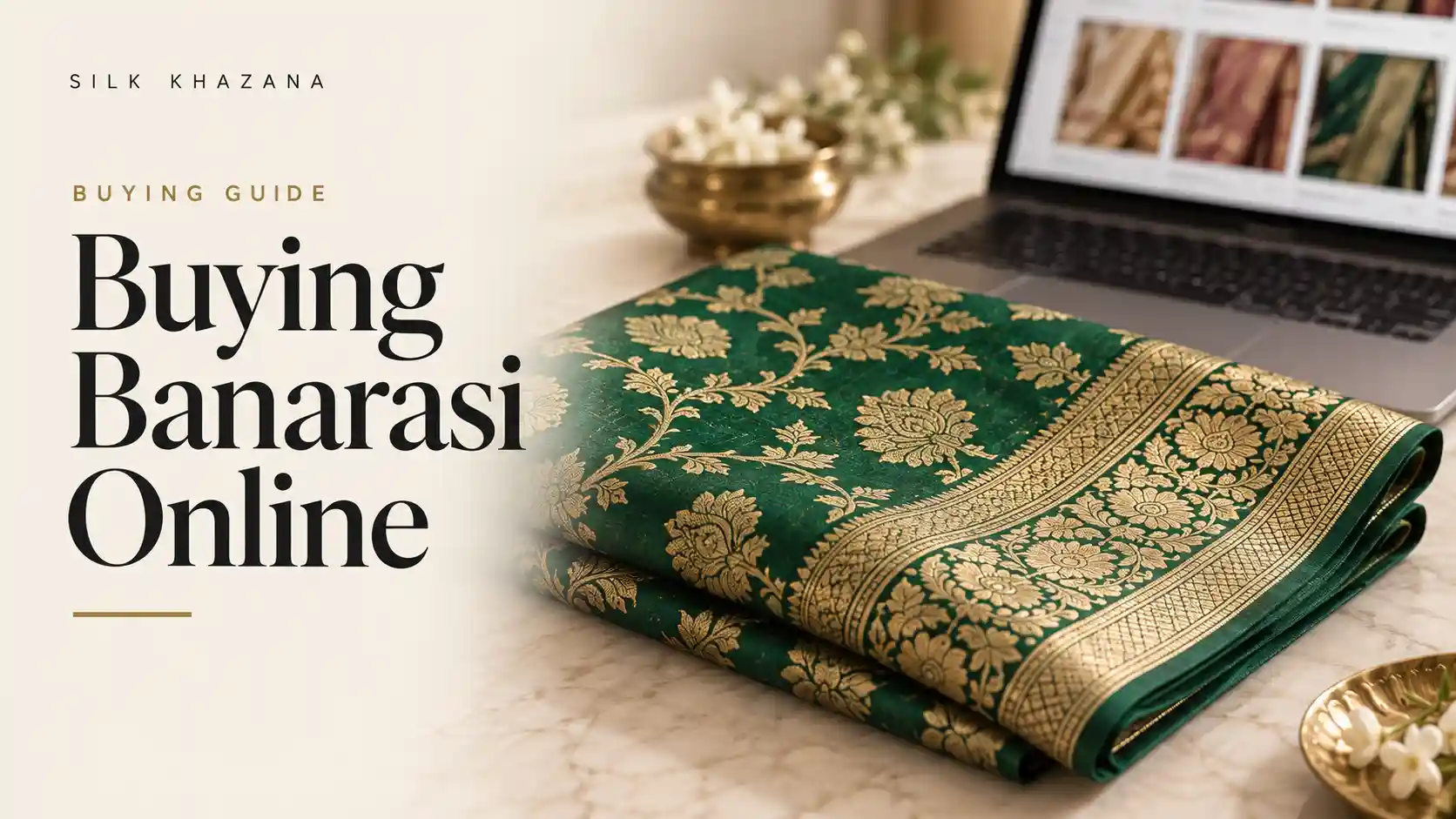
How to buy authentic Banarasi sarees online: a checklist for verifying the seller, asking the right questions and spotting red flags.

Buying a Banarasi saree online asks you to do something unusual: trust a photograph. You cannot feel the silk, see how the zari catches light or lift the pallu to judge its weight. A few clicks later a parcel arrives, and the saree in your hands is not quite what the picture promised.

It does not have to go that way. Many people buy excellent Banarasi sarees online, and the ones who do usually follow a handful of habits. This guide gives you those habits, in order.

How to buy authentic Banarasi sarees online: Step 1, check the seller

Before you look at a single saree, look at the seller.

  • Do they have a real address? A showroom or manufacturing unit you can find on a map is reassuring.
  • Can you contact them? Look for a phone number, WhatsApp, email and a response within a reasonable time.
  • Do they appear in more than one place? A website, a Google Business profile, social media pages and customer reviews that agree with each other point to a real business.
  • How long have they been operating? A long history is not a guarantee, but it counts.
  • Do they explain themselves? Honest sellers describe their fabrics, looms and processes in plain language.

A quick tip: search for the seller's name and address on Google Maps. Look at the photos, the reviews and the number of years in business.

Step 2: ask the right questions

The product page rarely tells the whole story. Ask the seller, in writing:

  • 1. What is the fibre? Is it pure silk?
  • 2. Is it handloom or powerloom? Read handloom vs powerloom first so you know what the answer means.
  • 3. What type of zari is used? Pure, tested or imitation? See real vs fake zari.
  • 4. Does it carry the Silk Mark label? And is it a Banarasi from Varanasi? Our guide to the GI tag and Silk Mark explains both.
  • 5. How long did it take to weave? A good seller can speak to this.
  • 6. What are the saree's dimensions and weight?
  • 7. What is the care advice?

Keep the answers. They are useful if there is a problem later.

Step 3: look at the pictures properly

  • Natural light photos. Showroom lamps and filters change colour. Ask for pictures near a window.
  • Close-ups of the weave and zari. You want to see the thread structure.
  • The back of the saree. Neat, short thread ends are a good sign.
  • The pallu, border and body together. Not only the pallu.
  • A fold or a drape. It shows how the fabric behaves.

If a seller only has polished studio images, ask for more. Candid photos from the showroom floor are often more honest.

Step 4: ask for a live video

This is the single most useful step. A short video call lets you:

  • See the saree move.
  • Ask to flip it, show the reverse, hold it to the light.
  • Compare colour in natural light.
  • Judge how the seller treats questions.

Sellers who are proud of their work are usually happy to show it.

Step 5: understand the price

Real Banarasi silk has a floor. Silk yarn, zari and weaving time all cost money. If a "pure handloom Banarasi katan with real zari" is priced like a printed polyester, something is not what it seems. Read why Banarasi sarees are expensive so you can judge the arithmetic.

At the same time, a high price does not guarantee authenticity. Compare, ask and judge the seller as much as the number.

Step 6: read the policies

Before paying, read:

  • Returns and exchanges. What is accepted, within how many days and under which conditions?
  • Shipping. Cost, time, tracking and insurance.
  • Payment methods. Secure channels, receipts and invoices.
  • Customisation terms if you are ordering something made to measure.

Policies vary, so check each seller's current terms. Ours are on the returns and exchanges and shipping and delivery pages.

Step 7: pay safely

  • Use secure, traceable payment methods.
  • Ask for an invoice that names the fabric, the loom type and the zari.
  • Be wary of requests to pay through unknown personal accounts with no invoice.
  • Keep screenshots of conversations and payment confirmations.

Step 8: unbox with care

  • Record a short unboxing video when the parcel arrives, showing the seal and the saree.
  • Check the saree against what you were told: colour, weave, zari, size.
  • Raise concerns quickly, within the seller's stated window.
  • Keep the packaging until you are satisfied.

Red flags

  • Prices far below what silk and zari could cost
  • Vague answers to simple questions
  • Photos that look copied from other sites or brands
  • No physical address or contact details
  • Pressure to buy immediately, such as fake countdowns
  • Refusal to do a video call
  • Claims such as "100% real gold zari" with no explanation
  • No clear returns policy
  • Payment requested to personal accounts with no invoice

Marketplace or manufacturer?

Large marketplaces offer convenience and buyer protections, but you may be buying from a reseller several steps away from the weaver. Buying from a manufacturer or a specialist showroom means shorter chains and clearer answers about the cloth. Neither option is automatically safer. What matters is how clearly the seller answers your questions.

Online shopping with Silk Khazana

We weave and sell Banarasi silk from our family unit in Varanasi, and we are happy to answer the questions above for any saree on our site. Message us on WhatsApp, tell us the occasion and what you like, and we will send photos and a video of the pieces that suit. If you are buying from abroad, our NRI guide covers shipping and sizing in more detail.

Further reading on how to buy authentic banarasi sarees online: Banarasi sari on Wikipedia, and the Silk Mark scheme.

Visiting Varanasi? Read our checklist on how to choose a trustworthy Banarasi saree shop in Varanasi.

Shopping in Varanasi? Read how to avoid common Banarasi saree shopping traps before you buy.

Key takeaways

  • Check the seller first: address, history, contact and reviews.
  • Ask about fibre, loom and zari in writing.
  • Ask for natural-light photos, the back of the weave and a live video.
  • Read the policies, pay traceably and unbox on camera.
  • Treat very low prices and vague answers as warnings.

Frequently Asked Questions

Yes, if you check the seller, ask clear questions, request a video and read the policies. Most problems come from skipping those steps.

Ask for the fibre, loom type and zari in writing, look for the Silk Mark label, and consider the GI tag. A reputable seller will answer openly.

Yes. It is the best way to see the saree move and judge colour and texture.

Contact the seller quickly, share your unboxing video and refer to the written answers you were given. Check the returns policy before ordering.

They can be, and they offer buyer protections. The key is to know who the seller is and to ask the same questions you would of any shop.

It depends on the silk, zari, weave density and whether it is handloom. Read why Banarasi sarees are expensive to understand the factors.

Message us on WhatsApp at +91 63073 05873 or visit our Varanasi showroom, and we will walk you through how to buy authentic banarasi sarees online with the saree in your hands.

Browse Banarasi Sarees

Looking for how to buy authentic banarasi sarees online? We manufacture Banarasi silk in Varanasi and have done since 1970, selling directly, so you can ask us anything about a saree and get a specific answer.

Not sure what suits you? Message us on WhatsApp at +91 63073 05873 and tell us the occasion. Visit us: J 14/180, opp. Chhavi Mahal Cinema, Qazi Sadullah Pura, Jaitpura, Varanasi 221001.

How to Revive an Old Banarasi Saree: Heirloom Care Guide | Silk Khazana
Care 6 Min Read

How to Revive an Old Banarasi Saree: Heirloom Care Guide

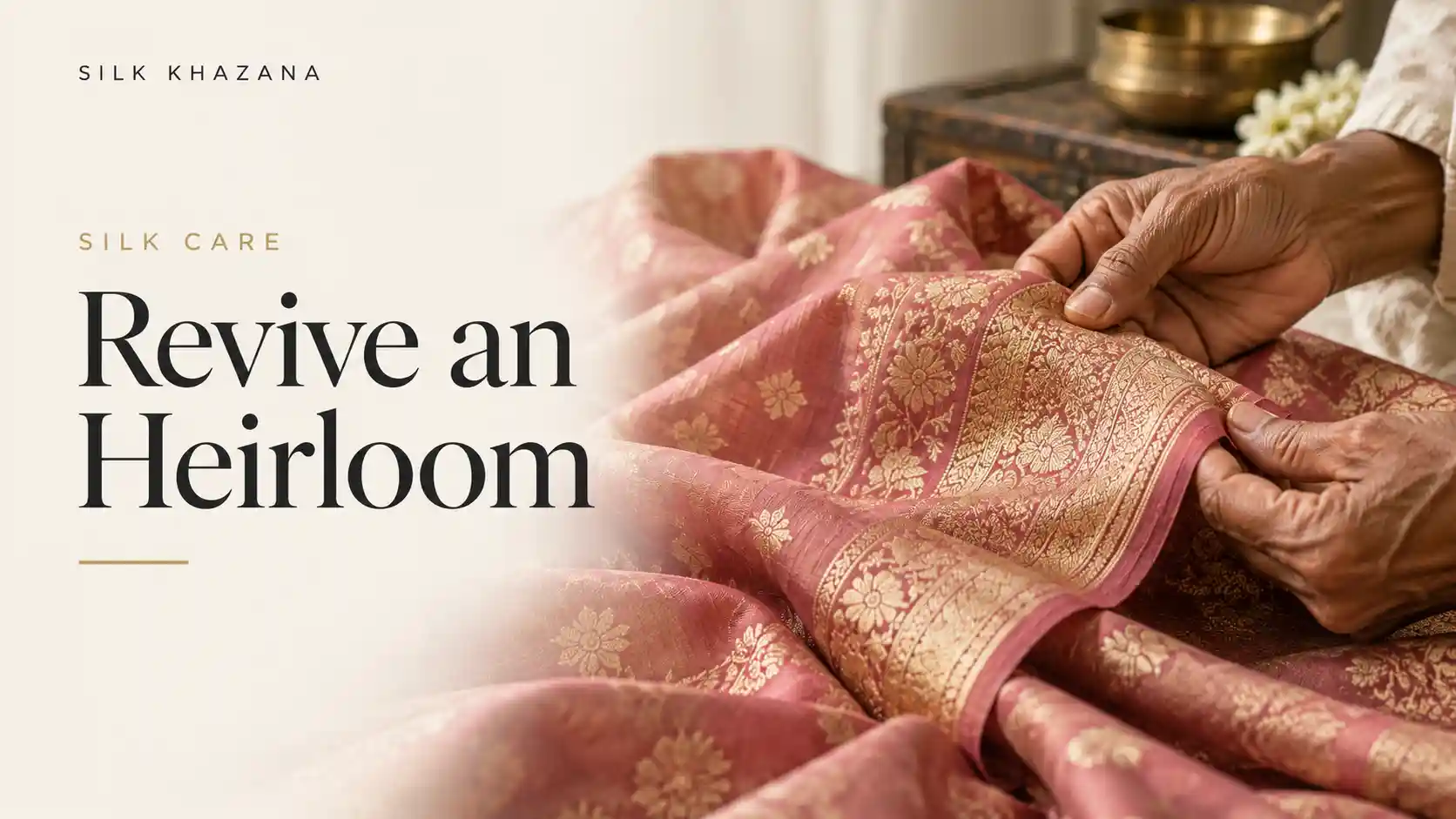
How to revive an old Banarasi saree: assess tarnished zari, weak folds, stains and moth holes, and learn what a specialist can do.

Somewhere in your family there is probably a saree in an old trunk. Maybe it is your grandmother's wedding saree, folded in a cloth that has gone soft with age. When you open it, you find a lot: memory, weight, a faint scent of camphor, and a few worries. The zari has gone dark. A fold line looks frail. There may be a stain, or a small hole.

This guide helps you decide what to do. It is not a repair manual, because the right answer depends on the saree. It is a way of thinking, plus what a specialist can and cannot do.

How to revive an old Banarasi saree: step one, pause

The first rule of caring for an heirloom is to stop and look before you act. Most of the damage we see comes from enthusiastic fixes: washing, scrubbing, ironing, bleach, lemon, toothpaste or an unlucky dry clean. Leave the saree as it is until you know what you have.

Step two: assess

Lay the saree flat on a clean cotton sheet in good light, with clean hands. Photograph it, front and back. Then look for:

  • Tarnished zari. Silver-based zari darkens with age. It is common and does not mean the zari is fake.
  • Weak fold lines. Silk that has been folded in the same place for decades can split along the crease.
  • Stains and yellowing. Sweat, oil or age can leave marks.
  • Insect damage. Small holes, thin patches or fine dust may indicate moths or silverfish.
  • Loose zari or threads. Metal threads can lift at the edges.
  • Fading. Some areas, especially those that faced light, may be paler.
  • Musty smell or damp spots. These suggest humidity.

Write down what you see. If you have the story of the saree, add it. When it was woven, who wore it, which occasion.

Step three: stabilise

  • Air it in a shaded, breezy spot for a few hours.
  • Do not fold along the old creases. Re-fold along new lines, with acid-free tissue in between.
  • Isolate it from other sarees if you suspect insects.
  • Store it flat in clean muslin until you decide.

Step four: talk to a specialist

A weaver, a textile restorer or an experienced cleaner can tell you what is realistic. Bring the saree, the photographs and your notes. Ask:

  • What condition is the silk in?
  • What can be improved, and what should be left alone?
  • What are the risks of each treatment?
  • Can fragile areas be reinforced?
  • What would you advise for storage afterwards?

If you cannot visit in person, send us clear photographs on WhatsApp and we will tell you honestly what we would suggest.

What specialists can often do

Gentle cleaning. A cleaner experienced in zari and old silk can sometimes remove surface dirt and odours. Results vary, and a cleaner should test first.

Brightening zari. Specialist cleaners can sometimes lift tarnish from silver zari. Success depends on the metal and its condition. Do not try home remedies.

Invisible mending. Known as rafoo, this is a careful darning technique used to close small holes and splits.

Reinforcing weak areas. Fine backing or stitching can support fragile fold lines or borders.

Re-weaving. In some cases, skilled weavers can re-create missing sections of weaving.

Secure loose zari. Loose threads can be re-stitched before they snag.

What cannot always be fixed

Honesty matters here. Some things have limits.

  • Badly deteriorated silk that crumbles or shatters may not tolerate cleaning or handling.
  • Dye loss cannot easily be reversed.
  • Large missing sections may not be reproducible.
  • Deep stains that have set over decades may only lighten.

A specialist who is straightforward about limits is worth trusting.

Giving an old saree a new life

If a saree is too fragile to wear, you can still keep it close.

  • Frame the pallu. A shadow-box frame with acid-free backing turns a beautiful pallu into wall art.
  • Make a dupatta, stole or jacket. A damaged saree often has intact sections that can be cut and reused.
  • Create a blouse, cushion covers or a lehenga panel. This is a long tradition in Indian families.
  • Make a keepsake for a younger relative. A scarf or a small bag made from a grandmother's saree carries her with you.

If you plan to reuse the fabric, consult an experienced tailor and discuss how to protect fragile sections.

What not to do

  • Do not wash an old Banarasi saree at home.
  • Do not iron zari.
  • Do not use bleach, lemon, toothpaste or harsh cleaners.
  • Do not hang the saree for long periods.
  • Do not seal it in plastic.
  • Do not ignore insects. Act early.

Protecting it afterwards

  • Wrap it in clean muslin with acid-free tissue.
  • Store flat in a cool, dry, dark cupboard.
  • Refold every few months along different lines.
  • Use neem or lavender pouches against insects.
  • Keep a note with the saree: who wore it, when and where.

See our full routine in how to store Banarasi sarees and our care notes in how to wash and care for Banarasi silk.

Why it is worth the effort

A Banarasi saree is a piece of work shaped by hands over weeks or months. If you would like to know more about the tradition behind it, read the history of Banarasi silk weaving. An heirloom is not only fabric. It carries a family's story, and caring for it is a way of passing that story on.

Further reading on how to revive an old banarasi saree: Banarasi sari on Wikipedia.

Key takeaways

  • Pause before you act. Most damage comes from well-meant fixes.
  • Assess and photograph before anything else.
  • Consult a specialist about cleaning, mending and reinforcing.
  • Consider a new life for fragile sarees: framing, dupattas, keepsakes.

Frequently Asked Questions

Often, to a degree. Cleaning, mending and reinforcing can improve many sarees, but results depend on the condition of the silk.

Silver-based zari tarnishes over time. It is normal and does not mean the zari is fake.

We advise against home washing. Take it to a specialist who handles old silk and zari.

Rafoo is an invisible darning technique used to repair small holes and splits in woven fabric.

Wrap it in muslin with acid-free tissue, store it flat in a cool, dry place and refold it every few months along new lines.

A framed pallu, a dupatta, a stole, cushion covers, a blouse or a keepsake bag.

Message us on WhatsApp at +91 63073 05873 or visit our Varanasi showroom, and we will walk you through how to revive an old banarasi saree with the saree in your hands.

Browse Banarasi Sarees

Looking for how to revive an old banarasi saree? We manufacture Banarasi silk in Varanasi and have done since 1970, selling directly, so you can ask us anything about a saree and get a specific answer.

Not sure what suits you? Message us on WhatsApp at +91 63073 05873 and tell us the occasion. Visit us: J 14/180, opp. Chhavi Mahal Cinema, Qazi Sadullah Pura, Jaitpura, Varanasi 221001.

How to Wash and Care for Banarasi Silk Sarees | Silk Khazana
Care 6 Min Read

How to Wash and Care for Banarasi Silk Sarees

How to wash and care for Banarasi silk: dry cleaning, stain first aid, ironing, sweat and perfume, without harsh home washing.

The honest answer to "how do I wash a Banarasi saree?" is: you mostly do not.

A Banarasi saree is a woven object of silk, dye and metal thread. Washing it at home, with water, soap and agitation, is the quickest way to lose its colour, stiffen its zari and dull its feel. The best care is gentle, minimal and mostly preventive.

This guide shows you how to keep a saree fresh between cleans, what to do when something spills, how to iron safely and how to choose a dry cleaner.

How to wash and care for Banarasi silk: the philosophy

  • 1. Prevent rather than correct. Most damage is avoidable: sweat, perfume, oil, damp and friction.
  • 2. Clean rarely. Every cleaning cycle wears the fibres and zari a little. Clean when needed, not by habit.
  • 3. Use a specialist. If it needs cleaning, take it to someone who knows silk and zari.
  • 4. Do not experiment. Home remedies from the internet can ruin a saree for good.

After every wear

  • Air it in the shade for a few hours before folding. Hang it over a clean cotton sheet or a padded hanger.
  • Check for marks on the underarms, pallu edge and hem.
  • Wipe the border gently with a dry, clean cloth if needed.
  • Fold it away in muslin once it is fully dry and fresh. See how to store Banarasi sarees.

Preventing the usual problems

Sweat. Underarm sweat is a common cause of stains and weakened fabric. Use underarm shields in the blouse and give the blouse its own care routine.

Perfume and hairspray. Alcohol can dull zari and mark silk. Spray perfume before dressing and let it dry. Keep hairspray and deodorants well away from the saree.

Oil and food. Eating in a saree is part of any wedding. Keep a napkin tucked at the waist, and sit with the pallu folded over your lap.

Rain and water. Organza and georgette can water-mark. Avoid rain, and carry an umbrella.

Rough surfaces. Sofas, car seats and chair edges can snag the weave. Be mindful when you sit.

What to do if something spills

Act quickly, and gently.

  • 1. Blot, never rub. Press a clean, dry cotton cloth over the spot to lift as much as possible.
  • 2. Do not add water, soap or any stain remover to the saree.
  • 3. For oil, you can sprinkle a little talcum powder or cornflour over the spot to absorb it, leave it for a few hours and brush it off softly. Then take the saree to a specialist.
  • 4. For anything else, such as kumkum, haldi, wine, tea or ink, blot and go straight to a cleaner. Tell them what it is and when it happened.

The sooner a specialist sees it, the better the chance of a clean result.

Dry cleaning: how to do it well

Dry cleaning is the usual recommendation for Banarasi silk, but not all dry cleaners are equal.

  • Ask about experience with zari and silk sarees. A cleaner who handles bridal wear is a good sign.
  • Show them the saree before you leave it. Point out stains, loose threads and delicate areas.
  • Ask them not to press the zari. Heat and pressure can flatten and dull metal threads.
  • Ask for a gentle process, without harsh chemicals.
  • Do not clean after every wear. Once or twice a year is often enough for a saree worn occasionally, with airing in between.
  • Check on pickup. Look at the zari, the colour and the hand feel.

What about hand washing?

We do not recommend washing Banarasi silk at home. Deep dyes, especially reds and dark greens, can bleed. Zari can tarnish or stiffen. Heavy weaves can shrink or lose their drape. Tissue, organza and georgette are even more delicate. Some very plain silks with no zari are sometimes hand washed by experienced owners, but with Banarasi weaving the risks outweigh the benefits.

If you are in doubt, ask the seller about the specific saree. We are glad to advise on a piece we made.

Ironing safely

  • Iron only when needed. Many Banarasi sarees need little or no ironing, particularly after airing.
  • Use the lowest silk setting.
  • Place a clean cotton cloth between the iron and the saree.
  • Iron on the reverse side, away from the zari.
  • Avoid steam, which can mark silk and tarnish zari.
  • For heavy or delicate pieces, leave pressing to a specialist.

Caring for the blouse and petticoat

The blouse takes more sweat than the saree. Wash or clean it according to its own fabric. A silk blouse follows the same rules as the saree. A cotton petticoat can be washed regularly, which reduces how often the saree itself needs attention.

Caring for special fabrics

  • Organza and kora: keep away from water and perfume. See our organza guide.
  • Tissue: handle carefully, since the zari runs through the cloth. See the tissue guide.
  • Georgette: guard against snags.
  • Heavy katan: fold with tissue between zari-heavy sections.

When something looks wrong

  • Zari has darkened: this may be normal tarnish on silver zari. Read real vs fake zari.
  • A fold line looks weak or split: stop folding along that line and consult a specialist.
  • You see insect damage: isolate the saree and see our restoration guide.

Further reading on how to wash and care for banarasi silk: Banarasi sari on Wikipedia.

Key takeaways

  • Clean rarely and prevent often. Air after every wear and guard against sweat and perfume.
  • Blot spills, never rub, and take the saree to a specialist.
  • Choose a dry cleaner who knows zari, and ask them not to press the borders.
  • We do not recommend home washing for Banarasi silk.

Frequently Asked Questions

We do not recommend it. Dyes can bleed, zari can stiffen or tarnish, and the drape can change. Choose a specialist dry cleaner instead.

Only when needed. For occasional wear, once or twice a year is often enough, with airing in between.

Blot gently, sprinkle a little talcum powder or cornflour to absorb the oil, brush it off after a few hours and take the saree to a specialist.

Yes, carefully: low silk setting, a cotton cloth in between, reverse side, no steam. For delicate or heavy pieces, use a professional.

It can. Alcohol may mark silk and dull zari. Apply perfume before dressing and let it dry.

Ask whether they handle zari and bridal wear, show them the saree and ask them not to press the borders.

Message us on WhatsApp at +91 63073 05873 or visit our Varanasi showroom, and we will walk you through how to wash and care for banarasi silk with the saree in your hands.

Browse Banarasi Sarees

Looking for how to wash and care for banarasi silk? We manufacture Banarasi silk in Varanasi and have done since 1970, selling directly, so you can ask us anything about a saree and get a specific answer.

Not sure what suits you? Message us on WhatsApp at +91 63073 05873 and tell us the occasion. Visit us: J 14/180, opp. Chhavi Mahal Cinema, Qazi Sadullah Pura, Jaitpura, Varanasi 221001.

How to Store Banarasi Silk Sarees Correctly | Silk Khazana
Care 6 Min Read

How to Store Banarasi Silk Sarees Correctly

How to store Banarasi silk sarees correctly: folding, muslin, humidity, moths, zari care and travel packing, from a Varanasi weaving family.

A Banarasi saree can last for generations or for a few seasons. The difference is rarely the quality of the weaving. It is how the saree is stored.

Silk and zari are strong but they have enemies: damp, light, creases that never move, insects, perfume and plastic. The good news is that protecting a saree is simple once you know the rules. Here is the routine we use and recommend.

How to store Banarasi silk sarees: the principles

  • 1. Clean and dry before storing. Never fold away a saree that carries sweat, perfume or food.
  • 2. Let it breathe. Silk needs air. Avoid sealed plastic.
  • 3. Avoid sharp creases staying in one place. Fold lines weaken fibres over time.
  • 4. Keep zari protected. Metal threads can tarnish and snag.
  • 5. Check regularly. A quick look every few months prevents most problems.

Step by step

1. Air the saree first

After wearing, hang the saree in a shaded, airy spot for a few hours. Do not leave it in direct sun, which can fade colour and dull the zari. This lets sweat and perfume evaporate before the fabric is folded.

2. Check for stains and weak spots

Look at the underarms, the pleats and the pallu edge. If you see a stain, avoid rubbing. Have a specialist cleaner look at it. Read our notes on washing and caring for Banarasi silk.

3. Fold it properly

Fold along the natural lines of the saree, with the pallu on top, then fold in half again to the size of your shelf. Keep the border visible on one edge. Avoid folding right through the middle of a dense motif.

4. Wrap in muslin or soft cotton

Wrap each saree separately in a clean, soft cotton cloth or muslin. Cotton lets air through and keeps dust away. Avoid plastic bags, which trap moisture and can encourage mould.

5. Add a layer of acid-free tissue

Place acid-free tissue paper between folds, especially in heavy zari areas. It cushions the metal threads and reduces friction.

6. Store flat or loosely stacked

Heavy katan sarees are happiest lying flat on a shelf. If you stack them, put the heaviest at the bottom and keep stacks low so the weight does not crush the lower pieces.

Where to keep them

  • A cool, dry, dark shelf inside a cupboard.
  • Away from outside walls, where damp can creep in.
  • Not directly on bare wood, which can leach colour or stain. Line shelves with cotton or acid-free paper.
  • Away from the kitchen and bathroom, where humidity changes.

In humid cities and during the monsoon, add silica gel sachets to the cupboard and replace them from time to time.

Keeping insects away

Moths, silverfish and other insects love silk and starch. A few safe habits help:

  • Keep the cupboard clean.
  • Use neem leaves, dried lavender or cedar in small cotton pouches near the sarees.
  • If you use camphor or mothballs, keep them in a closed pouch and never in direct contact with the saree, since they can stain and tarnish zari and leave a lingering smell.
  • Check the cupboard whenever you refold.

Refold and air regularly

Every three to four months:

  • 1. Take the saree out.
  • 2. Air it in the shade for an hour or two.
  • 3. Refold it along different lines. This stops permanent creases from forming and weakening the fibre.
  • 4. Return it to fresh muslin or tissue.

Mark a date in your calendar. It takes a few minutes per saree and adds years to its life.

Looking after zari

  • Store zari-heavy sarees separately from plain ones, so metal does not rub against delicate silk.
  • Keep perfume and hairspray away from the borders.
  • Avoid storing in a sealed space with little air, where silver zari can tarnish faster.
  • Place tissue between folds that carry zari.

Our guide on real vs fake zari explains why silver-based zari can darken over time and what is normal.

Hanging: yes or no?

Avoid hanging heavy sarees for long periods. The weight stretches the weave and stresses the zari. An occasional short airing on a padded hanger is fine, and then back to folded storage. Tissue, organza and georgette sarees also deserve flat or padded storage, since hanging can pull them out of shape. See the tissue silk guide.

Vacuum bags and plastic covers

We do not recommend vacuum-sealing silk or zari. Compression can crush fibres and trap moisture. Plastic covers are fine for short transport but not for long-term storage.

Packing for travel

  • Fold the saree loosely, with tissue between layers.
  • Wrap it in muslin or a soft cotton cloth.
  • Place it on top of the suitcase, not under heavy items.
  • Remove it from the bag as soon as you arrive.
  • Air it before the next wear.

A quick do and don't list

DoDon't
Air after every wearFold away a damp or perfumed saree
Wrap in muslinUse plastic bags
Refold every 3–4 monthsLeave the same crease for years
Keep in a cool, dry placeStore near damp walls
Use neem or lavender pouchesLet mothballs touch the saree
Store zari with tissueHang heavy sarees for long periods

Further reading on how to store banarasi silk sarees: Banarasi sari on Wikipedia.

Key takeaways

  • Air the saree before storing and wrap it in muslin, never plastic.
  • Refold along different lines every three to four months.
  • Protect zari with tissue and keep perfume away.
  • Store in a cool, dry, dark place with natural insect deterrents.

Frequently Asked Questions

Fold along its natural lines with the pallu on top, then fold to shelf size, with acid-free tissue between zari-heavy folds.

Only briefly, for airing. Long-term hanging stretches the weave and stresses the zari.

Plastic traps moisture and prevents airflow, which can lead to mould. Use muslin or soft cotton.

Every three to four months, along different lines, to avoid permanent creases.

Keep the cupboard clean and use neem, lavender or cedar in cotton pouches. Do not let mothballs touch the saree.

We advise against it. Compression can damage fibres and zari and trap moisture.

Message us on WhatsApp at +91 63073 05873 or visit our Varanasi showroom, and we will walk you through how to store banarasi silk sarees with the saree in your hands.

Browse Banarasi Sarees

Looking for how to store banarasi silk sarees? We manufacture Banarasi silk in Varanasi and have done since 1970, selling directly, so you can ask us anything about a saree and get a specific answer.

Not sure what suits you? Message us on WhatsApp at +91 63073 05873 and tell us the occasion. Visit us: J 14/180, opp. Chhavi Mahal Cinema, Qazi Sadullah Pura, Jaitpura, Varanasi 221001.