+9163073 05873 support@silkkhazana.in
Summer sale discount upto 30%! Shop Now

Mini Cart

History of Banarasi Silk Weaving: A Brief, Factual Guide | Silk Khazana
Heritage 8 Min Read

History of Banarasi Silk Weaving: A Brief, Factual Guide

A careful, factual history of Banarasi silk weaving: Kashi's textile tradition, Mughal influence, the weaving families, the GI tag and the craft today.

Ask when Banarasi weaving began and the honest answer is that nobody can give you a single date. The craft grew over many centuries, in many hands, and the written record is patchy. Anyone who offers an exact year is guessing.

What can be said with confidence is still remarkable. This is a short history of Banarasi silk in broad strokes, kept to what is well supported, with the uncertain parts marked as uncertain.

History of Banarasi silk weaving: a city of cloth

Varanasi, also called Banaras or Kashi, is one of the oldest continuously inhabited cities in the world and a centre of pilgrimage, learning and trade. Fine textiles have long been associated with the city. Accounts from different periods mention the cotton and silk cloth of Banaras, and the city's place on trade routes along the Ganga helped its cloth reach distant markets.

We will not pin the beginning to a year. What we can say is that weaving in Banaras is old, that it has deep roots in the city's life and that silk and gold-thread brocade became its best-known products.

Brocade and the art of zari

Banarasi weaving is best known for brocade: silk woven with metallic thread, called zari, to create raised patterns. Brocade traditions exist across Asia, and weavers in Banaras developed their own distinctive form.

Zari work came into its own with the demand for rich fabrics at courts and ceremonies. Weaving with fine metal thread requires patience and skill, and the weavers of Banaras built a reputation for it.

The Mughal influence

Historians generally agree that the Mughal period had a strong effect on Banarasi design. Persian and Central Asian taste for flowers, vines and intricate patterns merged with local Indian traditions. This is the source of much of what we recognise as Banarasi today: the dense floral jaal, the curved kalga or paisley, the creepers and the fine detailing.

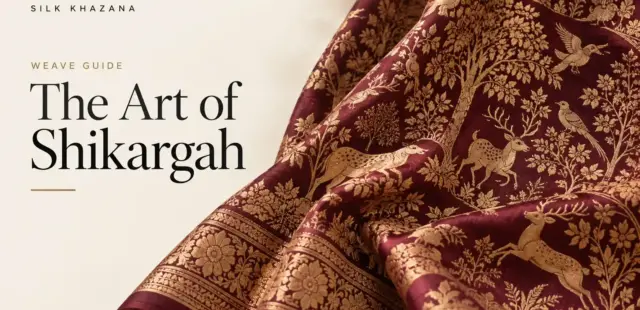
Hunting scenes known as shikargah draw on Mughal-era miniature painting. We explain the motifs in Banarasi motifs explained and the hunting weave in our shikargah guide.

The weaving families

Banarasi weaving is a shared craft. Weaving families from different communities have shaped it across generations, and many of them live and work in particular neighbourhoods of the city. Knowledge passes within families: how to set up a loom, how to read a design, how to handle zari without breaking it.

The people behind the cloth include designers who draw patterns, dyers who colour the yarn, weavers who work the loom and finishers who prepare the saree. Read more in our piece on the weavers of Varanasi.

Changing looms and tools

Weaving technology has changed over the centuries. Hand-operated looms, pattern-making devices and later mechanical systems all shaped what was possible. In the modern period, powerloom production arrived, making woven cloth faster and cheaper. Today, Banarasi sarees are made on both handlooms and powerlooms, with different qualities and prices. We explain the difference in handloom vs powerloom.

Challenges of the modern era

The twentieth century and beyond brought pressures. Cheaper powerloom and imitation products affected weavers. Changing tastes, rising costs of silk and zari and a shortage of younger people entering the trade posed challenges. Many weaving families moved to other work.

At the same time, interest in handloom has grown, and consumers are paying attention to authenticity, craft and origin.

Recognition: the GI tag

In 2009, Banaras brocades and sarees received a Geographical Indication (GI) tag. A GI tag recognises that a product is linked to a particular place and its traditional methods, and it helps protect the name from misuse. It applies to a defined region around Varanasi. For how to look for it, see our guide to the GI tag and Silk Mark.

Banarasi weaving today

Banarasi weaving is alive and varied. You can find:

  • Traditional katan sarees, woven in rich colours with heavy zari
  • Light organza and georgette, suited to contemporary wear
  • Modern colour palettes and designs, alongside classical motifs
  • A growing audience abroad, with Banarasi silk being worn at weddings around the world

Many families, including ours, continue to make Banarasi silk in Varanasi. Silk Khazana has been working in this trade since 1970, and we think of ourselves as one small part of a long story.

What we do not know

It is worth being open about gaps. Some stories are told about the craft's origin, such as legends of migration, patronage and particular dates. They may be true, partly true or later embellishments. When we cannot confirm a detail, we prefer to leave it out. If you are researching the history, museum collections, university textile departments and published scholarship are the best sources.

Why history matters when you buy

Knowing this history helps you ask better questions. When you hold a Banarasi saree, you are holding the result of a long tradition of design, skill and place. Authenticity, honest labelling and fair pricing keep that tradition viable. Read why Banarasi sarees are expensive to see where the value sits.

Further reading on history of banarasi silk weaving: Banarasi sari on Wikipedia.

Key takeaways

  • There is no single start date for Banarasi weaving, and exact claims should be treated with caution.
  • Brocade and zari work are the heart of the tradition.
  • Mughal and Persian influences shaped much of the design vocabulary.
  • Weaving families carry the craft, and both handloom and powerloom exist today.
  • The GI tag was granted in 2009 to Banaras brocades and sarees.

Frequently Asked Questions

There is no single date. Banaras has been known for fine textiles for a very long time, and the craft evolved gradually. We avoid exact claims we cannot support.

Historians point to the influence of Persian and Mughal art, which blended with local Indian traditions.

A Geographical Indication granted in 2009 to Banaras brocades and sarees, linking the product to Varanasi and the surrounding region.

Yes, many are woven on handlooms, though powerloom production is also common.

Zari creates the brocade effect, the raised metallic patterns that are the signature of Banarasi silk.

Museum collections, textile university departments and published scholarship offer deeper histories.

Message us on WhatsApp at +91 63073 05873 or visit our Varanasi showroom, and we will walk you through history of banarasi silk weaving with the saree in your hands.

About Silk Khazana

Looking for history of banarasi silk weaving? We manufacture Banarasi silk in Varanasi and have done since 1970, selling directly, so you can ask us anything about a saree and get a specific answer.

Not sure what suits you? Message us on WhatsApp at +91 63073 05873 and tell us the occasion. Visit us: J 14/180, opp. Chhavi Mahal Cinema, Qazi Sadullah Pura, Jaitpura, Varanasi 221001.
Banarasi Motifs Explained: Buti, Buta, Bel, Kalga | Silk Khazana
Heritage 7 Min Read

Banarasi Motifs Explained: Buti, Buta, Bel, Kalga

Banarasi motifs explained: a plain-language glossary of buti, buta, bel, kalga, jaal, shikargah and asharfi, and where to find them.

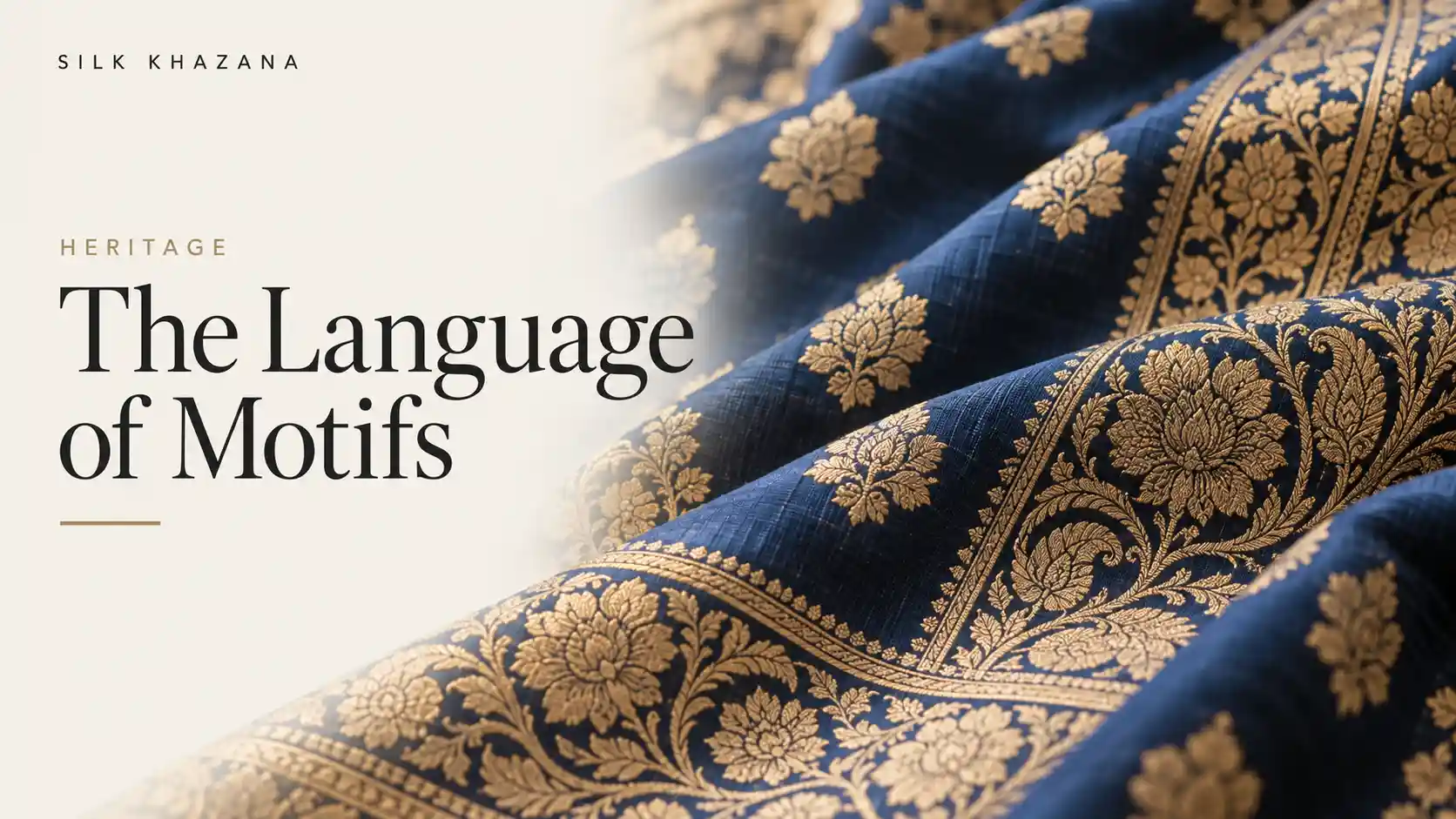
Open a Banarasi saree and you are looking at a language. Every flower, vine and leaf has a name, a place on the saree and a way of being woven. Once you learn a few of the words, the saree starts to read.

This glossary explains the main motifs in plain terms, where they appear and how to recognise them.

The short answer

  • Buti is a small motif.
  • Buta is a larger motif.
  • Bel is a vine or creeper motif, often along the border.
  • Kalga is a plume-shaped motif, close to a paisley.
  • Jaal is a net-like all-over pattern.
  • Shikargah is a hunting scene.

The rest of this page expands on each.

Where motifs sit on a saree

It helps to know the parts of a saree first.

  • Body (or zameen): the main field of the saree.
  • Border: the woven edge that runs along the length.
  • Pallu (or anchal): the decorated end that drapes over the shoulder.
  • Kona: the corner motif, often a kalga, near the pallu.
  • Jhallar: a decorative fringe or edge.

Motifs appear in all of these, and the pallu is usually the most elaborate.

Banarasi motifs: the glossary

Buti (or butti)

A buti is a small, repeated motif, often a flower, leaf or small geometric shape, woven in zari or colour. Scattered over the body, butis create a light, even surface. A saree with butis feels airy.

Look for it: across the body of organza, georgette and lighter katan sarees.

Buta (or butta)

A buta is a larger version of a buti, often a single, prominent flower or leaf. It may be woven in rows or alone. A buta saree has a bolder, more graphic character.

Look for it: in the body or pallu of katan sarees.

Bel

A bel is a vine or creeper that winds along the border or across the saree, with flowers and leaves branching off. The word means vine in Hindi.

Look for it: in borders, and in sarees with trailing floral patterns.

Kalga

A kalga is a plume or crest-shaped motif. It resembles a paisley, a curved teardrop with a pointed tip. The word refers to the feathered plume once worn on a royal turban. Kalga motifs are often woven large in the pallu and the kona.

Look for it: in the pallu, the corner and the border.

Ambi or kairi

A mango-shaped motif, closely related to the paisley and the kalga. It symbolises abundance in Indian design.

Look for it: in pallus and borders, often in rows.

Jaal

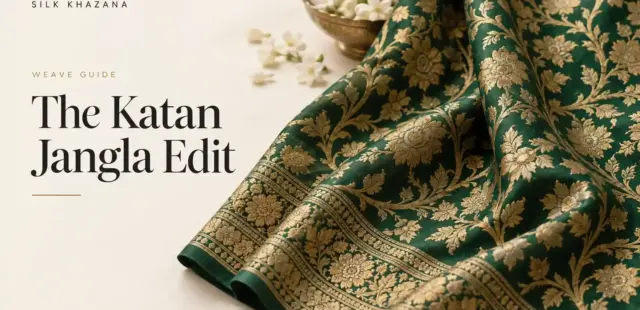
A jaal is a net-like, all-over pattern in which flowers, leaves and vines are linked into a lattice that covers the saree. It is one of the great Banarasi signatures. A dense jaal in leaves and creepers is sometimes called jangla. See our katan jangla guide.

Look for it: across the body of katan jangla and Jamawar sarees.

Shikargah

A shikargah is a hunting scene, with hunters on horseback or elephants, tigers, deer and birds among foliage. It draws on Mughal-era miniature painting. It is one of the few Banarasi designs with figures. Read our full guide to the shikargah saree.

Look for it: on the body and pallu of shikargah sarees.

Asharfi

A round, coin-like motif. The word refers to a gold coin. Woven in rows, asharfis give a sense of richness.

Look for it: on borders and body.

Phool and patti

Flowers (phool) and leaves (patti) are the building blocks of nearly all Banarasi design. Together they form buti, buta, bel and jaal.

Meenakari

Not a motif but a technique: coloured silk threads woven in to look like enamel on jewellery. It can appear in any motif. See our Meenakari, Rangkat and Jaal guide.

Quick reference

MotifWhat it isWhere you find it
ButiSmall repeated motifBody of lighter sarees
ButaLarger single motifBody and pallu
BelVine or creeperBorders and trailing designs
KalgaPlume, paisley-likePallu, kona, border
Ambi / KairiMango motifPallu, border
JaalNet-like all-over patternBody of jangla and Jamawar
ShikargahHunting sceneBody and pallu
AsharfiCoin-like round motifBorder and body

Why these motifs?

Banarasi design grew out of many traditions. Persian and Mughal art brought floral forms, intricate vines and the paisley. Indian textile traditions brought their own flowers and symbols. Islamic art tends to avoid figures, and floral and geometric motifs carry much of the decoration, while the shikargah is an exception. We explore this in the history of Banarasi silk weaving.

How a design reaches the loom

Designs are first drawn on graph paper by a specialist, often called a naqshaband, who maps the pattern thread by thread. That plan is then translated into instructions the loom can follow. Each motif is built up through hundreds of threads. This is why a densely woven saree takes time, and why the back of a well-made saree looks neat. We describe the people behind this in our piece on the weavers of Varanasi.

Reading a saree like an expert

Next time you look at a Banarasi saree, try this:

  • 1. Look at the body. Is it butis, butas or a jaal?
  • 2. Look at the border. Is there a bel or a row of ambis?
  • 3. Look at the pallu. Where is the kalga?
  • 4. Look at the corner. Is there a kona?
  • 5. Look at the back. Are the thread ends neat?

Further reading on banarasi motifs: Banarasi sari on Wikipedia.

Key takeaways

  • Buti is small, buta is large, bel is a vine, kalga is a plume, jaal is a net.
  • Shikargah is the figurative exception, a hunting scene.
  • Motifs sit in the body, border, pallu and corner.
  • Designs are mapped thread by thread before weaving begins.

Frequently Asked Questions

A buti is a small motif, usually a flower or leaf, repeated across the body of a saree.

A buti is small and a buta is larger. Both are woven motifs, but a buta is bolder.

They are closely related. A kalga is the Banarasi plume-shaped motif, which resembles the paisley.

Jaal means net. In a saree it describes a lattice of connected flowers and vines across the fabric.

A saree woven with hunting scenes: figures on horseback or elephants, animals and foliage.

Designs are mapped on graph paper by a specialist and then translated for the loom, with the weaver bringing them to life.

Message us on WhatsApp at +91 63073 05873 or visit our Varanasi showroom, and we will walk you through banarasi motifs with the saree in your hands.

Browse Katan Silk Sarees

Looking for banarasi motifs? We manufacture Banarasi silk in Varanasi and have done since 1970, selling directly, so you can ask us anything about a saree and get a specific answer.

Not sure what suits you? Message us on WhatsApp at +91 63073 05873 and tell us the occasion. Visit us: J 14/180, opp. Chhavi Mahal Cinema, Qazi Sadullah Pura, Jaitpura, Varanasi 221001.

Sign Up Newsletter

Sign up our newsletter and save 25% off for the next purchase!

Subscribe to our newsletters and don’t miss new arrivals, the latest fashion updates and our promotions.