+9163073 05873 support@silkkhazana.in
Handwoven Banarasi silk, direct from our Varanasi weaving family. Shop Now

Mini Cart

Real vs Fake Zari: 5 Ways to Check Before You Buy | Silk Khazana
Authenticity 7 Min Read

Real vs Fake Zari: 5 Ways to Check Before You Buy

Real vs fake zari: learn the three kinds, five practical checks and why real zari tarnishes, before you buy a Banarasi saree.

"Is the zari real?" is the question we hear most from customers who have been burned once. It is a fair question, and it is harder than it sounds, because zari is not simply real or fake. It comes in a ladder of qualities, and a price tag that fits one rung but a label that claims another is where most disappointment begins.

This guide explains the kinds of zari, five practical checks you can do yourself, and the questions that matter more than any test.

What is zari?

Zari is the metallic thread woven into a saree to create borders, motifs and shimmer. Traditionally it is made by wrapping a fine metal wire or flat strip around a silk or cotton core. In a Banarasi saree, zari is what turns a plain silk into brocade.

Real vs fake zari: the three kinds

TypeWhat it isHow it behaves
Pure (real) zariSilver wire or strip, plated with gold, wrapped around a silk or cotton coreRich, warm, heavier. Silver-based zari can tarnish over time
Tested or "metallic" zariCopper-based or lower-silver wire, plated to look like gold or silverA common middle quality. Looks good, costs less
Imitation zariMetallised polyester film wrapped on a threadBright and cheap. Does not tarnish, but can flake or peel

The pricing differences between these are large, which is why the zari type is a leading reason one Banarasi saree costs more than another. We explain this in why Banarasi sarees are expensive.

A word on honesty: very few sarees use real gold in the strict sense. When a seller says "real gold zari", ask exactly what that means, which metal sits inside, and how thick the plating is. A clear answer is a good sign. A vague one is not.

5 ways to check zari

No home test is perfect, so use several together.

1. Ask for the zari type in plain words, and in writing

This one beats any test. Ask: Is this pure zari, tested zari or imitation? A seller who knows the saree will tell you. Ask for it on the invoice or on the product description. The Silk Mark label certifies the silk, but not the zari, so the seller's word is the main record you have.

2. Look at the colour and the glow

Real or good-quality metallic zari has a warm, slightly muted glow, like old jewellery. Imitation zari often looks either very bright brassy-yellow or mirror-silver, and the shine stays constant whatever the angle. Tilt the saree under natural light and watch how the colour moves.

3. Check the thread up close

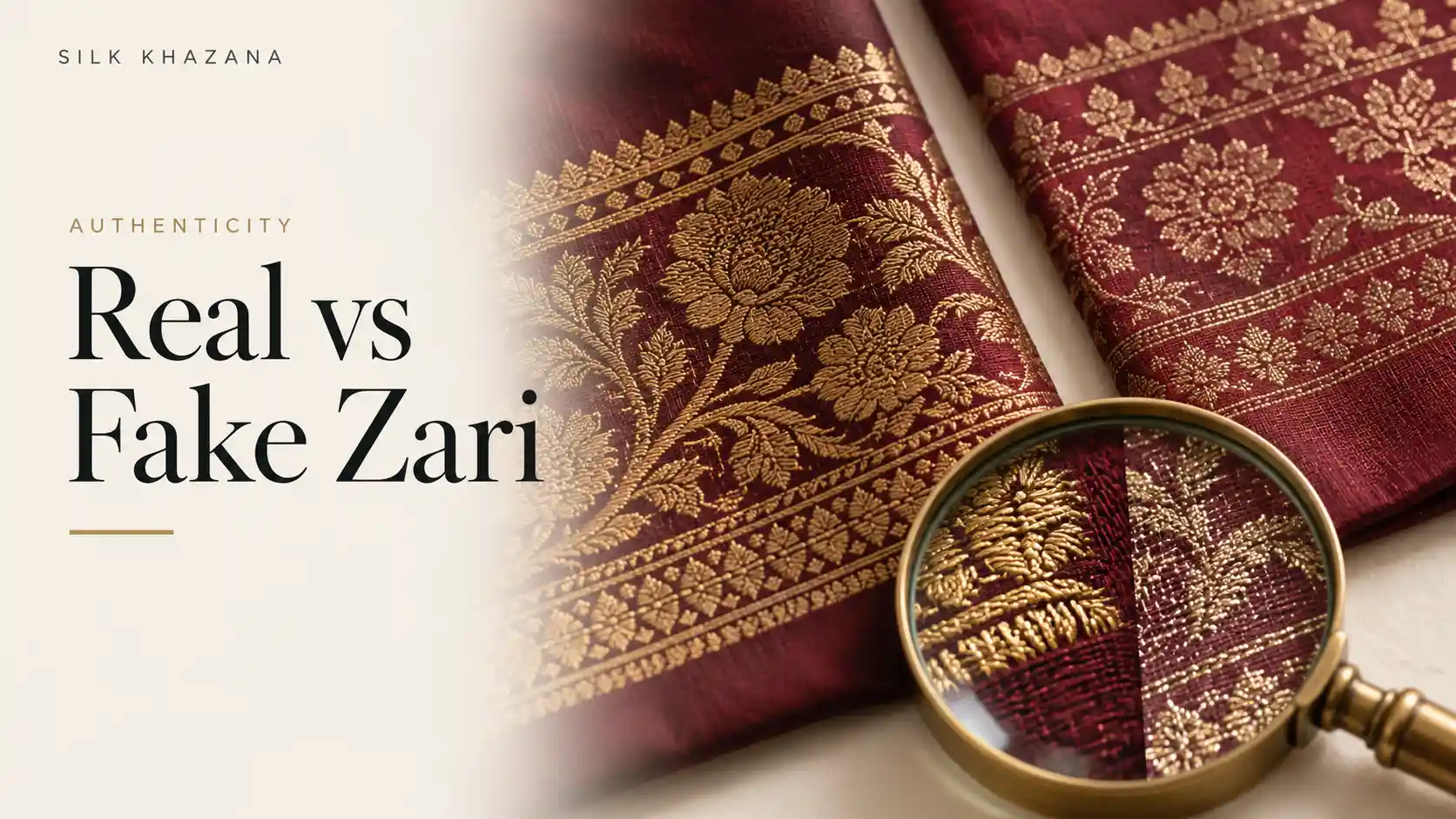
Use a magnifying glass or your phone camera on a loose thread end. Metal zari shows a core thread with metal wrapped around it. Imitation film often shows a flat, plastic-like ribbon that can curl, peel or look glassy at the cut end.

4. Feel the weight and the stiffness

Zari adds weight and a slight stiffness. A saree with a very broad zari border that feels featherlight may be using fine or imitation zari. Compare two sarees of similar design side by side if you can.

5. Try a loose-thread burn test, or ask for a lab test

Do this only on a loose thread, and only with the seller's permission, never on the saree body. Metal zari leaves a metallic or ashy residue after the silk core burns away. Imitation film melts, shrinks and leaves a dark, hard bead. For a high-value piece, a goldsmith or a textile testing laboratory can give a definitive answer.

Why real zari can tarnish

Here is something sellers do not always say. Silver-based zari can darken over time as the silver reacts with air, moisture and perfume. It is natural, and it does not mean the zari is fake. Imitation zari, by contrast, does not tarnish at all, which is why it can look "newer" for longer and flake instead of aging.

You can slow tarnishing by storing the saree in muslin, away from damp, and by keeping perfume off the borders. See our guide on storing Banarasi sarees.

Questions to ask before you buy

  • What type of zari is in this saree?
  • Is it handloom or powerloom?
  • Is the silk certified with the Silk Mark?
  • Can you show me the back of the zari work?
  • What is the care advice for this piece?

Our guides on handloom vs powerloom and GI tag and Silk Mark pair well with this one. If you are buying from a distance, read how to buy authentic Banarasi sarees online safely.

Further reading on real vs fake zari: Banarasi sari on Wikipedia.

Key takeaways

  • Zari comes in three tiers: pure, tested and imitation. Price should match the tier.
  • Ask for the zari type in plain words, and get it written down.
  • Look at colour, thread structure and weight, and use several checks together.
  • Real silver zari can tarnish. That is not a defect.

Frequently Asked Questions

Use several simple checks together: ask the zari type, inspect the glow, look at a loose thread under magnification and, with the seller's permission, try a loose-thread burn test. For high-value pieces, a goldsmith or lab can test it.

Most pure zari is silver wire plated with gold. If a seller says "real gold zari", ask them to explain exactly what that means.

No. The Silk Mark certifies silk content, not the zari. Ask the seller to state the zari type in writing.

Silver-based zari can tarnish over time. This is normal and does not mean the zari was fake.

It does not tarnish, but it can flake, peel or lose its coating with wear.

Specialist cleaners can sometimes brighten tarnished zari, but results vary. Do not try home remedies on a valuable saree.

Message us on WhatsApp at +91 63073 05873 or visit our Varanasi showroom, and we will walk you through real vs fake zari with the saree in your hands.

Explore our Zari Silk Sarees

Looking for real vs fake zari? We manufacture Banarasi silk in Varanasi and have done since 1970, selling directly, so you can ask us anything about a saree and get a specific answer.

Not sure what suits you? Message us on WhatsApp at +91 63073 05873 and tell us the occasion. Visit us: J 14/180, opp. Chhavi Mahal Cinema, Qazi Sadullah Pura, Jaitpura, Varanasi 221001.
Tussar Ghicha Silk Saree: Complete Guide | Silk Khazana
Fabrics 6 Min Read

Tussar Ghicha Silk Saree: Complete Guide

Tussar ghicha silk saree guide: why the texture is uneven, how to spot genuine tussar, and how to style and care for a Banarasi tussar saree.

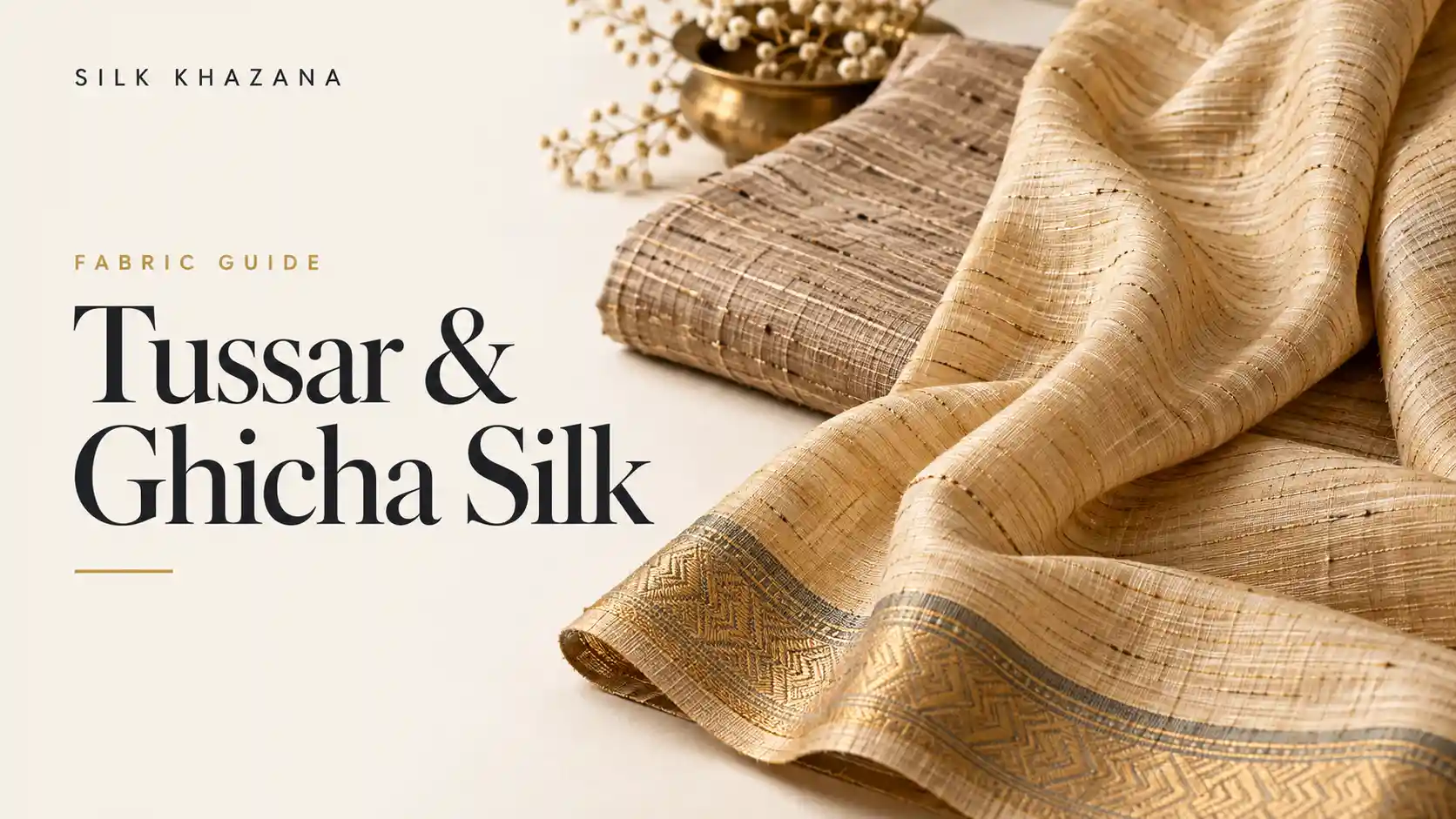
Most silk is made to look smooth. Tussar is not. It arrives with a warm, honeyed colour that no dye vat quite copies, a grain you can feel with your fingertips, and a quiet shine that belongs to daylight. It is silk with the edges left on.

If you are drawn to fabrics with character, this guide will help you understand tussar and its rougher cousin ghicha, and choose with confidence.

What is a tussar ghicha silk saree?

Tussar (also spelt tasar) is a wild silk. Most silk comes from silkworms raised indoors on mulberry leaves. Tussar comes from silkworms, mainly Antheraea mylitta, that live on forest trees such as arjun and asan, in regions including Jharkhand, Chhattisgarh and Odisha. The cocoons are collected, reeled into yarn and sent to weaving centres, including Varanasi.

Two results follow from this:

  • Colour. Tussar is naturally a pale gold, beige or tawny. It can be dyed, but many people love the natural shade.
  • Texture. The fibre is thicker and less uniform than mulberry silk, so the fabric feels coarser, drier and more textured.

What is ghicha?

Ghicha is a tussar yarn with a pronounced nubby, slubby surface, spun from the more irregular fibre of the cocoon. A ghicha fabric has visible knots and uneven threads that give it a rustic, handspun look. Think of it as tussar turned up a notch, textured on purpose.

In Banarasi weaving you may find tussar and ghicha combined with other fibres or techniques:

  • Tussar katan: a tussar-toned saree with a firmer katan feel
  • Tussar georgette: lighter and more flowing
  • Tussar khaddi: the softly textured style, in a tussar base
  • Ghicha borders: textured edges against a smoother body

How tussar looks and feels

Imagine linen's character with silk's warmth. A tussar saree has:

  • A dry, slightly rough hand. It is not slippery.
  • A matte sheen with subtle, uneven lustre.
  • A natural irregularity, with tiny slubs and slight variations in the thread.
  • A crisp fall that holds pleats well.
  • Breathability. Many wearers find tussar cooler than smoother silks.

Zari borders and motifs on tussar look striking because the metallic shine plays against the earthy base.

Where tussar suits best

  • Daytime festivals and pujas, where its warm tones feel right
  • Formal workwear and gatherings, for those who want silk without sparkle
  • Summer and early autumn weddings as a guest
  • Gifts for people who love handloom character

For the bride's main ceremony, tussar is not the usual choice. It shines better as a daytime or second-function saree.

Tussar compared with other textured silks

FabricSourceTextureBest for
TussarWild silkwormsDry, slightly coarseDaytime and festive wear
GhichaTussar, nubby yarnVery textured, rusticStatement texture
DupionDouble cocoons, mulberrySlubby, crisp, lustrousStructured looks
KatanMulberry silkSmooth, firmBridal and heirloom

See our dupion silk saree guide for the closest relative.

How to spot genuine tussar

  • 1. Look for natural unevenness. Genuine tussar has slight variation in the yarn. A surface that is perfectly uniform and printed with a "slub pattern" is worth a second look.
  • 2. Check the colour. Natural tussar has a warm, golden-beige shade that is slightly inconsistent across the length. Strong, flat colour often means dye or print.
  • 3. Feel the weight and grain. Tussar is drier and more textured than mulberry silk. Imitations in synthetic fibre feel smoother and cooler.
  • 4. Ask about the fibre and the loom. Read handloom vs powerloom to understand why it matters.
  • 5. Look for the Silk Mark. It certifies silk content, including wild silks.

Styling a tussar saree

Blouse. Contrast looks lovely: a deep maroon, teal or black raw silk against the golden base. A matching tussar blouse feels earthy and cohesive.

Draping. The body in the fabric keeps pleats crisp. A classic Nivi or a Bengali drape both suit it.

Jewellery. Antique gold, oxidised silver and temple jewellery are natural partners. Coloured stones in rust, emerald or lapis look rich on the warm tone.

Caring for tussar

  • Dry clean with a cleaner who knows silk.
  • Keep it out of strong sun, which can fade dyes and dull the natural colour.
  • Store folded in muslin, away from damp. See how to store Banarasi sarees.
  • Avoid rough surfaces, since the slubs can catch.
  • Iron on a low silk setting with a cloth between iron and fabric.

Further reading on tussar ghicha silk saree: Banarasi sari on Wikipedia, and the Silk Mark scheme.

Curious about wild silks? Read our moonga silk saree guide and moonga vs tussar silk comparison.

Key takeaways

  • Tussar is wild silk with a natural golden shade and a dry, textured hand.
  • Ghicha is the nubby, rustic version, spun from the more irregular fibre.
  • Natural unevenness is a good sign, and a perfectly uniform "slub" is not.
  • It is a daytime saree and a favourite for people who prefer character over gloss.

Frequently Asked Questions

Yes. It is silk from wild silkworms rather than the mulberry silkworm. It is a different kind of silk, not a lesser one.

Tussar is the wild silk. Ghicha is a very textured tussar yarn with visible nubs, giving a more rustic look.

The fibre is naturally thicker and less uniform than mulberry silk. That grain is part of its identity.

Natural tussar colour is fairly stable, but dyed tussar can fade in strong sunlight. Keep it out of direct sun.

Yes, as a guest or in a daytime function. For a bride's main ceremony, the heavier katan or jangla is the more usual choice.

Many wearers find it breathable and comfortable, though a cotton petticoat helps.

Message us on WhatsApp at +91 63073 05873 or visit our Varanasi showroom, and we will walk you through tussar ghicha silk saree with the saree in your hands.

Browse Tussar Silk Sarees

Looking for tussar ghicha silk saree? We manufacture Banarasi silk in Varanasi and have done since 1970, selling directly, so you can ask us anything about a saree and get a specific answer.

Not sure what suits you? Message us on WhatsApp at +91 63073 05873 and tell us the occasion. Visit us: J 14/180, opp. Chhavi Mahal Cinema, Qazi Sadullah Pura, Jaitpura, Varanasi 221001.
Khaddi Georgette Banarasi Saree: Complete Guide | Silk Khazana
Fabrics 7 Min Read

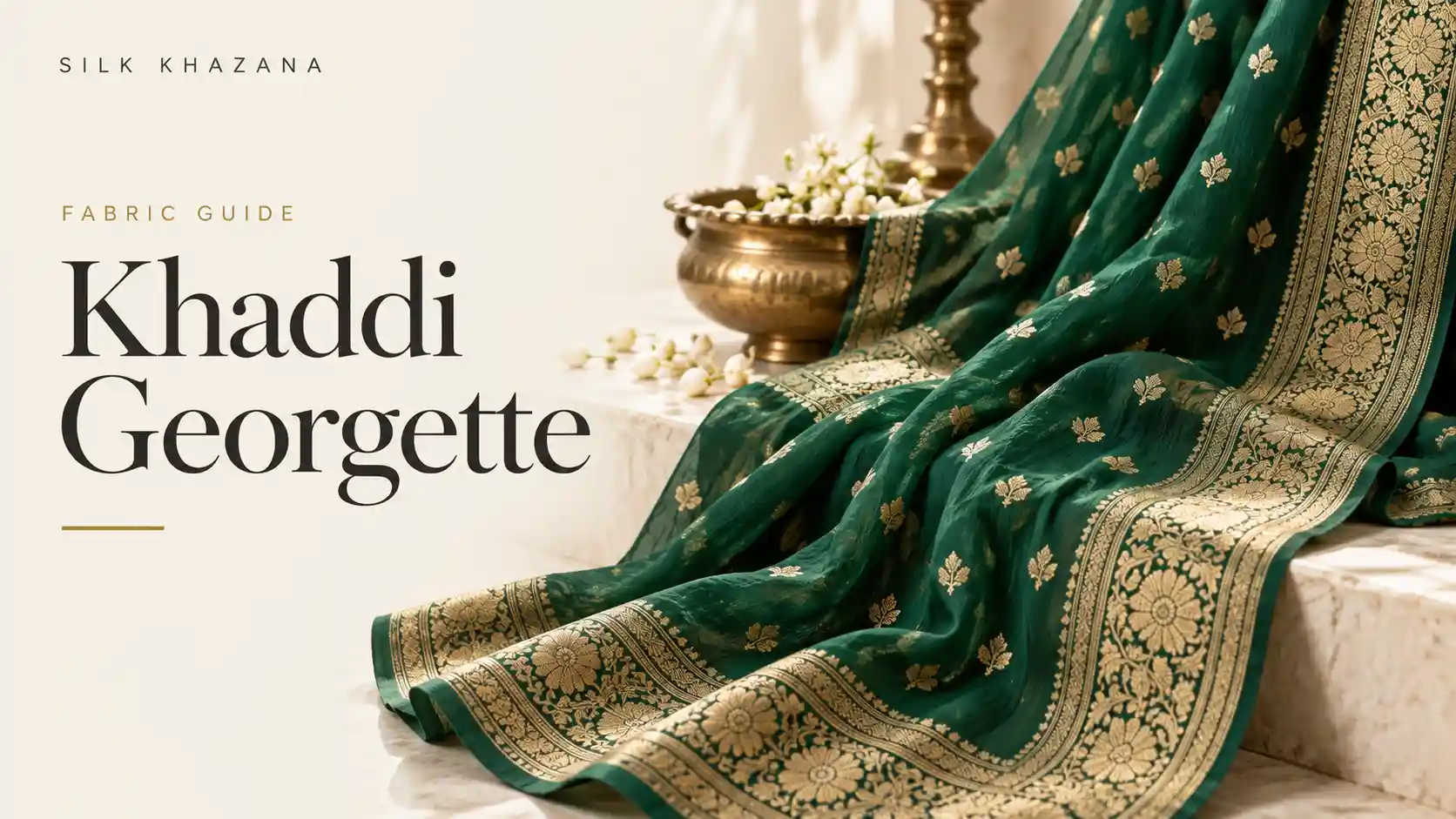
Khaddi Georgette Banarasi Saree: Complete Guide

Khaddi georgette Banarasi saree guide: how it drapes, how to spot pure silk georgette, and how to style and care for it.

Some Banarasi sarees ask you to carry them. Khaddi georgette does the opposite. It falls, flows and moves with you, and it gets through a long day of standing, sitting, travelling and dancing without complaint.

That ease is why it has become one of the most requested fabrics in our showroom, especially from guests, travellers and anyone who finds a heavy katan too much. Here is what the name means, how to choose well, and how to look after it.

What is a khaddi georgette Banarasi saree?

Khaddi georgette is a light, flowing Banarasi saree in which a georgette base carries woven zari or coloured-silk patterns, finished with the slightly textured hand of a khaddi weave.

Break the name into two parts:

  • Georgette is a fabric made from tightly twisted yarns, called crepe yarns. The twist gives it a fine, pebbled surface, a soft drape and a matte look.
  • Khaddi is the word Banarasi weavers use for a light, softly textured handloom style. It has nothing to do with khadi cotton. The term is used most often with georgette and chiffon, which is why you will also see khaddi chiffon in catalogues.

Weavers do not always use these words in exactly the same way, so treat the name as a guide and judge the cloth in your hands.

How it looks and feels

Run your hand over a khaddi georgette saree and you feel a gentle grain, never a slippery smoothness. The surface looks slightly matte, with a quiet depth rather than a gloss. It has a feathery weight: enough fall to hang beautifully, not enough to tire the shoulder.

Typical designs include:

  • Floral jaal over the body, delicate and airy
  • Scattered butis in zari or colour
  • Woven borders in zari, sometimes with Meenakari touches
  • Soft, blended palettes that suit the matte surface: dusty rose, sage, peacock, powder blue, ivory, deep wine

Why people choose it

  • It is easy to wear. The drape flatters and the pleats settle on their own.
  • It travels well. Georgette packs small and rarely shows creases. Ideal for tourists and NRI buyers.
  • It is forgiving. It suits many body types and heights.
  • It suits a wide range of occasions, from wedding guests' looks to festive evenings.

The trade-off is that georgette is delicate. It can snag, and a seam or border can pucker if handled roughly. Treat it kindly and it lasts.

Khaddi georgette compared with other Banarasi fabrics

FabricWeightDrapeBest for
Khaddi georgetteLightSoft, flowingReceptions, festive wear, travel
OrganzaVery lightCrisp, structuredDay functions, pleated looks
TissueLightFluid, metallicEvenings, photographs
KatanHeavyFirm, richBridal and heirloom pieces

If you are considering sheer fabrics too, our guides to organza and tissue are worth a read.

Pure silk georgette or a lookalike?

Georgette is also made in polyester, and polyester georgette is very common. It is worth asking.

  • 1. Ask for the fibre. "Pure silk georgette" should get a straightforward yes. Look for the Silk Mark label.
  • 2. Feel the surface. Silk georgette has a dry, grainy hand with a soft warmth. Polyester often feels cooler, slicker and more uniform.
  • 3. Look at the sheen. Silk's glow is soft and shifts with the light. Polyester can glare.
  • 4. Check the zari and motifs on the back. Clean, neat thread ends point to careful weaving.
  • 5. Do the arithmetic. Silk yarn and zari work have real costs. See why Banarasi sarees are expensive.

For more checks, see our guide on how to identify a pure Banarasi silk saree.

Styling a khaddi georgette saree

Blouse. Georgette likes a blouse with a little structure: raw silk, a fine brocade or velvet. A soft matching georgette blouse also works, with a lining. Browse necklines and sleeve ideas in our blouse design guide.

Petticoat. Georgette is semi-sheer, so match the petticoat closely. Satin gives a smoother line; cotton breathes better.

Draping. Because the fabric is slippery by nature, pre-pleat it and use a few discreet pins. A Nivi drape suits it. A lehenga-style or open-pallu drape lets the flow show.

Jewellery. Soft fabric allows a bolder necklace than organza does, but avoid sharp stones that might catch the weave.

For wedding-guest looks, our guide on Banarasi sarees for wedding guests and receptions shows how to dress it up.

Caring for khaddi georgette

  • Dry clean only. Choose a cleaner familiar with silk and zari.
  • Fold, do not hang. Hanging can pull the weave out of shape. Use muslin.
  • Protect from snags. Keep away from rough bag straps, zips and jewellery with sharp edges.
  • Avoid perfume and hairspray touching the cloth.
  • Iron only gently, on a low silk setting with a cotton cloth, or leave it to a professional.

Further reading on khaddi georgette banarasi saree: Banarasi sari on Wikipedia, and the Silk Mark scheme.

Key takeaways

  • Khaddi georgette is light, flowing and matte, with a softly textured handloom feel.
  • Georgette also comes in polyester, so always confirm the fibre.
  • It is the easy-travelling Banarasi, comfortable for long days and light to pack.
  • Match the petticoat and mind the snags.

Frequently Asked Questions

It is the Banarasi weaver's term for a light, softly textured handloom style, most often found in georgette and chiffon. It is not the same as khadi cotton.

It can be, but georgette is also made in polyester. Confirm the fibre and look for the Silk Mark label.

Yes, especially for guests, receptions and sangeet. For the bride's main ceremony, a heavier katan or jangla is the traditional choice.

They are different. Georgette has a pebbled grain and more body, while chiffon is finer and more transparent. Many khaddi sarees come in both.

We recommend dry cleaning. Zari and deep dyes do not forgive home washing.

Yes. It packs small and resists creasing, which is why travellers often pick it.

Message us on WhatsApp at +91 63073 05873 or visit our Varanasi showroom, and we will walk you through khaddi georgette banarasi saree with the saree in your hands.

Browse Khaddi Chiffon & Georgette Sarees

Looking for khaddi georgette banarasi saree? We manufacture Banarasi silk in Varanasi and have done since 1970, selling directly, so you can ask us anything about a saree and get a specific answer.

Not sure what suits you? Message us on WhatsApp at +91 63073 05873 and tell us the occasion. Visit us: J 14/180, opp. Chhavi Mahal Cinema, Qazi Sadullah Pura, Jaitpura, Varanasi 221001.
Kora Silk Saree Explained: Meaning, Feel and Buying Tips | Silk Khazana
Fabrics 6 Min Read

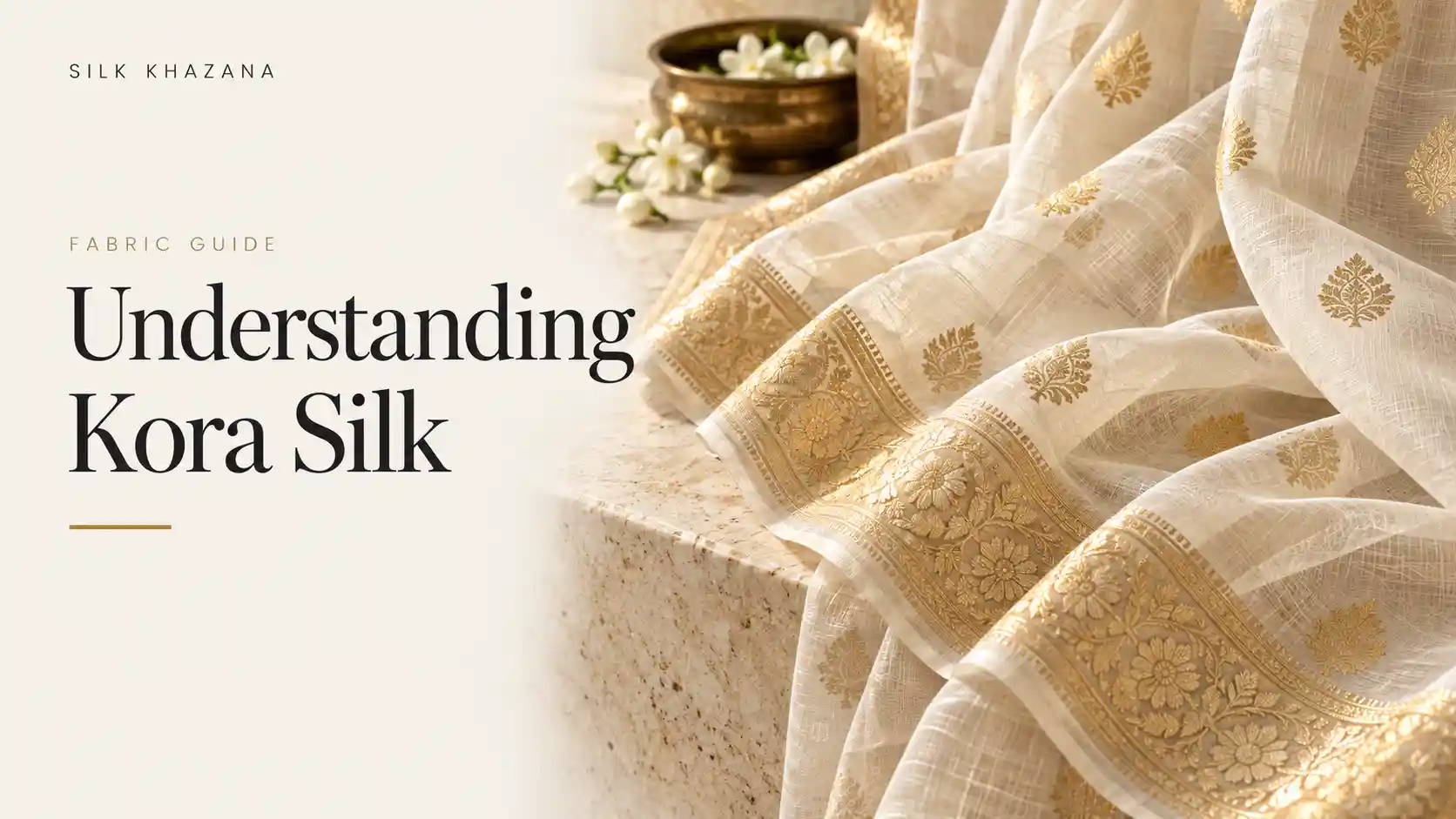
Kora Silk Saree Explained: Meaning, Feel and Buying Tips

Kora silk saree explained: what kora means, why it feels crisp, how it differs from organza and tissue, and how to choose and care for it.

Ask three people in Varanasi what kora means and you may get three slightly different answers. One will say it is organza. One will say it is the colour. One will say it is a fabric you can only find here. All three are close to the truth, which is exactly why the word confuses first-time buyers.

This guide gives you a clear working definition, explains why kora feels the way it does, and shows you how to buy, wear and care for it.

What does "kora" mean?

In Hindi, kora means raw, fresh or untouched. A kora sheet of paper is a blank one. In weaving, it points to silk that has been left close to its natural state.

A kora silk saree is a light, sheer, crisp Banarasi saree made from silk yarn that has not been fully degummed. Raw silk threads carry a natural gum called sericin. Fully processed silk has most of it removed, which makes it soft and glossy. Kora silk keeps some, and that is where the crispness and the slightly dry feel come from.

Why kora feels the way it does

Pick up a kora saree and you notice three things:

  • It is crisp. The cloth has a gentle stiffness and holds a pleat.
  • It is sheer. Light passes through the weave, and motifs appear to float.
  • It is matte. The glow is quiet and soft, not shiny.

With wear and cleaning, kora often relaxes. Many owners say their kora sarees became softer and more flowing with the years. This is normal and is part of its charm.

Kora, organza and tissue: how they relate

TermWhat it describesTypical feel
KoraSilk kept close to its natural, undegummed stateCrisp, dry, matte
OrganzaA sheer, structured fabric (silk or synthetic)Crisp, transparent
Kora organzaThe Banarasi sheer silk, as many weavers name itCrisp, light, floating motifs
TissueSilk with a metallic zari weft through the bodyFluid, shimmering

In practice, a Banarasi kora saree and a Banarasi silk organza saree are close relatives, and many weavers use the names almost interchangeably. The cleanest way to avoid confusion is to ask what the saree is made of. Our organza saree guide covers the sheer family in more detail, and the tissue guide covers the shimmering cousin.

The kinds of kora saree you will meet

Plain kora with a zari border. The simplest and most graceful. A clear field of colour with a narrow border and a pallu with some weight.

Kora with butis. Small woven motifs scattered across the body. Light and easy to wear.

Kora Meenakari. Coloured silk threads woven into the design, like enamelling on jewellery. Our note on Meenakari, Rangkat and Jaal explains the technique.

Kora tissue. A hybrid, with a sheer kora feel and a metallic gleam. You will sometimes see it described as kora tissue.

How to choose a good kora saree

  • 1. Check the weave in light. Hold the saree against a window. The threads should look even, with no thin patches or clumps.
  • 2. Look at the back of the motifs. Neat, short thread ends are a sign of careful weaving. Long loose floats can snag later.
  • 3. Feel the border. The border should lie flat and move with the saree, not pull it into puckers.
  • 4. Ask about the fibre. You want silk. Synthetic look-alikes exist at lower prices.
  • 5. Ask about the loom. Handloom and powerloom both produce kora. Both are legitimate, but they are priced and described differently. Read handloom vs powerloom.

Styling a kora saree

Kora looks best when you let its lightness lead. A few ideas:

  • Blouse: raw silk, velvet or a fine brocade. Choose a colour that complements the saree rather than matching it exactly.
  • Petticoat: a close shade in cotton or satin. The sheerness shows everything beneath.
  • Draping: the crisp pleat suits a neat Nivi drape. Pin from inside, and use fewer pins.
  • Jewellery: pearls, light kundan or a single temple necklace.
  • Occasions: day weddings, festive lunches, formal gatherings, summer celebrations.

Caring for kora silk

  • Take it to a dry cleaner who understands silk and zari. Do not wash it at home.
  • Store it folded in muslin, and refold along different lines every few months. See our guide to storing Banarasi sarees.
  • Do not use starch. Kora already has its own body.
  • Keep it away from perfume and rain.

Further reading on kora silk saree: Banarasi sari on Wikipedia, and the Silk Mark scheme.

Key takeaways

  • Kora means raw. The silk keeps some of its natural gum, which gives the cloth its crisp, dry feel.
  • Kora and organza are close relatives in Banarasi weaving, and the best way to be sure is to ask about fibre and loom.
  • It softens with wear, which is part of its character.
  • Treat it gently: dry clean, fold in muslin, keep away from rain and perfume.

Frequently Asked Questions

They overlap. Kora usually refers to silk that keeps some of its natural gum, and organza describes a sheer, crisp construction. In Banarasi weaving the two names are often used for similar sarees, so ask what the fabric is made of.

Genuine kora silk is silk. Because lookalikes exist, ask for the fibre in plain words and look for the Silk Mark label.

The natural gum in the yarn gives it body. Many kora sarees soften gradually with wear and professional cleaning.

Yes, particularly for day functions and as a second look. For the main bridal ceremony, a heavier katan or jangla is the more traditional choice.

It is one of the more comfortable Banarasi fabrics for warm weather: light, airy and dry to the touch.

Yes. It is sheer, so a well-matched petticoat is part of the outfit.

Message us on WhatsApp at +91 63073 05873 or visit our Varanasi showroom, and we will walk you through kora silk saree with the saree in your hands.

Browse Kora Silk Sarees

Looking for kora silk saree? We manufacture Banarasi silk in Varanasi and have done since 1970, selling directly, so you can ask us anything about a saree and get a specific answer.

Not sure what suits you? Message us on WhatsApp at +91 63073 05873 and tell us the occasion. Visit us: J 14/180, opp. Chhavi Mahal Cinema, Qazi Sadullah Pura, Jaitpura, Varanasi 221001.

Banarasi Organza Silk Saree: Guide and Styling Tips | Silk Khazana
Fabrics 7 Min Read

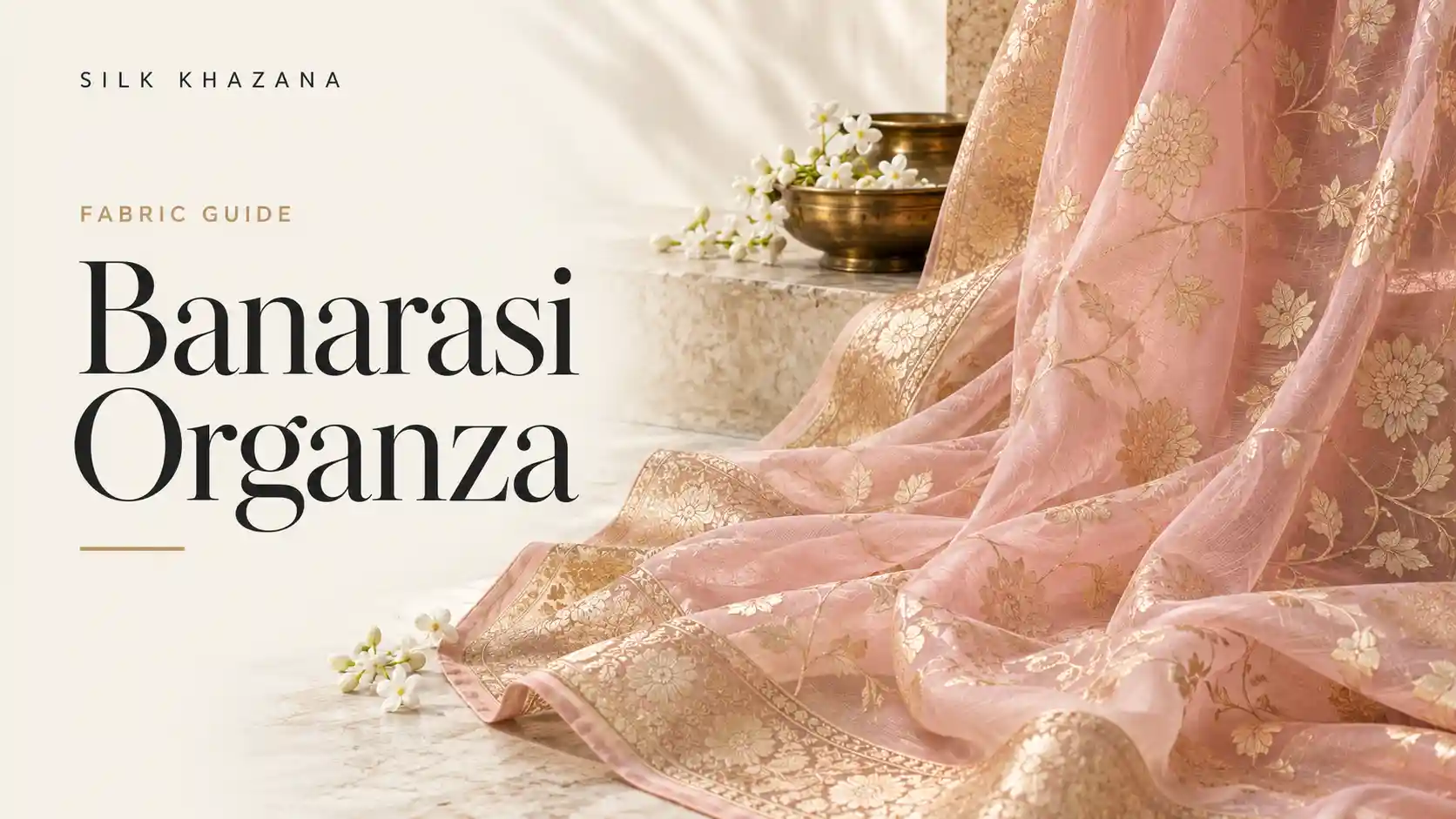
Banarasi Organza Silk Saree: Guide and Styling Tips

Banarasi organza silk saree guide: how to tell silk organza from polyester, plus styling, draping and care tips from a Varanasi weaving family.

Hold a Banarasi organza saree up to a window and the light goes straight through it. The zari motifs seem to hang in the air with nothing underneath them. That is the reason people fall for this fabric, and also the reason it needs a little more knowing than a katan does.

This guide covers what Banarasi organza really is, how to tell silk organza from the look-alikes, how to style and drape it, and how to look after it. We make these sarees at our family unit in Varanasi, so what follows comes from the loom and the showroom counter rather than a catalogue.

What is a Banarasi organza silk saree?

A Banarasi organza saree is a sheer, crisp silk saree woven in Varanasi, with zari or coloured-silk motifs sitting on a see-through ground. The cloth is light and slightly stiff, so it holds its shape instead of clinging.

Two things are worth separating here. "Banarasi" tells you where and how the saree is woven. "Silk" tells you what it is made of. Organza is only a type of fabric, and a good deal of the organza sold in India today is polyester or nylon. A saree can be called Banarasi organza and still not be silk, so check both words.

In Varanasi you will also hear weavers use the word kora for this kind of sheer silk. We explain how the two terms relate in our guide to the kora silk saree.

How it looks and feels

Silk organza has a dry, crisp hand. It is not slippery. When you fold a pleat it makes a faint rustle, and the pleat stays where you put it. The sheen is soft and changes with the angle, closer to the glow of frosted glass than to a mirror.

Because the ground is transparent, the design does the work. You will see:

  • Small butis scattered across the body, light and airy.
  • Jaal patterns, a net-like layout of flowers and vines that looks almost like embroidery floating on air.
  • Meenakari borders, where coloured silk threads are woven in to look like enamel work on jewellery.
  • Zari borders in gold, silver or antique tones, usually kept narrower than on a bridal katan.

Colours run from pale pastels to saturated jewel tones. Organza takes dye beautifully, and the transparency makes deep colours glow rather than sit heavy.

Where organza works best

Organza is a daytime and warm-weather favourite. It suits:

  • Day weddings, mehendi, haldi and engagement lunches
  • Festive occasions in spring, summer and early autumn
  • A second-function saree for a bride, when the first look is a heavy katan
  • Formal events where you want elegance without carrying five kilos of brocade

It is less happy in a packed car, a crowded temple queue or a downpour. Organza snags on rough surfaces and can water-mark. Plan the occasion around that and it will serve you well for years.

Organza compared with other light Banarasi fabrics

FabricFeelSheenBest for
OrganzaCrisp, sheer, structuredSoft, gentle glowDaytime functions, pleats that hold
TissueFluid, light, metallicAll-over shimmerEvenings, receptions
GeorgetteSoft, flowing, matteLowEasy all-day wear, travel
KatanFirm, weighty, durableRich, deepBridal, heirloom pieces

If the all-over shimmer of tissue appeals more, read our tissue silk saree guide.

How to tell silk organza from a look-alike

You do not need a laboratory. A few habits catch most problems.

  • 1. Ask for the fibre in plain words. "Pure silk organza" should come with a clear yes. Look for the Silk Mark label, which certifies silk content. It does not tell you whether the saree is handloom, a separate question we cover in handloom vs powerloom.
  • 2. Touch it. Silk organza feels dry and slightly textured. Polyester organza is often smooth, slick and uniformly shiny.
  • 3. Watch the light. Silk gives a soft, uneven glow that shifts as you move. Synthetic organza tends to throw a flat, glassy glare.
  • 4. Try a loose-thread burn test, politely. Only on a stray thread from the fall or an edge, and with the seller's permission, never on the saree body. Silk burns slowly, smells like burnt hair and leaves a crushable ash. Polyester melts, smells chemical and leaves a hard bead.
  • 5. Question a very low price. Zari work, silk yarn and weaving time all cost money. We explain the arithmetic in why Banarasi sarees are expensive.

For the wider verification toolkit, including the GI tag, see how to verify a genuine Banarasi saree.

How to style a Banarasi organza saree

Blouse. Raw silk, velvet or a small-motif brocade gives the sheer drape something solid to sit against. A matching organza blouse looks lovely but needs a lining, because you do not want it see-through. Our blouse design guide goes into necklines and sleeves.

Petticoat. This choice is half the look. Organza shows what is under it, so pick a close shade for a clean, continuous colour, or a deeper tone if you want the saree to wear a soft tint. Cotton or satin both work. A mismatched petticoat is the most common styling mistake we see.

Draping. The crispness helps. Pleats stay sharp, and the pallu falls with a little lift. A classic Nivi drape suits it well. Pin sparingly and from the inside, since every pin is a small risk to the weave. We walk through six drapes in how to drape a Banarasi saree.

Jewellery. Keep it fine. Pearls, light kundan and delicate temple pieces suit the airy fabric. Sharp-edged pieces, chunky cuffs and rough clasps tend to catch the weave.

Caring for organza

  • Dry clean only, with a cleaner who has handled zari before. Ask before you hand it over.
  • Store folded in muslin, with a layer of acid-free tissue between folds. Do not leave it hanging for long.
  • Keep it away from perfume, hairspray and rain. Organza can water-mark.
  • Iron only if you must, on low heat with a cotton cloth between iron and fabric, or leave it to a professional.
  • If it snags, do not pull. A snag can usually be eased back by a weaver or a skilled tailor.

Fuller routines are in our guides to washing and caring for Banarasi silk and storing Banarasi sarees.

Further reading on banarasi organza silk saree: Banarasi sari on Wikipedia, and the Silk Mark scheme.

Key takeaways

  • Banarasi organza is sheer, crisp silk with zari or coloured motifs floating on a transparent ground.
  • "Organza" alone does not mean silk. Confirm the fibre as well as the origin.
  • Match the petticoat carefully, since organza reveals what lies beneath.
  • It is a daytime, warm-weather fabric that rewards gentle handling.

Frequently Asked Questions

It can be, but it is not automatic. Organza describes the weave and feel, and the fibre can be silk, polyester or nylon. Ask for the fibre in plain words and look for the Silk Mark label.

Yes. It is light, breathable for a silk, and sits away from the skin. It is one of the more comfortable Banarasi choices for warm weather, though you will still want a cotton petticoat.

Yes. The fabric is sheer, so a well-matched petticoat is part of the outfit. Choose a close shade for a continuous colour or a deeper one for a tinted effect.

In Varanasi the two words overlap. Kora usually refers to the sheer, crisp silk made from yarn that keeps some of its natural gum, and organza describes the sheer construction. Weavers do not always use them identically, so ask what a particular saree is made of.

Many brides choose it for day functions, a haldi or a second look. For the main ceremony the heavier katan, jangla or Meenakari is the more traditional choice.

Avoid rough surfaces, sharp jewellery and tight pinning. Sit with the pallu folded in your lap, and keep it away from velcro, zips and bag clasps.

Message us on WhatsApp at +91 63073 05873 or visit our Varanasi showroom, and we will walk you through banarasi organza silk saree with the saree in your hands.

Browse Organza Silk Sarees

Looking for banarasi organza silk saree? We manufacture Banarasi silk in Varanasi and have done since 1970, selling directly, so you can ask us anything about a saree and get a specific answer.

Not sure what suits you? Message us on WhatsApp at +91 63073 05873 and tell us the occasion. Visit us: J 14/180, opp. Chhavi Mahal Cinema, Qazi Sadullah Pura, Jaitpura, Varanasi 221001.