+9163073 05873 support@silkkhazana.in
Summer sale discount upto 30%! Shop Now

Mini Cart

Shikargah Banarasi Saree: The Hunting-Scene Weave | Silk Khazana
Weaves 6 Min Read

Shikargah Banarasi Saree: The Hunting-Scene Weave

The shikargah Banarasi saree explained: its hunting-scene design, Mughal miniature roots, how it is woven, how to judge quality and how to care for it.

Most Banarasi sarees speak in flowers and vines. The shikargah tells a story.

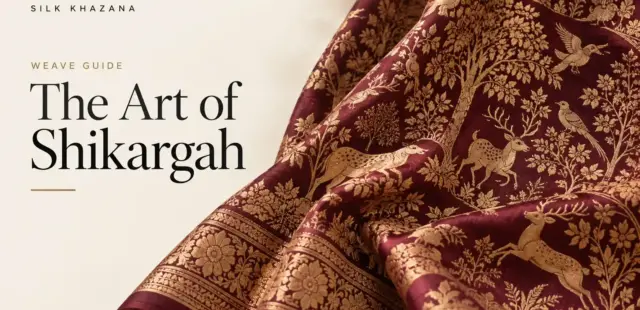
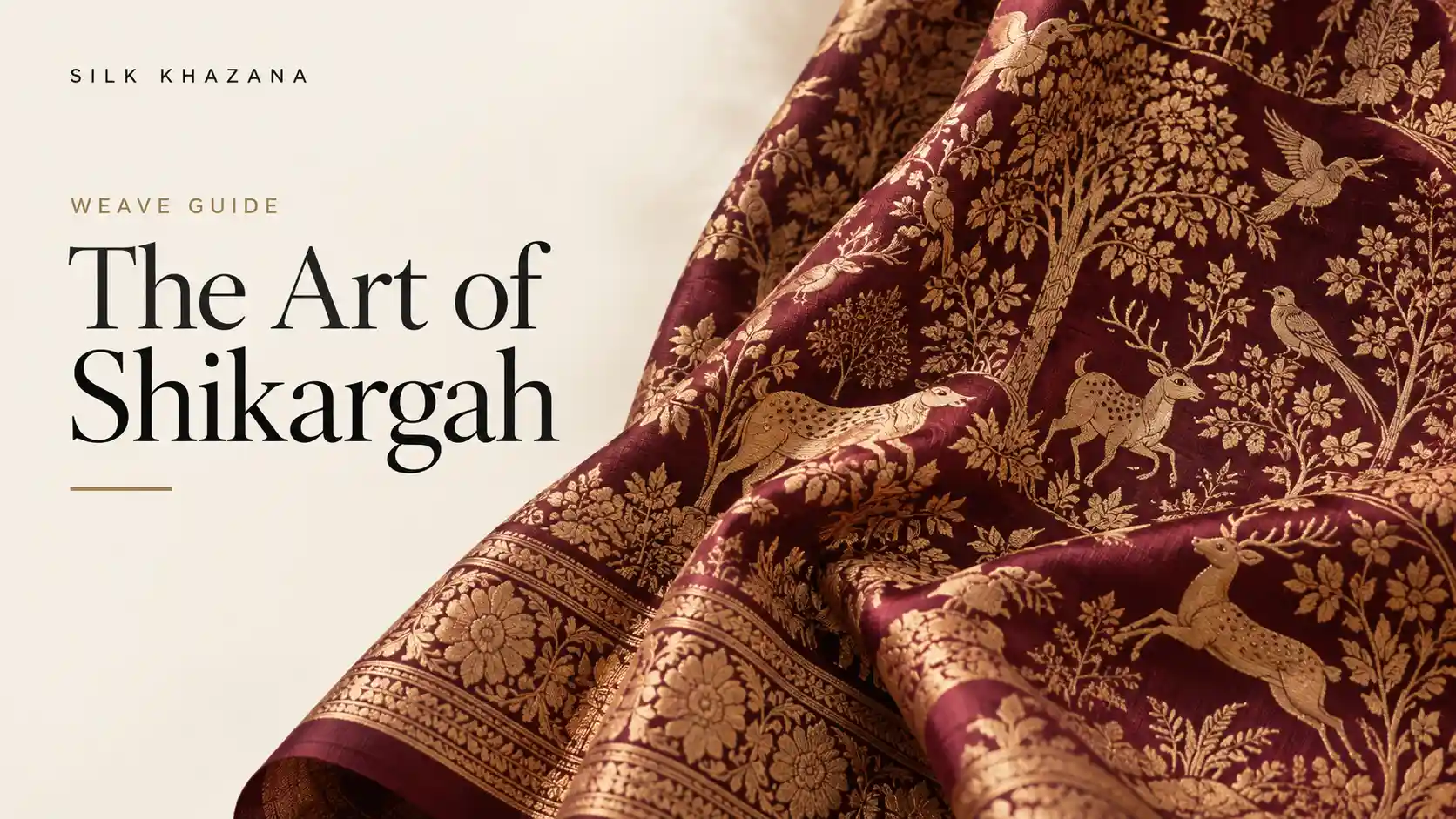
Look closely at one and you will find riders on horseback, elephants, tigers, deer and birds, all moving through a woven forest. It is one of the most narrative designs in Indian weaving, and among the most collected.

What is a shikargah Banarasi saree?

Shikargah means hunting ground, or a place for the hunt. In Banarasi weaving, a shikargah saree is one whose design shows hunting scenes set among trees, flowers and creepers.

Where the design comes from

The shikargah draws on the tradition of Mughal-era miniature painting, in which hunting scenes were a popular subject, as were courtly processions and gardens. Weavers translated that visual language into silk and zari. The result is a textile that reads like a painting.

The design is unusual in Banarasi work because it features figures. Much Banarasi design relies on floral, foliage and geometric motifs, so a saree with people and animals stands out. For the wider vocabulary of motifs, see Banarasi motifs explained, and for the background, our piece on the history of Banarasi silk weaving.

What you will see on one

  • Hunters on horseback or elephants, sometimes with spears or bows
  • Animals: tigers, deer, antelope, birds and sometimes other creatures
  • A woven landscape: trees, creepers, flowers and sometimes architecture
  • A rhythmic layout, with scenes repeated across the body and a more elaborate pallu

The figures are small and finely worked, so a shikargah rewards close looking.

How it is woven

A shikargah is demanding to weave. Each figure is built from many threads, and the placement of rider, animal and foliage must be planned in advance. A designer maps the pattern thread by thread, and the weaver brings it to life on the loom. The finer the figures, the more skill and time the saree takes.

Because of this, genuine, finely worked shikargah sarees tend to be among the more valued Banarasi pieces. For why the effort matters to price, see why Banarasi sarees are expensive.

Shikargah compared with other designs

ShikargahKatan JunglaButi saree
SubjectHunting scenes with figuresLeaves, vines and flowersSmall scattered motifs
MoodNarrative, collectableLush, classicalLight, airy
Detail levelVery highHighModerate
Best forCollectors, heirloom giftsBrides, ceremoniesEveryday festive wear

See our katan jungla guide for the plant-based counterpart.

How to judge quality

  • 1. Look at the figures. Riders, animals and trees should have clear outlines. Blurry or distorted figures suggest rushed work.
  • 2. Check the spacing. The scenes should be balanced, with no crowding or awkward gaps.
  • 3. Look at the pallu. It is usually the most detailed part, so it shows the weaver's skill.
  • 4. Turn it over. The reverse should be neat, with short, tidy thread ends.
  • 5. Ask about the zari and the loom. Request the zari type and the loom (handloom or powerloom) in writing. See real vs fake zari and handloom vs powerloom.
  • 6. Check the silk. Look for the Silk Mark and a clear fibre statement.

Who should choose a shikargah?

Choose one if you:

  • Love storytelling in textiles and want a saree with a talking point
  • Collect heritage weaves or want an heirloom
  • Are choosing a gift for someone who appreciates craft

If you prefer purely floral or abstract designs, a jungla or buti saree may suit you better.

A note on taste: some people prefer not to wear figurative designs. If that matters to you or your family, a floral Banarasi is a better choice.

Styling

  • Let the saree lead. The design is the statement, so keep the blouse simple, in a solid colour drawn from the saree.
  • Show the pallu. A drape that displays it, such as the Gujarati style, lets the scene be seen. See our draping guide.
  • Keep jewellery restrained. One statement piece is plenty.
  • Display it too. Many collectors frame the pallu or display the saree at home.

Care

Handle a shikargah as you would a collectable.

  • Dry clean only, with a specialist who knows silk and zari.
  • Store folded in muslin, and refold every few months so creases do not set in the same place. For heavily worked pallus, some owners store the saree rolled or hung in cloth.
  • Keep it away from damp, light, perfume and rough surfaces.
  • Wear it with care, avoiding jewellery that could snag the zari.

See our storage guide.

Further reading on shikargah banarasi saree: Banarasi sari on Wikipedia.

Key takeaways

  • Shikargah means hunting ground. The saree shows hunting scenes among foliage.
  • The design draws on Mughal-era miniature painting.
  • It is unusual in Banarasi weaving for its figures.
  • Quality shows in clear figures, balanced scenes and a neat reverse.
  • Ask about silk, zari and loom in writing.

Frequently Asked Questions

A Banarasi saree woven with hunting scenes: riders, animals and foliage, inspired by Mughal-era miniature painting.

Finely worked shikargah sarees are less common than floral designs and are often sought by collectors.

It can be, especially for guests, family and collectors. For a bride, families often choose floral or jaal designs, but taste varies.

It can be handloom or powerloom. Ask the seller which you are buying.

Dry clean with a silk specialist and store folded in muslin.

Yes. Shikargah is a design, not a colour, and it appears across many palettes.

Message us on WhatsApp at +91 63073 05873 or visit our Varanasi showroom, and we will walk you through shikargah banarasi saree with the saree in your hands.

Browse Shikargah Silk Sarees

Looking for shikargah banarasi saree? We manufacture Banarasi silk in Varanasi and have done since 1970, selling directly, so you can ask us anything about a saree and get a specific answer.

Not sure what suits you? Message us on WhatsApp at +91 63073 05873 and tell us the occasion. Visit us: J 14/180, opp. Chhavi Mahal Cinema, Qazi Sadullah Pura, Jaitpura, Varanasi 221001.
Katan Jungla Banarasi Saree: Complete Guide | Silk Khazana
Weaves 6 Min Read

Katan Jungla Banarasi Saree: Complete Guide

Katan jungla Banarasi saree guide: how the dense leaf-and-vine jaal is woven, how to recognise quality, and how to style and care for it.

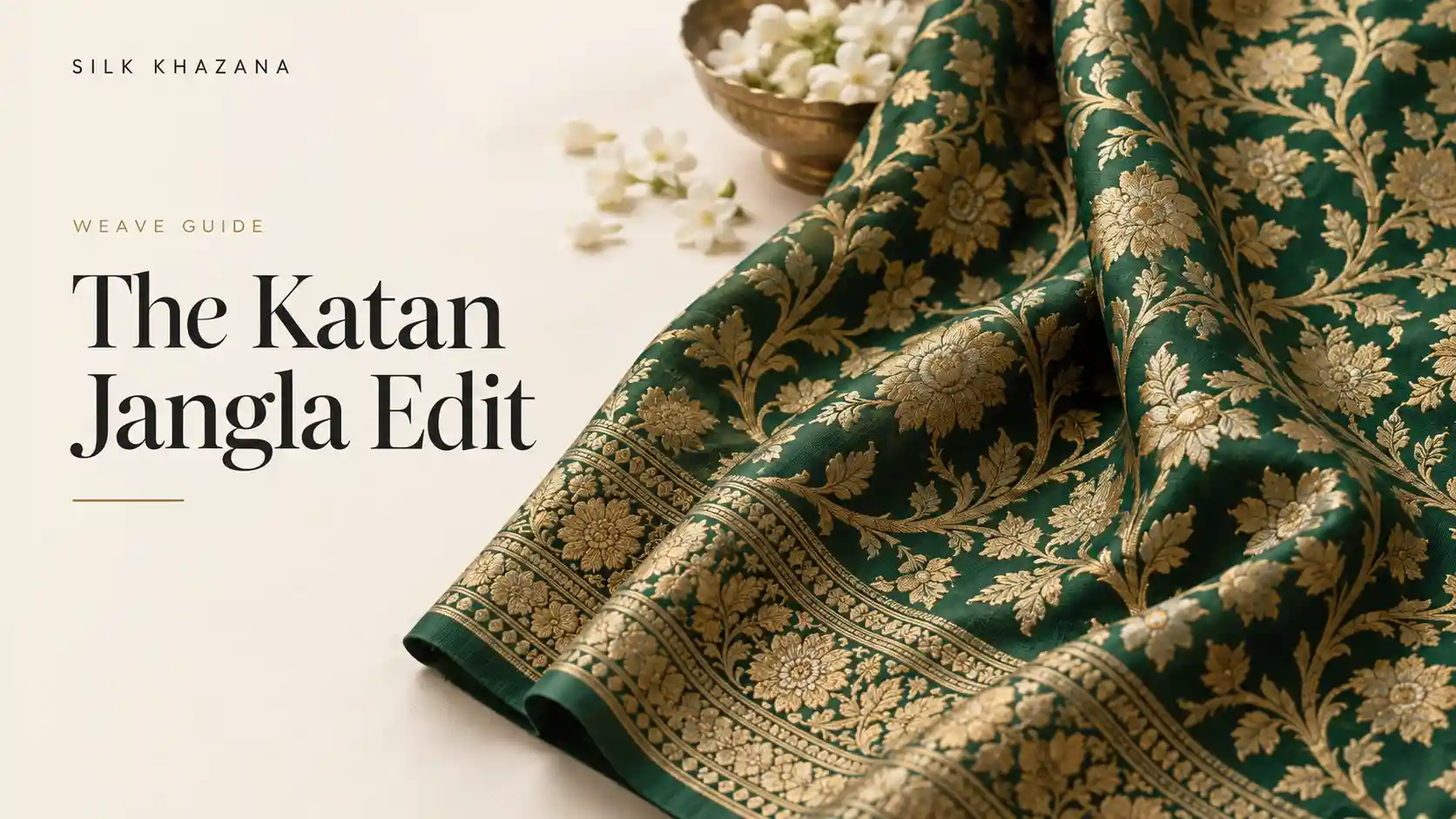
Imagine a forest woven in silk. Leaves, creepers and blossoms twine across the cloth so densely that there is almost no empty space between them. That is the idea behind the jungla (also spelled jangla) Banarasi saree.

This guide explains what it is, how to recognise a well-made one and how to wear and care for it.

What is a katan jungla Banarasi saree?

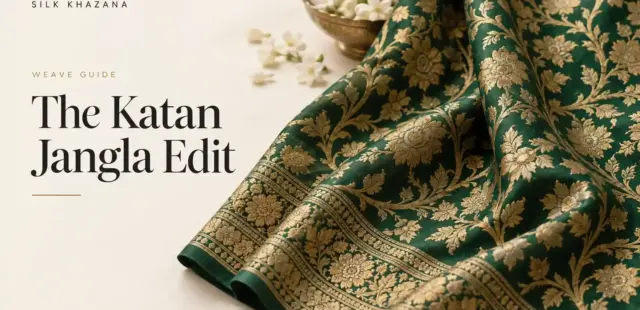
Jungla (or jangla) comes from the Hindi word for forest. In Banarasi weaving, it describes a dense, all-over jaal of leaves, vines and flowers that covers the body of the saree like undergrowth. When this pattern is woven on a katan base, a fine, strong silk made from twisted threads, it becomes a katan jungla.

The result is a saree that looks richly alive. The pattern flows from one motif to the next, with few quiet gaps.

The two parts of the name

  • Katan: a plain-woven silk made from twisted filament threads. It is smooth, strong and has a natural lustre. It is the classic base for fine Banarasi work. See our Pure Katan silk guide.
  • Jungla: the dense vine-and-leaf jaal pattern woven over it.

What it looks like

  • A lattice of leaves and creepers across the body, often in zari
  • Occasional flowers and buds among the foliage
  • Borders and pallu that echo the same vocabulary of motifs
  • Colour from the silk, with the pattern in zari or in contrasting silk thread

Some junglas are woven in a single zari colour for a subtle effect. Others add coloured silk for a more vivid look, sometimes with Meenakari accents. For the vocabulary of motifs, see Banarasi motifs explained.

How it is woven

A dense jaal means a lot of work. For each repeat of the pattern, the loom must lift and lower hundreds of threads in a set order, and the weaver adds extra threads, called supplementary weft, to create the motifs. The denser the jaal, the more time the saree takes.

This is part of why jungla sarees are valued, and why they cost more than lighter designs. Our piece on why Banarasi sarees are expensive explains where the effort and the cost go.

How to judge quality

  • 1. Pattern flow. Look at how the vines connect. Good junglas flow smoothly, without awkward breaks.
  • 2. Clarity of motifs. Leaves and flowers should be crisp, not blurry.
  • 3. The back of the weave. Short, neat thread ends signal careful work. Long, loose floats can snag.
  • 4. Zari quality. Ask whether the zari is pure, tested or imitation, in writing. Read real vs fake zari.
  • 5. Handloom or powerloom. Both exist. Ask which one applies. See handloom vs powerloom.
  • 6. Drape and weight. Hold the saree up. It should hang smoothly, with weight but not stiffness.

Jungla compared with other Banarasi styles

JunglaButi / ButaShikargahJamawar
PatternDense leaves and vinesScattered small or large motifsHunting scenes with figuresPacked multicolour paisleys
DensityVery denseOpenMedium to denseVery dense
MoodLush, classicalLight, airyNarrative, collectableRegal, shawl-like

See also our guide to Jamawar and Tanchoi sarees and the Meenakari, Rangkat and Jaal comparison.

Who is it for?

A katan jungla suits you if you like:

  • A richly patterned, classical saree that still feels refined
  • A heirloom piece meant to be worn for years
  • A bridal or ceremonial look, or a gift. See our bridal saree guide.

It may be heavy for very hot weather or for long days of standing. If comfort matters most, ask for a lighter weave.

Styling

  • Blouse: because the saree is rich, a solid blouse in a colour drawn from the saree usually looks best. A zari border blouse can add richness without competing.
  • Jewellery: the jaal is busy, so pick one focal piece, such as a statement necklace or earrings, rather than layering many.
  • Drape: a classic Nivi shows the body, and a Gujarati-style drape brings the pallu forward. See our draping guide.
  • Hair and makeup: keep the rest of the look simple so the saree is the centre of attention.

Care

  • Dry clean with a specialist who knows silk and zari.
  • Store folded in muslin, with tissue between folds on the zari.
  • Refold every few months along different lines.
  • Keep away from damp, perfume and rough surfaces.
  • Air it in shade for a few hours after wearing before putting it away.

See our storage guide.

Further reading on katan jungla banarasi saree: Banarasi sari on Wikipedia.

Key takeaways

  • Jungla means forest. It describes a dense jaal of leaves, creepers and flowers.
  • Katan is the silk base, known for strength and lustre.
  • Quality shows in smooth pattern flow, crisp motifs and a neat reverse.
  • Ask about zari and loom type in writing.
  • It is a heirloom-style saree, best cared for with dry cleaning and muslin storage.

Frequently Asked Questions

It comes from the Hindi word for forest and describes a dense jaal of leaves, vines and flowers.

It can be. Many brides choose katan sarees with dense jaal work for ceremonies.

It can be, depending on the amount of zari and the density of the weave.

Yes, in handloom and powerloom versions. Ask which you are buying.

A jungla focuses on leaves and vines, while a Jamawar typically has packed multicolour paisleys and florals, inspired by Kashmiri shawls.

Dry clean with a silk specialist and store folded in muslin.

Message us on WhatsApp at +91 63073 05873 or visit our Varanasi showroom, and we will walk you through katan jungla banarasi saree with the saree in your hands.

Browse Katan Jungla Sarees

Looking for katan jungla banarasi saree? We manufacture Banarasi silk in Varanasi and have done since 1970, selling directly, so you can ask us anything about a saree and get a specific answer.

Not sure what suits you? Message us on WhatsApp at +91 63073 05873 and tell us the occasion. Visit us: J 14/180, opp. Chhavi Mahal Cinema, Qazi Sadullah Pura, Jaitpura, Varanasi 221001.

Tanchoi Banarasi Saree and Jamawar: A Complete Guide | Silk Khazana
Fabrics 6 Min Read

Tanchoi Banarasi Saree and Jamawar: A Complete Guide

Tanchoi Banarasi saree and Jamawar explained: how the weaves differ, what to look for when buying, and how to style and care for them.

If a katan is a grand hall, Jamawar and Tanchoi are two very different rooms inside it. One is thick with colour and pattern, shawl-rich and regal. The other is quiet, almost whispering, with a pattern that appears only when light finds it.

Both are classics of Banarasi weaving, and both are often misunderstood. This guide explains what they are and how to choose between them.

What is a Jamawar saree?

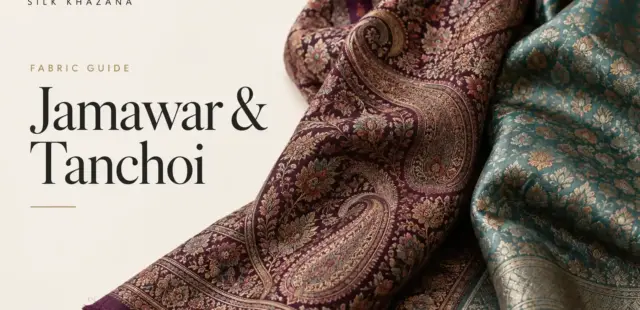
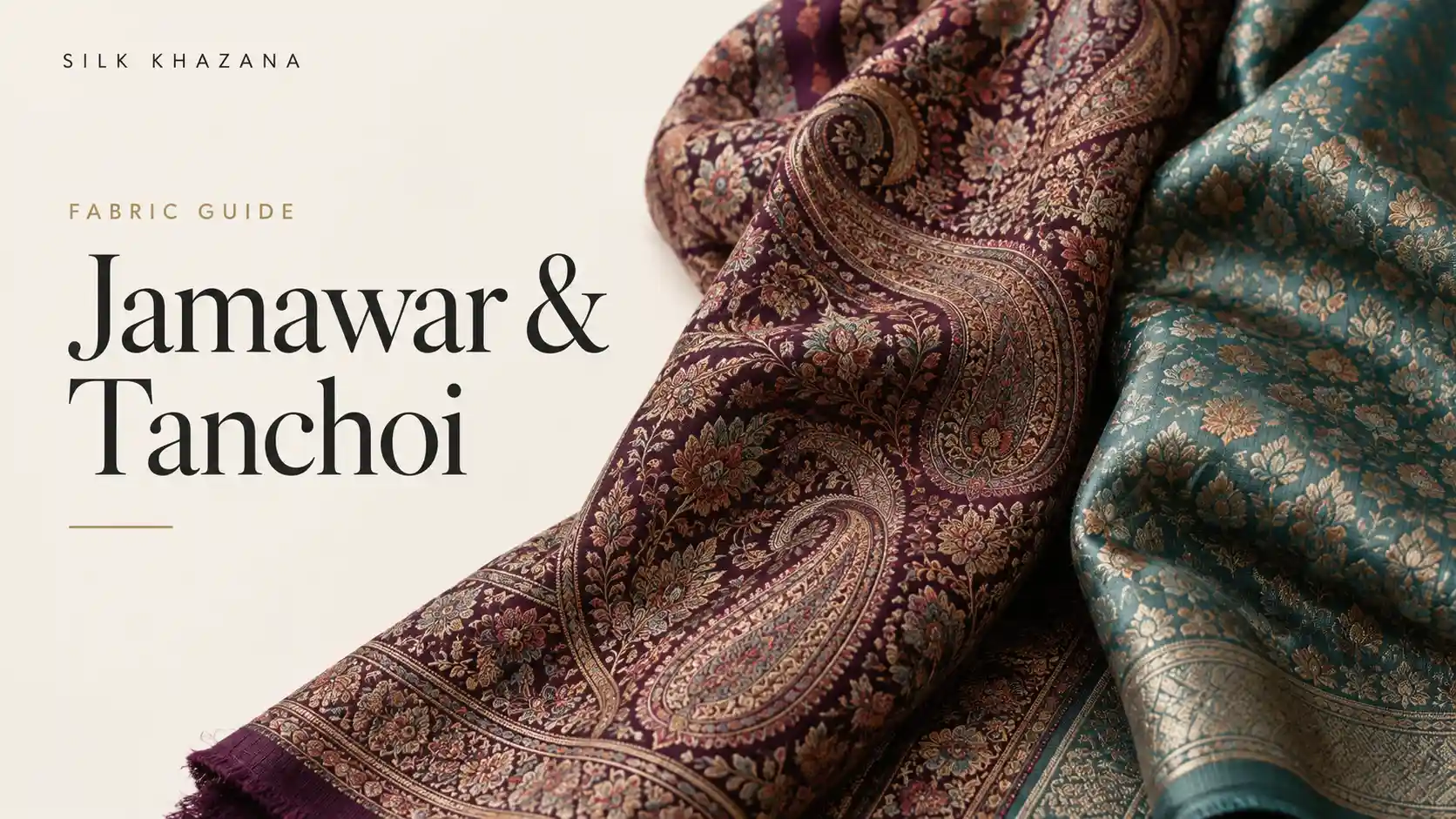
A Jamawar saree is a richly patterned Banarasi, densely woven in multiple colours, in a style inspired by the Jamawar shawls of Kashmir. Those shawls are known for their packed floral and paisley designs. The Banarasi version translates that richness into silk and zari.

What you see: a dense, almost carpet-like pattern of paisleys, flowers and vines, in several colours, often covering the whole saree.

How it feels: heavy, luxurious and substantial. It is a statement saree.

Techniques: the detailed pattern is typically built using supplementary threads that create the raised design, a bit like brocade.

Best for: brides, collectors and formal occasions, particularly in cooler weather.

What is a Tanchoi Banarasi saree?

A Tanchoi is a subtle, tone-on-tone weave with a fine, satin-like surface. The pattern is formed by supplementary silk threads in the same or a closely related colour as the ground, so the design shows through softly as the fabric moves.

What you see: small, delicate motifs such as paisleys, leaves and florals, finely rendered, usually in the same colour as the base.

How it feels: smooth, refined and dense. The surface has a quiet sheen.

A distinctive feature: a well-made Tanchoi is neat on the reverse, with no long floating threads at the back.

Origin story: the technique is traditionally associated with weavers who learned it from Chinese masters, and it was later adopted in Banaras and other centres. The details vary by account, so we hold the story lightly.

Best for: daytime events, understated formal wear and anyone who prefers refinement over display.

Jamawar vs Tanchoi at a glance

JamawarTanchoi
CharacterDense, multicolour, shawl-likeSubtle, tone-on-tone
PatternPacked paisleys and floralsSmall, delicate motifs
ColourSeveral colours togetherMostly one colour
WeightHeavyMedium, dense
SurfaceRaised, texturedSmooth, satin-like
MoodRegal, opulentQuiet, elegant
OccasionsWeddings, grand ceremoniesDay events, formal gatherings

Which one suits you?

  • Choose Jamawar if you want drama, presence and a piece that looks like heritage.
  • Choose Tanchoi if you want grace, subtlety and a saree that does not shout.
  • Choose a Jamawar-inspired Banarasi if you want the shawl look in a lighter form.

Think also about the colour and the occasion. A rich red Jamawar is a ceremony saree. A soft sage Tanchoi is a luncheon saree.

What to look for when buying

  • 1. Pattern clarity. In Jamawar, the motifs should be crisp and the colours well separated. In Tanchoi, the tone-on-tone patterns should be sharp.
  • 2. The back of the weave. A neat reverse points to careful work. For Tanchoi, a clean back is a mark of quality.
  • 3. Drape and weight. Hold the saree up and let it fall. Does it hang well?
  • 4. Fibre, loom and zari. Ask in writing. See handloom vs powerloom and real vs fake zari.
  • 5. Colour quality. Look at colours in natural light. Strong dyes can behave differently under cleaning.

Styling

Jamawar. Because the saree is already busy, keep the blouse simple, in a solid colour drawn from the saree. Choose jewellery that complements, with fewer pieces and a clear focal point. Draping styles that show the pallu, such as the Gujarati drape, suit it. See our draping guide.

Tanchoi. Let it be quiet. A contrast blouse in raw silk or velvet gives definition, and delicate jewellery suits the refined surface. A neat Nivi drape shows the sheen.

Care

Both need gentle, regular care.

  • Dry clean with a specialist who knows silk and zari.
  • Store folded in muslin, with tissue between layers. Heavy Jamawar benefits from lying flat.
  • Refold every few months along new lines.
  • Keep away from perfume, damp and rough surfaces.

See our storage guide for the full routine.

Further reading on tanchoi banarasi saree: Banarasi sari on Wikipedia.

Key takeaways

  • Jamawar is dense, multicolour and shawl-inspired. Tanchoi is subtle, tone-on-tone and satin-like.
  • Jamawar is for drama. Tanchoi is for quiet elegance.
  • Check the back of the weave, the pattern clarity and the drape.
  • Ask about fibre, loom and zari whichever you choose.

Frequently Asked Questions

A densely woven, multicolour Banarasi saree inspired by Kashmiri Jamawar shawls, with packed paisleys and florals.

A fine, tone-on-tone weave in which supplementary threads create delicate motifs on a smooth, satin-like surface.

Usually, yes. It is a substantial saree, suited to ceremonies and cooler weather.

It can be, especially for day events and guests. For a bride's main ceremony, a heavier katan or Jamawar is more common.

Look for crisp motifs, a smooth surface and a neat reverse with no long floating threads.

Dry clean with a specialist, store folded in muslin and refold every few months.

Message us on WhatsApp at +91 63073 05873 or visit our Varanasi showroom, and we will walk you through tanchoi banarasi saree with the saree in your hands.

Browse Jamawar Silk Sarees

Looking for tanchoi banarasi saree? We manufacture Banarasi silk in Varanasi and have done since 1970, selling directly, so you can ask us anything about a saree and get a specific answer.

Not sure what suits you? Message us on WhatsApp at +91 63073 05873 and tell us the occasion. Visit us: J 14/180, opp. Chhavi Mahal Cinema, Qazi Sadullah Pura, Jaitpura, Varanasi 221001.

Sign Up Newsletter

Sign up our newsletter and save 25% off for the next purchase!

Subscribe to our newsletters and don’t miss new arrivals, the latest fashion updates and our promotions.