+9163073 05873 support@silkkhazana.in
Handwoven Banarasi silk, direct from our Varanasi weaving family. Shop Now

Mini Cart

Banarasi Saree as a Wedding Gift: What to Choose | Silk Khazana
Authenticity 7 Min Read

How to Identify Pure Moonga Silk Saree: 6 Checks Before You Buy

How to identify a pure moonga silk saree: sheen, texture, fibre statement, weave and price checks, and the difference between moonga, tussar and Assam Muga.

Learning to identify pure moonga silk saree takes only a few simple checks.

"Moonga" (also spelled munga) is one of the most confusing words in saree shopping. Sellers use it for different fabrics, and some use it loosely to suggest a rare and expensive silk. Knowing what you are being offered is the first step to identifying a pure one.

This guide gives six practical checks. It comes from a Varanasi weaving family. Our own moonga sarees are tussar-type silk, and we say so plainly. For the full background, see our moonga silk saree guide and moonga vs tussar.

Check 1: Ask what "moonga" means for this saree

In the Banarasi trade, "moonga" or "munga" is commonly used as a trade term for a tussar-type silk with a golden, slightly textured look. It is not the same as Muga silk from Assam, which is a different silk with a Geographical Indication (GI) tag.

So the first question is simple: "Is this Assam Muga or tussar-type moonga?" An honest seller can answer. If a saree is sold as Assam Muga, ask for the proof.

Check 2: Ask for the fibre in writing

Ask for the fibre content on the bill or a written note, such as pure silk, silk blend or other. A seller who is confident about the saree should not hesitate. If you hear only "100% pure" with nothing written, keep asking.

Check 3: Look at the sheen and colour

Tussar-type silk usually has a natural, warm, slightly muted sheen, rather than the very bright glassy shine of some synthetics. The colour often has a natural golden or earthy tone. Strong, uniform, shiny colour on a saree sold as moonga is worth asking about. Dyed and bleached versions exist, so colour alone does not prove anything.

Check 4: Feel the texture

Tussar-type silk is generally a little coarser than mulberry silk, with a slightly uneven, grainy feel. It is not as slippery as polyester. Feel is a hint, not proof, because blends and finishing can change it. Compare it with a saree you know to be pure silk.

Check 5: Check the weave and the back

Look at the weave in daylight. For zari and motifs, look at the back of the saree, where the threads should look tidy rather than machine-flat. Our guide to identifying pure Banarasi silk and real vs fake zari explain what to look for.

Check 6: Compare the price honestly

Handwoven tussar-type silk with zari costs more than power-loom or blended cloth. Very low prices on a saree described as pure handloom moonga deserve questions. Also be careful with a very high first price. Ask what the fibre, weave and zari are, and compare similar sarees. Our guide to Banarasi saree scams in Varanasi covers pricing traps.

How not to identify a pure moonga silk saree

Do not ask a seller to burn the saree. It damages the cloth, and the result is not always conclusive for blends. Written fibre content and a proper bill are more reliable.

Further reading on the Banarasi sari and zari on Wikipedia.

Key takeaways

  • "Moonga" is a trade term, usually meaning tussar-type silk. It is not the same as GI-tagged Assam Muga silk.
  • Ask whether the saree is Assam Muga or tussar-type moonga, and ask for the fibre in writing.
  • Warm, natural sheen and a slightly grainy feel are hints, not proof.
  • Check the weave and the back of the saree in daylight.
  • Compare prices and keep the bill.

Frequently Asked Questions

Not necessarily. Muga is a specific silk from Assam with a GI tag. In Varanasi, "moonga" is commonly a trade term for a tussar-type silk. Always ask which one you are being sold.

Ask for the fibre in writing, check the sheen and texture, examine the back of the weave and compare the price. No single check is enough alone.

It usually has a softer, warmer sheen than synthetic fabrics. A very bright, glassy shine is worth asking about.

We do not recommend it. It damages the saree and is not reliable for blends. Written fibre content is better.

Price depends on the fibre, whether it is handwoven, the amount of zari and the design. Compare similar sarees and ask for details.

Silk Khazana is a Varanasi weaving family that has made and sold Banarasi silk since 1970. Our moonga sarees are tussar-type, and we say so openly. Message us on WhatsApp at +91 63073 05873.

Browse Moonga Sarees

We manufacture Banarasi silk in Varanasi and have done since 1970, selling directly, so you can ask us anything about a saree and get a specific answer.

Not sure what suits you? Message us on WhatsApp at +91 63073 05873 and tell us the occasion. Visit us: J 14/180, opp. Chhavi Mahal Cinema, Qazi Sadullah Pura, Jaitpura, Varanasi 221001.
Real vs Fake Zari: 5 Ways to Check Before You Buy | Silk Khazana
Authenticity 7 Min Read

Real vs Fake Zari: 5 Ways to Check Before You Buy

Real vs fake zari: learn the three kinds, five practical checks and why real zari tarnishes, before you buy a Banarasi saree.

"Is the zari real?" is the question we hear most from customers who have been burned once. It is a fair question, and it is harder than it sounds, because zari is not simply real or fake. It comes in a ladder of qualities, and a price tag that fits one rung but a label that claims another is where most disappointment begins.

This guide explains the kinds of zari, five practical checks you can do yourself, and the questions that matter more than any test.

What is zari?

Zari is the metallic thread woven into a saree to create borders, motifs and shimmer. Traditionally it is made by wrapping a fine metal wire or flat strip around a silk or cotton core. In a Banarasi saree, zari is what turns a plain silk into brocade.

Real vs fake zari: the three kinds

TypeWhat it isHow it behaves
Pure (real) zariSilver wire or strip, plated with gold, wrapped around a silk or cotton coreRich, warm, heavier. Silver-based zari can tarnish over time
Tested or "metallic" zariCopper-based or lower-silver wire, plated to look like gold or silverA common middle quality. Looks good, costs less
Imitation zariMetallised polyester film wrapped on a threadBright and cheap. Does not tarnish, but can flake or peel

The pricing differences between these are large, which is why the zari type is a leading reason one Banarasi saree costs more than another. We explain this in why Banarasi sarees are expensive.

A word on honesty: very few sarees use real gold in the strict sense. When a seller says "real gold zari", ask exactly what that means, which metal sits inside, and how thick the plating is. A clear answer is a good sign. A vague one is not.

5 ways to check zari

No home test is perfect, so use several together.

1. Ask for the zari type in plain words, and in writing

This one beats any test. Ask: Is this pure zari, tested zari or imitation? A seller who knows the saree will tell you. Ask for it on the invoice or on the product description. The Silk Mark label certifies the silk, but not the zari, so the seller's word is the main record you have.

2. Look at the colour and the glow

Real or good-quality metallic zari has a warm, slightly muted glow, like old jewellery. Imitation zari often looks either very bright brassy-yellow or mirror-silver, and the shine stays constant whatever the angle. Tilt the saree under natural light and watch how the colour moves.

3. Check the thread up close

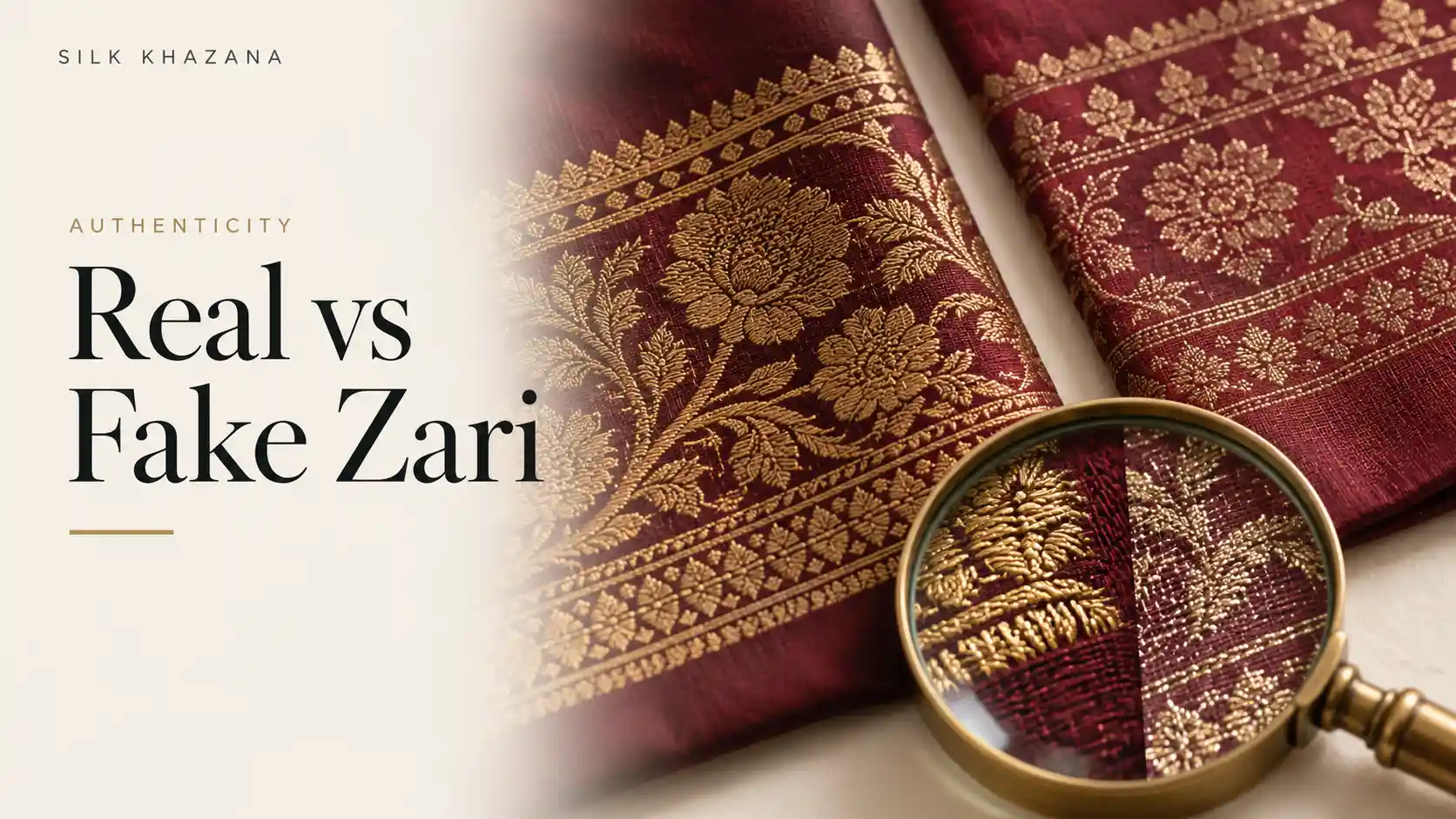
Use a magnifying glass or your phone camera on a loose thread end. Metal zari shows a core thread with metal wrapped around it. Imitation film often shows a flat, plastic-like ribbon that can curl, peel or look glassy at the cut end.

4. Feel the weight and the stiffness

Zari adds weight and a slight stiffness. A saree with a very broad zari border that feels featherlight may be using fine or imitation zari. Compare two sarees of similar design side by side if you can.

5. Try a loose-thread burn test, or ask for a lab test

Do this only on a loose thread, and only with the seller's permission, never on the saree body. Metal zari leaves a metallic or ashy residue after the silk core burns away. Imitation film melts, shrinks and leaves a dark, hard bead. For a high-value piece, a goldsmith or a textile testing laboratory can give a definitive answer.

Why real zari can tarnish

Here is something sellers do not always say. Silver-based zari can darken over time as the silver reacts with air, moisture and perfume. It is natural, and it does not mean the zari is fake. Imitation zari, by contrast, does not tarnish at all, which is why it can look "newer" for longer and flake instead of aging.

You can slow tarnishing by storing the saree in muslin, away from damp, and by keeping perfume off the borders. See our guide on storing Banarasi sarees.

Questions to ask before you buy

  • What type of zari is in this saree?
  • Is it handloom or powerloom?
  • Is the silk certified with the Silk Mark?
  • Can you show me the back of the zari work?
  • What is the care advice for this piece?

Our guides on handloom vs powerloom and GI tag and Silk Mark pair well with this one. If you are buying from a distance, read how to buy authentic Banarasi sarees online safely.

Further reading on real vs fake zari: Banarasi sari on Wikipedia.

Key takeaways

  • Zari comes in three tiers: pure, tested and imitation. Price should match the tier.
  • Ask for the zari type in plain words, and get it written down.
  • Look at colour, thread structure and weight, and use several checks together.
  • Real silver zari can tarnish. That is not a defect.

Frequently Asked Questions

Use several simple checks together: ask the zari type, inspect the glow, look at a loose thread under magnification and, with the seller's permission, try a loose-thread burn test. For high-value pieces, a goldsmith or lab can test it.

Most pure zari is silver wire plated with gold. If a seller says "real gold zari", ask them to explain exactly what that means.

No. The Silk Mark certifies silk content, not the zari. Ask the seller to state the zari type in writing.

Silver-based zari can tarnish over time. This is normal and does not mean the zari was fake.

It does not tarnish, but it can flake, peel or lose its coating with wear.

Specialist cleaners can sometimes brighten tarnished zari, but results vary. Do not try home remedies on a valuable saree.

Message us on WhatsApp at +91 63073 05873 or visit our Varanasi showroom, and we will walk you through real vs fake zari with the saree in your hands.

Explore our Zari Silk Sarees

Looking for real vs fake zari? We manufacture Banarasi silk in Varanasi and have done since 1970, selling directly, so you can ask us anything about a saree and get a specific answer.

Not sure what suits you? Message us on WhatsApp at +91 63073 05873 and tell us the occasion. Visit us: J 14/180, opp. Chhavi Mahal Cinema, Qazi Sadullah Pura, Jaitpura, Varanasi 221001.

Sign Up Newsletter

Sign up our newsletter and save 25% off for the next purchase!

Subscribe to our newsletters and don’t miss new arrivals, the latest fashion updates and our promotions.