+9163073 05873 support@silkkhazana.in
Handwoven Banarasi silk, direct from our Varanasi weaving family. Shop Now

Mini Cart

Banarasi Saree as a Wedding Gift: What to Choose | Silk Khazana
Authenticity 7 Min Read

How to Identify Pure Moonga Silk Saree: 6 Checks Before You Buy

How to identify a pure moonga silk saree: sheen, texture, fibre statement, weave and price checks, and the difference between moonga, tussar and Assam Muga.

Learning to identify pure moonga silk saree takes only a few simple checks.

"Moonga" (also spelled munga) is one of the most confusing words in saree shopping. Sellers use it for different fabrics, and some use it loosely to suggest a rare and expensive silk. Knowing what you are being offered is the first step to identifying a pure one.

This guide gives six practical checks. It comes from a Varanasi weaving family. Our own moonga sarees are tussar-type silk, and we say so plainly. For the full background, see our moonga silk saree guide and moonga vs tussar.

Check 1: Ask what "moonga" means for this saree

In the Banarasi trade, "moonga" or "munga" is commonly used as a trade term for a tussar-type silk with a golden, slightly textured look. It is not the same as Muga silk from Assam, which is a different silk with a Geographical Indication (GI) tag.

So the first question is simple: "Is this Assam Muga or tussar-type moonga?" An honest seller can answer. If a saree is sold as Assam Muga, ask for the proof.

Check 2: Ask for the fibre in writing

Ask for the fibre content on the bill or a written note, such as pure silk, silk blend or other. A seller who is confident about the saree should not hesitate. If you hear only "100% pure" with nothing written, keep asking.

Check 3: Look at the sheen and colour

Tussar-type silk usually has a natural, warm, slightly muted sheen, rather than the very bright glassy shine of some synthetics. The colour often has a natural golden or earthy tone. Strong, uniform, shiny colour on a saree sold as moonga is worth asking about. Dyed and bleached versions exist, so colour alone does not prove anything.

Check 4: Feel the texture

Tussar-type silk is generally a little coarser than mulberry silk, with a slightly uneven, grainy feel. It is not as slippery as polyester. Feel is a hint, not proof, because blends and finishing can change it. Compare it with a saree you know to be pure silk.

Check 5: Check the weave and the back

Look at the weave in daylight. For zari and motifs, look at the back of the saree, where the threads should look tidy rather than machine-flat. Our guide to identifying pure Banarasi silk and real vs fake zari explain what to look for.

Check 6: Compare the price honestly

Handwoven tussar-type silk with zari costs more than power-loom or blended cloth. Very low prices on a saree described as pure handloom moonga deserve questions. Also be careful with a very high first price. Ask what the fibre, weave and zari are, and compare similar sarees. Our guide to Banarasi saree scams in Varanasi covers pricing traps.

How not to identify a pure moonga silk saree

Do not ask a seller to burn the saree. It damages the cloth, and the result is not always conclusive for blends. Written fibre content and a proper bill are more reliable.

Further reading on the Banarasi sari and zari on Wikipedia.

Key takeaways

  • "Moonga" is a trade term, usually meaning tussar-type silk. It is not the same as GI-tagged Assam Muga silk.
  • Ask whether the saree is Assam Muga or tussar-type moonga, and ask for the fibre in writing.
  • Warm, natural sheen and a slightly grainy feel are hints, not proof.
  • Check the weave and the back of the saree in daylight.
  • Compare prices and keep the bill.

Frequently Asked Questions

Not necessarily. Muga is a specific silk from Assam with a GI tag. In Varanasi, "moonga" is commonly a trade term for a tussar-type silk. Always ask which one you are being sold.

Ask for the fibre in writing, check the sheen and texture, examine the back of the weave and compare the price. No single check is enough alone.

It usually has a softer, warmer sheen than synthetic fabrics. A very bright, glassy shine is worth asking about.

We do not recommend it. It damages the saree and is not reliable for blends. Written fibre content is better.

Price depends on the fibre, whether it is handwoven, the amount of zari and the design. Compare similar sarees and ask for details.

Silk Khazana is a Varanasi weaving family that has made and sold Banarasi silk since 1970. Our moonga sarees are tussar-type, and we say so openly. Message us on WhatsApp at +91 63073 05873.

Browse Moonga Sarees

We manufacture Banarasi silk in Varanasi and have done since 1970, selling directly, so you can ask us anything about a saree and get a specific answer.

Not sure what suits you? Message us on WhatsApp at +91 63073 05873 and tell us the occasion. Visit us: J 14/180, opp. Chhavi Mahal Cinema, Qazi Sadullah Pura, Jaitpura, Varanasi 221001.

Banarasi Saree as a Wedding Gift: What to Choose | Silk Khazana
Authenticity 6 मिनट

असली बनारसी साड़ी की पहचान कैसे करें: खरीदने से पहले 7 जाँच

असली बनारसी साड़ी की पहचान कैसे करें? हैंडलूम और पावरलूम का फर्क, ज़री, सिल्क मार्क और बिल की जाँच, बनारस के बुनकर परिवार की सलाह।

असली बनारसी साड़ी की पहचान सीखना खरीदारी का सबसे ज़रूरी कदम है।

बनारसी साड़ी महँगी होती है और अक्सर शादी या त्योहार के लिए खरीदी जाती है, इसलिए खरीदने से पहले उसकी पहचान करना ज़रूरी है। बाज़ार में हैंडलूम, पावरलूम और मिलावटी कपड़े, तीनों मिलते हैं, और देखने में कई बार एक जैसे लगते हैं।

यह लेख बनारस के एक बुनकर परिवार की ओर से है। हम 1970 से यहाँ बनारसी सिल्क बना रहे हैं। नीचे दी गई जाँचें किसी एक दुकान के बारे में नहीं हैं। ये किसी भी दुकान पर काम आती हैं।

1. कपड़े की जानकारी लिखित में माँगें

सबसे पहला और सबसे भरोसेमंद तरीका है पूछना। दुकानदार से कहें कि वह बिल या पर्ची पर साफ़ लिखे कि साड़ी किस धागे की है, जैसे शुद्ध रेशम (कतान), सिल्क मिक्स या पॉलिएस्टर। साथ में यह भी लिखवाएँ कि साड़ी हैंडलूम है या पावरलूम।

जो विक्रेता अपने सामान पर भरोसा रखता है, वह लिखने से नहीं हिचकता। अगर जवाब टालमटोल वाला हो, तो रुककर सोचें।

2. हैंडलूम और पावरलूम का फर्क समझें

हैंडलूम साड़ी हाथ से बुनी जाती है और एक साड़ी में कई दिन से लेकर कई हफ़्ते लग सकते हैं। पावरलूम साड़ी मशीन से बनती है, इसलिए जल्दी बनती है और सस्ती होती है। दोनों अपनी जगह ठीक हैं, पर कीमत एक जैसी नहीं होनी चाहिए। विस्तार से पढ़ें: हैंडलूम बनाम पावरलूम बनारसी साड़ी।

3. साड़ी का पिछला हिस्सा देखें

साड़ी को पलटकर पीछे से देखें। हाथ की बुनाई में डिज़ाइन के धागे पीछे हल्के से दिखते हैं और अक्सर थोड़ी अनियमितता होती है, जो हाथ के काम की पहचान है। मशीन की बुनाई ज़्यादा एकसमान और साफ़-सुथरी दिख सकती है। यह अकेली जाँच काफ़ी नहीं है, पर दूसरी जाँचों के साथ मदद करती है।

4. ज़री की जाँच करें

असली ज़री की चमक गहरी और टिकाऊ होती है, जबकि नकली ज़री अक्सर बहुत तेज़ और चमकीली दिखती है और समय के साथ काली पड़ सकती है। ज़री असली चाँदी-सोने की है, टेस्टेड है या कॉपर और पॉलिएस्टर की, यह भी पूछें और बिल पर लिखवाएँ। ज़्यादा जानकारी: असली और नकली ज़री।

5. सिल्क मार्क और जीआई की जानकारी लें

सिल्क मार्क रेशम की शुद्धता का एक प्रमाण है और बनारसी साड़ी को जीआई टैग भी मिला हुआ है। दोनों के बारे में विक्रेता से पूछें और टैग या लेबल को ध्यान से देखें। इन्हें जाँचने का तरीका हमारे अंग्रेज़ी लेख में बताया गया है: जीआई टैग और सिल्क मार्क कैसे जाँचें।

6. कीमत पर ध्यान दें

हाथ की बुनाई, रेशम और ज़री, इन सबमें लागत लगती है। अगर कोई साड़ी बहुत ही कम दाम पर "शुद्ध हैंडलूम कतान" बताकर बेची जा रही है, तो सवाल पूछना ठीक है। कीमत अकेले असलियत का सबूत नहीं है, पर बहुत बड़ी छूट अक्सर किसी समझौते की ओर इशारा करती है।

7. पक्का बिल लें और वापसी की शर्तें पूछें

खरीदने पर बिल ज़रूर लें, जिस पर दुकान का नाम, पता और साड़ी का विवरण हो। वापसी या बदलने की शर्तें खरीद से पहले पूछकर समझ लें। दुकान में साड़ी जलाकर जाँचने की सलाह न मानें, क्योंकि इससे कपड़ा खराब होता है और नतीजे हमेशा भरोसेमंद नहीं होते।

असली बनारसी साड़ी की पहचान और बनारस में खरीदारी

पर्यटक अक्सर कम समय और कम जानकारी के साथ खरीदारी करते हैं। जल्दबाज़ी न करें, दिन की रोशनी में साड़ी देखें और कई जगह दाम पूछें। आम गलतियों के बारे में पढ़ें: बनारस में साड़ी खरीदते समय सावधानियाँ।

अधिक जानकारी के लिए विकिपीडिया पर बनारसी साड़ी और ज़री देखें।

मुख्य बातें

  • विक्रेता से धागे और हैंडलूम/पावरलूम की जानकारी बिल पर लिखित में लें।
  • साड़ी का पिछला हिस्सा और ज़री की चमक ध्यान से देखें।
  • सिल्क मार्क और जीआई के बारे में पूछें, पर अकेली एक जाँच पर भरोसा न करें।
  • बहुत कम कीमत पर "शुद्ध हैंडलूम" के दावे पर सवाल करें।
  • पक्का बिल और वापसी की शर्तें खरीद से पहले तय करें।

अक्सर पूछे जाने वाले सवाल

कोई एक पक्की पहचान नहीं है। सबसे भरोसेमंद तरीका है बिल पर धागे और हैंडलूम की जानकारी लिखित में लेना और साथ में पीछे की बुनाई, ज़री, सिल्क मार्क और कीमत को देखना।

हैंडलूम साड़ी हाथ से बुनी जाती है और उसमें ज़्यादा समय लगता है। पावरलूम साड़ी मशीन से बनती है, इसलिए सस्ती और जल्दी बनती है।

हम इसकी सलाह नहीं देते। इससे साड़ी खराब होती है और मिश्रित धागों में नतीजा भ्रामक हो सकता है। लिखित जानकारी और बिल ज़्यादा भरोसेमंद हैं।

यह रेशम की शुद्धता का एक प्रमाण चिह्न है। इसके बारे में विक्रेता से पूछें और लेबल को ध्यान से देखें।

ऐसी जगह से जहाँ विक्रेता धागे, ज़री और हैंडलूम की जानकारी लिखित में देने को तैयार हो। सिल्क खज़ाना बनारस का बुनकर परिवार है और 1970 से बनारसी सिल्क बना रहा है। आप हमसे WhatsApp पर +91 63073 05873 पर बात कर सकते हैं।

हमारी साड़ियाँ देखें

हम 1970 से वाराणसी में बनारसी सिल्क बना रहे हैं और सीधे बेचते हैं, इसलिए साड़ी के बारे में आप कुछ भी पूछ सकते हैं और साफ़ जवाब पाएँगे।

Not sure what suits you? Message us on WhatsApp at +91 63073 05873 and tell us the occasion. Visit us: J 14/180, opp. Chhavi Mahal Cinema, Qazi Sadullah Pura, Jaitpura, Varanasi 221001.

Real vs Fake Zari: 5 Ways to Check Before You Buy | Silk Khazana
Authenticity 7 Min Read

Real vs Fake Zari: 5 Ways to Check Before You Buy

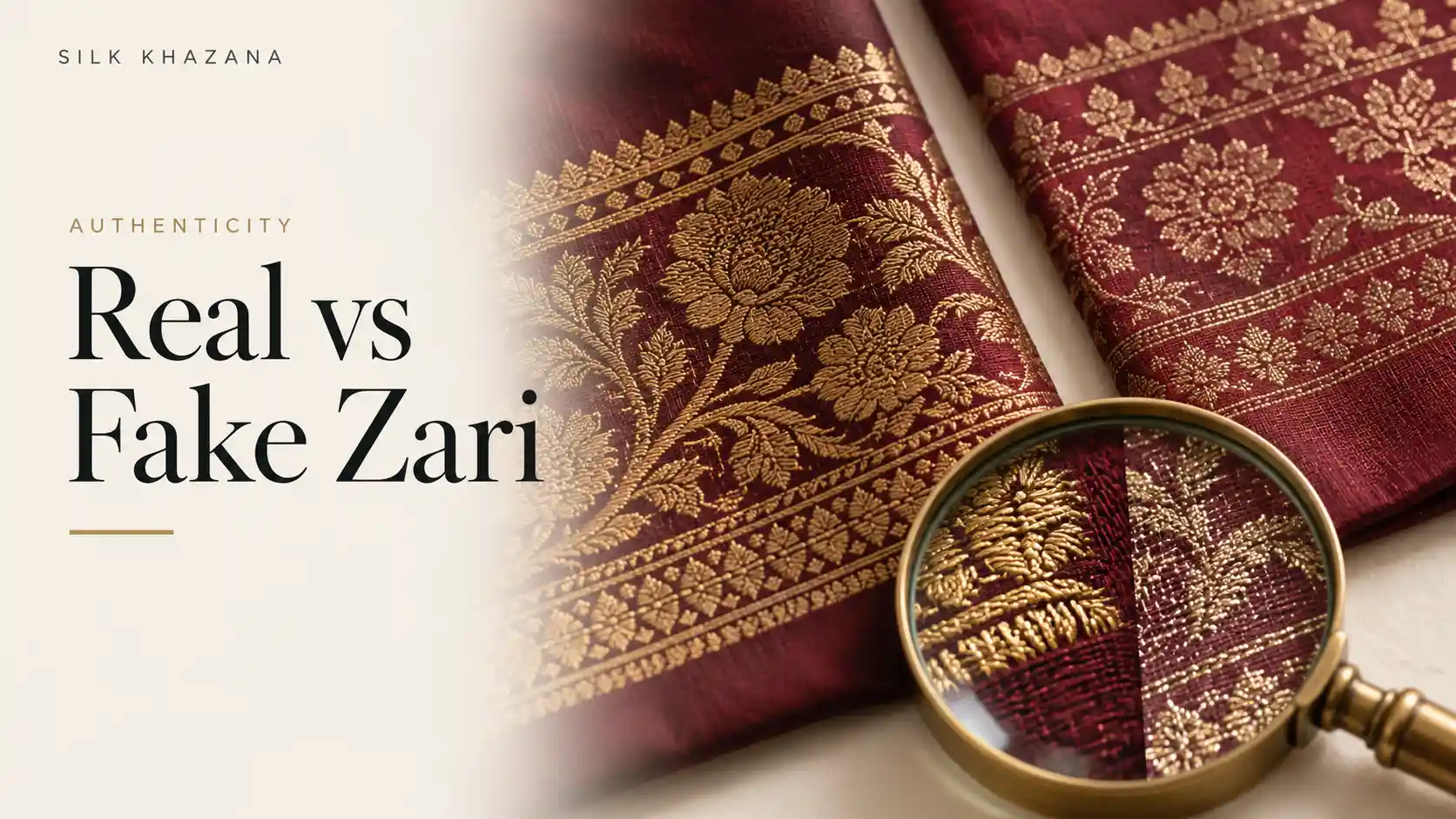
Real vs fake zari: learn the three kinds, five practical checks and why real zari tarnishes, before you buy a Banarasi saree.

"Is the zari real?" is the question we hear most from customers who have been burned once. It is a fair question, and it is harder than it sounds, because zari is not simply real or fake. It comes in a ladder of qualities, and a price tag that fits one rung but a label that claims another is where most disappointment begins.

This guide explains the kinds of zari, five practical checks you can do yourself, and the questions that matter more than any test.

What is zari?

Zari is the metallic thread woven into a saree to create borders, motifs and shimmer. Traditionally it is made by wrapping a fine metal wire or flat strip around a silk or cotton core. In a Banarasi saree, zari is what turns a plain silk into brocade.

Real vs fake zari: the three kinds

TypeWhat it isHow it behaves
Pure (real) zariSilver wire or strip, plated with gold, wrapped around a silk or cotton coreRich, warm, heavier. Silver-based zari can tarnish over time
Tested or "metallic" zariCopper-based or lower-silver wire, plated to look like gold or silverA common middle quality. Looks good, costs less
Imitation zariMetallised polyester film wrapped on a threadBright and cheap. Does not tarnish, but can flake or peel

The pricing differences between these are large, which is why the zari type is a leading reason one Banarasi saree costs more than another. We explain this in why Banarasi sarees are expensive.

A word on honesty: very few sarees use real gold in the strict sense. When a seller says "real gold zari", ask exactly what that means, which metal sits inside, and how thick the plating is. A clear answer is a good sign. A vague one is not.

5 ways to check zari

No home test is perfect, so use several together.

1. Ask for the zari type in plain words, and in writing

This one beats any test. Ask: Is this pure zari, tested zari or imitation? A seller who knows the saree will tell you. Ask for it on the invoice or on the product description. The Silk Mark label certifies the silk, but not the zari, so the seller's word is the main record you have.

2. Look at the colour and the glow

Real or good-quality metallic zari has a warm, slightly muted glow, like old jewellery. Imitation zari often looks either very bright brassy-yellow or mirror-silver, and the shine stays constant whatever the angle. Tilt the saree under natural light and watch how the colour moves.

3. Check the thread up close

Use a magnifying glass or your phone camera on a loose thread end. Metal zari shows a core thread with metal wrapped around it. Imitation film often shows a flat, plastic-like ribbon that can curl, peel or look glassy at the cut end.

4. Feel the weight and the stiffness

Zari adds weight and a slight stiffness. A saree with a very broad zari border that feels featherlight may be using fine or imitation zari. Compare two sarees of similar design side by side if you can.

5. Try a loose-thread burn test, or ask for a lab test

Do this only on a loose thread, and only with the seller's permission, never on the saree body. Metal zari leaves a metallic or ashy residue after the silk core burns away. Imitation film melts, shrinks and leaves a dark, hard bead. For a high-value piece, a goldsmith or a textile testing laboratory can give a definitive answer.

Why real zari can tarnish

Here is something sellers do not always say. Silver-based zari can darken over time as the silver reacts with air, moisture and perfume. It is natural, and it does not mean the zari is fake. Imitation zari, by contrast, does not tarnish at all, which is why it can look "newer" for longer and flake instead of aging.

You can slow tarnishing by storing the saree in muslin, away from damp, and by keeping perfume off the borders. See our guide on storing Banarasi sarees.

Questions to ask before you buy

  • What type of zari is in this saree?
  • Is it handloom or powerloom?
  • Is the silk certified with the Silk Mark?
  • Can you show me the back of the zari work?
  • What is the care advice for this piece?

Our guides on handloom vs powerloom and GI tag and Silk Mark pair well with this one. If you are buying from a distance, read how to buy authentic Banarasi sarees online safely.

Further reading on real vs fake zari: Banarasi sari on Wikipedia.

Key takeaways

  • Zari comes in three tiers: pure, tested and imitation. Price should match the tier.
  • Ask for the zari type in plain words, and get it written down.
  • Look at colour, thread structure and weight, and use several checks together.
  • Real silver zari can tarnish. That is not a defect.

Frequently Asked Questions

Use several simple checks together: ask the zari type, inspect the glow, look at a loose thread under magnification and, with the seller's permission, try a loose-thread burn test. For high-value pieces, a goldsmith or lab can test it.

Most pure zari is silver wire plated with gold. If a seller says "real gold zari", ask them to explain exactly what that means.

No. The Silk Mark certifies silk content, not the zari. Ask the seller to state the zari type in writing.

Silver-based zari can tarnish over time. This is normal and does not mean the zari was fake.

It does not tarnish, but it can flake, peel or lose its coating with wear.

Specialist cleaners can sometimes brighten tarnished zari, but results vary. Do not try home remedies on a valuable saree.

Message us on WhatsApp at +91 63073 05873 or visit our Varanasi showroom, and we will walk you through real vs fake zari with the saree in your hands.

Explore our Zari Silk Sarees

Looking for real vs fake zari? We manufacture Banarasi silk in Varanasi and have done since 1970, selling directly, so you can ask us anything about a saree and get a specific answer.

Not sure what suits you? Message us on WhatsApp at +91 63073 05873 and tell us the occasion. Visit us: J 14/180, opp. Chhavi Mahal Cinema, Qazi Sadullah Pura, Jaitpura, Varanasi 221001.

Why Silk Khazana is the best saree shop in Varanasi | Silk Khazana
Store Guide Authenticity

The Buyer's Guide

Why Silk Khazana is the best saree shop in Varanasi

A buyer’s guide to authentic Banarasi silk — without the guesswork.

Silk Khazana

Banarasi Silk Manufacturer since 1970 · Jaitpura, Varanasi · Worldwide Shipping

"Walk down any lane in Varanasi's saree market and you'll hear the same claim from every shop: 'Pure Banarasi silk, madam. Directly from the loom.' After a while, those words start to blur. When everyone says the same thing, how do you know who actually means it? That confusion is genuinely stressful, especially when you're shopping for a bridal saree or placing a bulk wholesale order where the stakes are high."

This guide is centred on one answer: Silk Khazana, the best saree shop in Varanasi for buyers who want authentic Banarasi silk without the guesswork. A manufacturer and wholesaler based in Jaitpura, Varanasi, Silk Khazana says it sources its sarees directly from the skilled artisans who sit at the loom. By the time you finish reading, you'll know what authentic Banarasi silk actually looks like, what Silk Khazana's collection covers, what prices to expect, what real customers have said, and exactly how to visit or place an order from wherever you are.
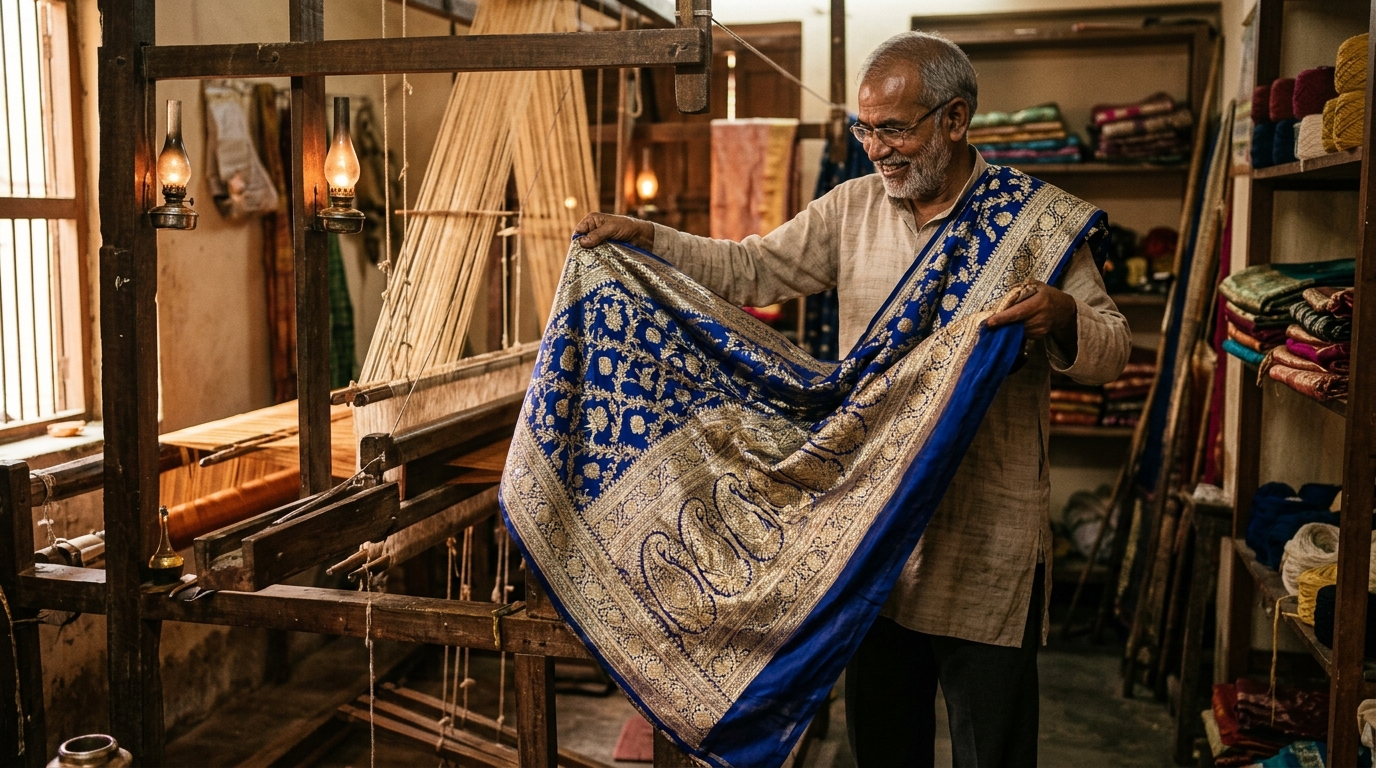
Artisan displaying authentic Banarasi Saree
Sourced directly from skilled artisans who sit at the loom.

What separates a trustworthy Banarasi saree shop from the rest

Before you walk into any saree shop in Varanasi, it helps to arrive with a small vocabulary. Not because you need to become a textile scholar, but because the right questions get you the right answers.

The weave types worth knowing before you buy

Katan is the purest Banarasi base: tightly twisted silk in both the warp and weft, which gives it a crisp, lustrous hand and a satisfying weight. Jamawar is the showstopper of the family, a dense brocade with richly worked, all-over motifs that covers the fabric like a painting. These are the heavier, more formal weaves, suited to weddings and grand occasions.

Jamdani and Minakari are lighter and more delicate, with motifs that seem to float on a translucent ground. Khaddi Georgette is the airy option, a crinkled, fluid drape that works beautifully for those who want the Banarasi aesthetic without the weight. Tanchoi uses a satin-like base with intricate woven ornamentation, less reliant on heavy zari than the classic brocades. Tissue, Organza/Kora, Shikargah, and Moonga round out the family, each with its own character and occasion.
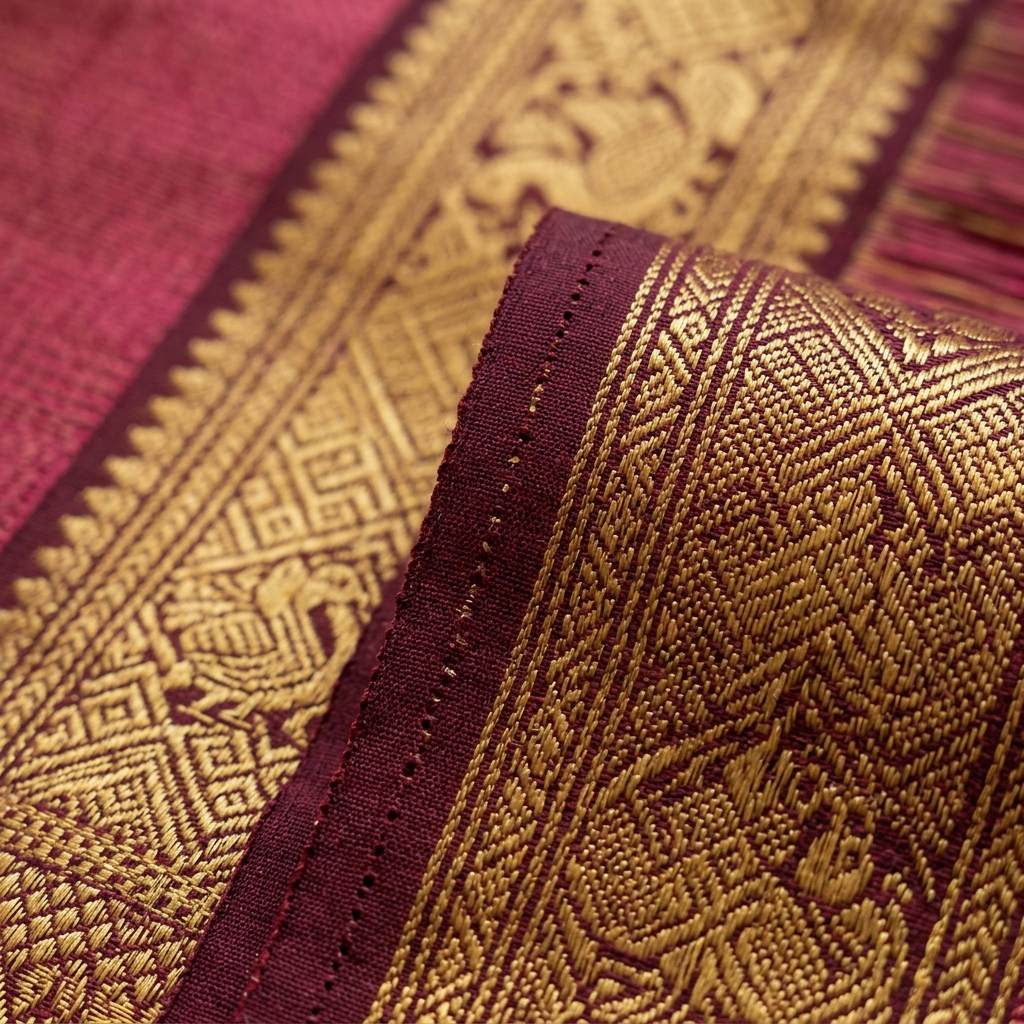
Banarasi Silk Zari detailing
Authentic zari and handloom marks are fingerprints of genuine craftsmanship.

Zari quality and handloom signs a first-time buyer can spot

Authentic zari is typically fine metallic thread wrapped around a silk or cotton core; many imitations tarnish sooner and lack the warm, deep gleam of the genuine article. On handloom sarees, look for slight irregularities in the weave, small variations in spacing or tension that a power loom simply doesn't produce. These aren't flaws; they're fingerprints.

Two certification marks provide an additional safety net: the GI tag ("Banaras Brocades and Sarees," registered in 2009) confirms the saree was woven in the notified Varanasi cluster, while the Silk Mark, issued by the Silk Mark Organisation of India under the Central Silk Board, confirms the fibre is pure natural silk. A legitimate Silk Mark tag carries a hologram and a unique authentication number you can verify. A shop that starts at the loom, rather than buying from traders, skips the layers of handling where authenticity most often gets lost.


Why Silk Khazana is the best saree shop in Varanasi for authentic Banarasi silk

There's a reason Silk Khazana describes itself as a Pure Banarasi Saree Manufacturer and Wholesaler rather than simply a saree shop. The distinction matters more than it sounds.

From weaver to wardrobe: how the supply chain actually works

Silk Khazana says its sarees are crafted by skilled artisans in Varanasi and travel directly to the showroom and online store without passing through layers of middlemen. That supply-chain structure has two practical consequences worth understanding. Quality oversight can be tighter when the same team that supervises weaving also decides what reaches the shelf. And pricing may be fairer, because you're not absorbing the markup each intermediary would otherwise add along the way.

For retail buyers, that can mean genuine handloom quality at honest prices. For wholesale traders and boutique owners, it means a manufacturer-level supply chain with the consistency and reliability that bulk sourcing demands.

Bridal collections and custom orders: what the craftsmen can do

Silk Khazana's in-house craftsmen, weavers, and designers collaborate on both ready pieces and bespoke commissions. For a bride with a specific colour combination in mind, or a boutique owner who wants exclusive designs that won't show up in a competitor's window, the custom order route is worth exploring. The bridal and wedding saree collections draw on the full range of Banarasi weaves, with embellishments and motifs chosen for occasion and impact. Call or message via WhatsApp to start a custom enquiry well before you need the finished piece.


Inside the collection: what you'll actually find here

Range matters. A shop that stocks only a handful of styles can't serve a bride hunting for a very specific weave, or a retailer who needs variety across price points. Silk Khazana's collection is built to cover the full spectrum.

Sarees for weddings, festivals, and everyday elegance

The core of the collection runs from bridal Katan silk and dense Jamawar pieces through Jamdani Minakari, Shikargah, Moonga, and contemporary Georgette Banarasi styles. Specific pieces in the range include the Jamawar Orange Banarasi Pathini Handloom Silk Saree and the Grey Jamdani Minakari Handloom Silk Saree, both strong examples of the shop's design sensibility, balancing traditional motifs with everyday wearability. Whether you're shopping for a wedding day saree, a Diwali celebration, or something elegant enough for a formal occasion without being overtly bridal, the collection has entries at every point.

Beyond sarees: dupattas, dress materials, and gifting options

Silk Khazana also stocks Banarasi dupattas, stoles, suit sets, and home furnishing textiles, including bed covers, cushion covers, and table runners. This makes the shop genuinely useful for trousseau shopping beyond the main saree, for coordinated gifting, and for buyers who want the Banarasi aesthetic across multiple pieces. For wholesale buyers, the breadth of categories means a single supplier relationship can cover a wider range of inventory needs.
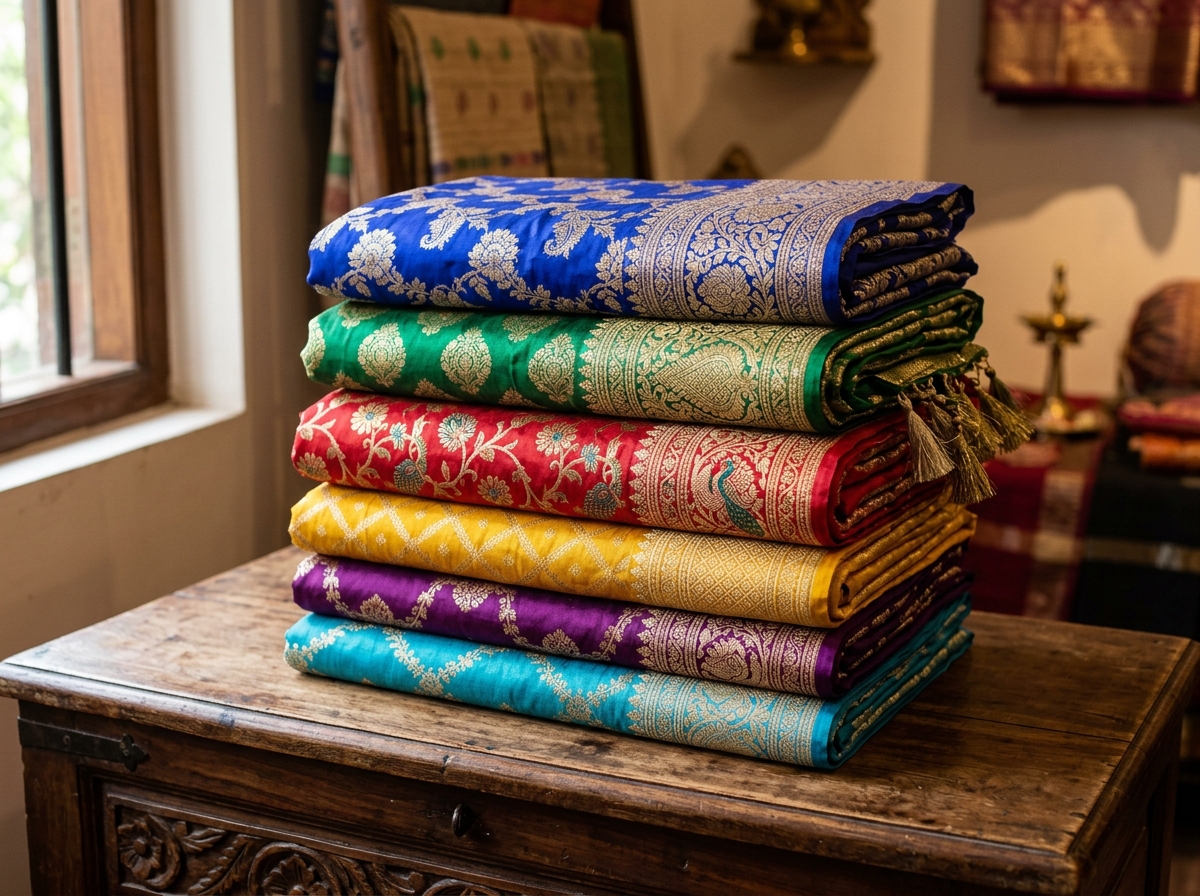
A collection of beautiful banarasi sarees
A diverse collection ensures there is a Banarasi weave for every occasion and style preference.

What it costs: honest price expectations for retail and wholesale

Prices vary considerably, and having a rough range in mind before you walk in avoids the most common buying mistakes.

₹

Retail pricing: what individual buyers should budget for

Authentic handloom Banarasi silk sarees in Varanasi currently range from around ₹7,000 for a plain Katan with a minimal zari border up to ₹2 lakh or more for densely worked Kadhua pieces with real zari. The weave and the zari work are the two biggest price drivers. A Katan with an elaborate border and pallav typically falls between ₹14,000 and ₹35,000; Jangla pieces range from ₹35,000 to ₹90,000; Tissue and Shikargah sarees can reach ₹2,00,000 for exceptional craftsmanship. Buying directly from a manufacturer like Silk Khazana can reduce intermediary markups, so the price you pay is more likely to reflect the actual work that went into the piece. Online orders above ₹2,000 qualify for free shipping.

📦

Wholesale enquiries: what traders and boutique owners need to know

Silk Khazana operates as a manufacturer-wholesaler, which means bulk pricing is available for retailers, boutique owners, and distributors. Minimum order quantities and specific pricing are best confirmed directly with the team, as requirements can vary by weave category and order type, contact Silk Khazana via WhatsApp or phone at +91 63073 05873 to discuss your requirements in full. Lower-entry sample orders may also be possible for buyers who want to assess quality before committing to a larger run. Cash-on-delivery is available within Uttar Pradesh for eligible orders.


What real customers say: Silk Khazana's ratings across platforms

Ratings are easy to claim. What actually matters is where they come from and whether they hold up across multiple platforms.

The rating picture: 4.9 stars and what's behind it

Silk Khazana holds a 4.9/5 rating from 567 Google reviews and a 4.9/5 from 582 ratings on Justdial for its Jaitpura location. (Ratings reflect figures at the time of writing and may be updated on each platform's listing.) Those numbers are consistent, which is meaningful: a shop can occasionally game one platform, but maintaining near-identical scores across independent review systems over hundreds of verified buyers is harder to fake. Reviewers consistently mention the variety of designs, the authentic quality of the Banarasi weaves, fair pricing, and staff who are patient and knowledgeable rather than pushy. That last detail matters more than most buyers realise: a high-pressure saree shop is exhausting and often leads to regrettable purchases.

What the absence of complaints tells you

Justdial's listing for the main Jaitpura branch flags no recurring complaints from its reviews. When hundreds of buyers, many of them making a significant, once-in-a-while purchase, come away without a common grievance, it signals that the shop's processes are consistent and its products are what they claim to be. A single bad experience can be an anomaly. No pattern of bad experiences, across hundreds of reviews, is a meaningful signal worth trusting.


How to visit or order: your complete practical guide

Here are all the details you need to visit in person or place an order from home.

📍

Finding the Jaitpura showroom: address, hours, and directions

The showroom is located at Plot J/14/180, Qazi Sadullah Pura, Alaipura, Opposite Chhavi Mahal Cinema, Jaitpura, Varanasi, Uttar Pradesh 221001. The shop is open 10 AM to 9 PM, seven days a week. Phone and WhatsApp: +91 63073 05873. Jaitpura is a well-known commercial area in Varanasi; if you're coming from the Ghats or the older city area, it's a straightforward auto or cab ride. Chhavi Mahal Cinema is a recognisable local landmark, so mentioning it to your driver will get you there without complications.

💻

Shopping online: ordering, shipping, and support

For shoppers who can't make the trip to Varanasi, Silk Khazana's website carries the collection with online ordering available through credit cards, debit cards, and net banking (Indian-issued cards supported). Free shipping applies on orders above ₹2,000. Cash-on-delivery is available within Uttar Pradesh for eligible orders; international shipping terms are best confirmed directly with the team before placing an order. WhatsApp and phone support are available for questions before you buy. For wholesale enquiries, calling or messaging directly is the most efficient route: the team can discuss bulk pricing, available stock across weave categories, and order requirements in a single conversation.

The bottom line: Silk Khazana, the best saree shop in Varanasi for discerning buyers

If you're a bride looking for a Banarasi saree that is genuinely handloom, properly authenticated, and priced without unnecessary intermediary markups, Silk Khazana is the kind of shop where the product and the story behind it match up. If you're a retailer or wholesale buyer, the direct-from-manufacturer supply chain removes much of the guesswork about what you're actually buying and putting on your shelves.

The practical facts are straightforward: the showroom is in Jaitpura, open daily from 10 AM to 9 PM, reachable at +91 63073 05873 by phone or WhatsApp. For many local buyers, Silk Khazana in Jaitpura, Varanasi, is simply the most reliable address in the city for authentic Banarasi silk, and the collection is available to browse and buy online as well. Whether you walk in off the street or order from home, the sarees speak for themselves. Many of the weavers behind them carry long traditions of the craft, passed through the weaving communities that have shaped Varanasi's textile heritage for centuries.

Shop with Confidence from the Source

Silk Khazana — weaving authentic Banarasi silk in Varanasi since 1970. Direct from the GI region, honest about every saree we sell.

The most reliable address in the city for authentic Banarasi silk.

Tissue Silk Saree: The Complete Guide | Silk Khazana
Fabrics 8 Min Read

Tissue Silk Saree: The Complete Guide

Most Banarasi sarees place their zari in the borders and motifs. A tissue saree puts it across the entire surface — which is why it doesn't just shine in places, it glows all over.

That single construction difference explains everything people love about tissue silk: the liquid, light-catching sheen, the surprising lightness, and the way it photographs beautifully under evening light. It also explains why tissue needs slightly different care from a heavy Katan.

This guide covers what tissue silk actually is, the three main types you'll encounter, who it suits, how to style it, and how to look after it. We weave tissue at Silk Khazana in Varanasi, where our family has been manufacturing Banarasi silk since 1970.

What is a tissue silk saree?

A tissue silk saree is a Banarasi saree woven with a fine silk warp and a metallic zari weft, so that zari runs through the body of the fabric rather than sitting only in the borders and motifs.

The result is a continuous, all-over sheen across the entire drape. Tissue is also noticeably lighter and more sheer than traditional Banarasi silks, with a fluid movement that catches light as you move.

This is worth being precise about, because it's commonly misunderstood: the shine is structural, not a finish. It isn't a coating, a print, or a treatment applied afterwards. It comes from how the fabric is woven. That's also why the glow doesn't wear off — it is the cloth.

Close-up of tissue silk weave showing fine silk warp and metallic zari weft
The structural glow: Zari weft intertwined with fine silk warp.

Why this matters when you're buying

If a "tissue" saree's shine looks like it sits on the surface rather than coming from it, examine it closely. Genuine tissue reveals its zari when you look into the weave and turn it in the light; the sheen shifts with the angle rather than staying flat.

The three types of tissue silk saree

Not all tissue sarees are the same, and knowing the difference helps you choose well.

Type Construction Character Best for
Plain Tissue Zari weft across a sheer silk ground Uninterrupted all-over glow, lightest Minimal, modern elegance
Tissue Brocade Raised woven motifs above the tissue ground Texture you can feel; shine plus pattern Festive occasions, statement wear
Katan Tissue Katan silk base with tissue-style zari More body and structure, still shimmering Weddings, when you want weight
A plain tissue Banarasi silk saree with a sheer silk ground

Plain Tissue

The purest expression of the technique. A sheer silk ground with zari weft throughout produces an unbroken, liquid sheen. It is the lightest of the three and reads as understated rather than ornate — ideal if you want luminosity without heavy ornamentation.

Tissue Brocade

Here, woven motifs — florals, paisleys, or a jaal lattice — sit raised above the tissue ground. Run a finger across the fabric and you can feel the pattern.

This combines the all-over glow with the traditional Banarasi brocade vocabulary, making it the most festive of the three and the most popular for celebrations.

Tissue brocade Banarasi saree with raised woven floral motifs
Katan tissue Banarasi saree with firmer Katan silk base

Katan Tissue

For buyers who love tissue's shimmer but want more presence, Katan Tissue pairs a firmer Katan silk base with tissue-style zari detailing.

It drapes with more weight and structure than plain tissue, which makes it a strong bridal-adjacent option — the shimmer of tissue, closer to the substance of a traditional wedding saree.

Who tissue silk suits best

Tissue tends to be the right choice when:

  • You want to stand out gracefully rather than through heavy ornamentation. Tissue attracts attention through light, not bulk.
  • The event is in the evening. Tissue is at its most spectacular under artificial and candle light, which is why it's a reception favourite.
  • You want lightness. If a heavy bridal Katan feels like too much to carry for hours, tissue delivers Banarasi luxury at a fraction of the weight.
  • You're photographed a lot. The light-catching surface is genuinely flattering in photographs.

Tissue is less suited to rough daily wear or situations where the fabric will be snagged or crushed — it's a special-occasion silk by nature.

Best occasions for a tissue saree

  • Wedding receptions — arguably the perfect tissue occasion; evening light, photographs, and a dress code that rewards elegance over sheer weight
  • Engagement ceremonies and sangeet — light enough to move and dance in
  • Festivals — Diwali and Karva Chauth especially, where the glow suits the occasion
  • Luxury gifting — tissue photographs beautifully and feels immediately special
  • Evening receptions and formal dinners

For the bride herself, we'd usually point to a heavier Katan, Jangla or Meenakari piece — with a Katan Tissue as an excellent option for a second function or reception look.

How to style a tissue silk saree

Blouse. Tissue's shimmer gives you two good routes: a contrasting raw silk or velvet blouse for depth and grounding, or a matching tissue blouse for a seamless, monochrome column. Velvet in particular works beautifully against tissue's lightness in cooler months.

Draping. Because tissue is light and slightly crisp, it holds pleats well and creates elegant volume. A classic Nivi drape suits it, and the pallu falls with lovely movement. Avoid over-tight pleating, which flattens the sheen.

Jewellery. Tissue already carries a great deal of shine, so restraint reads as more expensive. Consider:

  • Uncut/polki or kundan for a traditional look
  • Pearls for softness against gold tissue
  • One statement piece rather than a full set

Petticoat. This matters more with tissue than other silks. Because the fabric is sheer, choose a well-matched petticoat in a close shade — a mismatched one is visible through the drape.

Model wearing a tissue silk Banarasi saree draped gracefully
Elegant styling with a contrasting velvet blouse and traditional jewelry.

A practical note: be mindful of sharp-edged jewellery, embellished bags and rough surfaces. Tissue's fine zari weave can snag, and prevention is far easier than repair.

How to care for a tissue silk saree

Tissue is delicate, and its zari content means it needs slightly more attention than a sturdy Katan.

Dry Clean Only

Never machine wash. Use a cleaner experienced with zari work.

Store Folded

Hanging stretches the fabric and stresses the zari over time. Store folded.

Breathable Storage

Wrap in breathable cotton or muslin — never plastic, which traps moisture.

Refold Regularly

Refold every few months along different lines to prevent permanent creases.

Avoid Perfumes

Spray before dressing, never onto the saree — alcohol can dull the zari.

No Direct Sunlight

Avoid prolonged direct sunlight, which fades colour and can dull the sheen.

Iron on low heat with a cotton cloth between the iron and the fabric, if at all. Better still, let a professional handle it. Treated well, a good tissue saree stays luminous for many years.

Tissue vs other Banarasi fabrics

Tissue vs Katan

Katan is heavier, firmer and more durable — the traditional bridal choice. Tissue is lighter, shinier and more festive. Katan is the heirloom; tissue is the showpiece.

Tissue vs Organza

Both are light and somewhat sheer, but Organza is crisper and more matte, with motifs that appear to float on a transparent ground. Tissue is fluid and metallic. Choose Organza for daytime and structure; tissue for evening and glow.

Tissue vs Georgette

Georgette is soft, fluid and matte, with the best drape of the three and the easiest wear. Tissue trades some of that softness for shine and crispness.

For the full comparison across every Banarasi fabric, see our Complete Guide to Banarasi Silk Sarees.

What affects the price of a tissue saree

Tissue pricing is driven by the same factors as other Banarasi sarees, with one particular emphasis:

  • Zari type and density — especially significant here, since zari runs through the whole fabric rather than just the borders
  • Silk quality of the warp
  • Handloom or powerloom production
  • Brocade complexity — Tissue Brocade with intricate motifs costs more than plain tissue
  • Design and colour work

Because tissue carries zari throughout, the type of zari has an outsized effect on its price compared with a saree where zari appears only in borders. Always ask what the zari is. We explain the full picture in why Banarasi sarees are expensive.

Key takeaways

  • Tissue's glow is structural. A zari weft runs through the entire fabric, so the sheen comes from the weave itself, not a surface finish.
  • Three types, three purposes. Plain Tissue for understated glow, Tissue Brocade for festive texture, Katan Tissue when you want more weight.
  • It rewards careful handling. Store folded in muslin, refold periodically, dry clean only, and keep perfume and sharp jewellery away from the zari.

Frequently Asked Questions

A tissue silk saree is woven with a fine silk warp and a metallic zari weft, so zari runs through the whole fabric rather than only the borders and motifs. This produces a continuous all-over sheen, and makes tissue lighter and more sheer than traditional Banarasi silks.

No. Both are light and semi-sheer, but Organza is crisper and more matte, with motifs on a transparent ground. Tissue is fluid and metallic, with zari woven throughout for an all-over glow.

The three main types are Plain Tissue (zari weft on a sheer silk ground for uninterrupted glow), Tissue Brocade (raised woven motifs above the tissue ground), and Katan Tissue (a firmer Katan silk base with tissue-style zari for more body).

Yes — tissue is especially popular for receptions, engagements and sangeet, where evening light shows it at its best. For the bride's main ceremony, a heavier Katan, Jangla or Meenakari saree is the more traditional choice, with Katan Tissue a good middle ground.

Dry clean only, using a cleaner experienced with zari work. Never machine wash. Store folded in breathable cotton or muslin rather than hanging, and refold periodically to avoid permanent creases.

No. Tissue is among the lighter Banarasi fabrics — noticeably lighter than pure Katan — which makes it comfortable for long events while still looking luxurious.

The sheen comes from zari woven into the fabric rather than a surface coating, so it does not simply wear off. However, zari can dull over time if exposed to moisture, perfume or prolonged sunlight, so proper storage matters.

Explore tissue silk at Silk Khazana

We manufacture Banarasi silk in Varanasi and have done since 1970 — selling directly, so you can ask us anything about a saree and get a specific answer: the zari, the weave, whether it's handloom.

Not sure which suits your occasion? Message us on WhatsApp at +91 63073 05873 — tell us the event and we'll help you choose.

Sign Up Newsletter

Sign up our newsletter and save 25% off for the next purchase!

Subscribe to our newsletters and don’t miss new arrivals, the latest fashion updates and our promotions.