+9163073 05873 support@silkkhazana.in
Summer sale discount upto 30%! Shop Now

Mini Cart

Banarasi Sarees for Wedding Guests and Receptions | Silk Khazana
Styling 6 Min Read

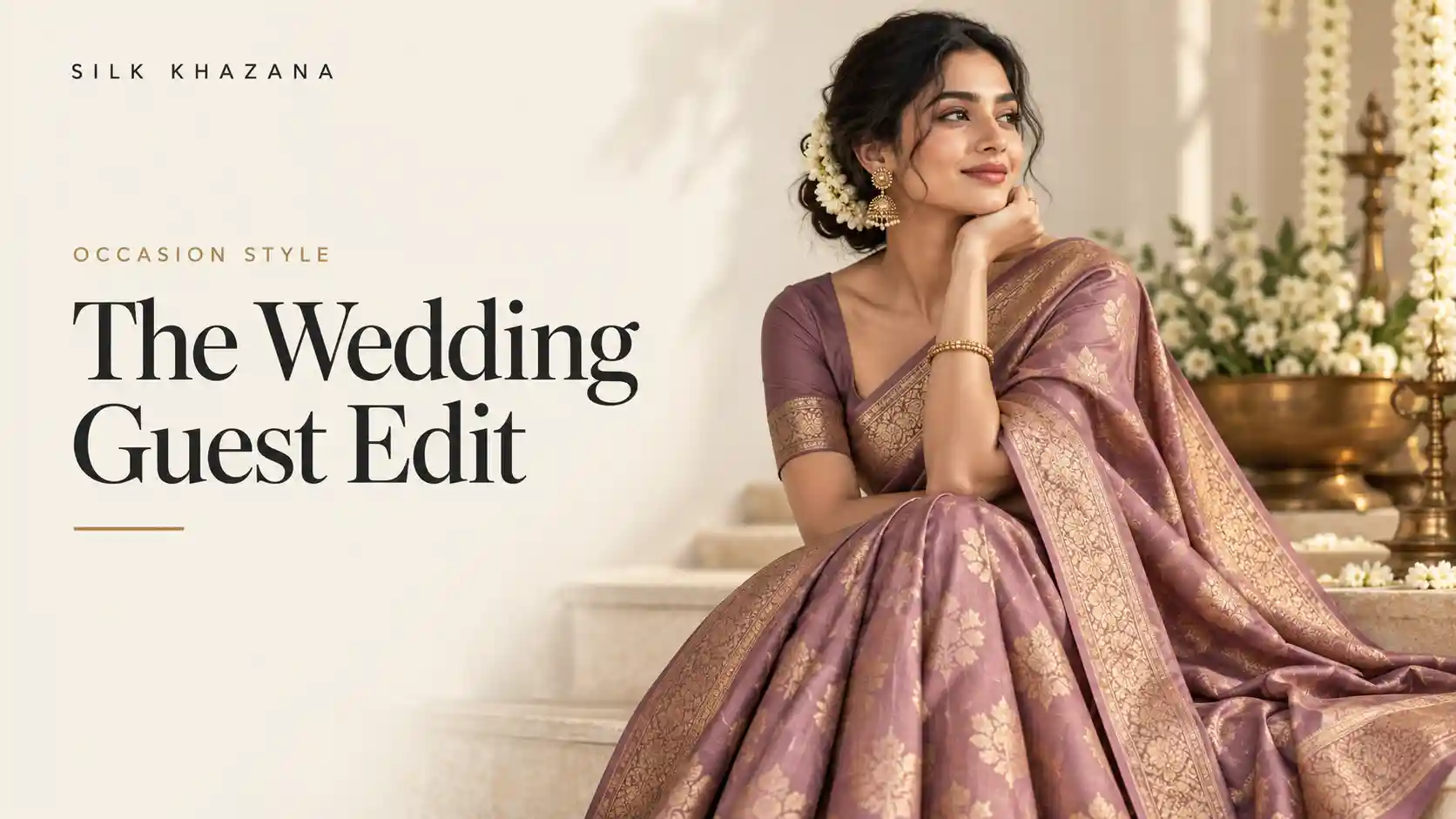
Banarasi Sarees for Wedding Guests and Receptions

Banarasi sarees for wedding guests and receptions: fabric, colour, etiquette and styling ideas for a sister, friend, aunt or mother.

If you are not the bride, your Banarasi saree has a different job. It needs to be beautiful without competing, comfortable for long hours of standing, eating, greeting and dancing, and appropriate to the occasion.

This guide helps guests, relatives and friends choose a saree that makes them feel festive and at ease.

Banarasi sarees for wedding guests: the guest's brief

A good wedding-guest saree does four things:

  • 1. Looks festive. A little shimmer, a rich border or a graceful pallu.
  • 2. Does not outshine the bride. Quiet confidence works better than the heaviest piece in the room.
  • 3. Feels comfortable. You may wear it for six or more hours.
  • 4. Suits the setting. Time of day, venue and season all matter.

A few etiquette notes

Customs vary by family and community, so use these as gentle guidance.

  • Avoid the bride's colour if you know it. Many guests steer clear of bridal red unless the family has asked for it.
  • Be thoughtful with white and black. Some families avoid them at weddings, and others accept them. When in doubt, choose a colour.
  • Consider the ritual. A haldi calls for yellows and brights, and a sangeet allows more sparkle.
  • Ask the host if you are unsure.

Fabrics that suit guests

FabricWhy it worksBest for
Khaddi georgetteLight, flowing, travels wellReceptions, sangeet, long days
Organza / KoraCrisp and airyDay weddings, mehendi, haldi
TissueShimmer without weightEvening receptions
Light katanRich without a heavy palluFormal ceremonies, winter weddings
TussarEarthy and distinctiveDay functions

See our guides to khaddi georgette, tissue silk and organza.

Colour ideas for guests

For day weddings: soft pinks, peach, sage, powder blue, lavender, mustard, ivory and pastel greens look fresh and photograph well in daylight.

For evening receptions: jewel tones such as emerald, wine, teal, plum and royal blue glow under lights. Champagne and gold tissue also suit the evening.

For winter weddings: deeper shades and velvet blouses feel natural.

For summer weddings: lighter fabrics in cooler shades keep you comfortable.

Ideas by role

Sister or close friend. You may be in many photographs. Choose a saree with a graceful pallu and a colour that stands apart from the bridal palette. Light georgette or organza gives freedom to move.

Aunt or senior relative. Katan in a rich but not bridal shade has presence. Choose a weight you can carry comfortably.

Mother of the bride or groom. Families often expect something rich and traditional. A katan with a beautiful border, in a tone that coordinates with the family palette, is a classic.

Friend of the couple. A modern, easy look, such as a tissue in champagne or a pastel organza, suits sangeet and receptions.

Out-of-town guest. Georgette packs small and resists creases, which makes travel easier.

Choosing for comfort

  • Weight. Try the saree on, or at least feel it. A heavy pallu feels lighter in the shop than at hour five.
  • Footwear. Drape in your actual shoes so the length is right.
  • Pleats and pins. Practise the drape. Our guide to draping a Banarasi saree shows several styles.
  • Blouse comfort. Check you can lift your arms and sit comfortably. See our blouse guide.
  • Petticoat. Match it closely with sheer fabrics.

Styling that looks effortless

  • Choose one statement element: the saree, the necklace or the blouse. Let one lead.
  • Keep jewellery in tune with the saree's zari tone.
  • Carry a stole or shawl for winter weddings or air-conditioned halls.
  • Pack a few spare pins and a small sewing kit.
  • Keep your bag soft and smooth to avoid snagging.

Planning your shopping

  • Start a few weeks before the wedding, to allow for blouse stitching and fall work.
  • Check the dress code if one has been given.
  • Share the event details when you shop. We can suggest a saree that suits the venue, the time of day and the season.
  • Ask about care. You may want to wear the saree again.

If you are buying from a distance, our guide on buying Banarasi sarees online safely covers what to check.

Mistakes to avoid

  • Wearing a saree so heavy you cannot move
  • Choosing the bridal colour by accident
  • Leaving blouse stitching to the last minute
  • Draping for the first time on the day
  • Ignoring the venue's lighting and temperature

Further reading on banarasi sarees for wedding guests: Banarasi sari on Wikipedia.

Planning for the festive season? See our Karwa Chauth saree guide and our Diwali Banarasi saree guide.

Key takeaways

  • Guests should choose festive but comfortable. Light katan, georgette, organza and tissue all work.
  • Avoid competing with the bride in colour and weight.
  • Match fabric and colour to the time of day and season.
  • Practise the drape and carry spare pins.

Frequently Asked Questions

Light katan, khaddi georgette, organza and tissue are popular guest choices. They look festive without the weight of a bridal piece.

Many guests avoid bridal red unless the family has said otherwise. If you are unsure, choose another rich shade or ask the host.

Jewel tones such as emerald, wine, teal and royal blue glow in evening light. Champagne and gold tissue also suit receptions.

It does not have to be. Georgette, organza and tissue are light, and a light katan can be comfortable for hours.

Customs vary. Some families avoid both, and others welcome them. When in doubt, choose a colour.

A few weeks before the wedding, so there is time for blouse stitching and a trial.

Message us on WhatsApp at +91 63073 05873 or visit our Varanasi showroom, and we will walk you through banarasi sarees for wedding guests with the saree in your hands.

Browse Georgette Silk Sarees

Looking for banarasi sarees for wedding guests? We manufacture Banarasi silk in Varanasi and have done since 1970, selling directly, so you can ask us anything about a saree and get a specific answer.

Not sure what suits you? Message us on WhatsApp at +91 63073 05873 and tell us the occasion. Visit us: J 14/180, opp. Chhavi Mahal Cinema, Qazi Sadullah Pura, Jaitpura, Varanasi 221001.
Blouse Designs for Banarasi Silk Sarees: Style Guide | Silk Khazana
Styling 6 Min Read

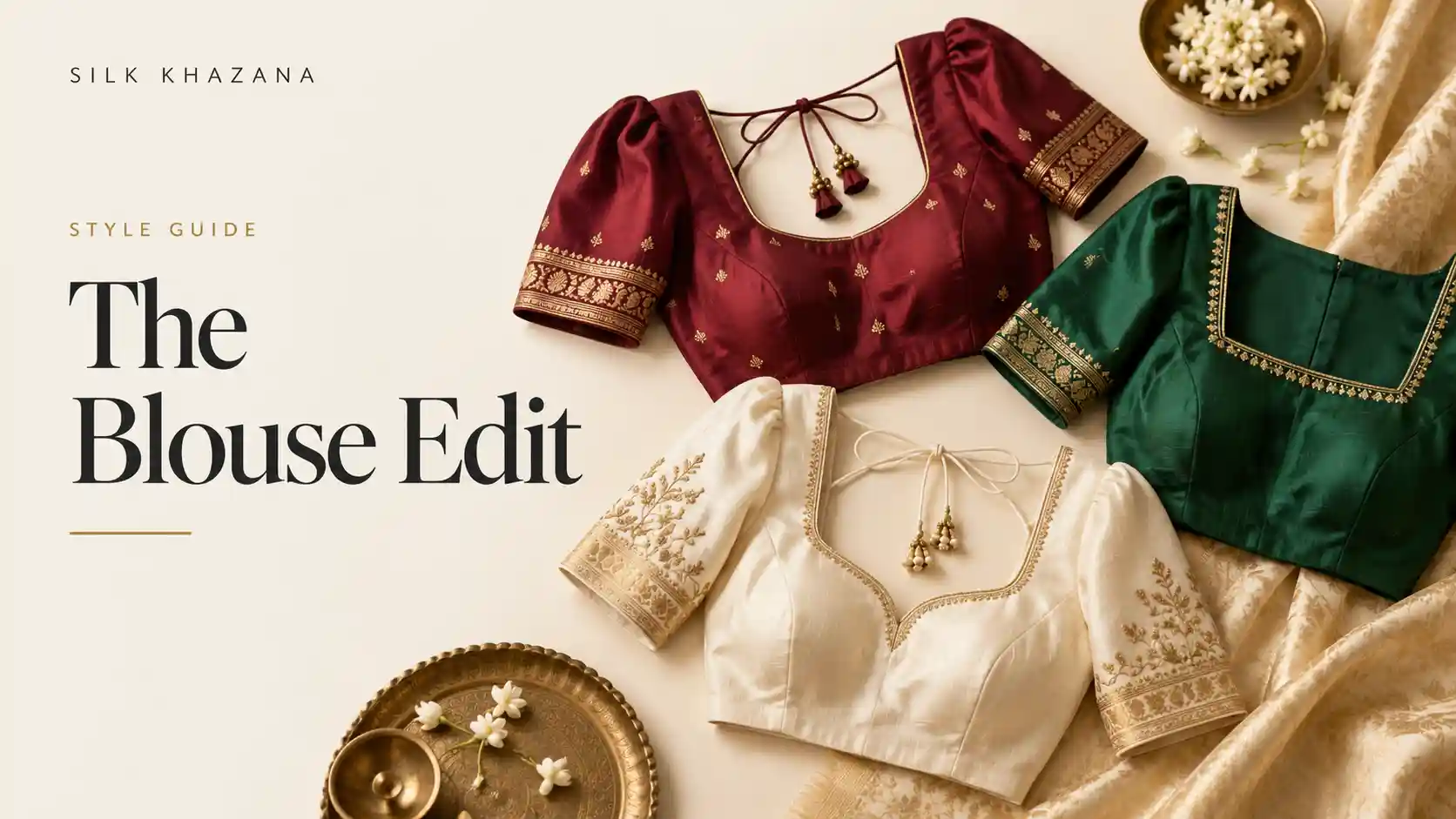
Blouse Designs for Banarasi Silk Sarees: Style Guide

Blouse designs for Banarasi silk sarees: neckline, sleeve and fabric ideas, with pairing advice for katan, organza, tissue and georgette.

The blouse decides how the whole saree reads. A rich katan with a plain, well-cut blouse looks composed. The same saree with a crowded blouse can look busy. A light organza with a stiff, heavy blouse can lose its air.

Here is a practical guide to necklines, sleeves, backs and fabrics for Banarasi silk, with pairing ideas for each saree type.

Blouse designs for Banarasi silk sarees: start with the saree

Before choosing a design, look at the saree and ask three questions.

  • 1. How much is happening in the saree? A dense Jangla or Meenakari already has plenty of detail. A plain border with a light pallu can take a more decorated blouse.
  • 2. How heavy is the fabric? Heavy sarees pair with structured blouses. Light sarees can take softer ones.
  • 3. What is the occasion? A wedding allows more ornament than an office lunch.

Blouse fabrics that work

Blouse fabricWhy it worksPair with
Raw silkFirm, takes a clean shape, dyes richlyKatan, organza, tissue
VelvetDeep, luxurious, wonderful in cooler monthsTissue, organza, georgette
Banarasi brocadeCohesive, rich, matches the traditionPlain-bodied sarees
Matching saree fabric (blouse piece)Seamless, traditionalMost sarees
Georgette or crepeSoft and lightLight georgette and organza
Net or organza (lined)Airy, modernOrganza, tissue

A note on the blouse piece. Most Banarasi sarees come with an unstitched blouse piece in the same weave. Ask to see it before you buy, since it shows how the pallu pattern might appear in the blouse. If you plan a contrast blouse, confirm the colour in natural light.

Neckline ideas

  • Boat neck. Wide, flattering, and timeless. Shows collarbones and balances heavy sarees.
  • Round neck. Simple and comfortable for long events.
  • V-neck. Elongates the neck. Works well with statement necklaces.
  • Square neck. Strong, structured line that suits raw silk and brocade.
  • High neck or collar. Elegant and covered. Pairs well with velvet.
  • Sweetheart. Soft and decorative for receptions.

A good rule: the busier the necklace, the simpler the neckline.

Sleeve ideas

  • Elbow length. The most versatile; comfortable and photographs well.
  • Three-quarter. Elegant and covered, good for formal and winter events.
  • Cap or short sleeve. Cooler, more relaxed.
  • Puff or gathered sleeve. Adds drama. Works best with simple necklines.
  • Bell or flared sleeve. Pairs beautifully with lighter fabrics.
  • Full sleeve. Traditional and rich. Lovely in velvet.

Think about movement. Whatever sleeve you choose, check you can lift your arms without the blouse pulling.

Back designs

  • Closed back with a button or hook. Clean and comfortable.
  • Deep U or V back. Elegant for evening.
  • Keyhole back. A subtle detail.
  • Dori or tie-up back. Playful and adjustable.
  • Back with fabric border. Echoes the saree's border for a connected look.

For heavy sarees, avoid anything so open at the back that it cannot hold the weight of the pallu pin.

Pairing blouses with saree types

SareeBlouse that worksWhy
Katan (plain body)Contrast raw silk or brocade, boat or square neckGives the saree a frame
Katan Jangla / JamawarSimple matching or solid-colour blouseThe saree is already busy
Organza / KoraRaw silk, velvet or lined fabricGives the airy fabric an anchor
TissueVelvet or raw silk in a deep shadeContrasts the shimmer
GeorgetteSoft fabric with a structured necklineBalances flow
TussarContrast raw silk in a deep shadeWarm and earthy

For more on specific fabrics, see our guides to organza and tissue silk.

Matching or contrast?

Matching gives a seamless, elegant column and suits traditional brides and formal events. Contrast adds personality and works well with plain-bodied sarees. A safe approach is a deeper tone of the saree's own colour, or a colour already present in the border or pallu. Our guide to bridal colours can help you choose palettes.

Tailoring tips

  • Take measurements properly, and try the blouse with your saree and petticoat.
  • Ask for lining in light fabrics.
  • Include hooks or a zip that sit flat and do not catch the saree.
  • Allow margins in seams so the blouse can be altered later.
  • Do a trial a week before the event, not the day before.
  • Think about padding only if you need it. Heavy padding adds bulk beneath a heavy saree.

Mistakes to avoid

  • Choosing a blouse that competes with the pallu
  • Ignoring the weight of the saree when selecting fabric
  • Cutting sleeves too tight for movement
  • Rushing the tailor
  • Forgetting that the blouse has to survive a long day of sitting, standing and hugging

Further reading on blouse designs for banarasi silk sarees: Banarasi sari on Wikipedia.

Key takeaways

  • Start with the saree. The blouse should support it, not compete.
  • Structured fabrics such as raw silk, velvet and brocade anchor light and sheer sarees.
  • Simple necklines suit statement necklaces.
  • Always do a trial with the saree, petticoat and jewellery.

Frequently Asked Questions

A structured blouse in raw silk, velvet or brocade suits most Banarasi sarees. Match the blouse to the saree's weight and the occasion.

Either works. Matching gives a seamless, traditional look. Contrast adds personality, especially with plain-bodied sarees.

Boat, V and square necks are popular. Choose one that suits your necklace and the saree's detail.

Yes. Most Banarasi sarees come with an unstitched blouse piece in the same weave. Look at it before buying to see how it will appear.

Elbow and three-quarter sleeves are the most versatile and photograph well.

Yes for sheer or light fabrics, and for comfort against the skin.

Message us on WhatsApp at +91 63073 05873 or visit our Varanasi showroom, and we will walk you through blouse designs for banarasi silk sarees with the saree in your hands.

Browse Banarasi Sarees

Looking for blouse designs for banarasi silk sarees? We manufacture Banarasi silk in Varanasi and have done since 1970, selling directly, so you can ask us anything about a saree and get a specific answer.

Not sure what suits you? Message us on WhatsApp at +91 63073 05873 and tell us the occasion. Visit us: J 14/180, opp. Chhavi Mahal Cinema, Qazi Sadullah Pura, Jaitpura, Varanasi 221001.

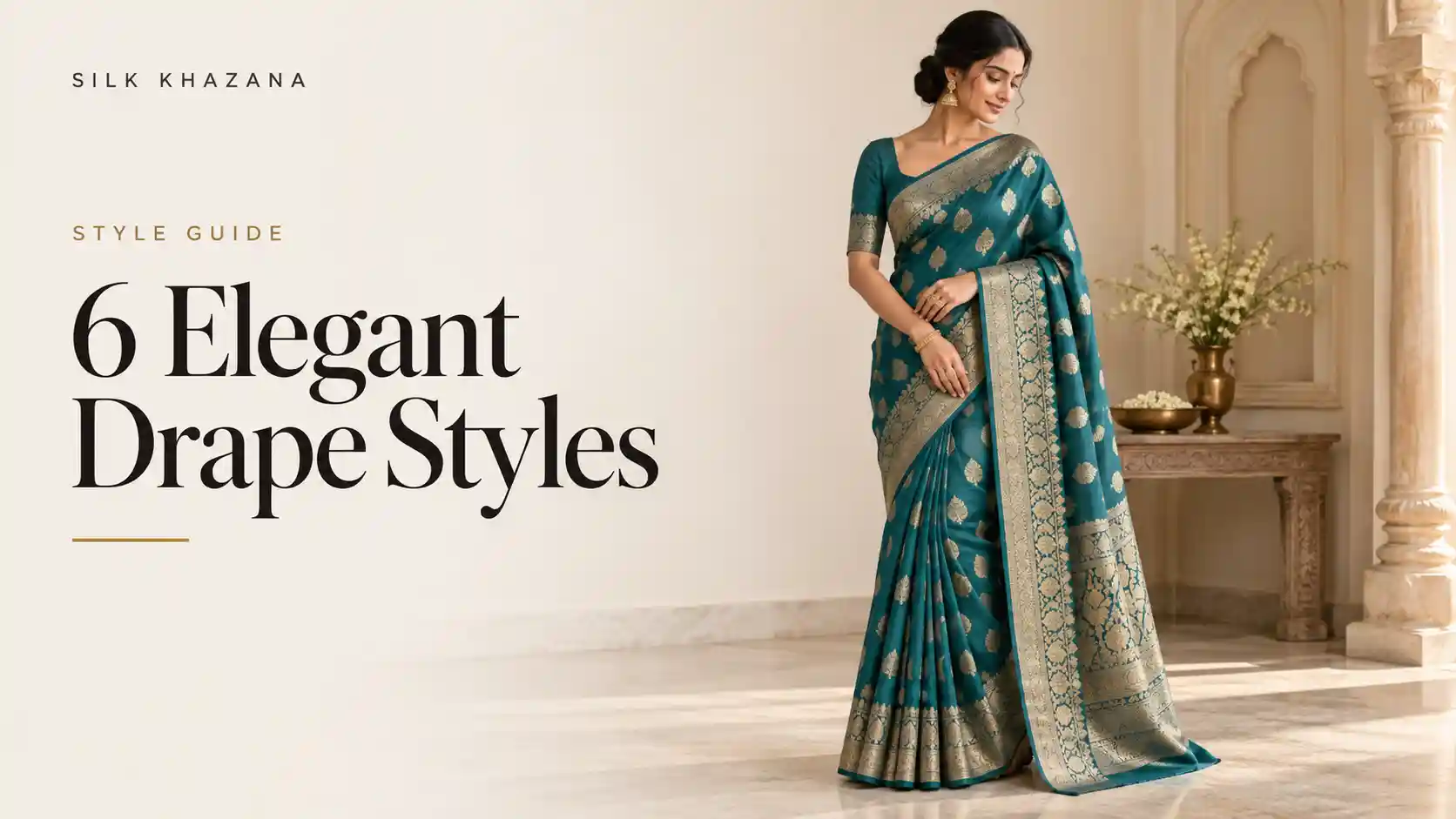
How to Drape Banarasi Saree: 6 Elegant Styles | Silk Khazana
Styling 7 Min Read

How to Drape Banarasi Saree: 6 Elegant Styles

How to drape Banarasi saree in six styles: Nivi, Gujarati, Bengali and belted, with tips for heavy katan, organza and tissue fabrics.

A Banarasi saree is not draped the way a cotton saree is. It is heavier, richer, and the pallu is the star. The way you pleat, pin and let it fall decides whether the weaving shows or disappears.

This guide walks through six styles, starting with the classic Nivi and moving to regional and modern variations, with practical notes for heavy katan, light organza and everything between.

How to drape Banarasi saree: before you begin

A few things make every drape easier.

  • Wear the right petticoat. Fit it snugly at the waist, with the hem at the height of the footwear you will wear.
  • Wear your footwear. The length of the saree depends on it. Always drape in the shoes you plan to wear.
  • Choose a firm blouse that will not shift as you move.
  • Have pins ready. Small, smooth safety pins work best. Pin from the inside, and use as few as you can.
  • Keep a mirror and a few minutes. Heavy sarees reward patience.

If you are new to draping, practise with the saree a few days before the occasion. A heavy katan behaves very differently from the practice cotton you may have used.

1. The classic Nivi drape

The most widely known style, and the best place to start.

  • 1. Tuck the plain end of the saree into the petticoat at the waist, starting at the right and wrapping once around the body.
  • 2. Bring the saree around until the lower edge just brushes the floor.
  • 3. Gather about five to seven pleats, each as wide as your palm. Align the folds and press them flat.
  • 4. Tuck the pleats at the centre front, facing left.
  • 5. Take the remaining fabric around the back, then over the left shoulder, and let the pallu fall.
  • 6. Pin the pallu at the shoulder, and adjust the length.

Best for: katan, tissue, organza, georgette. Almost every fabric, almost every occasion.

Tip for heavy katan: use narrower pleats, so the weight sits closer to the body, and pin the pallu with two pins instead of one.

2. Gujarati (seedha pallu) drape

In this style, the pallu comes over the right shoulder to the front, so that the motifs are on show.

  • 1. Start as for Nivi, tucking and wrapping once.
  • 2. Make your pleats and tuck them at the front.
  • 3. Bring the pallu from the back, under the left arm, across the chest and over the right shoulder.
  • 4. Spread the pallu so that the design is visible in front.
  • 5. Pin it at the shoulder and again at the waist if needed.

Best for: sarees with a beautiful pallu, such as Meenakari, Jangla and Rangkat. It is a showcase drape.

3. Bengali (aatpoure) drape

A graceful style with no pleats at the front. The pallu is draped across the body and over the left shoulder, often with the end brought to the front.

  • 1. Wrap the saree around the waist without front pleats.
  • 2. Bring the end around, forming a broad pleat that is tucked at the left.
  • 3. Place the pallu over the left shoulder, then bring a portion across the right side.
  • 4. Adjust so the borders frame the body.

Best for: lighter Banarasi fabrics such as georgette, tussar and organza, and for wearers who find front pleats bulky.

4. The belted drape

A modern take. Draped as Nivi, then fastened with a belt or kamarbandh at the waist.

  • 1. Drape in your preferred style.
  • 2. Slip a narrow belt over the pleats and pallu at the waist, and fasten.
  • 3. Adjust the saree so the pleats sit evenly.

Best for: tissue, organza and lighter silks. The belt keeps pleats in place, helps those who worry about slipping and adds a contemporary line.

5. The lehenga-style drape

This style turns the saree into a flowing skirt with the pallu worn like a dupatta.

  • 1. Use the pleats all the way round, tucking them evenly at the waist so the saree forms a skirt shape.
  • 2. Bring the pallu from the back, over the shoulder, as you would a dupatta.
  • 3. Pin the pallu and allow the end to fall freely.

Best for: sarees with a generous width, such as katan and Jamawar, at weddings and sangeet. It also manages heavy weight well.

6. The open pallu drape

A relaxed variation on Nivi in which the pallu is spread open at the front rather than pleated.

  • 1. Drape as Nivi, but do not pleat the pallu.
  • 2. Let the pallu fall loosely from the left shoulder and pin it at the shoulder only.
  • 3. Arrange the pallu to show the most beautiful part of the design.

Best for: receptions and photographs, where you want the pallu to be seen.

Matching the drape to the fabric

FabricDrape that worksNotes
KatanNivi, Gujarati, lehenga-styleNarrow pleats, strong pins
Organza / KoraNivi, belted, BengaliPin from inside, sparingly
TissueNivi, belted, open palluDo not over-tighten pleats
GeorgetteNivi, Bengali, beltedPre-pleat to stop slipping
JamawarGujarati, lehenga-styleHeavy, show the pallu

Common mistakes

  • Draping without your shoes. Length is guesswork otherwise.
  • Too many pins. Heavy pins can snag the weave.
  • Wide pleats on a heavy saree. They bulk at the waist.
  • Leaving the pallu unpinned. Banarasi pallus are heavy and slide.
  • Practising on the day. Try the drape beforehand.

Looking after the saree as you drape

  • Handle it with clean, dry hands.
  • Avoid pulling on the zari.
  • Fold the pallu with care when you take it off.
  • After the event, air the saree before folding. See our guide on how to store Banarasi sarees.

For ideas on pairing, see our blouse design guide. If you are shopping for your wedding, start with the Banarasi bridal saree guide.

Further reading on how to drape banarasi saree: Banarasi sari on Wikipedia.

Planning for the festive season? See our Karwa Chauth saree guide and our Diwali Banarasi saree guide.

Key takeaways

  • The Nivi drape is the most versatile for almost every Banarasi fabric.
  • Showcase drapes such as Gujarati and open pallu bring the pallu forward.
  • Heavy fabrics need narrow pleats and firm pins.
  • Practise ahead and drape in your shoes.

Frequently Asked Questions

The classic Nivi drape is the most straightforward and works with almost every fabric.

Use narrow pleats, snug petticoat tucking and two pins at the shoulder. A belt can also help.

The Gujarati (seedha pallu) and open pallu drapes both put the pallu on display.

As few as you can. Use smooth, small pins and fix them from the inside to protect the weave.

The principles are the same, but organza needs fewer pins and gentler handling.

The lower edge should just clear the floor in the footwear you will wear.

Message us on WhatsApp at +91 63073 05873 or visit our Varanasi showroom, and we will walk you through how to drape banarasi saree with the saree in your hands.

Browse all Banarasi Sarees

Looking for how to drape banarasi saree? We manufacture Banarasi silk in Varanasi and have done since 1970, selling directly, so you can ask us anything about a saree and get a specific answer.

Not sure what suits you? Message us on WhatsApp at +91 63073 05873 and tell us the occasion. Visit us: J 14/180, opp. Chhavi Mahal Cinema, Qazi Sadullah Pura, Jaitpura, Varanasi 221001.

Sign Up Newsletter

Sign up our newsletter and save 25% off for the next purchase!

Subscribe to our newsletters and don’t miss new arrivals, the latest fashion updates and our promotions.