
That single construction difference explains everything people love about tissue silk: the liquid, light-catching sheen, the surprising lightness, and the way it photographs beautifully under evening light. It also explains why tissue needs slightly different care from a heavy Katan.
This guide covers what tissue silk actually is, the three main types you'll encounter, who it suits, how to style it, and how to look after it. We weave tissue at Silk Khazana in Varanasi, where our family has been manufacturing Banarasi silk since 1970.
What is a tissue silk saree?
A tissue silk saree is a Banarasi saree woven with a fine silk warp and a metallic zari weft, so that zari runs through the body of the fabric rather than sitting only in the borders and motifs.
The result is a continuous, all-over sheen across the entire drape. Tissue is also noticeably lighter and more sheer than traditional Banarasi silks, with a fluid movement that catches light as you move.
This is worth being precise about, because it's commonly misunderstood: the shine is structural, not a finish. It isn't a coating, a print, or a treatment applied afterwards. It comes from how the fabric is woven. That's also why the glow doesn't wear off — it is the cloth.
The structural glow: Zari weft intertwined with fine silk warp.
Why this matters when you're buying
If a "tissue" saree's shine looks like it sits on the surface rather than coming from it, examine it closely. Genuine tissue reveals its zari when you look into the weave and turn it in the light; the sheen shifts with the angle rather than staying flat.
The three types of tissue silk saree
Not all tissue sarees are the same, and knowing the difference helps you choose well.
| Type | Construction | Character | Best for |
|---|---|---|---|
| Plain Tissue | Zari weft across a sheer silk ground | Uninterrupted all-over glow, lightest | Minimal, modern elegance |
| Tissue Brocade | Raised woven motifs above the tissue ground | Texture you can feel; shine plus pattern | Festive occasions, statement wear |
| Katan Tissue | Katan silk base with tissue-style zari | More body and structure, still shimmering | Weddings, when you want weight |
Plain Tissue
The purest expression of the technique. A sheer silk ground with zari weft throughout produces an unbroken, liquid sheen. It is the lightest of the three and reads as understated rather than ornate — ideal if you want luminosity without heavy ornamentation.
Tissue Brocade
Here, woven motifs — florals, paisleys, or a jaal lattice — sit raised above the tissue ground. Run a finger across the fabric and you can feel the pattern.
This combines the all-over glow with the traditional Banarasi brocade vocabulary, making it the most festive of the three and the most popular for celebrations.
Katan Tissue
For buyers who love tissue's shimmer but want more presence, Katan Tissue pairs a firmer Katan silk base with tissue-style zari detailing.
It drapes with more weight and structure than plain tissue, which makes it a strong bridal-adjacent option — the shimmer of tissue, closer to the substance of a traditional wedding saree.
Who tissue silk suits best
Tissue tends to be the right choice when:
- You want to stand out gracefully rather than through heavy ornamentation. Tissue attracts attention through light, not bulk.
- The event is in the evening. Tissue is at its most spectacular under artificial and candle light, which is why it's a reception favourite.
- You want lightness. If a heavy bridal Katan feels like too much to carry for hours, tissue delivers Banarasi luxury at a fraction of the weight.
- You're photographed a lot. The light-catching surface is genuinely flattering in photographs.
Tissue is less suited to rough daily wear or situations where the fabric will be snagged or crushed — it's a special-occasion silk by nature.
Best occasions for a tissue saree
- Wedding receptions — arguably the perfect tissue occasion; evening light, photographs, and a dress code that rewards elegance over sheer weight
- Engagement ceremonies and sangeet — light enough to move and dance in
- Festivals — Diwali and Karva Chauth especially, where the glow suits the occasion
- Luxury gifting — tissue photographs beautifully and feels immediately special
- Evening receptions and formal dinners
For the bride herself, we'd usually point to a heavier Katan, Jangla or Meenakari piece — with a Katan Tissue as an excellent option for a second function or reception look.
How to style a tissue silk saree
Blouse. Tissue's shimmer gives you two good routes: a contrasting raw silk or velvet blouse for depth and grounding, or a matching tissue blouse for a seamless, monochrome column. Velvet in particular works beautifully against tissue's lightness in cooler months.
Draping. Because tissue is light and slightly crisp, it holds pleats well and creates elegant volume. A classic Nivi drape suits it, and the pallu falls with lovely movement. Avoid over-tight pleating, which flattens the sheen.
Jewellery. Tissue already carries a great deal of shine, so restraint reads as more expensive. Consider:
- Uncut/polki or kundan for a traditional look
- Pearls for softness against gold tissue
- One statement piece rather than a full set
Petticoat. This matters more with tissue than other silks. Because the fabric is sheer, choose a well-matched petticoat in a close shade — a mismatched one is visible through the drape.
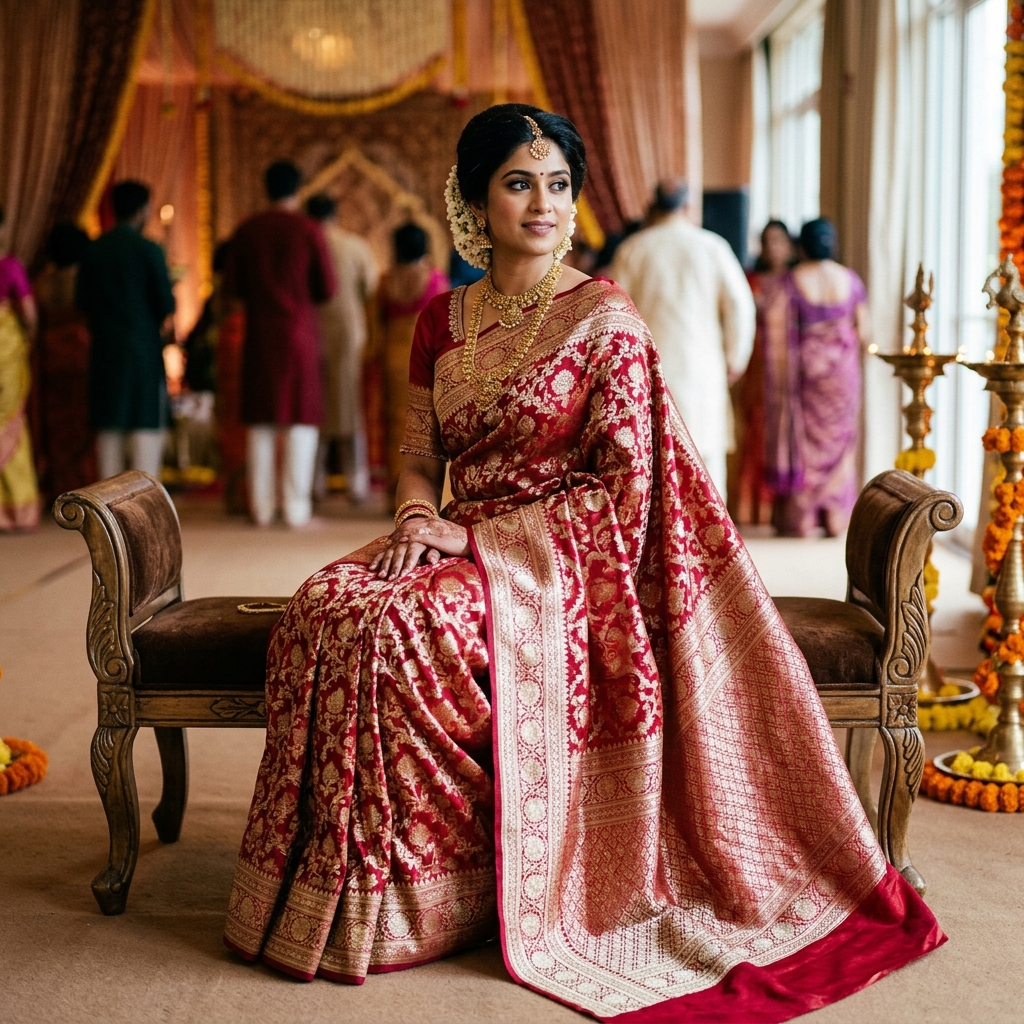
Elegant styling with a contrasting velvet blouse and traditional jewelry.
A practical note: be mindful of sharp-edged jewellery, embellished bags and rough surfaces. Tissue's fine zari weave can snag, and prevention is far easier than repair.
How to care for a tissue silk saree
Tissue is delicate, and its zari content means it needs slightly more attention than a sturdy Katan.
Dry Clean Only
Never machine wash. Use a cleaner experienced with zari work.
Store Folded
Hanging stretches the fabric and stresses the zari over time. Store folded.
Breathable Storage
Wrap in breathable cotton or muslin — never plastic, which traps moisture.
Refold Regularly
Refold every few months along different lines to prevent permanent creases.
Avoid Perfumes
Spray before dressing, never onto the saree — alcohol can dull the zari.
No Direct Sunlight
Avoid prolonged direct sunlight, which fades colour and can dull the sheen.
Iron on low heat with a cotton cloth between the iron and the fabric, if at all. Better still, let a professional handle it. Treated well, a good tissue saree stays luminous for many years.
Tissue vs other Banarasi fabrics
Tissue vs Katan
Katan is heavier, firmer and more durable — the traditional bridal choice. Tissue is lighter, shinier and more festive. Katan is the heirloom; tissue is the showpiece.
Tissue vs Organza
Both are light and somewhat sheer, but Organza is crisper and more matte, with motifs that appear to float on a transparent ground. Tissue is fluid and metallic. Choose Organza for daytime and structure; tissue for evening and glow.
Tissue vs Georgette
Georgette is soft, fluid and matte, with the best drape of the three and the easiest wear. Tissue trades some of that softness for shine and crispness.
For the full comparison across every Banarasi fabric, see our Complete Guide to Banarasi Silk Sarees.
What affects the price of a tissue saree
Tissue pricing is driven by the same factors as other Banarasi sarees, with one particular emphasis:
- Zari type and density — especially significant here, since zari runs through the whole fabric rather than just the borders
- Silk quality of the warp
- Handloom or powerloom production
- Brocade complexity — Tissue Brocade with intricate motifs costs more than plain tissue
- Design and colour work
Because tissue carries zari throughout, the type of zari has an outsized effect on its price compared with a saree where zari appears only in borders. Always ask what the zari is. We explain the full picture in why Banarasi sarees are expensive.
Key takeaways
- Tissue's glow is structural. A zari weft runs through the entire fabric, so the sheen comes from the weave itself, not a surface finish.
- Three types, three purposes. Plain Tissue for understated glow, Tissue Brocade for festive texture, Katan Tissue when you want more weight.
- It rewards careful handling. Store folded in muslin, refold periodically, dry clean only, and keep perfume and sharp jewellery away from the zari.
Frequently Asked Questions
A tissue silk saree is woven with a fine silk warp and a metallic zari weft, so zari runs through the whole fabric rather than only the borders and motifs. This produces a continuous all-over sheen, and makes tissue lighter and more sheer than traditional Banarasi silks.
No. Both are light and semi-sheer, but Organza is crisper and more matte, with motifs on a transparent ground. Tissue is fluid and metallic, with zari woven throughout for an all-over glow.
The three main types are Plain Tissue (zari weft on a sheer silk ground for uninterrupted glow), Tissue Brocade (raised woven motifs above the tissue ground), and Katan Tissue (a firmer Katan silk base with tissue-style zari for more body).
Yes — tissue is especially popular for receptions, engagements and sangeet, where evening light shows it at its best. For the bride's main ceremony, a heavier Katan, Jangla or Meenakari saree is the more traditional choice, with Katan Tissue a good middle ground.
Dry clean only, using a cleaner experienced with zari work. Never machine wash. Store folded in breathable cotton or muslin rather than hanging, and refold periodically to avoid permanent creases.
No. Tissue is among the lighter Banarasi fabrics — noticeably lighter than pure Katan — which makes it comfortable for long events while still looking luxurious.
The sheen comes from zari woven into the fabric rather than a surface coating, so it does not simply wear off. However, zari can dull over time if exposed to moisture, perfume or prolonged sunlight, so proper storage matters.