+9163073 05873 support@silkkhazana.in
Summer sale discount upto 30%! Shop Now

Silk Khazana Presents
Types of Banarasi Sarees: The Complete Guide Every Saree Lover Needs
Varanasi's Heritage Handloom Manufacturer
"There is a moment — and if you have ever held a Banarasi saree in your hands, you know exactly what it is — when the weight of the silk settles on your palm and something quiet happens inside you. It is not just fabric. It is three hundred years of a city's soul..."
Varanasi does not merely make sarees. Varanasi breathes them into existence.
But here is something that surprises most people: "Banarasi saree" is not a single thing. It is a family — a rich, layered, wildly varied family of fabrics, each with its own character, occasion, price point, and story. A bride shopping for her wedding lehenga-set has entirely different needs than the NRI woman looking for a lightweight saree she can carry in her cabin luggage to London. A Varanasi tourist stepping into a handloom showroom for the first time deserves to know exactly what she is looking at.
This guide exists for all of them.
At Silk Khazana, we have been weaving and selling pure handloom Banarasi sarees directly from our workshop in Varanasi for generations. We know these fabrics the way a gardener knows his soil — from underneath. Everything in this guide comes from that lived knowledge.
Let us walk you through every major type of Banarasi saree, what makes each one special, and how to find the one that is truly yours.
Already know what you want? Connect with our team on WhatsApp for personalized recommendations and exclusive designs not listed online.
What Makes a Banarasi Saree Unlike Any Other Fabric in the World?
Before we discuss the different types, it helps to understand what all Banarasi sarees share — the qualities that separate a genuine piece from the thousands of imitations flooding the market.
Pure silk from mulberry silkworms
The finest Banarasi sarees use Katan — a tightly twisted silk yarn that gives the fabric its characteristic density and drape. The silk is not soft in the way cotton is soft. It has weight. Substance. A kind of architectural quality that holds shape even as it moves.
Zari work rooted in Mughal craftsmanship
When the Mughal emperors arrived in the Indian subcontinent, they brought Persian motifs — jamdanis, bootis, jaal patterns, and the famous kairi (mango) design. Varanasi's master weavers absorbed these influences and made them their own. What you see in a Banarasi saree today — the floral jhaalar borders, the interlocked vine patterns, the shimmer of real gold and silver zari — is the living legacy of that cultural exchange.
Handloom weaving that cannot be automated
The most authentic Banarasi sarees are woven on pit looms or frame looms by hand, a process that can take anywhere from fifteen days to six months for a single saree. The weaver controls every thread. There is no machine that can replicate the slight, living irregularities that mark a handloom textile — and those irregularities are not flaws. They are fingerprints.
At Silk Khazana, every saree in our collection is woven by master craftsmen in Varanasi's weaving clusters. When you buy from us, you are buying directly from the source — no middlemen, no markups, no compromises on material.
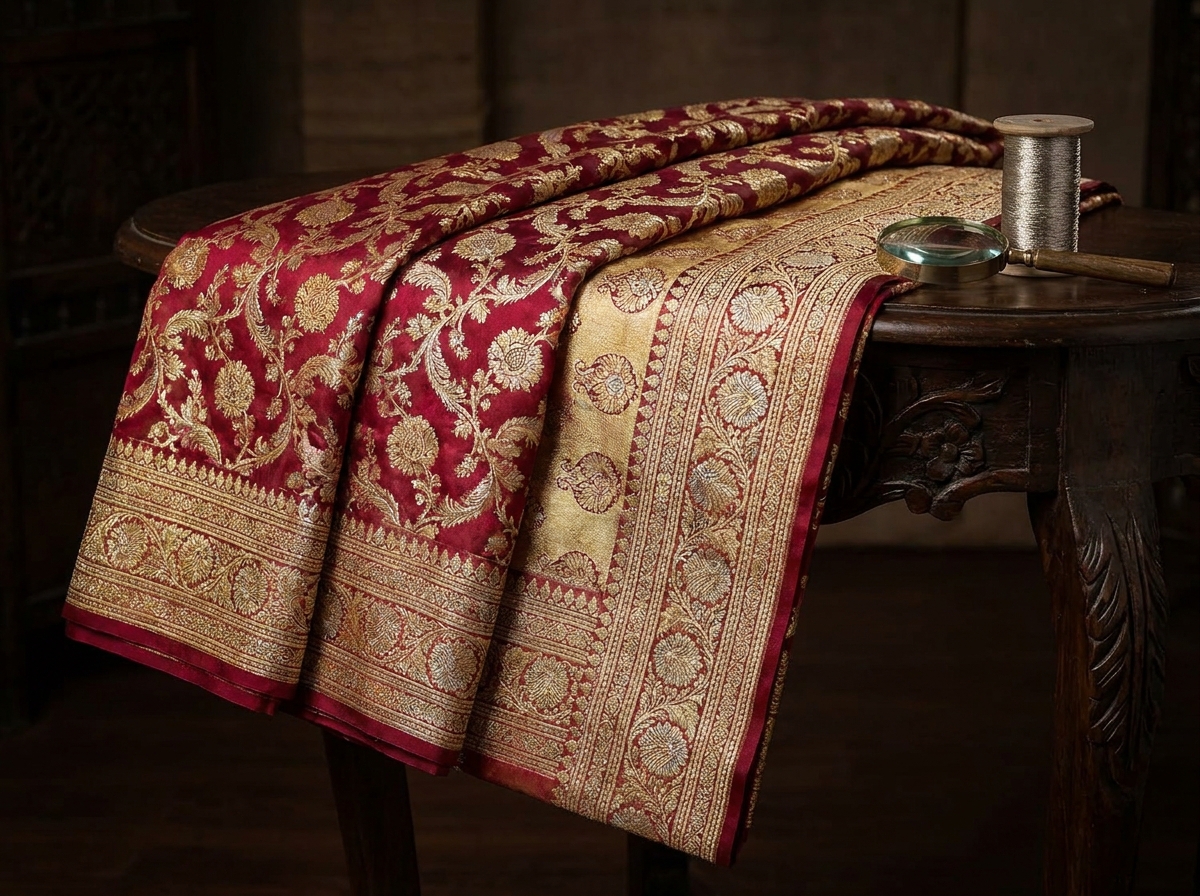
The Main Types of Banarasi Sarees — A Deep Dive
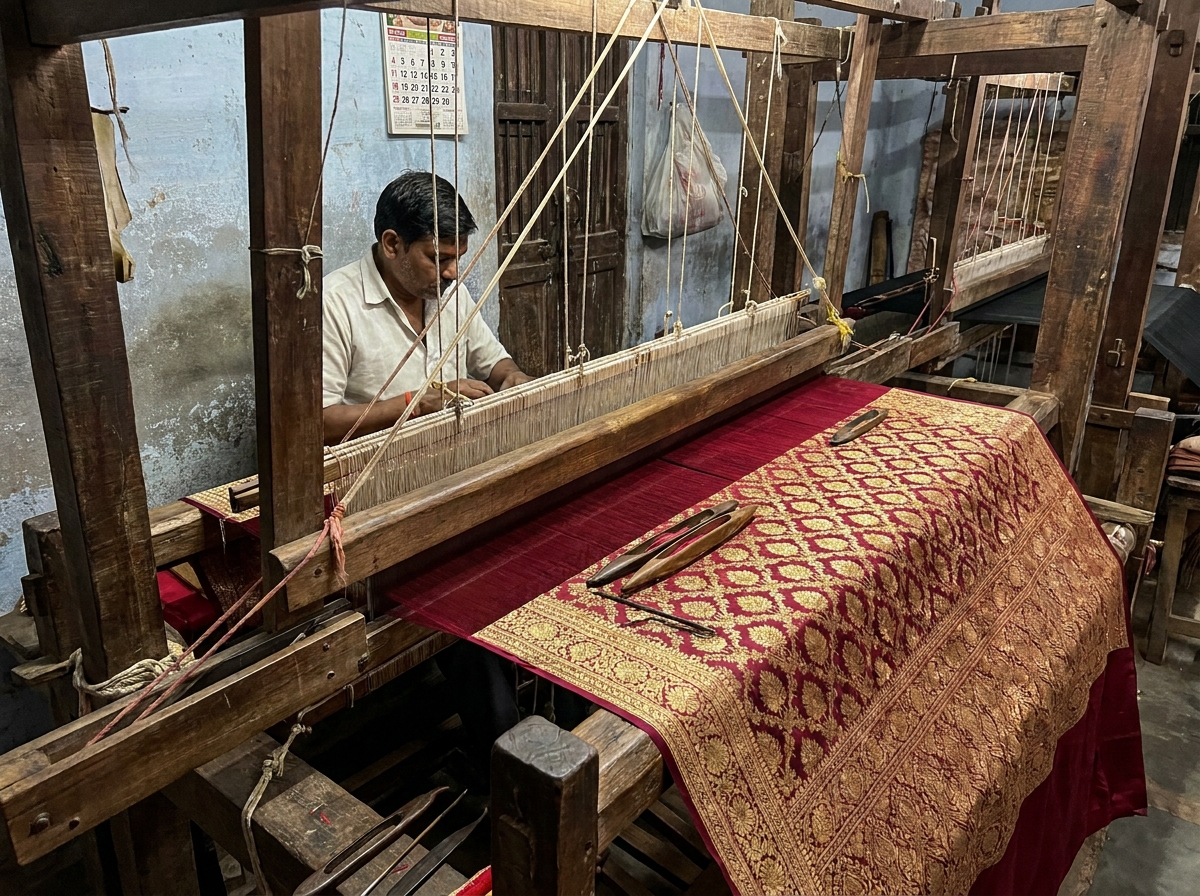
1. Katan Silk Banarasi Saree
Katan is the undisputed crown jewel of Banarasi weaving. The word itself comes from the Persian katan, meaning pure, and that is precisely what this fabric is.
Katan silk is made by tightly twisting multiple fine silk threads together before weaving. The result is a fabric with a smooth, almost glossy surface that catches light in a way that is deeply satisfying — not garish, not loud, but quietly radiant. Run your fingers across a Katan saree and you will feel the difference immediately: a firmness, a cool weight, a slight resistance that tells you this is a fabric of substance.
- Texture & Feel: Structured, heavy, smooth with a natural sheen. Does not crease easily once draped.
- Best Occasion: Bridal wear, wedding receptions, milestone anniversaries, Diwali, formal family ceremonies.
- Price Range: ₹12,000 – ₹1,50,000+ depending on zari type (real gold vs. metallic), design complexity, and weaving time.
- Buyer Persona: The bride-to-be, the mother of the bride, the NRI woman returning for a family wedding who wants to wear something that announces itself without announcing itself.
Katan sarees are typically passed down as heirlooms. We have customers in the UK whose mothers bought their Katan Banarasi from us thirty years ago — the sarees still look pristine.
2. Organza (Kora) Banarasi Saree
If Katan is the grand matriarch, Organza — known locally as Kora — is the younger, lighter-footed relative who surprises you with her elegance.
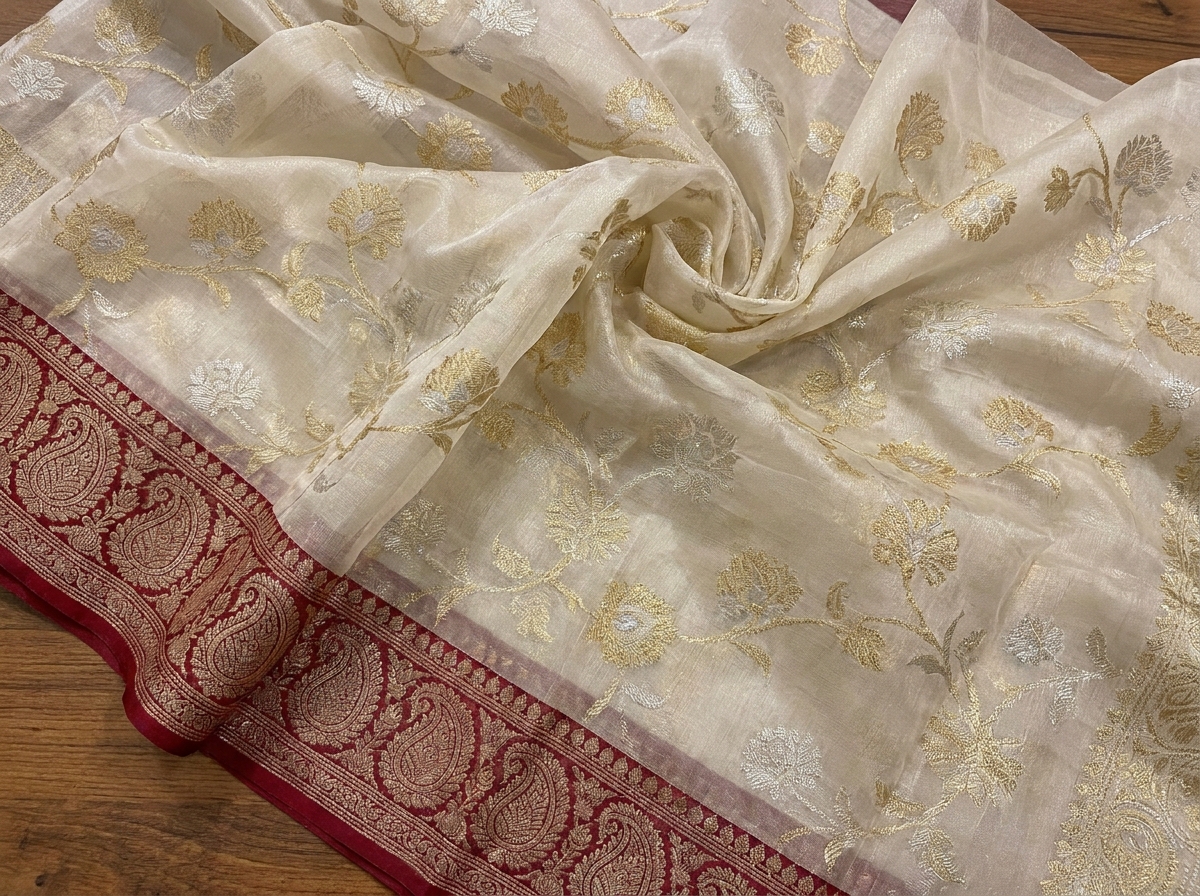
Kora is woven from raw, unprocessed silk. The threads are not degummed the way they are for Katan, which means the fabric retains a natural stiffness and a semi-transparent, almost papery quality. It is crisp without being rigid. Luminous without being heavy.
Draped, a Kora Organza Banarasi saree stands slightly away from the body, giving it a sculptural quality. The zari work on an Organza saree tends to be particularly striking — the near-transparent base makes the gold and silver patterns appear to float in mid-air.
- Texture & Feel: Crisp, lightweight, semi-transparent, with a subtle crinkle texture.
- Best Occasion: Summer weddings, outdoor ceremonies, receptions in warm climates, festivals like Navratri and Durga Puja. A brilliant option for NRI buyers who need something elegant but breathable.
- Price Range: ₹8,000 – ₹60,000
- Buyer Persona: The woman who wants to look dressed without feeling overdressed. The foreign tourist seeking a true Varanasi textile experience. The summer bride who refuses to compromise on elegance.
Explore our Organza collection. Visit our Varanasi showroom or browse online — lightweight Banarasi sarees shipped worldwide.
3. Georgette Banarasi Saree
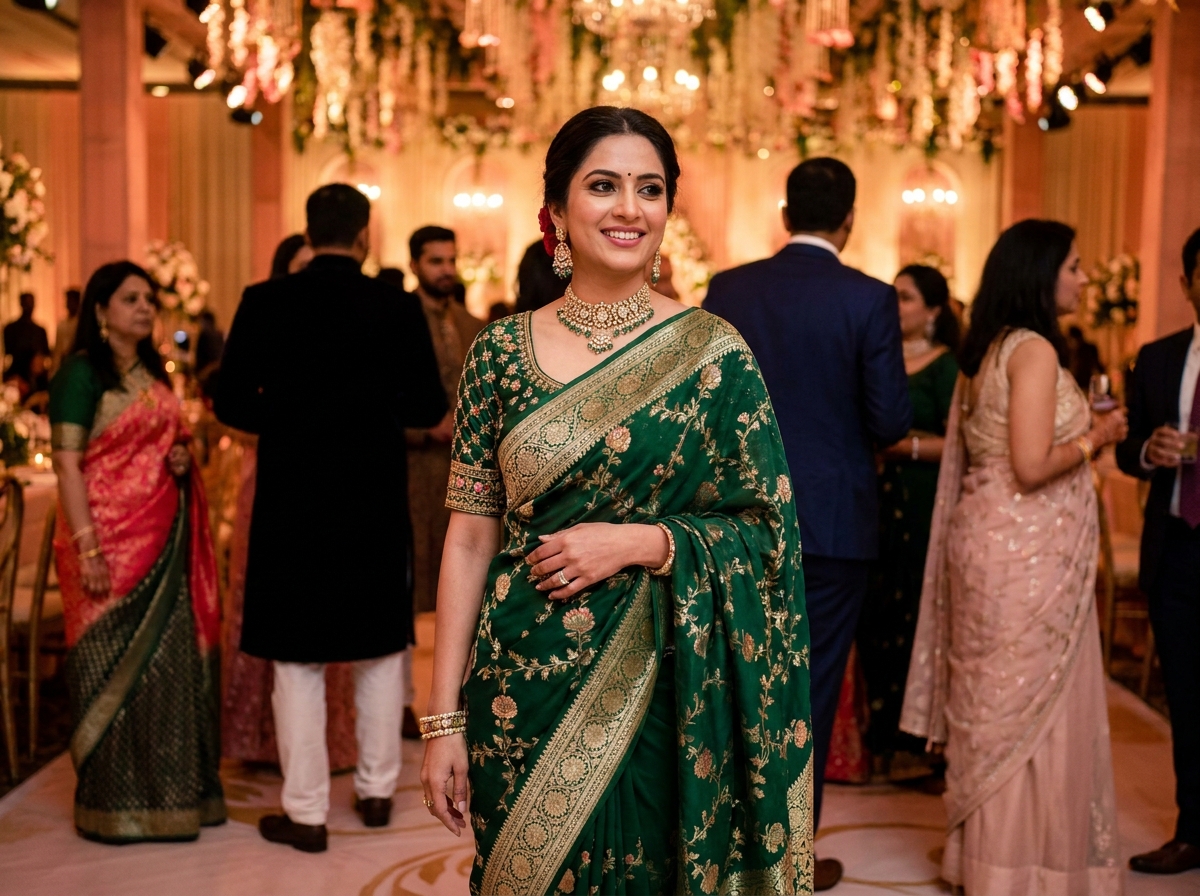
Georgette entered the Banarasi weaving vocabulary relatively recently — but the weavers of Varanasi adopted it with characteristic confidence, and the result is one of the most wearable, universally flattering types of Banarasi sarees available today.
Georgette is a crepe fabric with a slightly pebbled texture, made by alternating left- and right-twisted yarns. It drapes loosely, flows beautifully, and forgives most body types with equal grace. When Banarasi weavers began working butis, jhaalar borders, and full jaal patterns onto Georgette, something genuinely new was born — the structure of traditional Banarasi design on a fabric with the ease of modern wear.
- Texture & Feel: Soft, flowing, matte finish. Lighter than Katan but more structured than plain chiffon. Has a subtle bounce.
- Best Occasion: Evening parties, cocktail events, office wear for festive seasons, casual wedding guests, post-wedding functions like sangeet and mehendi.
- Price Range: ₹6,000 – ₹45,000
- Buyer Persona: Working women who love ethnic wear but need something practical. Party-goers who want glamour without stiffness. Young buyers experimenting with Banarasi for the first time.
A Georgette Banarasi is also one of the easiest types to carry while traveling — it folds flat and does not wrinkle badly, which makes it a favourite among NRI buyers.
4. Shattir Banarasi Saree
Very few fabrics in the world change colour as you move. Shattir does.
Shattir is a double-weave structure that uses two different coloured warp threads. From one angle, the saree appears to be one colour. Shift your position — or simply walk across a room — and the second colour blooms through. It is one of those things that cannot be fully appreciated in a photograph. You have to stand in front of a mirror with a Shattir saree draped over you and turn.
The iridescent effect is entirely structural, produced by the weave itself, not by dyes or finishes. This is what handloom craftsmanship looks like at its most quietly astonishing.
- Texture & Feel: Smooth with a subtle sheen, slightly heavier than Georgette. The dual-colour weave gives it a dense, layered feel.
- Best Occasion: Evening receptions, cocktail events, festive occasions where you want to make an impression through subtlety rather than loudness.
- Price Range: ₹9,000 – ₹55,000
- Buyer Persona: The connoisseur. The woman who has worn Banarasi sarees before and wants something most people at the party will not have seen. Collectors and premium buyers.
5. Tissue Banarasi Saree
Walk into a ray of sunlight wearing a Tissue Banarasi saree and the entire room will look at you. That is not an exaggeration.
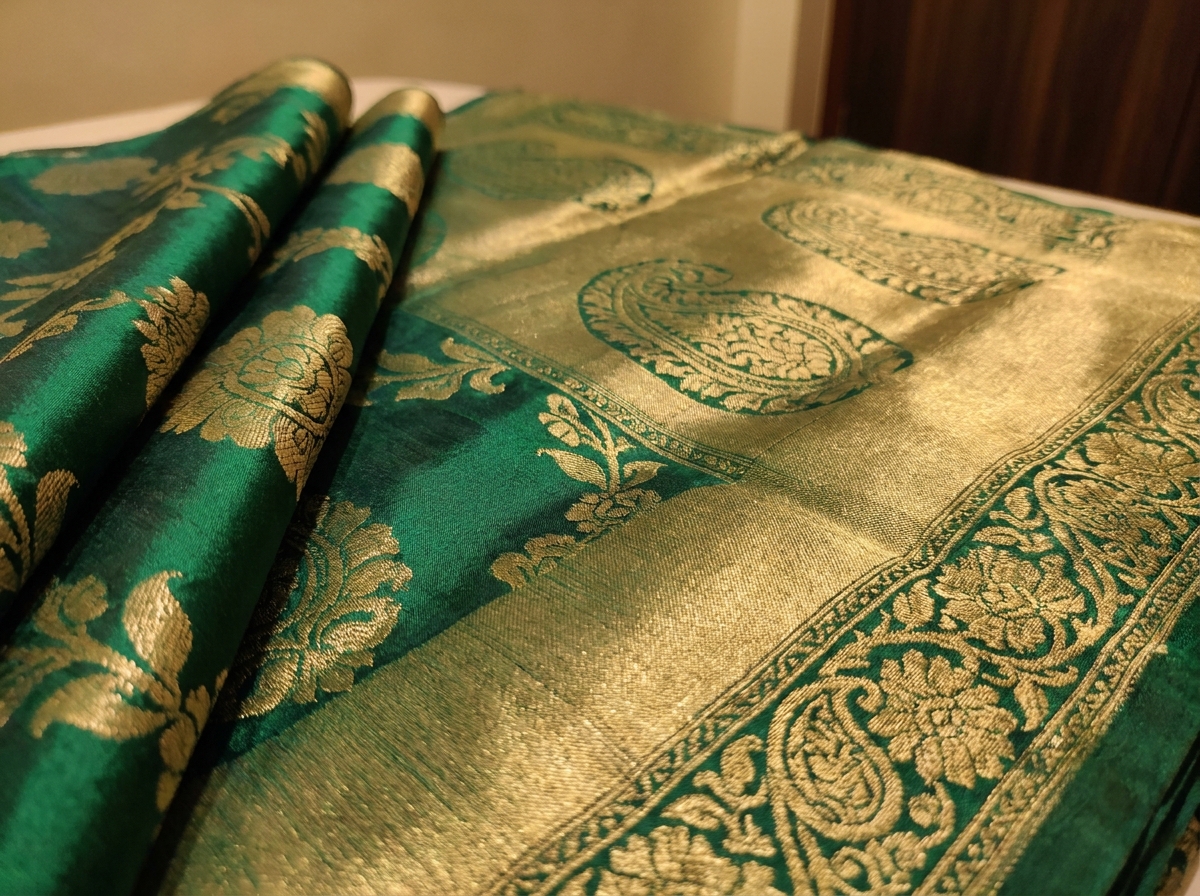
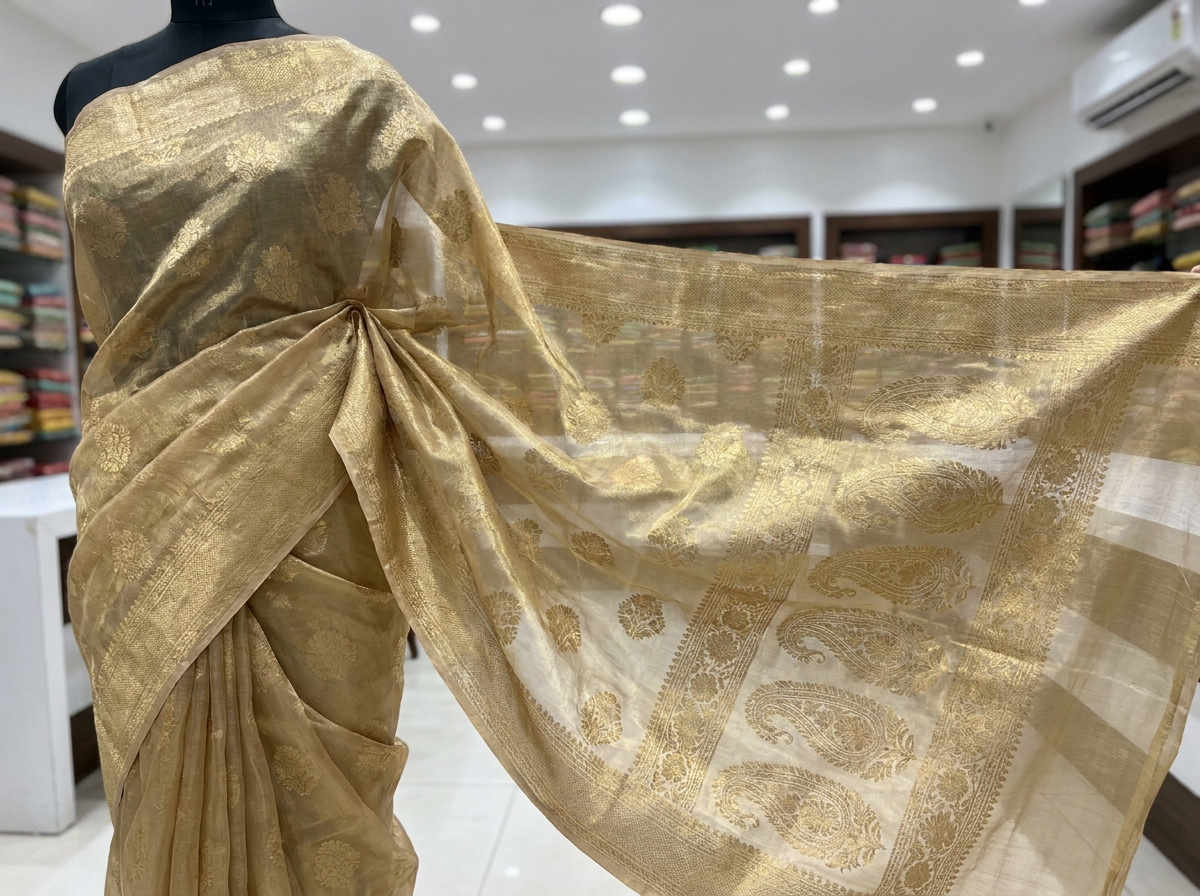
Tissue is woven by interlacing fine metallic — typically gold or silver — zari threads throughout the body of the fabric. The entire saree shimmers, not just the border or the pallu. The base fabric is usually silk, but the presence of metal threads throughout the weave means the saree carries a remarkable iridescent glow under any kind of light.
These are celebratory sarees. Wedding night sarees. Sarees worn when something important is being marked.
- Texture & Feel: Firm, slightly stiff, with a pronounced metallic shimmer over the entire surface. One of the heavier types.
- Best Occasion: Bridal trousseaux, sangeet, traditional wedding ceremonies, Diwali celebrations, formal puja events.
- Price Range: ₹15,000 – ₹2,00,000 (real zari pieces command premium pricing)
- Buyer Persona: Brides, mothers of brides, women celebrating milestone occasions, buyers investing in heirloom pieces.
6. Meenakari Banarasi Saree
If you want to understand what it means when people call Varanasi a city of colour, look at a Meenakari Banarasi saree.
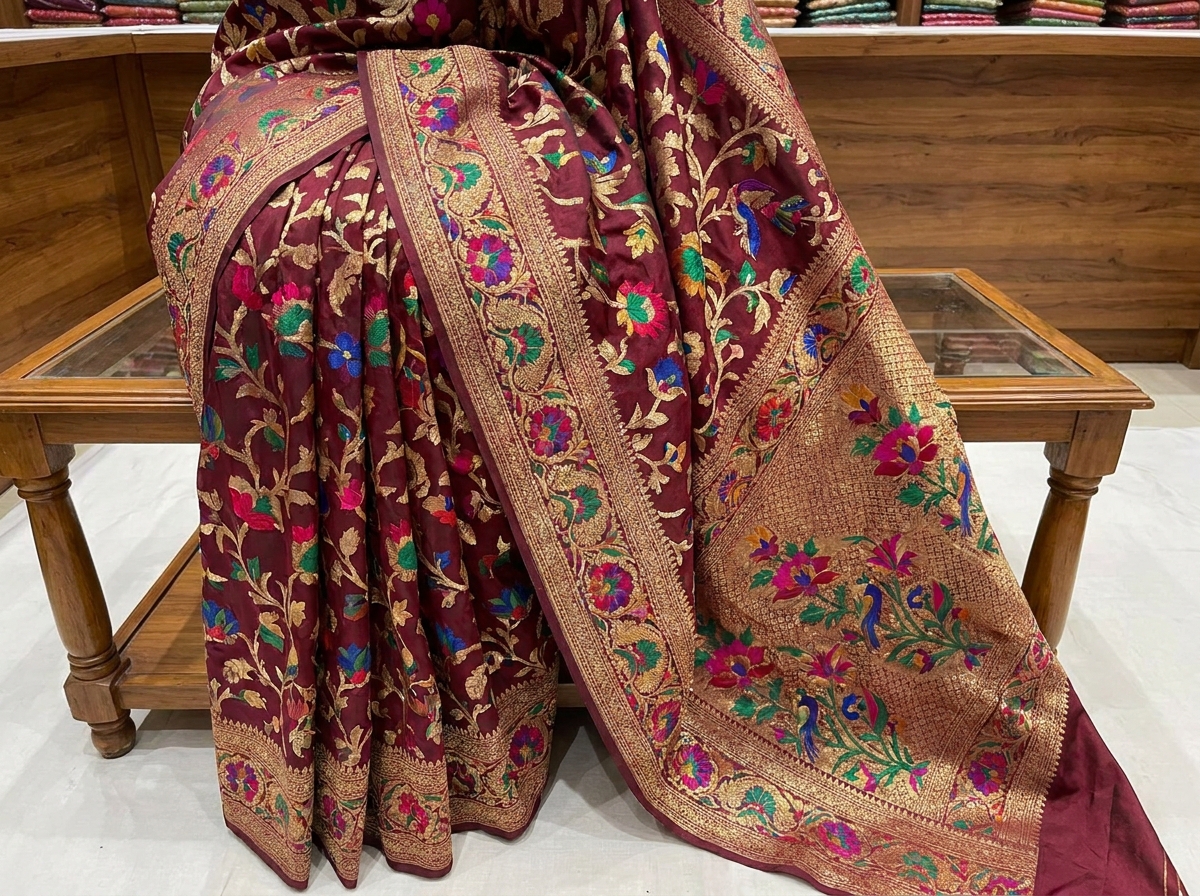
Meenakari is a weaving technique borrowed from the ancient art of enamelling jewellery — where multiple coloured threads are woven into the design to create motifs that are rich, multi-hued, and jewel-like. A single Meenakari buta (motif) might contain five or six different colours of silk thread, each one woven in by hand to create a pattern that looks like a painting. Flowers, peacocks, elephants — the motifs come alive in Meenakari work in a way that is genuinely extraordinary.
- Texture & Feel: Usually woven on a Katan or Georgette base. The surface has textural depth — raised in places where the coloured threads sit — and a visual density that rewards close inspection.
- Best Occasion: Weddings, festivals, special occasions where colour is celebrated. Brilliant for brides who want vibrant, non-traditional colours.
- Price Range: ₹10,000 – ₹80,000+
- Buyer Persona: Colour-lovers. Women who find all-gold Banarasis too monochromatic. Younger brides. Festival buyers.
7. Jangla Banarasi Saree
The word jangla means jungle — and when you see a Jangla Banarasi saree, you understand why.
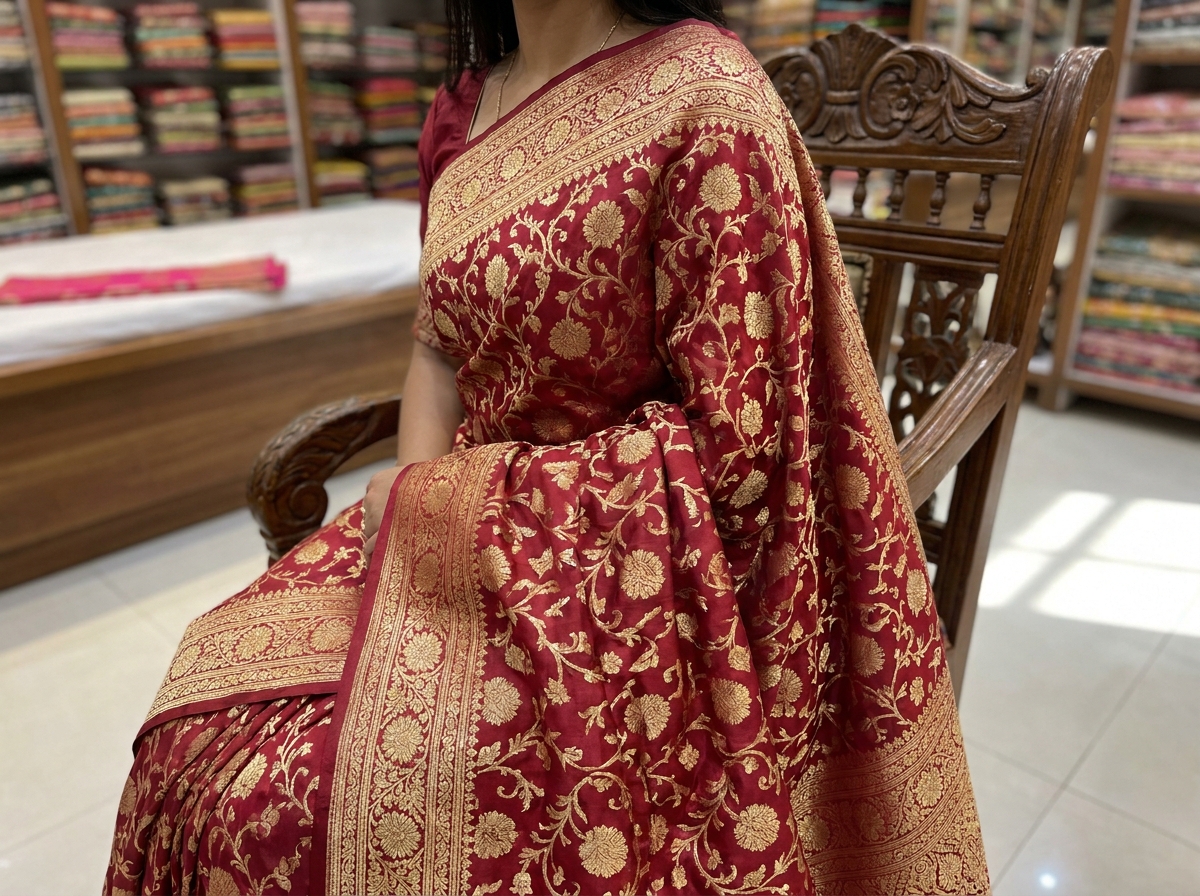
Jangla is defined by an all-over design that covers the entire body of the saree with dense, continuous motifs — typically scrolling vines, flowers, leaves, birds, and animals woven in an unbroken pattern from the pallu to the hem. There is no plain ground visible. The design consumes everything.
This is one of the most labour-intensive types of Banarasi sarees. A complex Jangla saree can take a master weaver three to four months to complete. The patience and precision required is extraordinary — every element of the pattern must align across the entire length of a six-metre saree.
- Texture & Feel: Dense, richly textured on the surface, with a heavier hand due to the all-over weave. Usually woven on Katan silk.
- Best Occasion: Grand weddings, religious ceremonies, formal family gatherings. The Jangla is a statement saree — it is worn when you want to honour an occasion fully.
- Price Range: ₹18,000 – ₹3,00,000+ (masterpiece pieces with real gold zari)
- Buyer Persona: Brides with a taste for the elaborate. Collectors. Premium buyers who appreciate the depth of handloom craftsmanship.
Want to see a Jangla saree in person? Connect with us on WhatsApp — our team can video call you through our latest arrivals.
How to Identify a Real Banarasi Saree (Before You Spend a Rupee)
The Banarasi saree market is flooded with machine-made imitations, power-loom copies, and synthetic "silk" sarees sold at prices that seem too good to be true — because they are. Here is how to protect yourself.
01
Look for the Silk Mark
The Silk Mark is a certification issued by the Silk Mark Organisation of India, guaranteeing the saree contains genuine silk. Legitimate sellers will have Silk Mark labelled sarees. Ask for it. If a seller cannot produce it, be cautious.
02
Feel the Weight and Temperature
Real silk is heavier than polyester of comparable length. More tellingly, silk is temperature-neutral — it feels cool in your hand when you first touch it, then adjusts to your body warmth. Synthetic fabrics feel uniformly room-temperature or slightly warm.
03
Examine the Zari
Genuine gold zari is made with a fine silver wire coated in real gold. It does not tarnish quickly and has a depth of colour that metallic thread cannot replicate. Ask if the zari is asli (real) or kalabattu (artificial). The price difference is significant.
04
Look for Handloom Irregularities
A handloom saree will have minute, almost imperceptible irregularities in the weave — slight variations in thread spacing, tiny inconsistencies in pattern alignment. These are not defects. They are the human hand at work. A perfectly machine-regular pattern is the first sign of power-loom production.
05
The Burn Test (for the bold)
Pull a single thread from the saree edge. Real silk burns slowly, smells like burning hair, and leaves an ash that crumbles to powder. Synthetic fibres melt, smell chemical, and leave a hard plastic bead.
06
Buy Directly from Weavers
The most reliable protection is the simplest: buy from a verified source. Silk Khazana sells exclusively from our own handloom workshop in Varanasi. We invite every customer to visit our production facility and watch their saree being made.

Your Banarasi Saree Buying Guide
By Occasion
| Occasion | Recommended Type | Why |
|---|---|---|
| Bridal wedding wear | Katan Silk / Jangla / Tissue | Maximum richness, heirloom quality |
| Wedding guest | Georgette Banarasi / Kora Organza | Elegant but manageable |
| Sangeet / Mehendi | Georgette / Meenakari | Playful colours, easy movement |
| Office festive wear | Georgette / Shattir | Professional, not overwhelming |
| Festival wear | Meenakari / Kora Organza | Colourful and seasonally right |
| Gift for NRI buyers | Kora Organza / Georgette | Lightweight, travel-friendly |
By Budget
- Under ₹10,000: Georgette Banarasi with metallic zari. Beautiful daily/festival wear.
- ₹10,000 – ₹30,000: Kora Organza, Meenakari, Shattir. Entry-level luxury.
- ₹30,000 – ₹80,000: Mid-range Katan Silk, Tissue sarees. Occasion wear and gifting.
- ₹80,000 and above: Masterpiece Jangla, real-gold Katan Silk, heirloom Tissue sarees.
By Body Type
- Petite frames: Kora Organza and Georgette drape lightly and avoid adding visual weight.
- Fuller figures: Katan Silk and Georgette with vertical zari patterns elongate the silhouette.
- Tall frames: Tissue and Jangla carry the drama of a fuller figure beautifully.
Why Silk Khazana?
(The Answer Is Simpler Than You Think)
We are not a brand that was built in a boardroom. We are a family of weavers and merchants who have been rooted in Varanasi for generations — in the same neighbourhoods, on the same streets where Banarasi silk has been woven for centuries.
When you buy from Silk Khazana, here is what that actually means:
- No middlemen. Our sarees go directly from our looms to you. The savings get passed on; the quality does not get compromised.
- 100% pure handloom silk. We do not stock power-loom sarees. Every piece in our collection is hand-woven by our artisans.
- Full transparency. Visit our workshop. Watch your saree being made. Ask questions about the zari, the weave count, the dyeing process. We welcome it.
- Worldwide shipping. Our sarees reach brides in New Jersey, London, Toronto, and Sydney. We handle everything — including careful dry-packing for international travel.
- Personalised curation. Not every customer knows exactly what she wants. Our team will spend time understanding your occasion, your budget, your body type, and your aesthetic — and find you the right saree, not just the most expensive one.
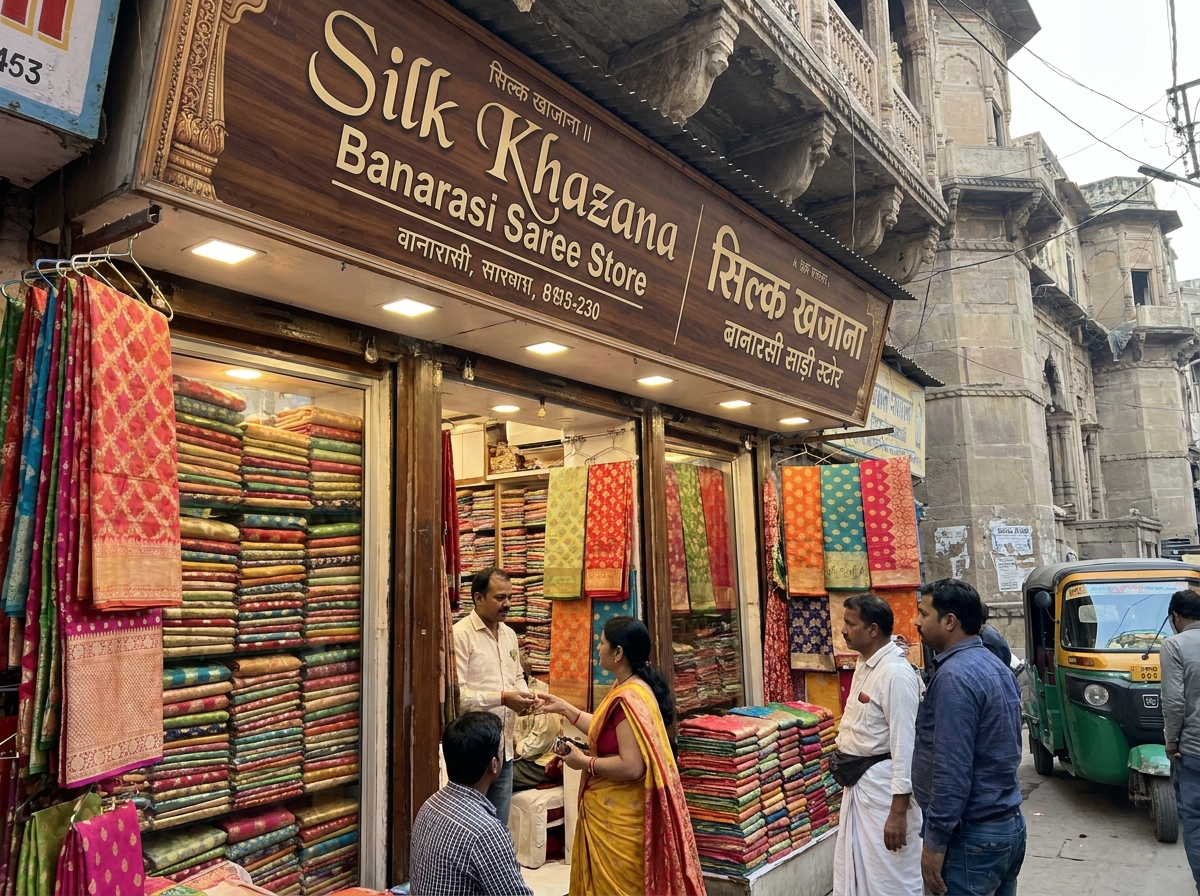
We are in the heart of Varanasi. If you are visiting the city — and you should — come see us. Walk the lanes of our workshop. Hold the sarees in your hands.
That moment when the silk settles on your palm? We would like to be there for it.
Visit our Varanasi Store: Get Directions | WhatsApp Us: +91 6307305873 | Explore the Full Collection: Shop Online
Frequently Asked Questions
Which type of Banarasi saree is best for a wedding?
For the bride herself, Katan Silk and Jangla Banarasi sarees are the gold standard — richly woven, deeply traditional, and designed to be heirlooms. For wedding guests and family members, Organza (Kora) and Georgette Banarasi sarees offer elegance with greater ease of wear. If maximum visual impact is the priority, a Tissue Banarasi with gold zari is unmatched.
How do I know if a Banarasi saree is pure silk?
Look for the Silk Mark certification on the label. Additionally, pure silk will feel cool to the touch initially, will drape with a natural weight, and a single thread burned carefully will smell like hair and leave powdery ash — not melt into a plastic bead the way synthetics do. Buying from verified manufacturers like Silk Khazana, who source directly from their own looms, eliminates the guesswork entirely.
Why are Banarasi sarees so expensive?
Authentic handloom Banarasi sarees are expensive because of the extraordinary human labour involved. A mid-range Katan Silk saree takes 15–30 days to weave by hand. A complex Jangla or Tissue saree can take 3–6 months. Every motif is woven thread by thread, by a craftsman who has spent years learning his loom. Add in the cost of pure silk yarn and genuine gold zari, and the price reflects not markup but reality. What you are paying for is irreplaceable human skill.
Which Banarasi saree type is the lightest?
Organza (Kora) Banarasi sarees are the lightest of the traditional types, followed closely by Georgette Banarasi sarees. Both are excellent choices for summer weddings, warm climates, or NRI buyers who need sarees that travel well. Kora Organza in particular has a distinctive crisp lightness that makes it feel almost like wearing structured air.
How do I store and maintain a Banarasi saree?
Banarasi sarees require careful, consistent care:
- Dry clean only — never machine wash.
- Wrap in muslin cloth (not plastic) — silk needs to breathe.
- Store flat or gently folded — avoid hanging.
- Air occasionally — air it for a few hours in indirect light every few months.
- Store with silica gel packets — to prevent moisture damage.
- Avoid perfume contact — direct spray can cause permanent discolouration.
The Thread That Holds Everything Together
"Jo tana bana hai, woh sirf kapda nahin hai"
— What has been woven is not merely cloth.
A Banarasi saree carries the memory of the city that made it. The smell of the Ganga at dawn. The sound of looms in narrow lanes. The patience of a craftsman who learned his art from his father, who learned from his father before him.
When you choose a Banarasi saree — whether you are a bride preparing for the most significant day of your life, an NRI woman maintaining a thread of connection to where she came from, or a visitor to Varanasi who wants to take home something that is truly real — you are not just buying fabric.
You are becoming part of a story that has been told, in silk and gold, for three hundred years.
At Silk Khazana, we are honoured to be your guide to that story.
Ready to find your saree?
Explore our latest handloom arrivals, visit our physical store in Varanasi, or let our experts help you style your perfect Banarasi look over WhatsApp.